Análisis del temblor esencial con Kinovea y MSC Adams View para su caracterización y simulación
DOI:
https://doi.org/10.37636/recit.v9n4e499Palabras clave:
Temblor Esencial, Enfermedad de Párkinson, Análisis del Temblor, Captura de Movimiento, Software KinoveaResumen
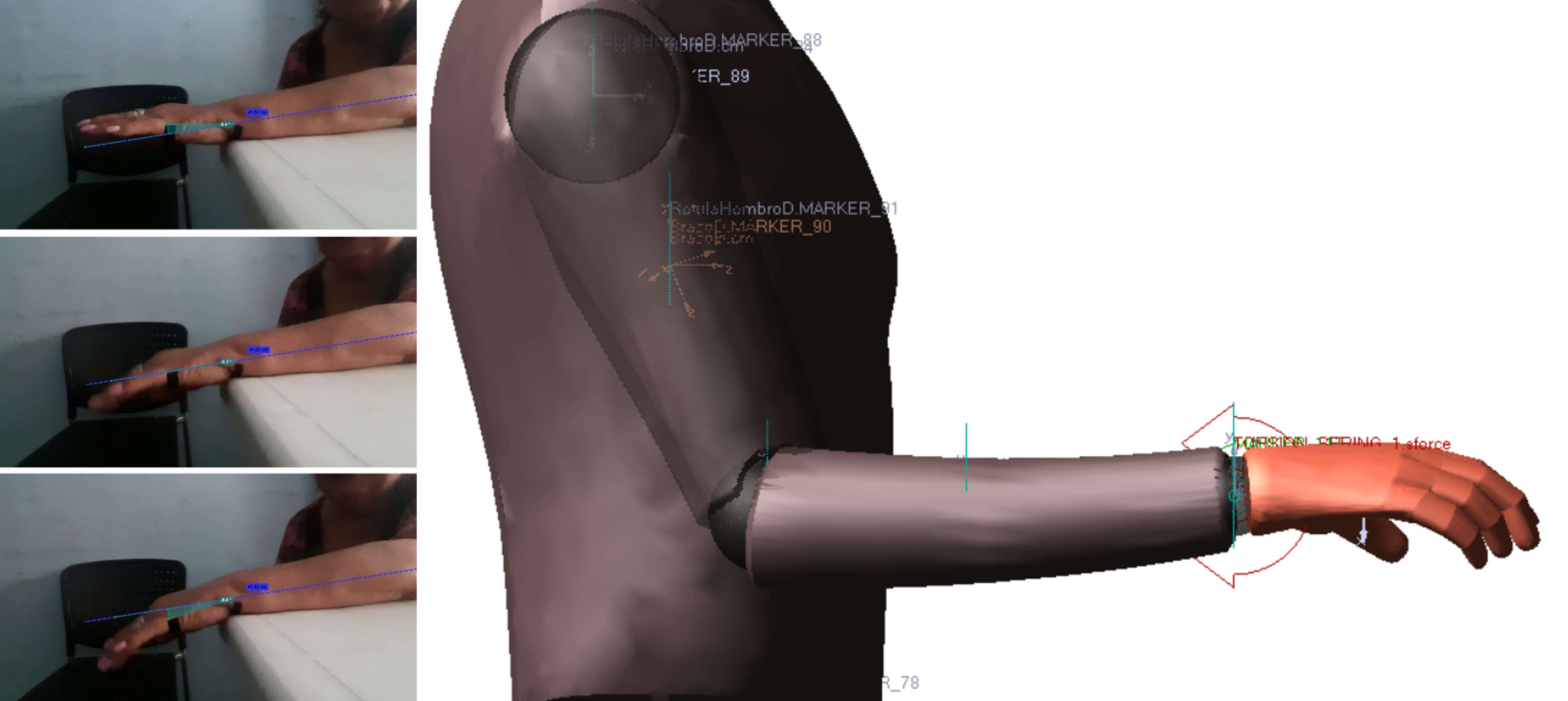
El temblor de mano es el movimiento involuntario más común provocado por enfermedades neurodegenerativas asociadas a la edad y trastornos de movimiento, como la enfermedad de párkinson y el temblor esencial, reconocido por ser el trastorno de movimiento más común entre la población de edad avanzada, afectado un 0.9% de la población mundial, la principal característica del temblor esencial, es el temblor cinético, el cual aparece en la realización de movimientos voluntarios en actividades cotidianas, como lo son, la escritura, comer y beber. En este trabajo se presenta el análisis del temblor de mano capturado en video usando el software Kinovea, posteriormente se utilizó dicho análisis para desarrollar un entorno virtual de simulación en el software MSC Adams View, con el propósito de integrar estos programas en el desarrollo de prototipos y técnicas de control para la supresión del temblor de mano, en este artículo se simuló la influencia del temblor en la muñeca en reposo y durante una acción voluntaria, también se simuló la acción de un exoesqueleto implementado un control PD para suprimir el temblor, obteniendo un 99.63% de supresión de movimientos con frecuencias dentro del rango característico del temblor (4 a 12Hz).
Descargas
Referencias
[1] K. Adabi and W. G. Ondo, “Shaking up Essential tremor: Peripheral devices and mechanical strategies to reduce tremor,” Tremor and Other Hyperkinetic Movements, vol. 14, no. 1, p. 55, Jan. 2024, doi: 10.5334/tohm.930.
[2] J. Mo and R. Priefer, “Medical Devices for Tremor Suppression: Current status and future directions,” Biosensors, vol. 11, no. 4, p. 99, Mar. 2021, doi: 10.3390/bios11040099.
[3] E. D. Louis, “Essential tremor,” New England Journal of Medicine, vol. 345, no. 12, pp. 887–891, Sep. 2001, doi: 10.1056/nejmcp010928.
[4] E. D. Louis and D. G. Machado, “Tremor-related quality of life: A comparison of essential tremor vs. Parkinson’s disease patients,” Parkinsonism & Related Disorders, vol. 21, no. 7, pp. 729–735, Apr. 2015, doi: 10.1016/j.parkreldis.2015.04.019.
[5] J. K. Monin et al., “Psychological Suffering in Essential Tremor: A study of patients and those who are close to them,” Tremor and Other Hyperkinetic Movements, vol. 7, no. 0, p. 526, Dec. 2017, doi: 10.5334/tohm.338.
[6] T. A. Zesiewicz et al., “Practice Parameter: Therapies for essential tremor [RETIRED],” Neurology, vol. 64, no. 12, pp. 2008–2020, Jun. 2005, doi: 10.1212/01.wnl.0000163769.28552.cd.
[7] T. A. Zesiewicz et al., “Evidence-based guideline update: Treatment of essential tremor,” Neurology, vol. 77, no. 19, pp. 1752–1755, Oct. 2011, doi: 10.1212/wnl.0b013e318236f0fd.
[8] D. Haubenberger and M. Hallett, “Essential tremor,” New England Journal of Medicine, vol. 378, no. 19, pp. 1802–1810, May 2018, doi: 10.1056/nejmcp1707928.
[9] J. Kim, T. Wichmann, O. T. Inan, and S. P. Deweerth, “A wearable system for attenuating essential tremor based on peripheral nerve stimulation,” IEEE Journal of Translational Engineering in Health and Medicine, vol. 8, pp. 1–11, Jan. 2020, doi: 10.1109/jtehm.2020.2985058.
[10] A. Yi, B. Zhang, N. Lau, and D. Zhang, “A hand exoskeleton with linear motors (HELM) for pathological tremor suppression of fingers,” Intelligent Sports and Health, vol. 1, no. 2, pp. 86–97, Apr. 2025, doi: 10.1016/j.ish.2025.03.002.
[11] A. Velisar et al., “Dual threshold neural closed-loop deep brain stimulation in Parkinson disease patients,” Brain Stimulation, vol. 12, no. 4, pp. 868–876, Feb. 2019, doi: 10.1016/j.brs.2019.02.020.
[12] G. Weerasinghe, B. Duchet, H. Cagnan, P. Brown, C. Bick, and R. Bogacz, “Predicting the effects of deep brain stimulation using a reduced coupled oscillator model,” PLoS Computational Biology, vol. 15, no. 8, p. e1006575, Aug. 2019, doi: 10.1371/journal.pcbi.1006575.
[13] J. S. Lora-Millan, G. Delgado-Oleas, J. Benito-León, and E. Rocon, “A review on Wearable Technologies for tremor Suppression,” Frontiers in Neurology, vol. 12, p. 700600, Aug. 2021, doi: 10.3389/fneur.2021.700600.
[14] E. Rocon, J. M. Belda-Lois, A. F. Ruiz, M. Manto, J. C. Moreno, and J. L. Pons, “Design and validation of a rehabilitation robotic exoskeleton for tremor assessment and suppression,” IEEE Transactions on Neural Systems and Rehabilitation Engineering, vol. 15, no. 3, pp. 367–378, Sep. 2007, doi: 10.1109/tnsre.2007.903917.
[15] Manzanares Quirós, Luis A.; Blanco Ortega, Andrés; Colín Ocampo, Jorge; Abúndez Pliego, Arturo; Cortés García, Claudia; Santana Camilo, José A. A Review on Control Devices for Hand Tremor Suppression. Tecnología y Ciencia Aplicada, 2025. Vol.8, No. 1.
[16] J. J. Hathaliya, H. Modi, R. Gupta, S. Tanwar, P. Sharma, and R. Sharma, “Parkinson and essential tremor classification to identify the
patient’s risk based on tremor severity,” Computers & Electrical Engineering, vol. 101, p. 107946, Apr. 2022, doi: 10.1016/j.compeleceng.2022.107946.
[17] T. Ando, M. Watanabe, K. Nishimoto, Y. Matsumoto, M. Seki, and M. G. Fujie, “Myoelectric-Controlled Exoskeletal Elbow Robot to suppress essential tremor: extraction of elbow flexion movement using STFTs and TDNN,” Journal of Robotics and Mechatronics, vol. 24, no. 1, pp. 141–149, Feb. 2012, doi: 10.20965/jrm.2012.p0141.
[18] T. Akıncı, N. Başçı, A. Gündüz, and M. E. Kızıltan, “Tremor analysis using surface electromyography: Is it required?,” Cerrahpasa Medical Journal, vol. 48, no. 3, pp. 272–274, Dec. 2024, doi: 10.5152/cjm.2024.24015.
[19] S. Williams, H. Fang, J. Alty, R. Qahwaji, P. Patel, and C. D. Graham, “A smartphone camera reveals an ‘invisible’ Parkinsonian tremor: a potential pre-motor biomarker?,” Journal of Neurology, vol. 265, no. 12, pp. 3017–3018, Sep. 2018, doi: 10.1007/s00415-018-9060-z.
[20] G. Deuschl, “Essential tremor and cerebellar dysfunction: Clinical and kinematic analysis of intention tremor,” Brain, vol. 123, no. 8, pp. 1568–1580, Aug. 2000, doi: 10.1093/brain/123.8.1568.
[21] F. Vial, P. Kassavetis, S. Merchant, D. Haubenberger, and M. Hallett, “How to do an electrophysiological study of tremor,” Clinical Neurophysiology Practice, vol. 4, pp. 134–142, Jan. 2019, doi: 10.1016/j.cnp.2019.06.002.
[22] B. Adlou, C. Wilburn, and W. Weimar, “Motion capture Technologies for Athletic Performance Enhancement and Injury Risk Assessment: A Review for Multi-Sport Organizations,” Sensors, vol. 25, no. 14, p. 4384, Jul. 2025, doi: 10.3390/s25144384.
[23] J. Dorado et al., “A computer-vision-based system for at-home rheumatoid arthritis rehabilitation,” International Journal of Distributed Sensor Networks, vol. 15, no. 9, p. 155014771987564, Sep. 2019, doi: 10.1177/1550147719875649.
[24] T. Hellsten, J. Karlsson, M. Shamsuzzaman, and G. Pulkkis, “The potential of Computer Vision-Based Marker-Less Human Motion Analysis for rehabilitation,” Rehabilitation Process and Outcome, vol. 10, p. 11795727211022330, Jan. 2021, doi: 10.1177/11795727211022330.
[25] K. Mills. “Motion analysis in the clinic: There’s an app for that”. Journal of Physiotherapy. vol. 61, no. 1, p. 49–50. 2015. doi: 10.1016/J.JPHYS.2014.11.014
[26] T. V. Ilić, S. Milanović, V. Potkonjak, A. Rodić, J. Santos-Victor, and S. Spasojević, “Combined vision and wearable sensors-based system for movement analysis in rehabilitation,” Methods of Information in Medicine, vol. 56, no. 02, pp. 95–111, Dec. 2016, doi: 10.3414/me16-02-0013.
[27] X. Suo, W. Tang, and Z. Li, “Motion capture Technology in sports scenarios: A survey,” Sensors, vol. 24, no. 9, p. 2947, May 2024, doi: 10.3390/s24092947.
[28] P. Fernández-González, A. Koutsou, A. Cuesta-Gómez, M. Carratalá-Tejada, J. C. Miangolarra-Page, and F. Molina-Rueda, “Reliability of Kinovea® Software and Agreement with a Three-Dimensional Motion System for Gait Analysis in Healthy Subjects,” Sensors, vol. 20, no. 11, p. 3154, Jun. 2020, doi: 10.3390/s20113154.
[29] C.H. Guzmán; A. Blanco; M.A. Oliver; J.L. Carrera, “Therapeutic Motion Analysis of Lower Limbs Using Kinovea.” International Journal of Soft Computing and Engineering (IJSCE), vol. 3, no. 2, 2013.
[30] Blanco-Ortega, Andrés, Colin-Ocampo, Jorge, Abúndez-Pliego, Arturo, Santana Camilo José A., Lara Barrios, Carlos M. y Vargas Ortiz, Miltón U. Rehabilitation movement analysis in upper limbs with Kinovea. Revista de Ingeniería y Tecnologías para el Desarrollo Sustentable. 13 (2025) 1 – 9.
[31] F. Zsarnoczky-Dulhazi, S. Agod, S. Szarka, K. Tuza, & B. Kopper. “AI-Based Motion Analysis Software for Sport and Physical Therapy Assessment”. Revista Brasileira de Medicina do Esporte. 2024. doi: 10.1590/1517-8692202430012022_0020i.
[32] R. Contini, R. J. Drillis, and M. Bluestein, “Determination of body segment parameters,” Human Factors: The Journal of the Human Factors and Ergonomics Society, vol. 5, no. 5, pp. 493–504, Oct. 1963, doi: 10.1177/001872086300500508.
[33] P. De Leva, “Adjustments to Zatsiorsky-Seluyanov’s segment inertia parameters,” Journal of Biomechanics, vol. 29, no. 9, pp. 1223–1230, Sep. 1996, doi: 10.1016/0021-9290(95)00178-6.
[34] N. Hogan, “Impedance Control: An Approach to Manipulation: Part II—Implementation,” Journal of Dynamic Systems Measurement and Control, vol. 107, no. 1, pp. 8–16, Mar. 1985, doi: 10.1115/1.3140713.
[35] H. Gomi and M. Kawato, “Human arm stiffness and equilibrium-point trajectory during multi-joint movement,” Biological Cybernetics, vol. 76, no. 3, pp. 163–171, Apr. 1997, doi: 10.1007/s004220050329.
[36] E. J. Perreault, R. F. Kirsch, and A. M. Acosta, “Multiple-input, multiple-output system identification for characterization of limb stiffness dynamics,” Biological Cybernetics, vol. 80, no. 5, pp. 327–337, May 1999, doi: 10.1007/s004220050529.
[37] S. Das et al., “Quantitative measurement of motor symptoms in Parkinson’s disease: A study with full-body motion capture data,” 33rd Annual International Conference of the IEEE EMBS, vol. 2011, pp. 6789–6792, Aug. 2011, doi: 10.1109/iembs.2011.6091674.
[38] P. M. Pecoraro, L. Marsili, A. J. Espay, M. Bologna, and L. Di Biase, “Computer Vision Technologies in Movement Disorders: A Systematic Review,” Movement Disorders Clinical Practice, vol. 12, no. 9, pp. 1229–1243, May 2025, doi: 10.1002/mdc3.70123.
[39] J. Shin et al., “Classification of Hand-Movement disabilities in Parkinson’s Disease using a Motion-Capture device and machine learning,” IEEE Access, vol. 12, pp. 52466–52479, Jan. 2024, doi: 10.1109/access.2024.3386367.
[40] P. Wegner et al., “Markerless motion capture reveals movement abnormalities in isolated REM sleep behavior disorder,” medRxiv, Sep. 2026, doi: 10.64898/2026.08.28.26361609.
[41] M. Delrobaei, S. Memar, M. Pieterman, T. W. Stratton, K. McIsaac, and M. Jog, “Towards remote monitoring of Parkinson’s disease tremor using wearable motion capture systems,” Journal of the Neurological Sciences, vol. 384, pp. 38–45, Nov. 2017, doi: 10.1016/j.jns.2017.11.004.
[42] P. Khwaounjoo et al., “Non-Contact hand movement analysis for optimal configuration of smart sensors to capture Parkinson’s disease hand tremor,” Sensors, vol. 22, no. 12, p. 4613, Jun. 2022, doi: 10.3390/s22124613.
[43] S. L. Pintea, J. Zheng, X. Li, P. J. M. Bank, J. J. Van Hilten, and J. C. Van Gemert, “Hand-Tremor frequency estimation in videos,” Lecture Notes in Computer Science, pp. 213–228, Jan. 2019, doi: 10.1007/978-3-030-11024-6_14.
[44] Y. Zhou, M. E. Jenkins, M. D. Naish, and A. L. Trejos, “The measurement and analysis of Parkinsonian hand tremor,” IEEE-EMBS International Conference on Biomedical and Health Informatics (BHI ...), pp. 414–417, Feb. 2016, doi: 10.1109/bhi.2016.7455922.
[45] Y. Zhou, M. E. Jenkins, M. D. Naish, and A. L. Trejos, “Characterization of Parkinsonian hand tremor and validation of a High-Order Tremor estimator,” IEEE Transactions on Neural Systems and Rehabilitation Engineering, vol. 26, no. 9, pp. 1823–1834, Jul. 2018, doi: 10.1109/tnsre.2018.2859793.
[46] L. Ferrigno et al., “A real-time tracking system for tremor and trajectory estimation in Parkinson’s disease-affected patients,” IEEE International Symposium on Medical Measurements and Applications (MeMeA), pp. 1–6, Jun. 2020, doi: 10.1109/memea49120.2020.9137210.
Publicado
Declaración de disponibilidad de datos
Los datos que respaldan los hallazgos de este estudio están disponibles a solicitud razonable al autor correspondiente.
Número
Sección
Categorías
Licencia
Derechos de autor 2026 Luis Alfonso Manzanares Quirós, Andrés Blanco-Ortega, Rafael Campos Amezcua, Enrique Alcudia-Zacarías, Arturo Abúndez Pliego, Arturo Javier Martínez Mata

Esta obra está bajo una licencia internacional Creative Commons Atribución 4.0.
Los autores/as que publiquen en esta revista aceptan las siguientes condiciones:
- Los autores/as conservan los derechos de autor y ceden a la revista el derecho de la primera publicación, con el trabajo registrado con la licencia de atribución de Creative Commons 4.0, que permite a terceros utilizar lo publicado siempre que mencionen la autoría del trabajo y a la primera publicación en esta revista.
- Los autores/as pueden realizar otros acuerdos contractuales independientes y adicionales para la distribución no exclusiva de la versión del artículo publicado en esta revista (p. ej., incluirlo en un repositorio institucional o publicarlo en un libro) siempre que indiquen claramente que el trabajo se publicó por primera vez en esta revista.
- Se permite y recomienda a los autores/as a compartir su trabajo en línea (por ejemplo: en repositorios institucionales o páginas web personales) antes y durante el proceso de envío del manuscrito, ya que puede conducir a intercambios productivos, a una mayor y más rápida citación del trabajo publicado (vea The Effect of Open Access).
Cómo citar