Prediction of structural response using different seismic intensity measures: Sa(T1) vs INp
DOI:
https://doi.org/10.37636/recit.v9n3e451Keywords:
Intensity measures, Spectral shape parameter Np, Seismic response, Reinforced concrete buildings, Incremental dynamic analysisAbstract
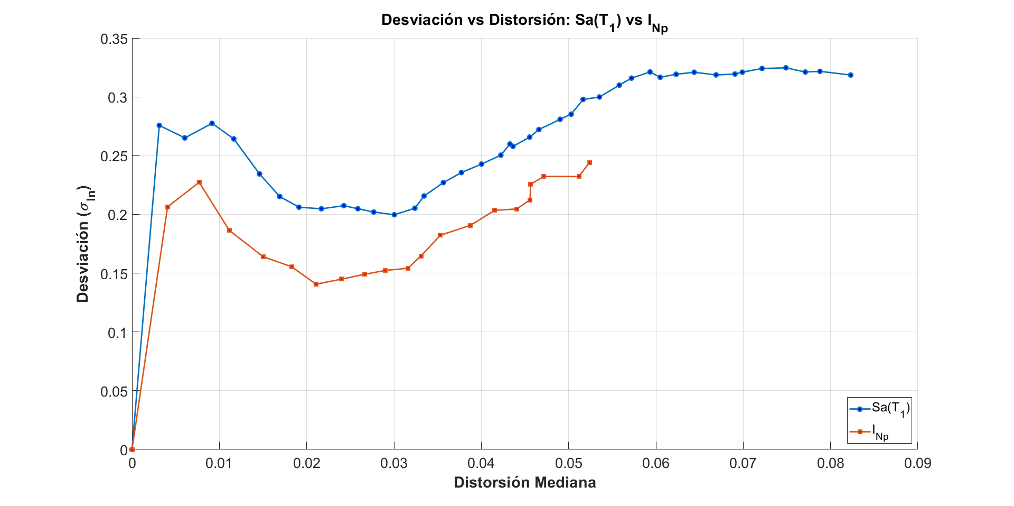
This research evaluates the efficiency of the scalar intensity measure INp compared to the traditional Sa(T1) for predicting structural response. The scientific novelty of the study lies in demonstrating how Sa(T1) severely overestimates damage in the inelastic range by ignoring the elongation of the structure's period, and how the INp measure corrects this limitation. Three models of eight-story reinforced concrete frames with low, medium, and high ductility were designed. These models were subjected to Incremental Dynamic Analysis (ADI) using soft soil seismic records and the Takeda hysteretic model to measure the Maximum Interstory Distortion (MID). The results confirm that INp significantly reduces dispersion and uncertainty. When evaluating the design limit distortion, INp achieved a decrease in the standard deviation of 7.24% in the low-ductility model, 36.58% in the medium-ductility model, and 30.51% in the high-ductility model. In conclusion, incorporating the spectral shape using INp avoids overestimation of Sa(T1) damage and offers much more reliable predictions for structural design.
Downloads
References
[1] S. L. Kramer, Geotechnical Earthquake Engineering, 1era. Ed. Estados Unidos: Prentice Hall, 1996. DOI: https://doi.org/10.1201/9781003512011-1
[2] E. Bojórquez, I. Iervolino, A. Reyes-Salazar, and S. E. Ruiz, “Comparing vector-valued intensity measures for fragility analysis of steel frames in the case of narrow-band ground motions,” Eng. Struct., vol. 45, pp. 472–480, Dec. 2012, doi: 10.1016/j.engstruct.2012.07.002. DOI: https://doi.org/10.1016/j.engstruct.2012.07.002
[3] N. Buratti, “A comparison of the performances of various ground-motion intensity measures.,” Sep. 2012, Lisbon, Portugal.
[4] E. Bojórquez and I. Iervolino, “Spectral shape proxies and nonlinear structural response,” Soil Dynamics and Earthquake Engineering, vol. 31, no. 7, pp. 996–1008, Jul. 2011, doi: 10.1016/j.soildyn.2011.03.006. DOI: https://doi.org/10.1016/j.soildyn.2011.03.006
[5] Edén Bojórquez Mora, Iunio Iervolino, Alfredo Reyes Salazar, Héctor Rodríguez Lozoya, and Luz Rivera Salas, “Una medida de intensidad sísmica basada en un parámetro para caracterizar la forma espectral denominado Np,” Ing. Sísmica , vol. 86, pp. 1–26, 2012. DOI: https://doi.org/10.18867/ris.86.151
[6] E. Bojórquez, R. Chávez, A. Reyes-Salazar, S. E. Ruiz, and J. Bojórquez, “A new ground motion intensity measure IB,” Soil Dynamics and Earthquake Engineering, vol. 99, pp. 97–107, Aug. 2017, doi: 10.1016/j.soildyn.2017.05.011. DOI: https://doi.org/10.1016/j.soildyn.2017.05.011
[7] J. I. Torres Peñuelas, “Eficiencia de medidas de intensidad sísmica vectorial en la predicción de la respuesta de edificios de C/R,” Universidad Autónoma de Sinaloa, México, 2018.
[8] J. I. Torres Peñuelas, “Desarrollo de medidas de intensidad sísmica avanzadas para la predicción de la respuesta estructural,” Universidad Autónoma de Sinaloa. México, México, 2023.
[9] E. Bojórquez Mora and I. Iervolino, “A spectral shape-based scalar ground motion intensity measure for maximum and cumulative structural demands,” Proc. 14th Eur. Conf. Earthq. , 2010.
[10] N. Buratti, “A Comparison of the Performances of Various Ground–Motion Intensity Measures,” in Proc. 15th World Conf. Earthq. Eng. (15WCEE), 2012.
[11] N. Zavala Gutiérrez et al., “Fragilidad sísmica de un edificio de concreto reforzado usando medidas de intensidad sísmica vectorial basadas en la forma espectral,” Cienc. Tecnol. (RECIT), vol. 5, no. 2, p. 220, 2022. DOI: https://doi.org/10.37636/recit.v52234250
[12] N. Zavala et al., “Vector-Valued Intensity Measures Based on Spectral Shape to Predict Seismic Fragility Surfaces in Reinforced Concrete Buildings,” Buildings, vol. 13, no. 1, p. 137, Jan. 2023, doi: 10.3390/buildings13010137. DOI: https://doi.org/10.3390/buildings13010137
[13] J. W. Baker and C. A. Cornell, “Vector-valued Intensity Measures Incorporating Spectral Shape For Prediction of Structural Response,” Journal of Earthquake Engineering, vol. 12, no. 4, pp. 534–554, May 2008, doi: 10.1080/13632460701673076. DOI: https://doi.org/10.1080/13632460701673076
[14] N. Luco and Cornell CA., “Structure-specific scalar intensity measures for near-source and ordinary earthquake ground motions,” Earthquake Spectra, vol. 23, no. 2, 2007. DOI: https://doi.org/10.1193/1.2723158
[15] Y. Zhou, P. Ge, J. Han, and Z. Lu, “Vector-valued intensity measures for incremental dynamic analysis,” Soil Dynamics and Earthquake Engineering, vol. 100, pp. 380–388, Sep. 2017, doi: 10.1016/j.soildyn.2017.06.014. DOI: https://doi.org/10.1016/j.soildyn.2017.06.014
[16] P. Tothong and N. Luco, “Probabilistic seismic demand analysis using advanced ground motion intensity measures,” Earthq. Eng. Struct. Dyn., vol. 36, no. 13, pp. 1837–1860, Oct. 2007, doi: 10.1002/eqe.696. DOI: https://doi.org/10.1002/eqe.696
[17] E. Bojórquez Mora, R. Chávez López, S. E. Ruiz Gómez, and A. Reyes Salazar, “UNA MEDIDA DE INTENSIDAD SÍSMICA QUE PREDICE EL COMPORTAMIENTO NO LINEAL Y EL EFECTO DE LOS MODOS SUPERIORES,” Revista de Ingeniería Sísmica, no. 90, pp. 1–33, Jun. 2014, doi: 10.18867/ris.90.12. DOI: https://doi.org/10.18867/ris.90.12
[18] E. Bojorquez, I. Iervolino, G. Manfredi, A. Santini, and N. Moraci, “Evaluating A New Proxy For Spectral Shape To Be Used As An Intensity Measure,” in AIP Conference Proceedings, AIP, 2008, pp. 1599–1606. doi: 10.1063/1.2963788. DOI: https://doi.org/10.1063/1.2963788
[19] E. Bojórquez, J. Carvajal, S. E. Ruiz, and J. Bojórquez, “Reliability-based ductility reduction factors surfaces using the generalized bojorquez ground motion intensity measure I,” Results in Engineering, vol. 23, p. 102756, Sep. 2024, doi: 10.1016/j.rineng.2024.102756. DOI: https://doi.org/10.1016/j.rineng.2024.102756
[20] E. Bojórquez, V. Baca, J. Bojórquez, A. Reyes-Salazar, R. Chávez, and M. Barraza, “A simplified procedure to estimate peak drift demands for mid-rise steel and R/C frames under narrow-band motions in terms of the spectral-shape-based intensity measure I,” Eng. Struct., vol. 150, pp. 334–345, Nov. 2017, doi: 10.1016/j.engstruct.2017.07.046. DOI: https://doi.org/10.1016/j.engstruct.2017.07.046
[21] P. Cordova, G. Deierlein, S. s. F. Mehanny, and C. Cornell, “Development of a two-parameter seismic intensity measure and probabilistic assessment procedure,” Jan. 2001.
[22] L. Eads, E. Miranda, and D. Lignos, “Spectral shape metrics and structural collapse potential,” Earthq. Eng. Struct. Dyn., vol. 45, no. 10, pp. 1643–1659, Aug. 2016, doi: 10.1002/eqe.2739. DOI: https://doi.org/10.1002/eqe.2739
[23] S. Minas and C. Galasso, “Accounting for spectral shape in simplified fragility analysis of case-study reinforced concrete frames,” Soil Dynamics and Earthquake Engineering, vol. 119, pp. 91–103, Apr. 2019, doi: 10.1016/j.soildyn.2018.12.025. DOI: https://doi.org/10.1016/j.soildyn.2018.12.025
[24] S. Minas, C. Galasso, and T. Rossetto, “Preliminary investigation on selecting optimal intensity measures for simplified fragility analysis of mid-rise RC buildings,” in Proc. 2nd Eur. Conf. Earthq, 2014.
[25] C. Málaga-Chuquitaype and K. Bougatsas, “Vector-IM-based assessment of alternative framing systems under bi-directional ground-motion,” Eng. Struct., vol. 132, pp. 188–204, Feb. 2017, doi: 10.1016/j.engstruct.2016.11.021. DOI: https://doi.org/10.1016/j.engstruct.2016.11.021
[26] H. Rajabnejad, H. Hamidi, S. Naseri, and M. Abbaszadeh, “Effect of intensity measures on the response of a 3D-structure under different ground motion duration,” International Journal of Engineering, vol. 34, no. 10, Oct. 2021, doi: 10.5829/ije.2021.34.10a.04. DOI: https://doi.org/10.5829/ije.2021.34.10a.04
[27] “SSN Catálogo de sismos UNAM, México.” doi: 10.21766/SSNMX/EC/MX. DOI: https://doi.org/10.21766/SSNMX/EC/MX
[28] A. K. Chopra, Dynamics of Structures: Theory and Applications to Earthquake Engineering, 4ta Ed. Pearson, 2012.
[29] Inc. Computers and Structures, “ETABS,” 2026, Berkeley, California, EE. UU.
[30] I. Salcido, El terremoto de 1985: Crónica del desastre en México, 1ra Ed. México: Sociedad Mexicana de Ingeniería Estructural y Casa de las Campanas Editores, 2020.
[31] I. Salcido, El terremoto de 2017: Diecinueve de septiembre negro, 1ra Ed. Mexico: Sociedad Mexicana de Ingeniería Estructural y Casa de las Campanas Editores, 2018.
[32] I. Salcido, El terremoto de 1957: El día en que el Ángel voló, 1ra Ed. Mexico: Sociedad Mexicana de Ingeniería Estructural y Casa de las Campanas Editores, 2019.
[33] Gobierno de la Ciudad de México, “Norma Técnica Complementaria para el Diseño por Sismo,” Secretaría de Obras y Servicios, p. 236, 2023.
[34] D. Vamvatsikos and C. A. Cornell, “Incremental dynamic analysis,” Earthq. Eng. Struct. Dyn., vol. 31, no. 3, pp. 491–514, Mar. 2002, doi: 10.1002/eqe.141. DOI: https://doi.org/10.1002/eqe.141
[35] A. J. Carr, “Ruaumoko 3D,” 2007, Department of Civil and Natural Resources Engineering, University of Canterbury, Christchurch, New Zealand.
[36] T. Takeda, M. A. Sozen, and N. N. Nielsen, “Reinforced Concrete Response to Simulated Earthquakes,” Journal of the Structural Division, vol. 96, no. 12, pp. 2557–2573, Dec. 1970, doi: 10.1061/JSDEAG.0002765. DOI: https://doi.org/10.1061/JSDEAG.0002765
[37] S. Otani, “Inelastic Analysis of R/C Frame Structures,” Journal of the Structural Division, vol. 100, no. 7, pp. 1433–1449, Jul. 1974, doi: 10.1061/JSDEAG.0003821. DOI: https://doi.org/10.1061/JSDEAG.0003821
Downloads
Published
Data Availability Statement
The datasets generated during the study are available from the corresponding author upon request
License
Copyright (c) 2026 Jesús Prisicliano Romo Villa, Edén Bojórquez Mora, Jesús David Tirado Ibarría, Juan Bojórquez Mora, Sonia Elda Ruiz Gómez

This work is licensed under a Creative Commons Attribution 4.0 International License.
The authors who publish in this journal accept the following conditions:
The authors retain the copyright and assign to the journal the right of the first publication, with the work registered with the Creative Commons Attribution license 4.0, which allows third parties to use what is published as long as they mention the authorship of the work and the first publication in this magazine.
Authors may make other independent and additional contractual agreements for the non-exclusive distribution of the version of the article published in this journal (eg, include it in an institutional repository or publish it in a book) as long as they clearly indicate that the work it was first published in this magazine.
Authors are allowed and encouraged to share their work online (for example: in institutional repositories or personal web pages) before and during the manuscript submission process, as it can lead to productive exchanges, greater and more quick citation of published work (see The Effect of Open Access).
How to Cite