Artificial intelligence as a mediating agent of architectural learning: a transdisciplinary perspective
DOI:
https://doi.org/10.37636/recit.v9n2e458Keywords:
Architectural learning, Artificial intelligence, Transdisciplinarity, Pedagogical mediation, Design cognitionAbstract
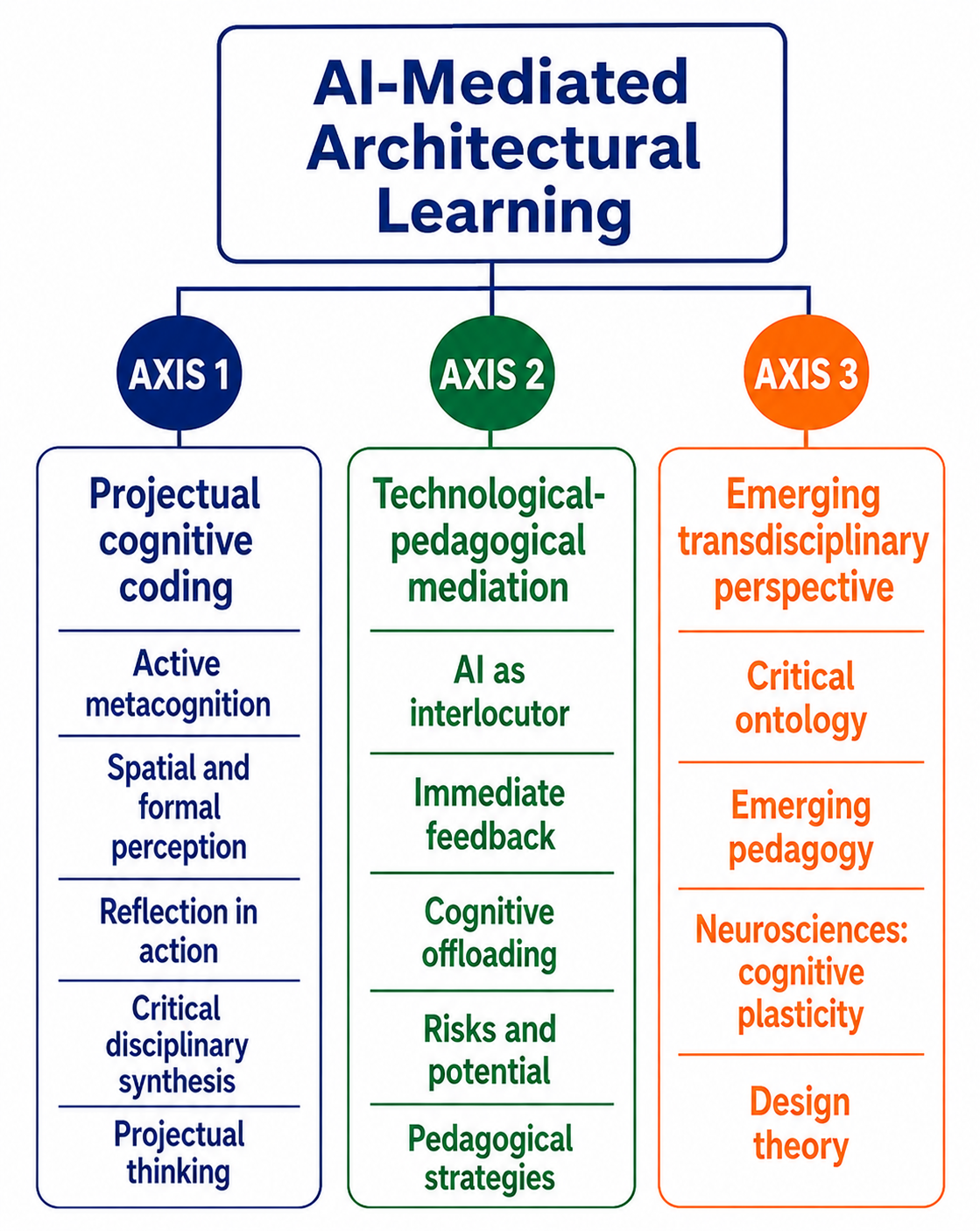
The incorporation of Artificial Intelligence (AI) in educational environments has rapidly modified learning processes in architecture and has transformed design methods, ways of thinking, and the generation of new disciplinary knowledge. This article presents a critical literature review and a conceptual analysis of AI as a mediating agent of contemporary architectural learning, developed from a transdisciplinary perspective and under the interpretive framework of critical ontology, which structures educational reality into three layers: the subjective, the intersubjective, and the objective. The study problematizes the emerging curricular fragmentation resulting from the absence of pedagogical guidelines that orient the responsible use of this technology. As the central result of the analysis, an epistemological proposal articulated in three dimensions is formulated: the cognitive (critical synthesis and metacognition), the intersubjective (normative and shared ethics), and the objective (data, algorithms, and metrics). This conceptual architecture constitutes the appropriate conduit for integrating AI into formative processes, provided that four specific pedagogical conditions are met to preserve critical thinking, design creativity, and the intellectual autonomy of the architect in training.
Downloads
References
[1] E. Kasneci et al., “ChatGPT for good? On opportunities and challenges of large language models for education,” Learning and Individual Differences, vol. 103, Art. no. 102274, 2023, doi: 10.1016/j.lindif.2023.102274. DOI: https://doi.org/10.1016/j.lindif.2023.102274
[2] D. Komatina, M. Miletic, and M. Mosurovic Ruzicic, “Embracing artificial intelligence (AI) in architectural education: A step towards sustainable practice?,” Buildings, vol. 14, no. 8, Art. no. 2578, 2024, doi: 10.3390/buildings14082578. DOI: https://doi.org/10.3390/buildings14082578
[3] Chaos and Architizer, “The state of AI in architecture: Insights from 1,200+ architects and designers,” Chaos Group, 2025. [Online]. Available: https://blog.chaos.com/the-state-of-ai-in-architecture-survey-insights
[4] Higher Education Policy Institute and Kortext, “Student academic experience survey 2025,” HEPI, 2025.
[5] C.-K. Y. Chan and H. Y. Hu, “Students use of large language models in Hong Kong,” Computers and Education: Artificial Intelligence, vol. 6, Art. no. 100224, 2023, doi: 10.1016/j.caeai.2023.100224.
[6] H. Crompton and D. Burke, “Artificial intelligence in higher education: The state of the field,” Computers and Education: Artificial Intelligence, vol. 4, 2023, doi: 10.1016/j.caeai.2023.100124. DOI: https://doi.org/10.1186/s41239-023-00392-8
[7] S. Hejazi, M. Shafaei, and M. Hafezi, “The gap between architecture education and architectural profession in Iran,” International Journal of Architectural Research and Practice, vol. 7, no. 2, pp. 45–62, 2019.
[8] R. Oxman, “Thinking difference: Theories and models of parametric design thinking,” Design Studies, vol. 52, pp. 4–39, 2017, doi: 10.1016/j.destud.2017.06.001. DOI: https://doi.org/10.1016/j.destud.2017.06.001
[9] M. Butt et al., “Transdisciplinary engineering design education: Ontology for a generic product design process,” Procedia CIRP, vol. 70, pp. 338–343, 2018, doi: 10.1016/j.procir.2018.02.019. DOI: https://doi.org/10.1016/j.procir.2018.02.019
[10] UNESCO, Artificial Intelligence and Education: Guidance for Policy-Makers. Paris, France: UNESCO Publishing, 2021. [Online]. Available: https://unesdoc.unesco.org/ark:/48223/pf0000376709
[11] E. Jaakkola, “Designing conceptual articles: Four approaches,” AMS Review, vol. 10, pp. 18–26, 2020, doi: 10.1007/s13162-020-00161-0. DOI: https://doi.org/10.1007/s13162-020-00161-0
[12] F. Ouyang and P. Jiao, “Artificial intelligence in education: The three paradigms,” Computers and Education: Artificial Intelligence, vol. 2, Art. no. 100020, 2021, doi: 10.1016/j.caeai.2021.100020. DOI: https://doi.org/10.1016/j.caeai.2021.100020
[13] D. A. Schön, The Reflective Practitioner: How Professionals Think in Action. New York, NY, USA: Basic Books, 1983.
[14] D. A. Kolb, Experiential Learning: Experience as the Source of Learning and Development. Englewood Cliffs, NJ, USA: Prentice Hall, 1984.
[15] U. Hettithanthri and P. Hansen, “Design studio practice in the context of architectural education: A narrative literature review,” International Journal of Technology and Design Education, 2022, doi: 10.1007/s10798-021-09694-2. DOI: https://doi.org/10.1007/s10798-021-09694-2
[16] A. M. Salama, Spatial Design Education: New Directions for Pedagogy in Architecture and Beyond. London, U.K.: Routledge, 2015, doi: 10.4324/9781315610276. DOI: https://doi.org/10.4324/9781315610276
[17] R. Oxman, “Theories of the digital in architecture,” Architectural Design, vol. 87, no. 5, pp. 10–17, 2017. DOI: https://doi.org/10.1002/ad.2233
[18] L. Floridi, The Logic of Information: A Theory of Philosophy as Conceptual Design. Oxford, U.K.: Oxford Univ. Press, 2019. DOI: https://doi.org/10.1093/oso/9780198833635.001.0001
[19] K. Holstein, V. Aleven, and N. Rummel, “A conceptual framework for human-AI hybrid adaptivity in education,” in Proc. 21st Int. Conf. Artificial Intelligence in Education (AIED), 2020, pp. 290–304, doi: 10.1007/978-3-030-52237-7_20. DOI: https://doi.org/10.1007/978-3-030-52237-7_20
[20] L. S. Vygotsky, Mind in Society: The Development of Higher Psychological Processes. Cambridge, MA, USA: Harvard Univ. Press, 1978.
[21] N. Selwyn, Education and Technology: Key Issues and Debates, 2nd ed. London, U.K.: Bloomsbury, 2022. DOI: https://doi.org/10.5040/9781350145573
[22] A. Ghimire and J. Edwards, “From guidelines to governance: A study of AI policies in education,” AI and Ethics, vol. 5, no. 2, pp. 143–159, 2024, doi: 10.1007/s43681-024-00487-9.
[23] L. Tan, “Pedagogical ethics of AI mediation: Rebalancing autonomy and automation in higher education,” Teaching in Higher Education, vol. 29, no. 5, pp. 723–741, 2024, doi: 10.1080/13562517.2024.1190104. DOI: https://doi.org/10.1080/13562517.2023.2298841
[24] E. Morin, On Complexity. Cresskill, NJ, USA: Hampton Press, 2008.
[25] B. Nicolescu, “Methodology of transdisciplinarity,” World Futures, vol. 70, no. 3–4, pp. 186–199, 2014, doi: 10.1080/02604027.2014.934631. DOI: https://doi.org/10.1080/02604027.2014.934631
[26] G. Yazici and F. Dogan, “Fostering metacognition in the design studio: The effect of minimal interventions on architectural students metacognitive awareness,” Thinking Skills and Creativity, 2024, doi: 10.1016/j.tsc.2024.101651. DOI: https://doi.org/10.1016/j.tsc.2024.101651
[27] R. Williams, “Two modes of being together: The levels of intersubjectivity and their relevance for education,” Frontiers in Psychology, 2022, doi: 10.3389/fpsyg.2022.919929. DOI: https://doi.org/10.3389/fnhum.2022.981366
[28] R. Razzouk and V. Shute, “What is design thinking and why is it important?,” Review of Educational Research, vol. 82, no. 3, pp. 330–348, 2012, doi: 10.3102/0034654312457429. DOI: https://doi.org/10.3102/0034654312457429
[29] C. Panayi, E. Roussou, and N. Charalambous, “Architectural design studio: Embracing a transdisciplinary approach,” in School of Architecture(s) - New frontiers of architectural education, M. Barosio et al., Eds. Cham, Switzerland: Springer, 2024, pp. 273–282, doi: 10.1007/978-3-031-71959-2_30. DOI: https://doi.org/10.1007/978-3-031-71959-2_30
[30] M. Salih, “Data-informed design: Using AI to enhance reflective learning in architecture,” Automation in Construction, vol. 164, Art. no. 105489, 2024, doi: 10.1016/j.autcon.2024.105489. DOI: https://doi.org/10.1016/j.autcon.2024.105489
[31] T. Bellwether, “Ethical frameworks for AI integration in higher education: From governance to pedagogy,” Computers and Education, vol. 205, Art. no. 104913, 2025, doi: 10.1016/j.compedu.2025.104913.
[32] P. Boddington, Towards a Code of Ethics for Artificial Intelligence. Cham, Switzerland: Springer, 2017. DOI: https://doi.org/10.1007/978-3-319-60648-4
[33] X. Li, “Integrating generative AI tools into architectural design pedagogy: A reflective framework for higher education,” Frontiers in Educational Technology, vol. 10, no. 1, pp. 1–14, 2025.
[34] C.-K. Y. Chan, K. H. Cheng, and M. Lee, “A comprehensive AI policy education framework for university governance and practice,” International Journal of Educational Technology in Higher Education, vol. 20, no. 1, Art. no. 45, 2023, doi: 10.1186/s41239-023-00383-1. DOI: https://doi.org/10.1186/s41239-023-00408-3
[35] A. Villanueva and R. Rahbarianyazd, “Perceptions of AI adoption in architectural design: Investigating social inequalities in technology access,” Journal of Digital Architectural Studies, vol. 5, no. 2, pp. 112–130, 2024.
[36] A. Alshahrani, “Enhancing the use of artificial intelligence in architectural education,” Frontiers in Built Environment, 2025. DOI: https://doi.org/10.3389/fbuil.2025.1610709
[37] K. Holstein, B. McLaren, and V. Aleven, “A conceptual framework for human-AI hybrid adaptivity,” International Journal of Artificial Intelligence in Education, vol. 30, no. 4, pp. 1–27, 2020, doi: 10.1007/s40593-020-00213-2.
[38] L. Chiapello, “Dewey, Schön and reflection-in-action: Re-examining reflective practice in contemporary design education,” in Proc. Design Research Society (DRS) Conf., 2022. DOI: https://doi.org/10.21606/drs.2022.349
[39] O. Zawacki-Richter, V. I. Marin, M. Bond, and F. Gouverneur, “Systematic review of research on artificial intelligence applications in higher education,” International Journal of Educational Technology in Higher Education, vol. 18, Art. no. 39, 2021, doi: 10.1186/s41239-021-00237-8.
[40] W. Holmes et al., Artificial Intelligence and Education: A Critical View Through the Lens of Human Rights, Democracy and the Rule of Law. Strasbourg, France: Council of Europe, 2022.
Downloads
Published
Data Availability Statement
The research data in this article belongs to an ongoing investigation in the Doctorate in Architecture and Urbanism at the UV of Xalapa. This doctoral research is being conducted by Architect Thadee Birzavitt Garcia Quintero and is in its initial stages of development.
Issue
Section
Categories
License
Copyright (c) 2026 Thadee Birzavitt Garcia Quintero, Pedro Martinez Olivarez, Moises Barrera Sanchez, Carlos Cesar Morales Guzman

This work is licensed under a Creative Commons Attribution 4.0 International License.
The authors who publish in this journal accept the following conditions:
The authors retain the copyright and assign to the journal the right of the first publication, with the work registered with the Creative Commons Attribution license 4.0, which allows third parties to use what is published as long as they mention the authorship of the work and the first publication in this magazine.
Authors may make other independent and additional contractual agreements for the non-exclusive distribution of the version of the article published in this journal (eg, include it in an institutional repository or publish it in a book) as long as they clearly indicate that the work it was first published in this magazine.
Authors are allowed and encouraged to share their work online (for example: in institutional repositories or personal web pages) before and during the manuscript submission process, as it can lead to productive exchanges, greater and more quick citation of published work (see The Effect of Open Access).
How to Cite