Influence of ductility on the seismic fragility of reinforced concrete buildings on soft soil in Mexico City
DOI:
https://doi.org/10.37636/recit.v9n2e489Keywords:
Mid-rise buildings, Reinforced concrete, Current seismic codes, Behavior factor Q, IDA, Seismic fragility curves, Seismic intensityAbstract
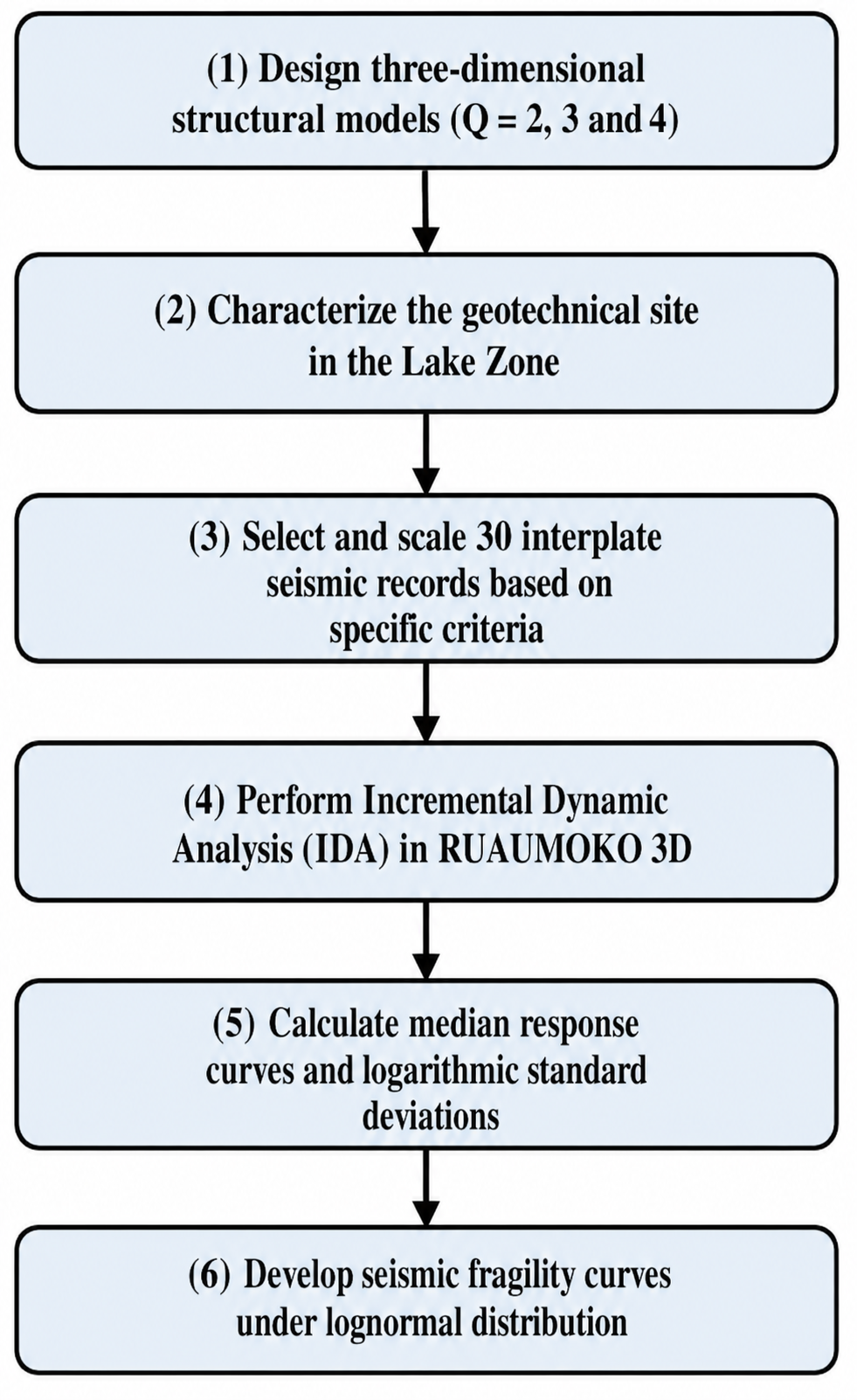
In the presented article, it must be noted that ductility is a fundamental parameter in seismic and structural engineering, since, as is well known among various researchers in the seismological field, ductility itself is related to the ability of a building to dissipate energy through a phenomenon known as nonlinear behavior. From what we have just described arises the importance of estimating, herein, the influence of ductility on the seismic performance of buildings. Under this approach, the present investigation evaluates the seismic fragility of mid-rise buildings that the authors assume to be located in Mexico City, designed in accordance with the current seismic regulations of the jurisdiction. To this end, three eight story reinforced concrete buildings situated in the Lake Zone were analyzed. It should also be noted that all three structures described in this investigation were designed with seismic behavior factor levels ranging from low and medium to high. In order to gain a deeper understanding of the subject addressed herein, the authors proposed that the methodological strategy must be grounded in the execution of Incremental Dynamic Analyses (IDA) based on a set of 30 accelerographic records from narrow-band interplate earthquakes, obtained from national databases and representative of the Valley of Mexico, scaled by the authors to 20 seismic intensity levels also expressed in terms of the spectral acceleration of the fundamental vibration mode Sa(T1) of the building. From the structural responses obtained, seismic fragility curves were constructed under the assumption of a lognormal distribution. It is likewise important for the authors to convey that this investigation constitutes one of the first contributions to simultaneously contrast three normative ductility levels Q = 2, Q = 3, and Q = 4, within the framework of the NTC-2023 of Mexico City, and by applying a direct probabilistic approach. It is confirmed that the quantitative results obtained clearly demonstrate that the seismic intensity corresponding to a 50% probability of exceedance for the collapse state under analysis increases from 266 cm/s² in the structure with low ductility or Q = 2, to a value of 396 cm/s² for Q = 3 or medium ductility, and reaches 730 cm/s² in the design employing high ductility with Q = 4. From these findings, it is concluded that the high-ductility designs studied exhibited a structural capacity approximately three times greater when subjected to extreme seismic events, with notably higher overall safety levels under the soft soil conditions evaluated.
Downloads
References
[1] M. E. Rodríguez, “Requisitos de control de distorsiones, ductilidad, resistencia e irregularidad estructural en las normas de diseño sísmico de la Ciudad de México,” Revista de Ingeniería Sísmica, no. 114, Art. no. e669, Jan. 2025, doi: 10.18867/ris.114.669. DOI: https://doi.org/10.18867/ris.114.669
[2] P. Fajfar, “A nonlinear analysis method for performance-based seismic design,” Earthquake Spectra, vol. 16, no. 3, pp. 573–592, Aug. 2000, doi: 10.1193/1.1586128. DOI: https://doi.org/10.1193/1.1586128
[3] S. Ruiz et al., “Evaluación de la fragilidad de dos soluciones de rehabilitación para un edificio con planta baja débil dañado durante el sismo 19/S17,” Revista de Ingeniería Sísmica, no. 102, pp. 1–25, Jan. 2020, doi: 10.18867/ris.102.531. DOI: https://doi.org/10.18867/ris.102.513
[4] Gobierno de la Ciudad de México, Normas Técnicas Complementarias sobre Criterios y Acciones para el Diseño Estructural de las Edificaciones, Gaceta Oficial de la Ciudad de México, México, Nov. 6, 2023.
[5] Gobierno de la Ciudad de México, Normas Técnicas Complementarias para Diseño y Construcción de Estructuras de Concreto, Gaceta Oficial de la Ciudad de México, México, Nov. 6, 2023.
[6] Gobierno de la Ciudad de México, Normas Técnicas Complementarias de Diseño por Sismo, Gaceta Oficial de la Ciudad de México, México, Nov. 6, 2023.
[7] L. Esteva, “Nonlinear seismic response of soft-first-story buildings subjected to narrow-band accelerograms,” Earthquake Spectra, vol. 8, no. 3, pp. 373–389, Aug. 1992, doi: 10.1193/1.1585686. DOI: https://doi.org/10.1193/1.1585686
[8] M. J. N. Priestley, “Displacement-based seismic assessment of reinforced concrete buildings,” Journal of Earthquake Engineering, vol. 1, no. 1, pp. 157–192, Jan. 1997, doi: 10.1080/13632469708962365. DOI: https://doi.org/10.1080/13632469708962365
[9] D. Santos, J. Melo, and H. Varum, “Code Requirements for the Seismic Design of Irregular Elevation RC Structures,” Buildings, vol. 14, no. 5, Art. no. 1351, May 2024, doi: 10.3390/buildings14051351. DOI: https://doi.org/10.3390/buildings14051351
[10] C. A. Cornell et al., “Probabilistic basis for 2000 SAC federal emergency management agency steel moment frame guidelines,” Journal of Structural Engineering, vol. 128, no. 4, pp. 526–533, Apr. 2002, doi: 10.1061/(ASCE)0733-9445(2002)128:4(526). DOI: https://doi.org/10.1061/(ASCE)0733-9445(2002)128:4(526)
[11] F. J. Velarde Cruz, J. Bojórquez Mora y E. Bojórquez Mora, “Confiabilidad estructural de edificios de concreto reforzado y sistema dual,” Revista de Ingeniería Sísmica, no. 107, pp. 74–90, Jul. 2022, doi: 10.18867/ris.107.626. DOI: https://doi.org/10.18867/ris.107.626
[12] H. Hernández-Barrios et al., “Evaluation of the new seismic design requirements for RC buildings in Mexico City,” Engineering Structures, vol. 305, pp. 112-128, Apr. 2025, doi: 10.1016/j.engstruct.2025.117130.
[13] J. Avilés, “Interacción suelo-estructura: concepto de diseño,” Revista de Ingeniería Sísmica, no. 61, pp. 15–32, Oct. 1999, doi: 10.18867/ris.61.120. DOI: https://doi.org/10.18867/ris.61.243
[14] D. Vamvatsikos and C. A. Cornell, “Incremental dynamic analysis,” Earthquake Engineering & Structural Dynamics, vol. 31, no. 3, pp. 491–514, Mar. 2002, doi: 10.1002/eqe.141. DOI: https://doi.org/10.1002/eqe.141
[15] J. W. Baker, “Efficient analytical fragility function fitting using dynamic structural analysis,” Earthquake Spectra, vol. 31, no. 1, pp. 579–599, Feb. 2015, doi: 10.1193/021113EQS025M. DOI: https://doi.org/10.1193/021113EQS025M
[16] J. M. Castro and R. S. Guerrero, “Machine Learning applications for the generation of seismic fragility curves in Mexico City,” Journal of Earthquake Engineering, vol. 30, no. 2, pp. 45–67, Feb. 2025, doi: 10.1080/13632469.2025.2410291.
[17] A. Ramirez and P. Lopez, “Evaluation of the seismic resilience of reinforced concrete buildings according to the NTC-2023 guidelines,” Structures, vol. 82, pp. 110–125, Apr. 2026, doi: 10.1016/j.istruc.2026.104560.
[18] M. Miglietta, et al., “Integrating Building- and Site-Specific and Generic Fragility Curves into Seismic Risk Assessment,” CivilEng, vol. 5, no. 4, pp. 888–910, Dec. 2023, doi: 10.3390/civileng5040050. DOI: https://doi.org/10.3390/civileng5040050
[19] C. Alarcón, Á. López, and J. C. Vielma, “Performance of Medium-Rise Buildings with Reinforced Concrete Shear Walls Designed for High Seismic Hazard,” Materials, vol. 16, no. 5, Art. no. 1859, Mar. 2023, doi: 10.3390/ma16051859. DOI: https://doi.org/10.3390/ma16051859
[20] A. J. Carr, RUAUMOKO: Inelastic Dynamic Analysis Program (Manual). University of Canterbury, New Zealand, 2004.
[21] R. Park and T. Paulay, Reinforced Concrete Structures, 1st ed. New York, NY, USA: Wiley-Interscience, 1975, pp. 195–269. DOI: https://doi.org/10.1002/9780470172834
[22] T. Takeda, M. A. Sozen, and N. N. Nielsen, “Reinforced Concrete Response to Simulated Earthquakes,” Journal of the Structural Division, ASCE, vol. 96, no. 12, pp. 2433–2457, Dec. 1970, doi: 10.1061/JSDEAG.0002765. DOI: https://doi.org/10.1061/JSDEAG.0002765
[23] SAP2000 Integrated Software for Structural Analysis and Design, version 25, Computers and Structures, Inc., Berkeley, CA, USA, 2023.
[24] Sistema de Acciones Sísmicas de Diseño (SASID), Instituto de Ingeniería, UNAM, Ciudad de México, México, 2023.
[25] A. Tena-Colunga, et al., “Seismic design of RC structures in Mexico City: Evolution of the code,” Engineering Structures, vol. 292, Art. no. 116542, Oct. 2023, doi: 10.1016/j.engstruct.2023.116542. DOI: https://doi.org/10.1016/j.engstruct.2023.116542
[26] H. E. Reyes-Heredia, J. Bojórquez y E. Bojórquez, “Propuesta de combinación de carga sísmica para la ciudad de México tomando en cuenta diferentes tipos de suelos,” Revista de Ingeniería Sísmica, no. 113, pp. 81–105, Jul. 2024, doi: 10.18867/ris.113.637. DOI: https://doi.org/10.18867/ris.113.637
[27] H. E. Reyes-Heredia, J. Bojórquez-Mora, E. Bojórquez-Mora, M. A. Barraza-Guerrero, and H. A. Leyva-Madrigal, “Life cycle cost comparison of reinforced concrete buildings located in different types of soils in Mexico City,” Revista de Ciencias Tecnológicas (RECIT), vol. 7, no. 1, Art. no. e276, Jan. 2024, doi: 10.37636/recit.v6n4e276. DOI: https://doi.org/10.37636/recit.v6n4e276
[28] M. Ordaz, Efectos de sitio y su importancia en la ingeniería sísmica. México: Universidad Nacional Autónoma de México, 2000.
[29] K. C. Meza-Fajardo, J. Aguirre, P. Cuellar, A. S. Papageorgiou, and J. Virieux, “Quantitative analysis of surface-wave propagation in the Mexico City Valley,” Earthquake Engineering & Structural Dynamics, vol. 52, no. 11, pp. 2755–2771, Sep. 2023, doi: 10.1002/eqe.3893. DOI: https://doi.org/10.1002/eqe.3893
[30] Base de Datos de Acelerogramas Fuertes, Instituto de Ingeniería, UNAM, México, 2024. [En línea]. Disponible en: http://aplicaciones.iingen.unam.mx/AcelerogramasRSMSS/
[31] Base de Datos de la Red Acelerográfica de la Ciudad de México, Centro de Instrumentación y Registro Sísmico A.C., México, 2024. [En línea]. Disponible en: https://www.cires.org.mx
[32] N. Zavala, E. Bojórquez, M. Barraza, J. Bojórquez, A. Villela, J. Campos, J. Torres, R. Sánchez, and J. Carvajal, “Vector-Valued Intensity Measures Based on Spectral Shape to Predict Seismic Fragility Surfaces in Reinforced Concrete Buildings,” Buildings, vol. 13, no. 1, Art. no. 137, Jan. 2023, doi: 10.3390/buildings13010137. DOI: https://doi.org/10.3390/buildings13010137
[33] S. E. Ruiz and M. A. Santos, “Seismic risk assessment of irregular buildings in Mexico City: Impacts of the 2023 code update,” Earthquake Spectra, vol. 42, no. 1, pp. 45–62, Feb. 2026, doi: 10.1173/eqs.2026.042.
[34] D. Tolentino, et al., “Stochastic modeling of ground motions for the 2023 Mexico City seismic microzonation,” Bulletin of Earthquake Engineering, vol. 23, no. 4, pp. 2100–2125, Mar. 2025, doi: 10.1007/s10518-025-01980-y.
[35] F. Jalayer, “Direct Probabilistic Seismic Analysis: Implementing Non-linear Dynamic Assessments,” Ph.D. dissertation, Dept. Civil Env. Eng., Stanford Univ., Stanford, CA, USA, 2003.
Downloads
Published
Data Availability Statement
The data supporting the results of this study are available upon reasonable request to the corresponding author.
License
Copyright (c) 2026 Seiko Christian Suzuki Espino, Juan Bojórquez Mora, Edén Bojórquez Mora, Rody Abraham Soto Rojo

This work is licensed under a Creative Commons Attribution 4.0 International License.
The authors who publish in this journal accept the following conditions:
The authors retain the copyright and assign to the journal the right of the first publication, with the work registered with the Creative Commons Attribution license 4.0, which allows third parties to use what is published as long as they mention the authorship of the work and the first publication in this magazine.
Authors may make other independent and additional contractual agreements for the non-exclusive distribution of the version of the article published in this journal (eg, include it in an institutional repository or publish it in a book) as long as they clearly indicate that the work it was first published in this magazine.
Authors are allowed and encouraged to share their work online (for example: in institutional repositories or personal web pages) before and during the manuscript submission process, as it can lead to productive exchanges, greater and more quick citation of published work (see The Effect of Open Access).
How to Cite