Seismic record selection criterion inspired by Np: application to a C/R building with different ductility capacity
DOI:
https://doi.org/10.37636/recit.v9n3e455Keywords:
Seismic record selection, Spectral shape parameter Np, Seismic response, Reinforced concrete buildingsAbstract
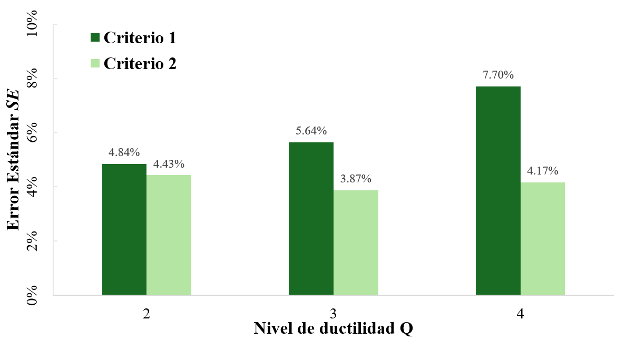
The selection of seismic records is a fundamental step in nonlinear dynamic analysis, an essential tool for the seismic evaluation of buildings; however, under current regulatory criteria, this procedure often results in a significant dispersion of the structural response. Therefore, this paper proposes a seismic record selection criterion based on the spectral shape parameter Np. The methodology is applied to an eight-story reinforced concrete (RC) building designed for three ductility levels (Q = 2, 3, and 4) according to the Building Code for Mexico City. To demonstrate the advantages of using the spectral shape parameter Np, incremental dynamic analyses (ADI) are performed on the three versions of the RC building. For the seismic analyses, 50 seismic records obtained from soft soil in Mexico City are used, and the Np values associated with each record and specific structural case are obtained. The results show that the Np-based procedure reduces the standard error of the structural response, measured in terms of the maximum interstory drift, in all cases studied. Specifically, a reduction of up to 45% is observed compared to the standard methodology, allowing for a more accurate estimation of the structural performance of buildings. Therefore, the spectral shape parameter Np can be effectively applied in the selection of seismic records.
Downloads
References
[1] Instituto para la seguridad de las construcciones en la Ciudad de México, Normas Técnicas Complementarias (NTC-2023). Ciudad de México, México: Gaceta oficial de la Ciudad de México, 2023. Disponible: https://www.isc.cdmx.gob.mx/directores-res/cursos-de-actualizacion-2022/normas-tecnicas-complementarias-2023
[2] M. Fragiadakis, D. Vamvatsikos, “Seismic assessment of structures and lifelines” J. Sound and Vib., vol. 334, pp. 29–56, 2015. https://doi.org/10.1016/j.jsv.2013.12.031 DOI: https://doi.org/10.1016/j.jsv.2013.12.031
[3] R. Medina, H. Krawinkler, “Seismic Demands for Nondeteriorating Frame Structures and Their Dependence on Ground Motions”, Pacific Earthquake Engineering Research Center, Stanford University, PEER Report 2003/15, Stanford, CA, 2004. Disponible: https://peer.berkeley.edu/publications/2003-15
[4] J. J. Bommer, A. B. Acevedo, “The use of real earthquake accelerograms as input to dynamic analysis”, J. Earthq. Eng., Vol. 8, no. 1, pp. 43-91, 2004. https://doi.org/10.1080/13632460409350521 DOI: https://doi.org/10.1080/13632460409350521
[5] I. Iervolino, C. A. Cornell, “Record selection for nonlinear seismic analysis of structures,” Earthq. Spectra, vol. 21, no. 3, pp. 685–713, 2005. https://doi.org/10.1193/1.1990199 DOI: https://doi.org/10.1193/1.1990199
[6] J. W. Baker and C. A. Cornell, “Spectral shape, epsilon and record selection,” Earthq. Eng. & Str. Dyn., vol. 35, pp. 1077–1095, 2006. https://doi.org/10.1002/eqe.571 DOI: https://doi.org/10.1002/eqe.571
[7] E. Bojórquez, I. Iervolino y G. Manfredi, “Spectral shape proxies and nonlinear structural response”, Soil Dyn. and Earthq. Eng., vol. 31, no. 7, pp. 996-1008, 2011. https://doi.org/10.1016/j.soildyn.2011.03.006 DOI: https://doi.org/10.1016/j.soildyn.2011.03.006
[8] N. Shome, C. A. Cornell, P. Bazzurro, J. E. Carballo, "Earthquake, Records and Nonlinear MDOF Responses", Dept. of Civil Eng., Stanford University; Stanford, CA, USA, Rep. RMS-29, 1997. https://searchworks.stanford.edu/view/yn623sv4192
[9] N. Shome, C. A. Cornell, “Probabilistic Seismic Demand Analysis of Nonlinear Structures”, Dept. of Civil Eng., Stanford University; Stanford, CA, USA, Rep. RMS-35, 1999. https://nehrpsearch.nist.gov/static/files/NSF/PB99143372.pdf
[10] R. P. Kennedy, et al., "Engineering characterization of ground motions--task I: effects of characteristics of free-field motion on structural response." NUREG/CR-3805, vol. 1, 1984. Disponible: https://www.osti.gov/servlets/purl/6848574 DOI: https://doi.org/10.2172/6848574
[11] CEN, Eurocode 8: Design of structures for earthquake resistance – Part 1: General rules, seismic actions and rules for buildings. Brussels, Belgium: European Standard EN 1998-1, 2004.
[12] American Society of Civil Engineers (ASCE), ASCE/SEI 7-22: Minimum Design Loads and Associated Criteria for Buildings and Other Structures, Reston, VA: ASCE, 2022.
[13] J. W. Baker, C. A. Cornell, “Vector-valued intensity measures incorporating spectral shape for prediction of structural response”, J. of Earthq. Eng., vol. 12, no. 4, pp. 534-554, 2008. https://doi.org/10.1080/13632460701673076 DOI: https://doi.org/10.1080/13632460701673076
[14] P. P. Córdova, G. G. Deierlein, S. S. F. Mehanny, and C. A. Cornell, “Development of a two-parameter seismic intensity measure and probabilistic assessment procedure”, J. of Eng. and Applied Sc., vol. 51, pp. 1–20, 2001. Disponible:
[15] N. Buratti, “A comparison of the performances of various ground-motion intensity measures” in Proc. 15th World Conf. on Earthquake Engineering, Lisbon, Portugal, 2012. Disponible:
https://www.iitk.ac.in/nicee/wcee/article/WCEE2012_5499.pdf
[16] E. Bojórquez, I. Iervolino, G. Manfredi, “Evaluating a new proxy for spectral shape to be used as an intensity measure”, in Seismic Engineering International Conference commemorating the 1908 Messina and Reggio Calabria Earthquake (MERCEA’08), Reggio Calabria, Italy, 2008, pp. 8-11. https://doi.org/10.1063/1.2963788 DOI: https://doi.org/10.1063/1.2963788
[17] E. Bojórquez, R. Chávez, A. Reyes-Salazar, S. Ruiz, J. Bojórquez, “A new ground motion intensity measure IB”, Soil Dyn. and Earthq. Eng., vol. 199, pp. 97–107, 2017. https://doi.org/10.1016/j.soildyn.2017.05.011 DOI: https://doi.org/10.1016/j.soildyn.2017.05.011
[18] J. W. Baker and C. A. Cornell, “A vector-valued ground motion intensity measure consisting of spectral acceleration and epsilon”, Earthq. Eng. & Struct. Dyn., vol. 34, pp. 1193–1217, 2005.
https://doi.org/10.1002/eqe.474 DOI: https://doi.org/10.1002/eqe.474
[19] C. Smerzini, C. Galasso, I. Iervolino y R. Paolucci, “Ground Motion Record Selection Based on Broadband Spectral Compatibility”, Earthq. Spectra, vol. 30, no. 4, pp. 1427-1448, 2014.
https://doi.org/10.1193/052312EQS197M DOI: https://doi.org/10.1193/052312EQS197M
[20] S. Yaghmaei-Sabegh,S. Karami, M. Hosseini-Moghadam, “Selection and scaling of spectrum-compatible ground motion records using hybrid coded genetic algorithms”, Sci. Iran. A., vol. 24, no. 3, pp. 910-925, 2017. https://doi.org/10.24200/sci.2017.4075 DOI: https://doi.org/10.24200/sci.2017.4075
[21] M. Georgioudakis, M. Fragiadakis, M. Papadrakakis, “Multi-criteria selection and scaling of ground motion records using Evolutionary Algorithms”, In Proc. 10th International Conf. on Structural Dynamics, EURODYN, Rome, Italy, 2017. https://doi.org/10.1016/j.proeng.2017.09.504 DOI: https://doi.org/10.1016/j.proeng.2017.09.504
[22] E. Bojórquez, “A New Spectral Shape-Based Record Selection Approach Using Np and Genetic Algorithms” Math. Prob. in Engineering, vol. 2013, no. 679026, 2013. https://doi.org/10.1155/2013/679026 DOI: https://doi.org/10.1155/2013/679026
[23] E. Bojórquez, et al. “Optimal Acceleration and Energy-Based Record Selection Using Artificial Intelligence Approaches and Np” J. Earthq. Eng., vol. 28, no. 2, pp. 582-601, 2023. DOI: https://doi.org/10.1080/13632469.2023.2220035
[24] E. Bojórquez, I. Iervolino, A. Reyes-Salazar y S. Ruiz, “Comparing vector-valued intensity measures for fragility analysis of steel frames in the case of narrow-band ground motions”, Eng. Struct., vol. 45, 472-480, 2012.
https://doi.org/10.1016/j.engstruct.2012.07.002 DOI: https://doi.org/10.1016/j.engstruct.2012.07.002
[25] P. Tothong, N. Luco, “Probabilistic seismic demand analysis using advanced ground motion intensity measures”, Earthq. Eng. and Struct. Dyn., vol. 36, no. 13, pp. 1837–1860, 2007. https://doi.org/10.1002/eqe.696 DOI: https://doi.org/10.1002/eqe.696
[26] E. Bojórquez, J. Carvajal, S. E. Ruiz y J. Bojórquez, “Reliability-based ductility reduction factors surfaces using the generalized Bojorquez ground motion intensity measure IBg”, R. in Eng., vol. 23, no. 102756, 2024. https://doi.org/10.1016/j.rineng.2024.102756 DOI: https://doi.org/10.1016/j.rineng.2024.102756
[27] G. W. Housner, "Spectrum Intensities of Strong Motion Earthquakes", in Proc. Symposium on Earthquake and Blast Effects on Structures, Los Angeles, CA, 1952, pp. 20-36. Disponible: https://authors.library.caltech.edu/records/x3jjd-y5366
[28] J. L. Von-Thun, L. H. Roehm, G. A. Scott y J. A. Wilson, "Earthquake Ground Motions for Design and Analysis of Dams", in Earthquake Engineering and Soil Dynamics II - Recent Advance in Ground-Motion Evaluation, Geotechnical Special Publication 20. NY, New York, USA: ASCE, 1988, pp. 463-481.
[29] E. Bojórquez, V. Baca, J. Bojórquez, A. Reyes-Salazar, R. Chávez, and M. Barraza, “A simplified procedure to estimate peak drift demands for mid-rise steel and R/C frames under narrow-band motions in terms of the spectral-shape-based intensity measure "I" _("N" _"p" )”, Eng. Struct., vol. 150, pp. 334–345, 2017. https://doi.org/10.1016/j.engstruct.2017.07.046 DOI: https://doi.org/10.1016/j.engstruct.2017.07.046
[30] E. Bojórquez, L. Astorga, A. Reyes-Salazar, A. Terán-Gilmore, J. Velázquez, J. Bojórquez, y L. Rivera, “Prediction of hysteretic energy demands in steel frames using vector-valued IMs”, Steel and Composite Struct., vol. 19, no. 3, pp. 697–711, 2015.
https://doi.org/10.12989/scs.2015.19.3.697 DOI: https://doi.org/10.12989/scs.2015.19.3.697
[31] M. Kaplán, “Optimización de la intensidad generalizada de Bojórquez para maximizar el desempeño sísmico de edificaciones de concreto reforzado”, Tesis de Maestría, Universidad Autónoma de Sinaloa, Sinaloa, Mexico, 2025.
[32] Vamvatsikos D, Cornell CA, “Incremental dynamic analysis”, Earthq. Eng. and Struct. Dyn., vol. 31, no. 3, pp. 491–514, 2002. https://doi.org/10.1002/eqe.141 DOI: https://doi.org/10.1002/eqe.141
[33] A.J. Carr, Ruaumoko3D: Inelastic three-dimensional analysis program, Christchurch, New Zealand: University of Canterbury 2007.
[34] T. Takeda, M. A. Sozen y N. N. Nielsen, “Reinforced concrete response to simulated earthquakes”, J. Struct. Div. ASCE, vol. 96, no. 12, pp. 2557-2573, 1970. https://doi.org/10.1061/JSDEAG.0002765 DOI: https://doi.org/10.1061/JSDEAG.0002765
[35] H. Aslani, E. Miranda, “Probabilistic response assessment for building-specific loss estimation”, PEER Report 2003/03, Pacific Earthquake Engineering Research Center, University of California at Berkeley, Berkeley, California, pp. 49, 2003. Disponible:
https://peer.berkeley.edu/sites/default/files/0303_e._miranda_h._aslani.pdf
Downloads
Published
Data Availability Statement
The datasets generated and/or analyzed during this study are available through the corresponding author upon request.
License
Copyright (c) 2026 Jesús David Tirado Ibarría, Edén Bojórquez Mora, Jesús Prisciliano Romo Villa, Juan Bojórquez Mora

This work is licensed under a Creative Commons Attribution 4.0 International License.
The authors who publish in this journal accept the following conditions:
The authors retain the copyright and assign to the journal the right of the first publication, with the work registered with the Creative Commons Attribution license 4.0, which allows third parties to use what is published as long as they mention the authorship of the work and the first publication in this magazine.
Authors may make other independent and additional contractual agreements for the non-exclusive distribution of the version of the article published in this journal (eg, include it in an institutional repository or publish it in a book) as long as they clearly indicate that the work it was first published in this magazine.
Authors are allowed and encouraged to share their work online (for example: in institutional repositories or personal web pages) before and during the manuscript submission process, as it can lead to productive exchanges, greater and more quick citation of published work (see The Effect of Open Access).
How to Cite