EL CHAMIZAL 2019–2025: Análisis socioterritorial y diseño de un sistema inteligente de gestión del espacio público fronterizo en contextos de movilidad humana
DOI:
https://doi.org/10.37636/recit.v9n3e454Palabras clave:
Movilidad humana, Espacio público fronterizo, Gestión territorial inteligente, Resiliencia socioambiental, Inteligencia artificial aplicadaResumen
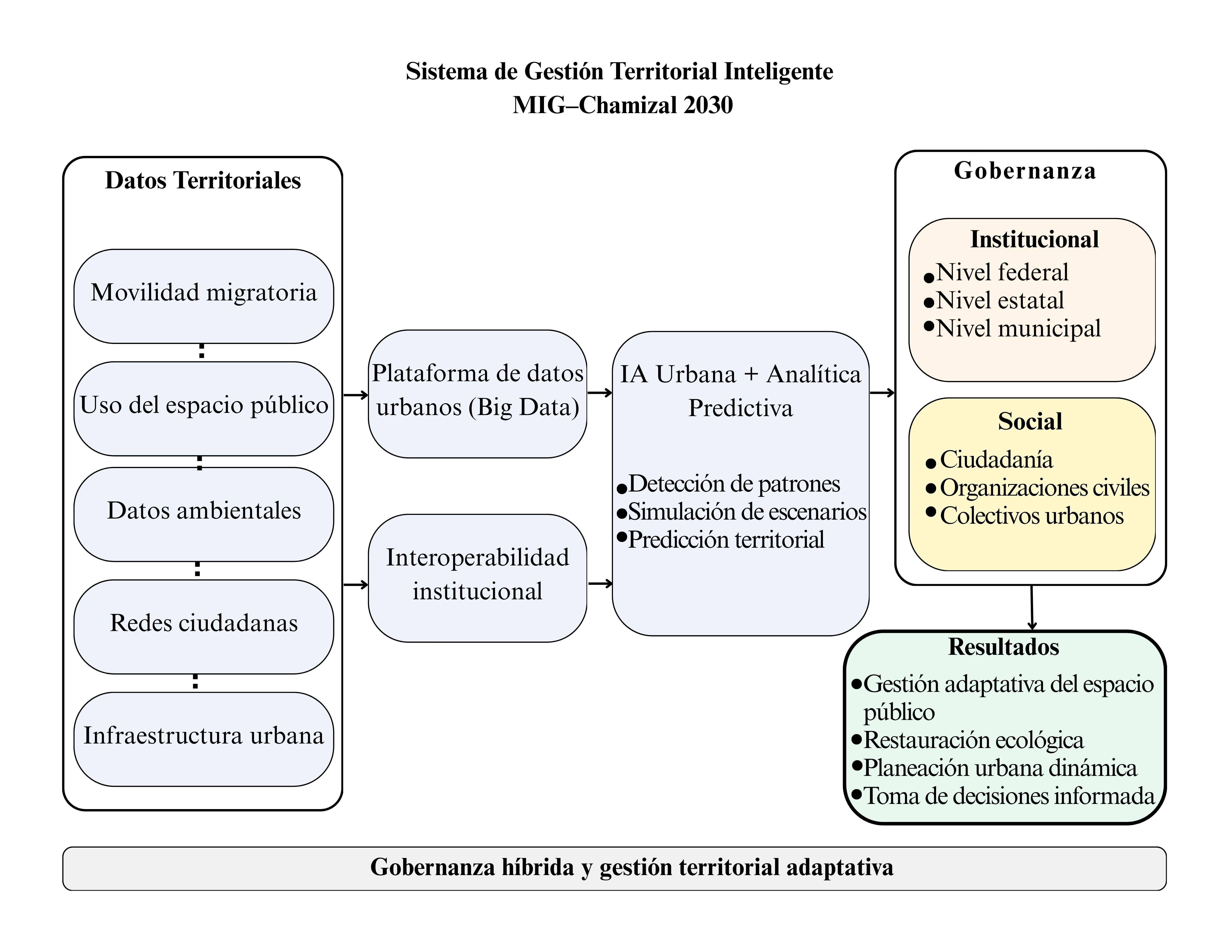
El Parque Público Federal El Chamizal, ubicado en Ciudad Juárez, Chihuahua, es un espacio público fronterizo estratégico configurado por la movilidad humana, la degradación ambiental y una gestión institucional fragmentada. Entre 2019 y 2024, los flujos migratorios sostenidos convirtieron el parque en un territorio de tránsito y ocupación temporal, con asentamientos informales, sobreuso del suelo y tensiones socioambientales. En 2025, los cambios en la política migratoria de Estados Unidos redujeron la presencia de personas migrantes en un estimado de entre 65.1 % y 80 %, modificando los patrones de uso sin revertir los daños acumulados ni fortalecer la capacidad de gestión. Este estudio tiene como objetivo analizar las transformaciones socioterritoriales de El Chamizal (2019–2025) y delinear un sistema integrado de gestión del espacio público respaldado por inteligencia artificial para mejorar la toma de decisiones, la coordinación multinivel y la resiliencia urbana. La investigación sigue un enfoque cualitativo que combina observación in situ, análisis espacial fenomenológico, revisión hemerográfica y evaluación documental sistemática bajo los criterios PRISMA 2020, con el fin de asegurar trazabilidad y rigor metodológico. Los hallazgos muestran un deterioro ambiental persistente, responsabilidades superpuestas y dependencia de decisiones extraterritoriales. Como contribución, el estudio propone un modelo orientado a sistemas (MIG–Chamizal 2030), basado en gobernanza interoperable, monitoreo inteligente en tiempo real, analítica predictiva y restauración ecológica progresiva, acompañado de protocolos humanitarios adaptativos para sustentar una acción pública contextual y basada en evidencia hacia 2030.
Descargas
Referencias
[1] H. Lefebvre, The Production of Space. Oxford: Blackwell, 1991.
[2] M. Sheller y J. Urry, “The new mobilities paradigm”, Environ. Plan. A, vol. 38, núm. 2, pp. 207–226, feb. 2006, doi: 10.1068/a37268. DOI: https://doi.org/10.1068/a37268
[3] I. Katz, “Borderzone departure cities: jumping-off points of irregular migration at the urban edge of Europe”, Antipode, vol. 55, pp. 1608–1633, oct. 2023, doi: 10.1111/anti.12923. DOI: https://doi.org/10.1111/anti.12923
[4] S. C. Colombeau, “Policing the internal Schengen borders-managing the double bind between free movement and migration control”, Policing and Society, 2015, doi: 10.1080/10439463.2015.1072531. DOI: https://doi.org/10.1080/10439463.2015.1072531
[5] E. Moreno, “Relevancia del patrimonio en Ciudad Juárez Chihuahua, espacios públicos abiertos e imaginario social”, Tesis doctoral, Universidad Autónoma del Estado de Morelos (UAEM), Cuernavaca, Morelos, México, 2017. Consultado: el 5 de marzo de 2026. [En línea]. Disponible en: http://riaa.uaem.mx/handle/20.500.12055/944
[6] J. Pierre y B. G. Peters, Governance, Politics and the State. London, 2020.
[7] M. Maggetti y P. Trein, “Multilevel governance and problem-solving: Towards a dynamic theory of multilevel policy-making?”, Public Adm., vol. 97, núm. 2, 2019, doi: 10.1111/padm.12573. DOI: https://doi.org/10.1111/padm.12573
[8] Organización Internacional para las Migraciones (OIM), “Seguimiento de Flujos de Población Migrante: Ciudad Juárez, octubre 2023”, Ciudad de México / Ciudad Juárez, oct. 2023. Consultado: el 23 de marzo de 2026. [En línea]. Disponible en: http://www.omi.gob.mx/work/models/OMI/Seccion_Publicaciones/QPM/mxusa/QPM_ene-feb.pdf
[9] Gobierno de México, “Iniciativas y acciones del INM en la frontera norte”, Instituto Nacional de Migración. Consultado: el 7 de noviembre de 2023. [En línea]. Disponible en: https://www.gob.mx/inm/prensa/inm-informa-de-trabajos-de-transformacion-en-estaciones-migratorias-para-no-repeticion-de-hechos-como-el-de-cd
[10] P. Romo, “Abandona Semarnat El Chamizal: no tiene proyectos de rescate y ni siquiera ha terminado el programa obligatorio”, El Heraldo de Juárez, Ciudad Juárez, Chihuahua, México, 2 de marzo de 2026. Consultado: el 5 de marzo de 2026. [En línea]. Disponible en: https://oem.com.mx/elheraldodejuarez/local/abandona-semarnat-el-chamizal-no-tiene-proyectos-de-rescate-y-ni-siquiera-ha-terminado-el-programa-obligatorio-28554975
[11] Y. Murakami y K. Kimura, Human-Centered Services Computing for Smart Cities. Singapore: Springer Nature, 2024, doi: 10.1007/978-981-97-0779-9. DOI: https://doi.org/10.1007/978-981-97-0779-9
[12] A. S. Prince, “A Comprehensive Big Data Governance Framework for Smart Cities: Leveraging IoT, Scalable Analytics, and Participatory Models for Sustainable Urban Management”, Int. J. Res. Appl. Sci. Eng. Technol., vol. 13, núm. 3, 2025, doi: 10.22214/ijraset.2025.65944. DOI: https://doi.org/10.22214/ijraset.2025.65944
[13] E. Nica, “Urban big data analytics and sustainable governance networks in integrated smart city planning and management”, Geopolitics, History, and International Relations, vol. 13, núm. 2, 2021, doi: 10.22381/GHIR13220217. DOI: https://doi.org/10.22381/GHIR13220217
[14] M. J. Page et al., “The PRISMA 2020 statement: An updated guideline for reporting systematic reviews”, BMJ, vol. 372, 2021, doi: 10.1136/bmj.n71. DOI: https://doi.org/10.1136/bmj.n71
[15] R. Medina, “La apropiación del espacio público de inmigrantes centroamericanos en la Ciudad de México: ¿visibilidad o invisibilidad impuesta? El caso del Centro Histórico”, Revista de Urbanismo, vol. 47, pp. 40–57, dic. 2022, doi: 10.5354/0717-5051.2022.66032. DOI: https://doi.org/10.5354/0717-5051.2022.66032
[16] S. Cranston y K. Duplan, “Infrastructures of migration and the ordering of privilege in mobility”, Migr. Stud., vol. 11, núm. 2, pp. 330–348, jun. 2023, doi: 10.1093/migration/mnad001. DOI: https://doi.org/10.1093/migration/mnad001
[17] J. A. C. Urriola y H. R. Brevis, “Habitability Conditions and Uses of Public Space in International Migrants of Temuco, Chile”, Migraciones Internacionales, vol. 14, ene. 2023, doi: 10.33679/rmi.v1i1.2653. DOI: https://doi.org/10.33679/rmi.v1i1.2653
[18] C. Pinzón y J. Fonseca, “Arrival Infrastructures, an Approach to the Migrant Space in Bogotá as a Destination City”, Dearq, vol. 2021, núm. 30, pp. 60–69, may 2021, doi: 10.18389/dearq30.2021.07. DOI: https://doi.org/10.18389/dearq30.2021.07
[19] J. Morales, “Violencia y derechos humanos de centroamericanos en México: la paradoja entre ser un país de migrantes y un país de tránsito”, Boletín Americanista, vol. 60, pp. 227–246, 2010. Consultado: el 19 de febrero de 2026. [En línea]. Disponible en: https://www.researchgate.net/publication/254490512_Violencia_y_derechos_humanos_de_centroamericanos_en_Mexico_la_paradoja_entre_ser_un_pais_de_migrantes_y_un_pais_de_transito
[20] S. Vertovec, “Migrant transnationalism and modes of transformation”, 2004, doi: 10.1111/j.1747-7379.2004.tb00226.x. DOI: https://doi.org/10.1111/j.1747-7379.2004.tb00226.x
[21] S. Vertovec, “Trends and Impacts of Migrant Transnationalism”, Society, vol. 3, núm. 3, 2004.
[22] M. T. Martínez Almanza, M. N. González Valles y A. Castro Valles, “El crimen organizado y su impacto en la movilidad humana en Ciudad Juárez”, Enseñanza e Investigación en Psicología Nueva Época, vol. 6, núm. Migraciones, pp. 140–151, feb. 2024, doi: 10.62364/cneip.6.2024.207. DOI: https://doi.org/10.62364/cneip.6.2024.207
[23] V. Martínez, “De nuevo, autoridades instalarán albergue temporal para migrantes en Los Hoyos del Chamizal”, La Verdad Juárez, Ciudad Juárez, Chihuahua, México, 6 de octubre de 2023. Consultado: el 19 de febrero de 2026. [En línea]. Disponible en: https://laverdadjuarez.com/2023/10/06/de-nuevo-autoridades-instalaran-albergue-temporal-para-migrantes-en-los-hoyos-del-chamizal/
[24] J. Pescinski, “The politicization of migrants’ onward movements from Italy to France”, Territ. Politic. Gov., 2026, doi: 10.1080/21622671.2025.2587705. DOI: https://doi.org/10.1080/21622671.2025.2587705
[25] B. Nieswand, Theorising Transnational Migration: The Status Paradox of Migration. 2012, doi: 10.4324/9780203810439. DOI: https://doi.org/10.4324/9780203810439
[26] S. Condon, A. Portes y J. DeWind, “Rethinking migration. New theoretical and empirical perspectives”, Population (French Edition), vol. 62, núm. 4, 2007, doi: 10.2307/20451057. DOI: https://doi.org/10.2307/20451057
[27] S. Motta y J. K. L. Koehler, “Who has the time? The temporality of tensions in the transboundary Red River basin”, Ecology and Society, vol. 30, núm. 4, 2025, doi: 10.5751/ES-16586-300433. DOI: https://doi.org/10.5751/ES-16586-300433
[28] E. J. Chocobar Reyes y R. F. Barreda Medina, “Estructuras metodológicas PICO y PRISMA 2020 en la elaboración de artículos de revisión sistemática: Lo que todo investigador debe conocer y dominar”, Ciencia Latina Revista Científica Multidisciplinar, vol. 9, núm. 1, pp. 8525–8543, mar. 2025, doi: 10.37811/cl_rcm.v9i1.16491. DOI: https://doi.org/10.37811/cl_rcm.v9i1.16491
[29] A. Mosselson, “Cities of Sanctuary in Environments of Hostility: Competing and Contrasting Migration Infrastructures”, Antipode, vol. 53, núm. 6, pp. 1725–1744, nov. 2021, doi: 10.1111/anti.12739. DOI: https://doi.org/10.1111/anti.12739
[30] I. Gómez Cruz, “Acude colectivo a reforestar ‘Los Hoyos’ de El Chamizal”, Norte Digital, Ciudad Juárez, Chihuahua, México, 23 de marzo de 2023. Consultado: el 18 de marzo de 2026. [En línea]. Disponible en: https://nortedigital.mx/acude-colectivo-a-reforestar-los-hoyos-de-el-chamizal/
[31] Instituto Municipal de Investigación y Planeación (IMIP), “Plan maestro para el parque ‘El Chamizal’”, Ciudad Juárez, Chihuahua, México, 2017. Consultado: el 10 de marzo de 2026. [En línea]. Disponible en: https://www.imip.org.mx/imip/node/137
[32] Instituto Municipal de Investigación y Planeación (IMIP), “Atlas de Riesgos Naturales y Atlas de Riesgos Antropogénicos, Ciudad Juárez, Chihuahua”, IMIP, Ciudad Juárez, 2016.
[33] C. H. Ayuntamiento del Municipio de Juárez, Reglamento del Consejo de Administración de “El Chamizal”. Ciudad Juárez, Chihuahua, México, 2022, p. 1. Consultado: el 19 de febrero de 2026. [En línea]. Disponible en: https://juarez.gob.mx/transparencia/docs/72-reglamento-del-consejo-administrativo-de-el-chamizal-public-16-feb-2022.docx?
[34] M. J. Nieuwenhuijsen, “Urban and transport planning, environmental exposures and health-new concepts, methods and tools to improve health in cities”, 2016, doi: 10.1186/s12940-016-0108-1. DOI: https://doi.org/10.1186/s12940-016-0108-1
[35] Secretaría de Desarrollo Urbano y Ecología (SDUE) y Gobierno del Estado de Chihuahua, “Plan maestro mega parque El Chamizal, Ciudad Juárez, Chihuahua, México”, Ciudad Juárez, Chihuahua, México, jun. 2018. Consultado: el 19 de febrero de 2026. Documento no disponible públicamente; cita elaborada a partir de copia parcial del documento.
[36] Secretaría de Desarrollo Urbano y Ecología (Gobierno del Estado de Chihuahua) y Secretaría de Comunicaciones y Obras Públicas, “Análisis Costo-Beneficio Megaparque El Chamizal, Cd. Juárez Chihuahua”, Ciudad Juárez, Chihuahua, México, may 2020. Consultado: el 19 de febrero de 2026. [En línea]. Disponible en: http://ihacienda.chihuahua.gob.mx/tfiscal/indtfisc/abcparquechamizal.pdf
[37] S. Peña, “Movilidad transfronteriza, planeación y gobernanza en la frontera México-Estados Unidos: Procesos y resultados”, Gestión y Política Pública, vol. 30, núm. 1, pp. 1–30, jun. 2021, doi: 10.29265/gypp.v30i1.804. DOI: https://doi.org/10.29265/gypp.v30i1.804
Publicado
Declaración de disponibilidad de datos
Los datos que respaldan los hallazgos de este estudio se derivan de fuentes disponibles públicamente, incluidos informes institucionales, registros hemerográficos y bases de datos internacionales (por ejemplo, OIM y observatorios de migración). Los datos procesados y el marco analítico utilizados en este estudio están disponibles a solicitud razonable del autor. Debido a la naturaleza del estudio, no se generó ningún conjunto de datos primario.
Licencia
Derechos de autor 2026 Elian Coral Moreno Sánchez, Erik Lugo Cano

Esta obra está bajo una licencia internacional Creative Commons Atribución 4.0.
Los autores/as que publiquen en esta revista aceptan las siguientes condiciones:
- Los autores/as conservan los derechos de autor y ceden a la revista el derecho de la primera publicación, con el trabajo registrado con la licencia de atribución de Creative Commons 4.0, que permite a terceros utilizar lo publicado siempre que mencionen la autoría del trabajo y a la primera publicación en esta revista.
- Los autores/as pueden realizar otros acuerdos contractuales independientes y adicionales para la distribución no exclusiva de la versión del artículo publicado en esta revista (p. ej., incluirlo en un repositorio institucional o publicarlo en un libro) siempre que indiquen claramente que el trabajo se publicó por primera vez en esta revista.
- Se permite y recomienda a los autores/as a compartir su trabajo en línea (por ejemplo: en repositorios institucionales o páginas web personales) antes y durante el proceso de envío del manuscrito, ya que puede conducir a intercambios productivos, a una mayor y más rápida citación del trabajo publicado (vea The Effect of Open Access).
Cómo citar