Factores que influyen en el aprendizaje de los niños a través de su interés en las áreas STEM
DOI:
https://doi.org/10.37636/recit.v9n2e408Palabras clave:
STEM, Factores críticos, Educación básica, Ciencia y Tecnología, Aprendizaje infantilResumen
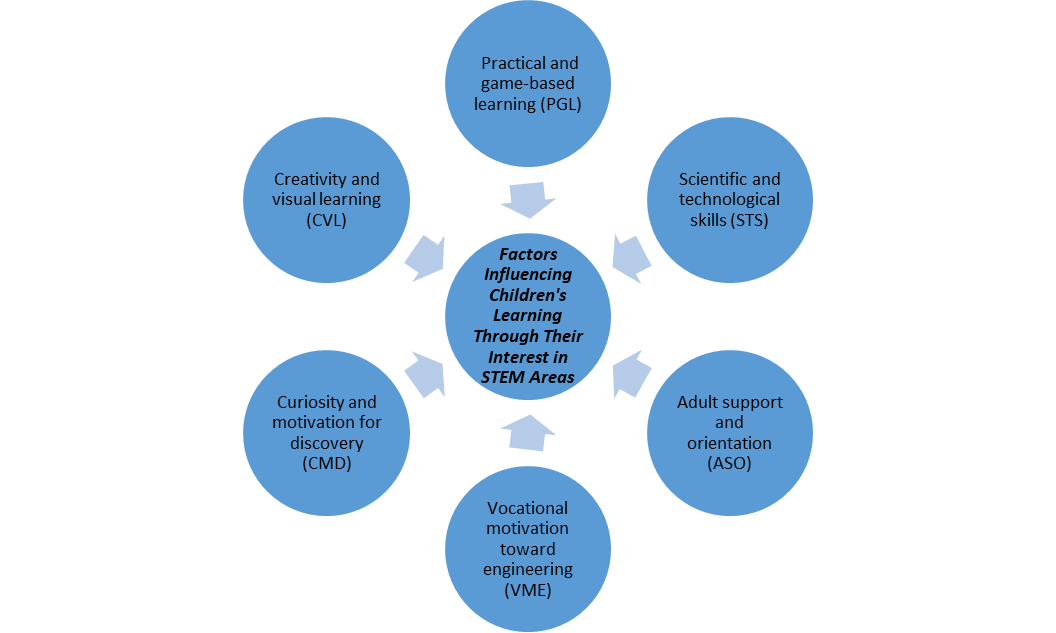
Este trabajo explora los factores e indicadores que influyen en el interés y la motivación de los niños para dedicarse a la Ciencia, Tecnología y Matemáticas (STEM) en la educación básica. El interés en STEM, a través de las dimensiones de Aprendizaje Práctico y Lúdico, Tecnologías y Habilidades Científicas, Motivación Vocacional hacia la Ingeniería, Creatividad y Aprendizaje Visual, Apoyo y Orientación del Adulto, y Curiosidad y Motivación por el Descubrimiento, fue evaluado a partir de datos obtenidos en un instrumento de encuesta aplicado a 165 niños de primaria. Los resultados mostraron que los niños exhiben un mayor interés en actividades dinámicas y dispositivos tecnológicos, y resaltan la relevancia de factores como el apoyo familiar y la experiencia práctica en el desarrollo de habilidades STEM. Estos hallazgos sugieren la necesidad de currículos educativos específicos para aumentar el interés en STEM desde una edad temprana, con intervenciones dirigidas a obtener mejores competencias STEM en la etapa de educación básica.
Descargas
Referencias
[1] Universidad Nacional Autónoma de México (UNAM), Preferencias Profesionales en Niños de Primaria en México, 2023. Disponible en: www.unam.edu.mx.
[2] C. Álvarez, "Encuesta nacional sobre el interés infantil en STEM," Journal of Education in México, vol. 3, no. 13, pp. 45-58, 2019.
[3] S. Cheryan, E. J. Lombard, F. Hailu, L. N. H. Pham, y K. Weltzien, «Global patterns of gender disparities in STEM and explanations for their persistence», Nature Reviews Psychology, vol. 4, n.o 1, pp. 6-19, nov. 2024, doi: 10.1038/s44159-024-00380-3. DOI: https://doi.org/10.1038/s44159-024-00380-3
[4] G. Lampropoulos y Kinshuk, «Virtual reality and gamification in education: a systematic review», Educational Technology Research and Development, vol. 72, n.o 3, pp. 1691-1785, mar. 2024, doi: 10.1007/s11423-024-10351-3. DOI: https://doi.org/10.1007/s11423-024-10351-3
[5] A. D. Pellegrini y P. K. Smith, "The Development of Play During Childhood: Forms and Possible Functions," en Play: Learning through play, P. K. Smith, Ed. Encyclopedia on Early Childhood Development, 2023. https://onlinelibrary.wiley.com/doi/pdf/10.1111/1475-3588.00212
[6] Y. Lou, P. C. Abrami, y S. d'Apollonia, "Small Group and Individual Learning with Technology: A Meta-Analysis," Review of Educational Research, vol. 71, n.º 3, pp. 449-521, 2021. DOI: https://doi.org/10.3102/00346543071003449
[7] J. Tan, S. Wu, L. Wu, and S. Ma, “Cognitive conflicts in collaborative programming and their impact on computational concept acquisition,” Learn Instr, vol. 98, p. 102151, 2025, doi: https://doi.org/10.1016/j.learninstruc.2025.102151. DOI: https://doi.org/10.1016/j.learninstruc.2025.102151
[8] C. Liu y S. S. Wu, "Green finance, sustainability disclosure and economic implications," Fulbright Review of Economics and Policy, vol. 1, núm. 1, pp. 1-15, 2023. DOI: https://doi.org/10.1108/FREP-03-2022-0021
[9] V. Aryadoust, Y. X. N. Soo, y J. Zhai, «Exploring the state of research on motivation in second language learning: a review and a reliability generalization meta-analysis», IRAL - International Review Of Applied Linguistics In Language Teaching, vol. 62, n.o 2, pp. 1093-1126, feb. 2023, doi: 10.1515/iral-2022-0115. DOI: https://doi.org/10.1515/iral-2022-0115
[10] K. Rozenkowska, “Theory of planned behavior in consumer behavior research: A systematic literature review,” Int J Consum Stud, vol. 47, no. 6, pp. 2670–2700, Nov. 2023, doi: https://doi.org/10.1111/ijcs.12970. DOI: https://doi.org/10.1111/ijcs.12970
[11] M. Johnson, S. Davis y R. Lee, "An integrative review of physical activity in adults with inflammatory bowel disease," Journal of Clinical Nursing, vol. 30, núm. 1-2, pp. 3-15, 2021.
[12] G. Palaigeorgiou y A. Grammatikopoulou, "An investigation of teachers' perceptions and integration of Web 2.0 tools into literacy instruction," Interactive Technology and Smart Education, vol. 19, núm. 1, pp. 1-15, 2022.
[13] J. Colelli, M. Di Bernardo, y F. Verde, «Toward a patterned theory of inner speech: rethinking Vygotsky through 4E cognition and phenomenology», Mind & Society, vol. 24, n.o 1, pp. 91-107, abr. 2025, doi: 10.1007/s11299-025-00319-y. DOI: https://doi.org/10.1007/s11299-025-00319-y
[14] K. T. A. S. Kasturiratna, A. Hartanto, C. H. Y. Chen, E. M. W. Tong, and N. M. Majeed, “Umbrella review of meta-analyses on the risk factors, protective factors, consequences and interventions of cyberbullying victimization,” Nat Hum Behav, vol. 9, no. 1, pp. 101–132, 2025, doi: 10.1038/s41562-024-02011-6. DOI: https://doi.org/10.1038/s41562-024-02011-6
[15] International Science Teaching Foundation, International Science Teaching Foundation. https://science-teaching.org/es
[16] L. Price, Psychometric Methods: Theory into Practice, London, U.K: The Guilford Press, 2017.
[17] B. Flynn, S. Sakakibara, R. Sakakibara, K. Bates, y E. Flynn, "Empirical research methods in operations management," Journal of Operations Management, vol. 9, núm. 2, pp. 250-284, 1990. DOI: https://doi.org/10.1016/0272-6963(90)90098-X
[18] M. Malhotra y V. Grover, "An assessment of survey research in POM: From constructs to theory," Journal of Operations Management, vol. 16, núm. 4, pp. 407-425, 1998. https://doi.org/10.1016/S0272-6963(98)00021-7 DOI: https://doi.org/10.1016/S0272-6963(98)00021-7
[19] K. Lepistö, M. Saunila, and J. Ukko, “Enhancing customer satisfaction, personnel satisfaction and company reputation with total quality management: combining traditional and new views,” Benchmarking: An International Journal, vol. 31, no. 1, pp. 75–97, Aug. 2022, doi: 10.1108/BIJ-12-2021-0749. DOI: https://doi.org/10.1108/BIJ-12-2021-0749
[20] C. O’Reilly, A. Devitt, and N. Hayes, “Critical thinking in the preschool classroom - A systematic literature review,” Think Skills Creat, vol. 46, p. 101110, 2022, doi: https://doi.org/10.1016/j.tsc.2022.101110. DOI: https://doi.org/10.1016/j.tsc.2022.101110
[21] I. H. Yue Yim, “A critical review of teaching and learning artificial intelligence (AI) literacy: Developing an intelligence-based AI literacy framework for primary school education,” Computers and Education: Artificial Intelligence, vol. 7, p. 100319, 2024, doi: https://doi.org/10.1016/j.caeai.2024.100319. DOI: https://doi.org/10.1016/j.caeai.2024.100319
[22] P. K. Kuhl, "Learning and the Social Brain," Edutopia, 25-jul-2018. [Enlace]. (Accedido: 24-feb-2025).
[23] E. M. Heemskerk, "The vice and virtue of conflict in boards: A longitudinal study into the effects of board conflict on firm performance," European Journal of Economic and Social Systems, vol. 33, núm. 1, pp. 1-22, 2020. https://doi.org/10.1111/ejed.12549 DOI: https://doi.org/10.1111/ejed.12549
[24] OECD, OECD Economic Outlook, Volume 2021 Issue 1, OECD Publishing, 2021.
[25] S. Fayer, A. Lacey, y A. Watson, "STEM occupations: Past, present, and future," U.S. Bureau of Labor Statistics, 2017.
[26] A. Paivio, "Dual Coding Theory," en Mental Representations: A Dual Coding Approach, Oxford: Oxford University Press, 1990, pp. 583-605. DOI: https://doi.org/10.1093/acprof:oso/9780195066661.003.0004
[27] O. N. Saracho, An Integrated Play-Based Curriculum for Young Children, Routledge/Taylor and Francis Group, 2020. DOI: https://doi.org/10.4324/9780429440991
[28] D. Açar and M. D. Gül, “Academic and Socio-Emotional Experiences of a Twice-Exceptional Student,” Behavioral Sciences, vol. 15, no. 10, 2025, doi: 10.3390/bs15101349. DOI: https://doi.org/10.3390/bs15101349
[29] C. Desforges y A. Abouchaar, The impact of parental involvement, parental support and family education on pupil achievement and adjustment: A literature review, Londres: Department for Education and Skills, 2003.
[30] R. M. Ryan y E. L. Deci, "Self-determination theory and the facilitation of intrinsic motivation, social development, and well-being," American Psychologist, vol. 55, no. 1, pp. 68-78, 2000. DOI: https://doi.org/10.1037//0003-066X.55.1.68
[31] R. Hernández, C. Fernández, y P. Baptista, Metodología de la Investigación. Ciudad de México, México: McGraw-Hill, 2010.
[32] J. Padua, Técnicas de Investigación Aplicadas a las Ciencias Sociales. Ciudad de México, México: Fondo de Cultura Económica, 2018.
[33] P. Tintaya Condori, "Operacionalización de las variables psicológicas," Rev. Investig. Psicol., no. 13, pp. 63-78, 2015.
[34] David Goretzko, Karik Siemund, and Philipp Sterner, “Evaluating Model Fit of Measurement Models in Confirmatory Factor Analysis,” Educ Psychol Meas, vol. 84, no. 1, pp. 123–144, Feb. 2024, doi: 10.1177/00131644231163813. DOI: https://doi.org/10.1177/00131644231163813
[35] E. G. Carmines y R. A. Zeller, Reliability and Validity Assessment. Thousand Oaks, CA, EE. UU.: SAGE Publications, Inc., 1979. doi: 10.4135/9781412985642. DOI: https://doi.org/10.4135/9781412985642
[36] N. Cohen y G. Seid, Metodología de la investigación, ¿para qué?. Buenos Aires, Argentina: CLACSO, 2017. [En línea]. Disponible en: https://biblioteca.clacso.edu.ar/clacso/se/20190823024606/Metodologia_para_que.pdf.
[37] R. Hernández-Nieto, Contributions to Statistical Analysis: The Coefficients of Proportional Variance, Content Validity and Kappa. Thousand Oaks, CA, EE. UU.: SAGE Publications, 2002. doi: 10.1604/9781588987150.
[38] N. Maldonado-Suárez y F. Santoyo-Telles, «Validez de contenido por juicio de expertos: Integración cuantitativa y cualitativa en la construcción de instrumentos de medición», REIRE Revista D Innovació I Recerca En Educació, vol. 17, n.o 2, jun. 2024, doi: 10.1344/reire.46238. DOI: https://doi.org/10.1344/reire.46238
[39] S. Siegel y N. J. Castellan, Nonparametric Statistics for the Behavioral Sciences. 2.ª ed. Nueva York, NY, EE. UU.: McGraw-Hill, 1988.
[40] D. J. Sheskin, Handbook of Parametric and Nonparametric Statistical Procedures. 4.ª ed. Boca Ratón, FL, EE. UU.: Chapman & Hall/CRC, 2004. DOI: https://doi.org/10.1201/9781420036268
[41] J. K. Lindsey y G. J. Jones, Applied Statistical Methods: A Guide for the Social Sciences. 3.ª ed. Oxford, Reino Unido: Oxford University Press, 2018.
[42] G. S. Alkhadim, “Cronbach’s Alpha and Semantic Overlap Between Items: A Proposed Correction and Tests of Significance,”Front Psychol, vol. Volume 13-2022, 2022, [Online]. Available:https://www.frontiersin.org/journals/psychology/articles/10.3389/fpsyg.2022.81540 DOI: https://doi.org/10.3389/fpsyg.2022.815490
[43] L. Cohen, L. Manion y K. Morrison, Research Methods in Education. 8.ª ed. Nueva York, NY, EE. UU.: Routledge, 2017. doi: 10.4324/9781315456539. DOI: https://doi.org/10.4324/9781315456539
[44] G. A. Johanson y G. P. Brooks, "Desarrollo inicial de escalas: tamaño de muestra para estudios piloto," Educational and Psychological Measurement, vol. 70, no. 3, pp. 394–400, 2010. doi: 10.1177/0013164409355692. DOI: https://doi.org/10.1177/0013164409355692
[45] M. A. Hertzog, "Considerations in determining sample size for pilot studies," Research in Nursing & Health, vol. 31, no. 2, pp. 180–191, 2008. doi: 10.1002/nur.20247. DOI: https://doi.org/10.1002/nur.20247
[46] D. George y P. Mallery, IBM SPSS Statistics 29 Step by Step. 2024. doi: 10.4324/9781032622156. DOI: https://doi.org/10.4324/9781032622156
[47] D. H. Clements, M. Vinh, C.-I. Lim, y J. Sarama, «STEM for inclusive excellence and equity», en Developing Culturally and Developmentally Appropriate Early STEM Learning Experiences, 2023, pp. 148-171. doi: 10.4324/9781032634197-10. DOI: https://doi.org/10.4324/9781032634197-10
[48] K.J. Haines et al., "Barriers and enablers to telehealth use by physiotherapists during the COVID-19 pandemic: A qualitative study," Physiotherapy, vol. 108, pp. 40-47, 2023. doi: 10.1016/j.physio.2023.03.006. DOI: https://doi.org/10.1016/j.physio.2022.09.003
[49] P. Brusilovsky y E. Millán, "The return of Intelligent Textbooks," Proceedings of the 17th International Conference on Intelligent Tutoring Systems (ITS 2021), Atenas, Grecia, 2021.
[50] L. N. Casas & S. M. Muñoz Niños y niñas científicos: desarrollo de habilidades STEM a partir de unidades de aprendizaje. [online]. Disponible en: http://hdl.handle.net/11349/30474
[51] J. J. Barragán-Paredes, J. C. Montaño-Bautista, V. A. Alvarado-Veliz, Y Suquitana-Reyes, T. M. Suquitana-Reyes. “El uso de juegos educativos para el desarrollo de competencias STEM (Ciencia, Tecnología, Ingeniería y Matemáticas) en educación básica”. Polo del Conocimiento, vol. 9(11), pp. 215-224, 2024 https://doi.org/10.23857/pc.v9i11.8270.
[52] W. Hernández Álvarez, H. D. Vega-Santofimio, Cuéllar-Guarnizo, J. A. Cuéllar.Guarnizo, Y M. A. Gutiérrez-Cárdenas. “Tecnología para el aprendizaje: una reflexión desde la robótica educativa y STEM en el desarrollo de competencias del siglo XXI”. Praxis, Vol. 20(3). 2024 http://dx.doi.org/10.21676/23897856.5864. DOI: https://doi.org/10.21676/23897856.5864
Descargas
Publicado
Número
Sección
Categorías
Licencia
Derechos de autor 2026 Yuridia Vega, Eder German Lizárraga Medina, Marina de la Vega Rodríguez, Manuel Javier Rosel Solís, Alex Bernardo Pimentel Mendoza, Vladimir Becerril Mendoza

Esta obra está bajo una licencia internacional Creative Commons Atribución 4.0.
Los autores/as que publiquen en esta revista aceptan las siguientes condiciones:
- Los autores/as conservan los derechos de autor y ceden a la revista el derecho de la primera publicación, con el trabajo registrado con la licencia de atribución de Creative Commons 4.0, que permite a terceros utilizar lo publicado siempre que mencionen la autoría del trabajo y a la primera publicación en esta revista.
- Los autores/as pueden realizar otros acuerdos contractuales independientes y adicionales para la distribución no exclusiva de la versión del artículo publicado en esta revista (p. ej., incluirlo en un repositorio institucional o publicarlo en un libro) siempre que indiquen claramente que el trabajo se publicó por primera vez en esta revista.
- Se permite y recomienda a los autores/as a compartir su trabajo en línea (por ejemplo: en repositorios institucionales o páginas web personales) antes y durante el proceso de envío del manuscrito, ya que puede conducir a intercambios productivos, a una mayor y más rápida citación del trabajo publicado (vea The Effect of Open Access).
Cómo citar