Modelado de los músculos extraoculares por el método de Lagrange
DOI:
https://doi.org/10.37636/recit.v9n4e477Palabras clave:
Mecánica lagraniana, Movimientos sacádicos, Planta oculomotoraResumen
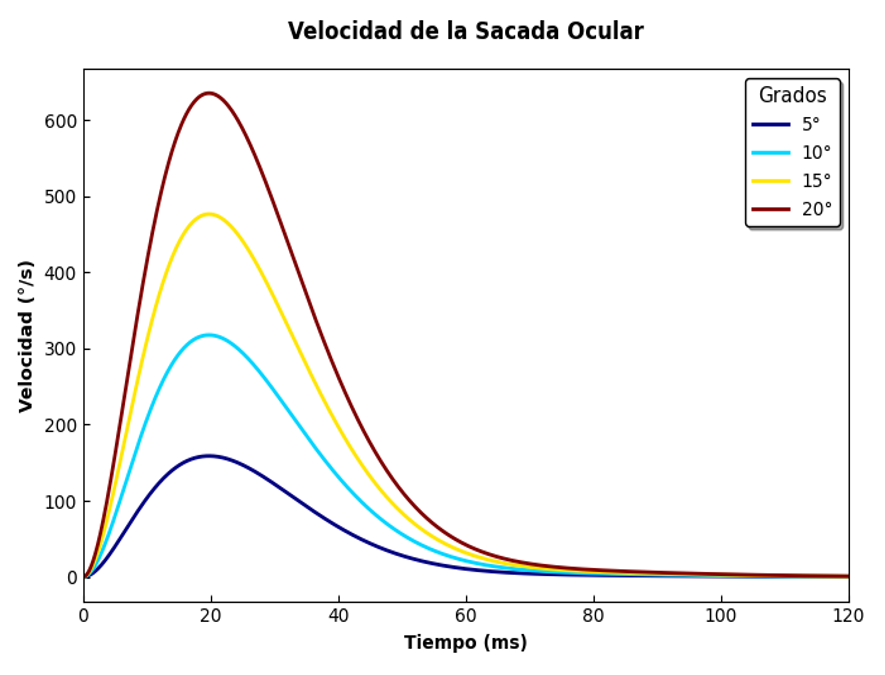
En este trabajo se ha desarrollado un método matemático para describir la dinámica del movimiento sacádico del globo ocular; este es un proceso biomecánico rápido que resulta de la interacción entre propiedades pasivas del ojo y la activación de los músculos extraoculares. Aquí, la metodología utilizada se basa en el formalismo de Lagrange, donde se ha considerado el globo ocular como un cuerpo rígido esférico con una única coordenada generalizada asociada a su rotación angular horizontal. El sistema se acopla a una representación viscoelástica lineal pasiva simplificada para capturar los efectos elásticos y disipativos de los músculos rectos. El sistema resultante se expresa como una ecuación diferencial lineal de segundo orden, cuya solución analítica se obtiene mediante el programa Python. Los resultados obtenidos muestran perfiles dinámicos de posición, velocidad y aceleración angular consistentes con el comportamiento cualitativamente reportados en la literatura. Por otra parte, la relación entre la velocidad máxima y la amplitud muestra una buena concordancia para sacadas de 15° a 20°, sin embargo, las diferencias observadas para amplitudes de 5° a 10° sugieren que la formulación actual puede mejorase mediante el ajuste de parámetros no lineales.
Descargas
Referencias
[1] L. A. Remington, Clinical Anatomy and Physiology of the Visual System, 3rd Ed. Reino Unido: Elsevier/Butterworth-Heinemann, 2012. https://books.google.com.mx/books?id=vyGnpwAACAAJ DOI: https://doi.org/10.1016/B978-1-4377-1926-0.10001-3
[2] R. J. Leigh and D. S. Zee, The Neurology of Eye Movements, 5th Ed. Oxford, UK: Oxford Univ. Press, 2015. https://books.google.com.mx/books?id=v2s0BwAAQBAJ DOI: https://doi.org/10.1093/med/9780199969289.001.0001
[3] J. M. Miller, "The mechanics of orbital connective tissue," Dev. Ophthalmol., Vol. 40, pp. 11–26, 2007. https://doi.org/10.1159/000100353 DOI: https://doi.org/10.1159/000100353
[4] H. Goldstein, C. P. Poole, and J. L. Safko, Classical Mechanics, 3rd Ed. United States: Pearson Education, 2002. DOI: https://doi.org/10.1119/1.1484149
[5] A. V. Hill, “The heat of shortening and the dynamic constants of muscle,” Proceedings of the Royal Society of London. Series B, Biological Sciences, Vol. 126, no. 843, pp. 136–195, 1938. https://doi.org/10.1098/rspb.1938.0050 DOI: https://doi.org/10.1098/rspb.1938.0050
[6] F. E. Zajac, "Muscle and tendon: properties, models, scaling, and application to biomechanics and motor control," Crit. Rev. Biomed. Eng., Vol. 17, no. 4, pp. 359–411, 1989. https://hal.science/hal-04849267v1
[7] A. T. Bahill, “Development, validation, and sensitivity analyses of human eye movement models,” CRC Critical Reviews in Bioengineering, Vol. 4, no. 4, pp. 271–355, 1980. http://sysengr.engr.arizona.edu/publishedPapers/CRCpress.pdf
[8] C. A. Scudder, C. S. Kaneko, and A. F. Fuchs, "The brainstem system for generating saccadic eye movements,” Exp. Brain Res., Vol. 142, no. 4, pp. 439–462, Feb. 2002. https://doi.org/10.1007/s00221-001-0912-9. DOI: https://doi.org/10.1007/s00221-001-0912-9
[9] D. L. Sparks, “The brainstem control of saccadic eye movements,” Nature Reviews Neuroscience, Vol. 3, no. 12, pp. 952-964, 2002. https://doi.org/10.1038/nrn986 DOI: https://doi.org/10.1038/nrn986
[10] D. L. Sparks, Ellen J. Barton, “Neural control of saccadic eye movements,” Current Opinion in Neurobiology, Vol. 3, pp. 966-972, 1993. https://doi.org/10.1016/0959-4388(93)90169-Y DOI: https://doi.org/10.1016/0959-4388(93)90169-Y
[11] G. Westheimer, “Mechanism of saccadic eye movements,” AMA Archives of Ophthalmology, Vol. 52, no. 5, pp. 710–724, 1954. https://doi.org/10.1001/archopht.1954.00920050716006 DOI: https://doi.org/10.1001/archopht.1954.00920050716006
[12] D. A. Robinson, “The mechanics of human saccadic eye movement,” The Journal of Physiology, Vol. 174, no. 2, pp. 245–264, 1964. https://doi.org/10.1113/jphysiol.1964.sp007485 DOI: https://doi.org/10.1113/jphysiol.1964.sp007485
[13] M. R. Clark and L. Stark, “Control of human eye movements: I. Modelling of extraocular muscle,” Mathematical Biosciences, Vol. 20, no. 3–4, pp. 191–211, 1974. https://doi.org/10.1016/0025-5564(74)90001-7 DOI: https://doi.org/10.1016/0025-5564(74)90001-7
[14] A. Bahill, M. R. Clark, and L. Stark, “The main sequence, a tool for studying human eye movements,” Mathematical Biosciences, Vol. 24, no. 3–4, pp. 191–204, 1975. https://doi.org/10.1016/0025-5564(75)90075-9 DOI: https://doi.org/10.1016/0025-5564(75)90075-9
[15] J. L. Demer, et al., “Evidence for fibromuscular pulleys of the recti extraocular muscles,” Investigative Ophthalmology & Visual Science, Vol. 41, no. 6, pp. 1280-1290, 2000. https://pubmed.ncbi.nlm.nih.gov/7730022/
[16] T. Haslwanter, “Mechanics of eye movements: Implications of the ‘orbital revolution,” Annals of the New York Academy of Sciences, Vol. 956, no. 1, pp. 33–41, 2002. https://doi.org/10.1111/j.1749-6632.2002.tb02806.x DOI: https://doi.org/10.1111/j.1749-6632.2002.tb02806.x
[17] C. Quaia and L. M. Optican, “Dynamic eye plant models and the control of eye movements,” Strabismus, Vol. 11, no. 1, pp. 17–31, 2003. https://doi.org/10.1076/stra.11.1.17.14088 DOI: https://doi.org/10.1076/stra.11.1.17.14088
[18] J. Prieto, et al., “OpenEyeSim: A biomechanical model for simulation of closed-loop visual perception,” Journal of Vision, Vol. 16, no. 1, pp. 1-18, 2016. https://doi.org/10.1167/16.15.25 DOI: https://doi.org/10.1167/16.15.25
[19] O. V. Komogortsev, C. Holland, S. Jayarathna, and A. Karpov, “2D linear oculomotor plant mathematical model: Verification and biometric applications,” ACM Transactions on Applied Perception, Vol. 10, no. 4, pp. 1–18, 2013. https://doi.org/10.1145/2536764.2536774 DOI: https://doi.org/10.1145/2536764.2536774
[20] A. D. Polpitiya, W. P. Dayawansa, C. F. Martin and B. K. Ghosh, "Geometry and Control of Human Eye Movements," in IEEE Transactions on Automatic Control, vol. 52, no. 2, pp. 170-180, 2007, https://doi.org/10.1109/TAC.2006.887902 DOI: https://doi.org/10.1109/TAC.2006.887902
[21] T. T. Ivancevic, B. Jovanovic, S. Djukic, M. Djukic, and S. Markovic, “Complex Sports Biodynamics With Practical Applications in Tennis”. ABC, vol. 2, pp. 1-319, 2009. https://doi.org/10.1007/978-3-540-89971-6 DOI: https://doi.org/10.1007/978-3-540-89971-6
[22] D. Purves, G. J. Augustine, D. Fitzpatrick, et al., Neuroscience, 2nd Ed. Sunderland (MA): Sinauer Associates, 2001. https://www.ncbi.nlm.nih.gov/books/NBK10991/
[23] M. Latarjet and A. R. Liard, Anatomía humana, 5th Ed. Ciudad Autónoma de Buenos Aires: Médica Panamericana, 2019. https://books.google.co.ve/books?id=Gn64RKVTw0cC&printsec=frontcover&hl=es#v=onepage&q&f=false
[24] P. A. Sylvestre and K. E. Cullen, “Quantitative analysis of abducens neuron discharge dynamics during saccadic and slow eye movements,” Journal of Neurophysiology, Vol. 82, no. 5, pp. 2612-2632, 1999. https://doi.org/10.1152/jn.1999.82.5.2612 DOI: https://doi.org/10.1152/jn.1999.82.5.2612
[25] K. Ogata, Modern Control Engineering, 5th Ed. Upper Saddle River, NJ, USA: Prentice Hall, 2010.
[26] R. A. Clark and J. L. Demer, “The Effect of Axial Length on Extraocular Muscle Leverage”, American Journal of Ophthalmology, https://doi.org/10.1016/j.ajo.2020.03.033 DOI: https://doi.org/10.1016/j.ajo.2020.03.033
[27] D. G. Z. and M. R. Cullen, Differential Equations with Boundary-Value Problems, 7th Ed. Singapore, the United Kingdom, Australia, Mexico, Brazil, and Japan, Canada: Cengage Learning ,2009.
[28] M. F. Land, S. M. Furneaux and I. D. Gilchrist, ‘The Organization of Visually Mediated Actions in a Subject without Eye Movements’, Neurocase, Vol. 8, pp. 80–87, 2002. https://doi.org/10.1093/neucas/8.1.80. DOI: https://doi.org/10.1076/neur.8.1.80.16239
[29] R. H. S. Carpenter, Movements of the Eyes, 2nd Ed. London: Pion, 1988.
[30] Python Software Foundation, (2022). Python (V2, 3.11.1). https://www.python.org/doc/
[31] J. VanderPlas, Python Data Science Handbook: Essential tools for working with data, 1rd Ed. 1005 Gravenstein Highway North, Sebastopol, CA 95472: O'Reilly Media, Inc., (2016). Python Data Science Handbook: Essential Tools for Working with Data - Jake VanderPlas - Google Libros
[32] C. R. Harris et al., "Array programming with NumPy," Nature, Vol. 585, no. 7825, pp. 357–362, 2020. https://doi.org/10.1038/s41586-020-2649-2 DOI: https://doi.org/10.1038/s41586-020-2649-2
[33] P. Virtanen et al., "SciPy 1.0: fundamental algorithms for scientific computing in Python," Nature Methods, Vol. 17, no. 3, pp. 261–272, 2020. https://doi.org/10.1038/s41592-019-0686-2 DOI: https://doi.org/10.1038/s41592-019-0686-2
[34] L. Gila, A. Villanueva, R. Cabeza, “Fisiopatología y técnicas de registro de los movimientos oculares,” Anales Sis San Navarra, Vol. 32, pp. 9-26, 2009. https://doi.org/10.4321/S1137-66272009000600002 DOI: https://doi.org/10.4321/S1137-66272009000600002
[35] A. T. Bahill, A. Brockenbrough , B. T. Troost, “Variability and development of a normative data base for saccadic eye movements”, Invest Ophthalmol Vis Sci., 1981, pp 116-25. https://www.researchgate.net/publication/15948395_Variability_and_development_of_a_normative_data_base_for_saccadic_eye_movements
Publicado
Declaración de disponibilidad de datos
Los datos no se han publicado
Número
Sección
Categorías
Licencia
Derechos de autor 2026 David Espinosa Gómez, Eligio Cruz Albaro, Gonzalo Viramontes Gamboa, Cristopher Duarte Carranza

Esta obra está bajo una licencia internacional Creative Commons Atribución 4.0.
Los autores/as que publiquen en esta revista aceptan las siguientes condiciones:
- Los autores/as conservan los derechos de autor y ceden a la revista el derecho de la primera publicación, con el trabajo registrado con la licencia de atribución de Creative Commons 4.0, que permite a terceros utilizar lo publicado siempre que mencionen la autoría del trabajo y a la primera publicación en esta revista.
- Los autores/as pueden realizar otros acuerdos contractuales independientes y adicionales para la distribución no exclusiva de la versión del artículo publicado en esta revista (p. ej., incluirlo en un repositorio institucional o publicarlo en un libro) siempre que indiquen claramente que el trabajo se publicó por primera vez en esta revista.
- Se permite y recomienda a los autores/as a compartir su trabajo en línea (por ejemplo: en repositorios institucionales o páginas web personales) antes y durante el proceso de envío del manuscrito, ya que puede conducir a intercambios productivos, a una mayor y más rápida citación del trabajo publicado (vea The Effect of Open Access).
Cómo citar