Caracterización, diseño y recuperación potencial de recursos residuales mediante un modelo integrado 5S: estudio de caso en una facultad de ciencias de la salud
DOI:
https://doi.org/10.37636/recit.v9n4e507Palabras clave:
Sostenibilidad en el campus, Gestión integral de residuos, Metodología 5S, Residuos biológico-infecciosos, Economía circular, Educación superiorResumen
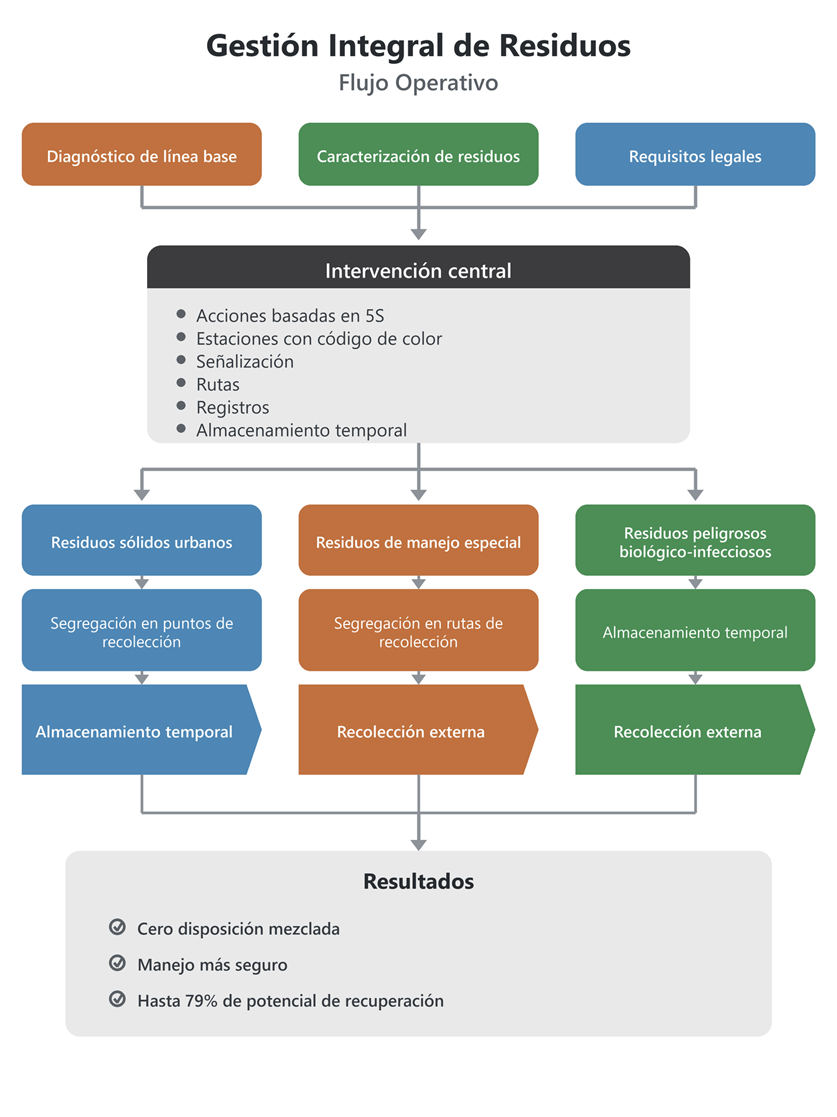
Este estudio de caso reporta el desarrollo y la evaluación de un modelo integrado de gestión de residuos basado en la metodología 5S para una facultad de ciencias de la salud de una universidad pública del centro de México, donde coexisten flujos de residuos sólidos urbanos, de manejo especial y peligrosos biológico-infecciosos. La investigación siguió un diseño de caso único que comprendió diagnóstico de línea base, caracterización técnica de los residuos, diseño de un modelo operativo estructurado en torno a las cinco etapas 5S (Seiri, Seiton, Seiso, Seiketsu, Shitsuke), implementación piloto y evaluación. El diagnóstico estimó una generación aproximada de 2,200 kg de residuos al mes en condiciones de disposición mezclada y recuperación efectiva nula, mientras que la caracterización mostró que hasta el 79% del flujo tenía potencial de recuperación si se aplicaba una segregación adecuada. El modelo tradujo cada etapa 5S en acciones concretas de gestión de residuos, incluidas estaciones con código de color, rutas internas, criterios de almacenamiento temporal, señalización de peligro basada en el Sistema Globalmente Armonizado, contenedores diferenciados para residuos biológico-infecciosos y registros básicos. La evaluación se centró en el orden operativo, la efectividad de la segregación, la seguridad y la alineación regulatoria con las normas mexicanas (NOM-161-SEMARNAT-2011 y NOM-087-SEMARNAT-SSA1-2002). La intervención produjo una arquitectura operativa coherente que convierte el potencial de recuperación identificado en práctica rutinaria, al tiempo que redujo los riesgos de exposición y mejoró el cumplimiento normativo. La principal contribución es un marco replicable y de bajo costo a escala de facultad que conecta los objetivos de sostenibilidad del campus con las operaciones diarias, particularmente en entornos académicos del área de la salud de instituciones públicas con recursos limitados en América Latina.
Descargas
Referencias
[1] M. C. Oliveira and J. Proença, "Sustainable Campus Operations in Higher Education Institutions: A Systematic Literature Review," Sustainability, vol. 17, no. 2, art. 607, 2025. DOI: https://doi.org/10.3390/su17020607
[2] W. Leal Filho et al., “Sustainable Development Goals and sustainability teaching at universities: Falling behind or getting ahead of the pack?,” Journal of Cleaner Production, vol. 232, pp. 285–294, 2019. https://doi.org/10.1016/j.jclepro.2019.05.309 DOI: https://doi.org/10.1016/j.jclepro.2019.05.309
[3] E. Nolasco, P. H. Vieira Durães, J. Pereira Gonçalves, M. C. de Oliveira, L. Monteiro de Abreu, and A. Nascimento de Almeida, "Characterization of solid wastes as a tool to implement waste management strategies in a university campus," International Journal of Sustainability in Higher Education, vol. 22, no. 2, pp. 217–236, 2021. DOI: https://doi.org/10.1108/IJSHE-12-2019-0358
[4] M. Hindiyeh, M. Jaradat, A. Albatayneh, B. Alabdellat, Y. Al-Mitwali, and B. Hammad, "Sustainable Green University: Waste Auditing, German Jordanian University as a Case Study," Frontiers in Built Environment, vol. 8, art. 884656, 2022. DOI: https://doi.org/10.3389/fbuil.2022.884656
[5] S. Dahlawi and M. F. El Sharkawy, "Assessment of solid waste management practice in the university campus," International Journal of Sustainability in Higher Education, vol. 22, no. 3, pp. 561–575, 2021. DOI: https://doi.org/10.1108/IJSHE-05-2020-0183
[6] A. Jakimiuk, Y. Matsui, A. Podlasek, E. Koda, V. S. N. S. Goli, and S. Voběrková, "Closing the loop: A case study on pathways for promoting sustainable waste management on university campuses," Science of the Total Environment, vol. 892, art. 164349, 2023. DOI: https://doi.org/10.1016/j.scitotenv.2023.164349
[7] A. Gallardo, N. Edo-Alcón, M. Carlos, and M. Renau, “The determination of waste generation and composition as an essential tool to improve the waste management plan of a university,” Waste Management, vol. 53, pp. 3–11, 2016. https://doi.org/10.1016/j.wasman.2016.04.013 DOI: https://doi.org/10.1016/j.wasman.2016.04.013
[8] Cámara de Diputados del H. Congreso de la Unión, Ley General para la Prevención y Gestión Integral de los Residuos (Última Reforma DOF 18-01-2021). México: Diario Oficial de la Federación, 2021.
[9] SEMARNAT, Norma Oficial Mexicana NOM-161-SEMARNAT-2011, que establece los criterios para clasificar a los residuos de manejo especial y determinar cuáles están sujetos a plan de manejo. México: Diario Oficial de la Federación, 1 de febrero de 2013.
[10] SSA, Norma Oficial Mexicana NOM-087-SEMARNAT-SSA1-2002, Protección ambiental — Salud ambiental — Residuos peligrosos biológico-infecciosos — Clasificación y especificaciones de manejo. México: Diario Oficial de la Federación, 17 de febrero de 2003.
[11] P. Ghisellini, C. Cialani, and S. Ulgiati, “A review on circular economy: The expected transition to a balanced interplay of environmental and economic systems,” Journal of Cleaner Production, vol. 114, pp. 11–32, 2016. https://doi.org/10.1016/j.jclepro.2015.09.007 DOI: https://doi.org/10.1016/j.jclepro.2015.09.007
[12] L. Salguero-Puerta, J. C. Leyva-Díaz, F. J. Cortés-García, and V. Molina-Moreno, "Sustainability Indicators Concerning Waste Management for Implementation of the Circular Economy Model on the University of Lomé (Togo) Campus," International Journal of Environmental Research and Public Health, vol. 16, no. 12, art. 2234, 2019. DOI: https://doi.org/10.3390/ijerph16122234
[13] International Organization for Standardization, ISO 14001:2015 Environmental management systems — Requirements with guidance for use. Geneva, Switzerland: ISO, 2015.
[14] H. Hirano, 5 Pillars of the Visual Workplace: The Sourcebook for 5S Implementation. Portland, OR, EE. UU.: Productivity Press, 1995.
[15] T. Osada, The 5S’s: Five Keys to a Total Quality Environment. Tokyo, Japón: Asian Productivity Organization, 1991.
[16] M. Jiménez, L. Romero, M. Domínguez, and M. del M. Espinosa, "5S methodology implementation in the laboratories of an industrial engineering university school," Safety Science, vol. 78, pp. 163–172, 2015. https://doi.org/10.1016/j.ssci.2015.04.022 DOI: https://doi.org/10.1016/j.ssci.2015.04.022
[17] M. de L. F. Oliveira et al., "5S System in a university clinical laboratory as an important tool for quality assurance in work and learning-teaching environments," Brazilian Journal of Health Review, vol. 8, no. 6, art. e84735, 2025. https://doi.org/10.34119/bjhrv8n6-374 DOI: https://doi.org/10.34119/bjhrv8n6-374
[18] S. Kanamori, A. Shibanuma, and M. Jimba, "Applicability of the 5S management method for quality improvement in health-care facilities: a review," Tropical Medicine and Health, vol. 44, art. 21, 2016. https://doi.org/10.1186/s41182-016-0022-9 DOI: https://doi.org/10.1186/s41182-016-0022-9
[19] H. Ishijima, N. Miyamoto, F. Masaule, and R. John, "Improvements to healthcare waste management at regional referral hospitals in Tanzania using the KAIZEN approach," The TQM Journal, vol. 34, no. 5, pp. 939–956, 2022. https://doi.org/10.1108/TQM-10-2020-0254 DOI: https://doi.org/10.1108/TQM-10-2020-0254
[20] S. Hammami, F. Hmida, H. Gharbi, A. Ben Salah, and C. Hamouda, "Implementation of the 5S-KAIZEN-TQM approach in a public hospital in Tunisia," Tunisie Médicale, vol. 100, no. 7, pp. 503–513, 2022.
[21] H. Ishijima, K. Nishikido, M. Teshima, S. Nishikawa, and E. A. Gawad, "Introducing the ‘5S-KAIZEN-TQM’ approach into public hospitals in Egypt," International Journal of Health Care Quality Assurance, vol. 33, no. 1, pp. 89–109, 2019.
https://doi.org/10.1108/IJHCQA-06-2018-0143 DOI: https://doi.org/10.1108/IJHCQA-06-2018-0143
[22] E. Çetin, A. Hussein, and S. Güneş-Durak, "Advancing Sustainable Medical Waste Management: A Case Study on Waste Generation and Classification in a University Hospital Microbiology Laboratory," Sustainability, vol. 17, no. 10, art. 4325, 2025. DOI: https://doi.org/10.3390/su17104325
[23] D. A. Salas, P. Criollo, and A. D. Ramirez, "The role of higher education institutions in the implementation of circular economy in Latin America," Sustainability, vol. 13, no. 17, art. 9805, 2021. https://doi.org/10.3390/su13179805 DOI: https://doi.org/10.3390/su13179805
[24] R. K. Yin, Case Study Research and Applications: Design and Methods, 6th ed. Thousand Oaks, CA, EE. UU.: SAGE, 2018.
[25] A. Prüss-Üstün, E. Giroult, and P. Rushbrook, Safe Management of Wastes from Health-Care Activities, 2nd ed. Geneva, Switzerland: World Health Organization, 2013.
[26] W. E. Deming, Out of the Crisis. Cambridge, MA, EE. UU.: MIT Center for Advanced Engineering Study, 1986.
[27] Secretaría del Trabajo y Previsión Social, Norma Oficial Mexicana NOM-018-STPS-2015, Sistema Armonizado para la Identificación y Comunicación de Peligros y Riesgos por Sustancias Químicas Peligrosas en los Centros de Trabajo. Ciudad de México, México: Diario Oficial de la Federación, 2015.
[28] Secretaría de Medio Ambiente y Recursos Naturales, Norma Oficial Mexicana NOM-052-SEMARNAT-2005, Que Establece las Características, el Procedimiento de Identificación, Clasificación y los Listados de los Residuos Peligrosos. Ciudad de México, México: Diario Oficial de la Federación, 2005.
[29] Cámara de Diputados del H. Congreso de la Unión, Ley General del Equilibrio Ecológico y la Protección al Ambiente. Ciudad de México, México: Diario Oficial de la Federación, 1988 (última reforma).
[30] J. P. Womack and D. T. Jones, Lean Thinking: Banish Waste and Create Wealth in Your Corporation, 2nd ed. New York, NY, EE. UU.: Free Press, 2003.
Publicado
Número
Sección
Categorías
Licencia
Derechos de autor 2026 Iván Avila-Raya, Martha Angélica Lemus-Solorio, Luis Enrique Rosas-Avalos, José Luis Rivera-Rojas, Luis Jesús Villarreal-Gómez, María Esther Carcamo-Escalera, Alfonso Lemus-Solorio

Esta obra está bajo una licencia internacional Creative Commons Atribución 4.0.
Los autores/as que publiquen en esta revista aceptan las siguientes condiciones:
- Los autores/as conservan los derechos de autor y ceden a la revista el derecho de la primera publicación, con el trabajo registrado con la licencia de atribución de Creative Commons 4.0, que permite a terceros utilizar lo publicado siempre que mencionen la autoría del trabajo y a la primera publicación en esta revista.
- Los autores/as pueden realizar otros acuerdos contractuales independientes y adicionales para la distribución no exclusiva de la versión del artículo publicado en esta revista (p. ej., incluirlo en un repositorio institucional o publicarlo en un libro) siempre que indiquen claramente que el trabajo se publicó por primera vez en esta revista.
- Se permite y recomienda a los autores/as a compartir su trabajo en línea (por ejemplo: en repositorios institucionales o páginas web personales) antes y durante el proceso de envío del manuscrito, ya que puede conducir a intercambios productivos, a una mayor y más rápida citación del trabajo publicado (vea The Effect of Open Access).
Cómo citar