Analysis and Improvement of the extrusion area in the weaving process of a textile company
DOI:
https://doi.org/10.37636/recit.v9n3e506Keywords:
Disponibilidad, Mantenimiento, Unidades de bobinado, Extrusión, Hilo de polipropileno, Industria textilAbstract
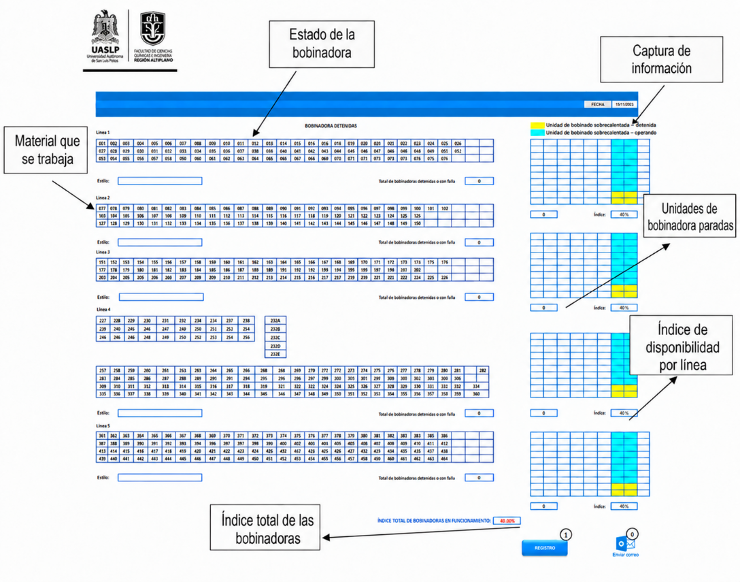
La baja disponibilidad de las unidades de bobinado puede afectar la continuidad de la producción y dificultar la toma de decisiones de mantenimiento en procesos textiles. En la empresa estudiada, ubicada en Matehuala, San Luis Potosí, el seguimiento de estos equipos dependía principalmente de registros manuales y referencias asociadas con su ubicación física, lo que limitaba la trazabilidad, el análisis histórico de fallas y la priorización de intervenciones. El objetivo de este estudio fue desarrollar e implementar un método estructurado y de bajo costo para fortalecer la gestión del mantenimiento de las unidades de bobinado del área de extrusión. La investigación se desarrolló como un estudio de caso de tipo aplicado, con enfoque cuantitativo y alcance descriptivo. El método integró diagnóstico del proceso de mantenimiento, observación directa, estudio de tiempos, análisis causa-raíz, inspecciones termográficas, identificación individual de las unidades de bobinado, clasificación de fallas, priorización de equipos críticos, captura digital de información y evaluación mediante indicadores de disponibilidad. La gestión de los registros y el cálculo de indicadores se automatizaron mediante una herramienta desarrollada en Microsoft Excel® con Visual Basic for Applications. El análisis TOP 10 identificó 40 posiciones críticas y 579 recurrencias de inactividad. Después de la implementación, la disponibilidad general de las líneas evaluadas fue de 93.7 %, superior a la meta corporativa de 86.0 %. Los resultados muestran que la integración estructurada de identificación, priorización, trazabilidad y análisis automatizado de indicadores constituye una alternativa práctica y de bajo costo para apoyar la gestión del mantenimiento en condiciones industriales reales.
Downloads
References
[1] C. E. David, R. Uche, O. Nwufo, D. A. Ekpechi, and C. C. Kingsley, “Integrating machine availability and preventive maintenance to improve productive efficiency in a manufacturing industry,” Asian Journal of Current Research, vol. 9, no. 2, pp. 91–109, 2024, doi: 10.56557/ajocr/2024/v9i28610. DOI: https://doi.org/10.56557/ajocr/2024/v9i28610
[2] J. M. Wakiru, L. Pintelon, P. Muchiri, and P. Chemweno, “Integrated maintenance policies for performance improvement of a multi-unit repairable, one product manufacturing system,” Production Planning & Control, vol. 32, no. 5, pp. 347–367, 2021, doi: 10.1080/09537287.2020.1736684. DOI: https://doi.org/10.1080/09537287.2020.1736684
[3] E. Tovar Porras, “Tipos de mantenimiento industrial,” monografía de pregrado, Universidad Nacional de Educación Enrique Guzmán y Valle, Lima, Perú, 2021. [Online]. Available: https://repositorio.une.edu.pe/items/96312717-9e73-4acf-a695-006062a06de3. [Accessed: Dic. 15, 2025].
[4] M. Holgado, M. Macchi, and S. Evans, “Exploring the impacts and contributions of maintenance function for sustainable manufacturing,” International Journal of Production Research, vol. 58, no. 23, pp. 7292–7310, 2020, doi: 10.1080/00207543.2020.1808257. DOI: https://doi.org/10.1080/00207543.2020.1808257
[5] F. Rodriguez and L. Gomez Bravo, Indicadores de calidad y productividad de la empresa. Caracas, Venezuela: CAF, 1991. [Online]. Available: https://scioteca.caf.com/handle/123456789/863. [Accessed: Dic. 15, 2025].
[6] J. T. Selvik and E. P. Ford, “Down time terms and information used for assessment of equipment reliability and maintenance performance,” in System Reliability, C. Volosencu, Ed. IntechOpen, 2017, doi: 10.5772/intechopen.71503. DOI: https://doi.org/10.5772/intechopen.71503
[7] M. Hodkiewicz and M. T.-W. Ho, “Cleaning historical maintenance work order data for reliability analysis,” Journal of Quality in Maintenance Engineering, vol. 22, no. 2, pp. 146–163, 2016, doi: 10.1108/JQME-04-2015-0013. DOI: https://doi.org/10.1108/JQME-04-2015-0013
[8] ISO 14224:2016, Petroleum, Petrochemical and Natural Gas Industries—Collection and Exchange of Reliability and Maintenance Data for Equipment, 3rd ed. Geneva, Switzerland: International Organization for Standardization, 2016. [Online]. Available: https://www.iso.org/standard/64076.html. [Accessed: Jun. 25, 2026].
[9] G. Alemayehu, M. Avvari, B. Alemu, and A. M. Gebrekidan, “Performance evaluation of Faffa Food Share Company through computerized maintenance management system (CMMS),” Journal of Engineering, vol. 2023, Art. no. 4856457, 2023, doi: 10.1155/2023/4856457. DOI: https://doi.org/10.1155/2023/4856457
[10] A. Labib, “World-class maintenance using a computerised maintenance management system,” Journal of Quality in Maintenance Engineering, vol. 4, no. 1, pp. 66–75, 1998, doi: 10.1108/13552519810207470. DOI: https://doi.org/10.1108/13552519810207470
[11] Microsoft, “Automatizar tareas con la grabadora de macros,” Microsoft Support. [Online]. Available: https://support.microsoft.com/es-es/excel/automate-tasks-with-the-macro-recorder. [Accessed: Oct. 15, 2025].
[12] Y.-J. Lu, W.-C. Lee, and C.-H. Wang, “Using data mining technology to explore causes of inaccurate reliability data and suggestions for maintenance management,” Journal of Loss Prevention in the Process Industries, vol. 83, Art. no. 105063, Jul. 2023, doi: 10.1016/j.jlp.2023.105063. DOI: https://doi.org/10.1016/j.jlp.2023.105063
[13] A. Salonen, M. Bengtsson, and V. Fridholm, “The possibilities of improving maintenance through CMMS data analysis,” in SPS2020: Proceedings of the Swedish Production Symposium, October 7–8, 2020, K. Säfsten and F. Elgh, Eds., Advances in Transdisciplinary Engineering, vol. 13, pp. 249–260, 2020, doi: 10.3233/ATDE200163. DOI: https://doi.org/10.3233/ATDE200163
[14] S. Lukens, M. Naik, K. Saetia, and X. Hu, “Best practices framework for improving maintenance data quality to enable asset performance analytics,” Annual Conference of the PHM Society, vol. 11, no. 1, 2019, doi: 10.36001/phmconf.2019.v11i1.836. DOI: https://doi.org/10.36001/phmconf.2019.v11i1.836
[15] C. Rauwendaal, Polymer Extrusion, 5th ed. Munich, Germany: Carl Hanser Verlag, 2014, doi: 10.3139/9781569905395. DOI: https://doi.org/10.1007/978-1-56990-539-5
[16] S. Hube, M. Behr, S. Elgeti, M. Schön, J. Sasse, and C. Hopmann, “Numerical design of distributive mixing elements,” Finite Elements in Analysis and Design, vol. 204, Art. no. 103733, 2022, doi: 10.1016/j.finel.2022.103733. DOI: https://doi.org/10.1016/j.finel.2022.103733
[17] I. El Hassani, C. El Mazgualdi, and T. Masrour, “Artificial intelligence and machine learning to predict and improve efficiency in manufacturing industry,” arXiv preprint arXiv:1901.02256, 2019. [Online]. Available: https://arxiv.org/abs/1901.02256. [Accessed: Sep. 10, 2025].
[18] T. Zonta, C. A. da Costa, R. da R. Righi, M. J. de Lima, E. S. da Trindade, and G. P. Li, “Predictive maintenance in the Industry 4.0: A systematic literature review,” Computers & Industrial Engineering, vol. 150, Art. no. 106889, 2020, doi: 10.1016/j.cie.2020.106889. DOI: https://doi.org/10.1016/j.cie.2020.106889
[19] L. Silvestri, A. Forcina, V. Introna, A. Santolamazza, and V. Cesarotti, “Maintenance transformation through Industry 4.0 technologies: A systematic literature review,” Computers in Industry, vol. 123, Art. no. 103335, 2020, doi: 10.1016/j.compind.2020.103335. DOI: https://doi.org/10.1016/j.compind.2020.103335
[20] J. Bokrantz, A. Skoogh, C. Berlin, T. Wuest, and J. Stahre, “Smart Maintenance: A research agenda for industrial maintenance management,” International Journal of Production Economics, vol. 224, Art. no. 107547, 2020, doi: 10.1016/j.ijpe.2019.107547. DOI: https://doi.org/10.1016/j.ijpe.2019.107547
[21] K. Mahlamäki and M. Nieminen, “Analysis of manual data collection in maintenance context,” Journal of Quality in Maintenance Engineering, vol. 26, no. 1, pp. 104–119, 2020, doi: 10.1108/JQME-12-2017-0091 DOI: https://doi.org/10.1108/JQME-12-2017-0091
[22] R. F. da Silva and G. F. M. de Souza, “Modeling a maintenance management framework for asset management based on ISO 55000 series guidelines,” Journal of Quality in Maintenance Engineering, vol. 28, no. 4, pp. 915–937, 2022, doi: 10.1108/JQME-08-2020-0082. DOI: https://doi.org/10.1108/JQME-08-2020-0082
[23] P. Muchiri and L. Pintelon, “Performance measurement using overall equipment effectiveness (OEE): Literature review and practical application discussion,” International Journal of Production Research, vol. 46, no. 13, pp. 3517–3535, 2008, doi: 10.1080/00207540601142645. DOI: https://doi.org/10.1080/00207540601142645
[24] T. Ylipää, A. Skoogh, J. Bokrantz, and M. Gopalakrishnan, “Identification of maintenance improvement potential using OEE assessment,” International Journal of Productivity and Performance Management, vol. 66, no. 1, pp. 126–143, 2017, doi: 10.1108/IJPPM-01-2016-0028. DOI: https://doi.org/10.1108/IJPPM-01-2016-0028
[25] M. M. Schiraldi and M. Varisco, “Overall Equipment Effectiveness: Consistency of ISO standard with literature,” Computers & Industrial Engineering, vol. 145, Art. no. 106518, 2020, doi: 10.1016/j.cie.2020.106518 DOI: https://doi.org/10.1016/j.cie.2020.106518
[26] H. N. Teixeira, I. Lopes, and A. C. Braga, “Condition-based maintenance implementation: A literature review,” Procedia Manufacturing, vol. 51, pp. 228–235, 2020, doi: 10.1016/j.promfg.2020.10.033 DOI: https://doi.org/10.1016/j.promfg.2020.10.033
[27] P. Venegas, E. Ivorra, M. Ortega, and I. Sáez de Ocáriz, “Towards the automation of infrared thermography inspections for industrial maintenance applications,” Sensors, vol. 22, no. 2, Art. no. 613, 2022, doi: 10.3390/s22020613. DOI: https://doi.org/10.3390/s22020613
[28] R. Wang, X. Zhan, H. Bai, E. Dong, Z. Cheng, and X. Jia, “A review of fault diagnosis methods for rotating machinery using infrared thermography,” Micromachines, vol. 13, no. 10, Art. no. 1644, 2022, doi: 10.3390/mi13101644. DOI: https://doi.org/10.3390/mi13101644
[29] R.-I. Chang, C.-Y. Lee, and Y.-H. Hung, “Cloud-based analytics module for predictive maintenance of the textile manufacturing process,” Applied Sciences, vol. 11, no. 21, Art. no. 9945, 2021, doi: 10.3390/app11219945. DOI: https://doi.org/10.3390/app11219945
[30] Y.-H. Hung, “Developing an improved ensemble learning approach for predictive maintenance in the textile manufacturing process,” Sensors, vol. 22, no. 23, Art. no. 9065, 2022, doi: 10.3390/s22239065 DOI: https://doi.org/10.3390/s22239065
[31] I. Errandonea, S. Beltrán, and S. Arrizabalaga, “Digital Twin for maintenance: A literature review,” Computers in Industry, vol. 123, Art. no. 103316, 2020, doi: 10.1016/j.compind.2020.103316. DOI: https://doi.org/10.1016/j.compind.2020.103316
[32] T. P. Carvalho, F. A. A. M. N. Soares, R. Vita, R. da P. Francisco, J. P. Basto, and S. G. S. Alcalá, “A systematic literature review of machine learning methods applied to predictive maintenance,” Computers & Industrial Engineering, vol. 137, Art. no. 106024, 2019, doi: 10.1016/j.cie.2019.106024. DOI: https://doi.org/10.1016/j.cie.2019.106024
[33] M. Pech, J. Vrchota, and J. Bednář, “Predictive maintenance and intelligent sensors in smart factory: Review,” Sensors, vol. 21, no. 4, Art. no. 1470, 2021, doi: 10.3390/s21041470 DOI: https://doi.org/10.3390/s21041470
[34] G. M. Sang, L. Xu, and P. de Vrieze, “A predictive maintenance model for flexible manufacturing in the context of Industry 4.0,” Frontiers in Big Data, vol. 4, Art. no. 663466, 2021, doi: 10.3389/fdata.2021.663466. DOI: https://doi.org/10.3389/fdata.2021.663466
[35] C. Franciosi, A. Voisin, S. Miranda, S. Riemma, and B. Iung, “Measuring maintenance impacts on sustainability of manufacturing industries: From a systematic literature review to a framework proposal,” Journal of Cleaner Production, vol. 260, Art. no. 121065, 2020, doi: 10.1016/j.jclepro.2020.121065. DOI: https://doi.org/10.1016/j.jclepro.2020.121065
Downloads
Published
Data Availability Statement
Not applicable
Issue
Section
Categories
License
Copyright (c) 2026 Yesenia Kiabeth Chairez Saucedo, Pedro Cruz Alcantar

This work is licensed under a Creative Commons Attribution 4.0 International License.
The authors who publish in this journal accept the following conditions:
The authors retain the copyright and assign to the journal the right of the first publication, with the work registered with the Creative Commons Attribution license 4.0, which allows third parties to use what is published as long as they mention the authorship of the work and the first publication in this magazine.
Authors may make other independent and additional contractual agreements for the non-exclusive distribution of the version of the article published in this journal (eg, include it in an institutional repository or publish it in a book) as long as they clearly indicate that the work it was first published in this magazine.
Authors are allowed and encouraged to share their work online (for example: in institutional repositories or personal web pages) before and during the manuscript submission process, as it can lead to productive exchanges, greater and more quick citation of published work (see The Effect of Open Access).
How to Cite