Modeling of the extraocular muscles using the Lagrange method
DOI:
https://doi.org/10.37636/recit.v9n4e477Keywords:
Lagrangian mechanics, Saccadic eye movements, Oculomotor plantAbstract
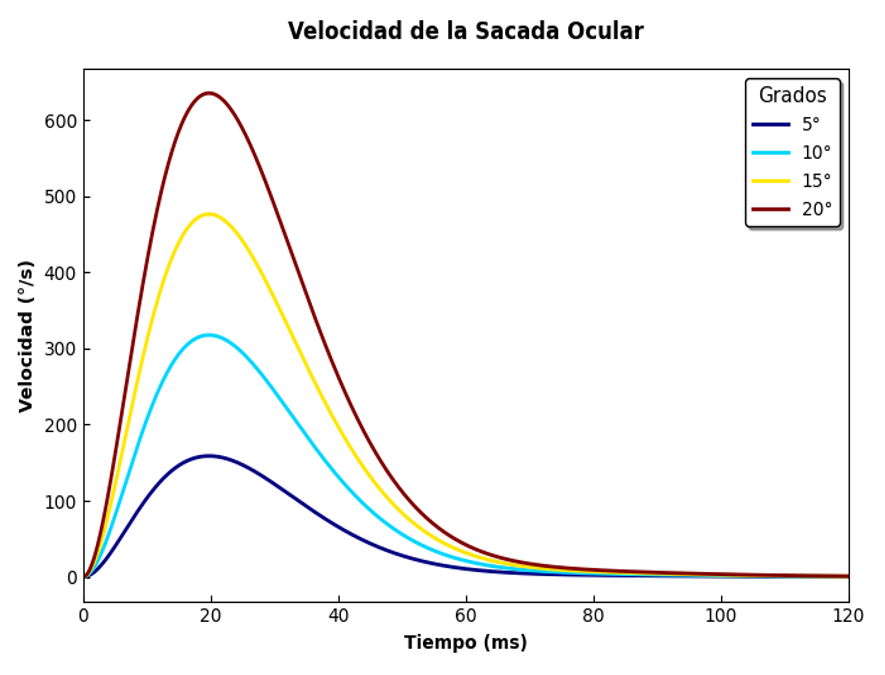
In this work, we developed a mathematical model to describe the dynamics of saccadic eye movements, a rapid biomechanical process resulting from the interaction between the passive mechanical properties of the eyeball and the activation of the extraocular muscles. The proposed methodology is based on the Lagrangian formalism, in which the eyeball is modeled as a rigid spherical body with a single generalized coordinate describing its horizontal angular rotation. The system is modeled using a simplified passive linear viscoelastic model to capture the elastic and dissipative effects of the rectus muscles. The resulting system is expressed as a second-order linear differential equation, whose analytical solution is obtained using a Python program. The predicted angular position, velocity, and acceleration profiles are in good qualitative agreement with the characteristic behavior of saccadic eye movements reported in the literature. Furthermore, the relationship between peak angular velocity and saccade amplitude shows good agreement with experimental observations for amplitudes between 15° and 20°. However, the discrepancies observed for smaller amplitudes, ranging from 5° and 10°, suggest that the current formulation could be improved by incorporating nonlinear effects and performing a more comprehensive calibration of the model parameters.
Downloads
References
[1] L. A. Remington, Clinical Anatomy and Physiology of the Visual System, 3rd Ed. Reino Unido: Elsevier/Butterworth-Heinemann, 2012. https://books.google.com.mx/books?id=vyGnpwAACAAJ DOI: https://doi.org/10.1016/B978-1-4377-1926-0.10001-3
[2] R. J. Leigh and D. S. Zee, The Neurology of Eye Movements, 5th Ed. Oxford, UK: Oxford Univ. Press, 2015. https://books.google.com.mx/books?id=v2s0BwAAQBAJ DOI: https://doi.org/10.1093/med/9780199969289.001.0001
[3] J. M. Miller, "The mechanics of orbital connective tissue," Dev. Ophthalmol., Vol. 40, pp. 11–26, 2007. https://doi.org/10.1159/000100353 DOI: https://doi.org/10.1159/000100353
[4] H. Goldstein, C. P. Poole, and J. L. Safko, Classical Mechanics, 3rd Ed. United States: Pearson Education, 2002. DOI: https://doi.org/10.1119/1.1484149
[5] A. V. Hill, “The heat of shortening and the dynamic constants of muscle,” Proceedings of the Royal Society of London. Series B, Biological Sciences, Vol. 126, no. 843, pp. 136–195, 1938. https://doi.org/10.1098/rspb.1938.0050 DOI: https://doi.org/10.1098/rspb.1938.0050
[6] F. E. Zajac, "Muscle and tendon: properties, models, scaling, and application to biomechanics and motor control," Crit. Rev. Biomed. Eng., Vol. 17, no. 4, pp. 359–411, 1989. https://hal.science/hal-04849267v1
[7] A. T. Bahill, “Development, validation, and sensitivity analyses of human eye movement models,” CRC Critical Reviews in Bioengineering, Vol. 4, no. 4, pp. 271–355, 1980. http://sysengr.engr.arizona.edu/publishedPapers/CRCpress.pdf
[8] C. A. Scudder, C. S. Kaneko, and A. F. Fuchs, "The brainstem system for generating saccadic eye movements,” Exp. Brain Res., Vol. 142, no. 4, pp. 439–462, Feb. 2002. https://doi.org/10.1007/s00221-001-0912-9. DOI: https://doi.org/10.1007/s00221-001-0912-9
[9] D. L. Sparks, “The brainstem control of saccadic eye movements,” Nature Reviews Neuroscience, Vol. 3, no. 12, pp. 952-964, 2002. https://doi.org/10.1038/nrn986 DOI: https://doi.org/10.1038/nrn986
[10] D. L. Sparks, Ellen J. Barton, “Neural control of saccadic eye movements,” Current Opinion in Neurobiology, Vol. 3, pp. 966-972, 1993. https://doi.org/10.1016/0959-4388(93)90169-Y DOI: https://doi.org/10.1016/0959-4388(93)90169-Y
[11] G. Westheimer, “Mechanism of saccadic eye movements,” AMA Archives of Ophthalmology, Vol. 52, no. 5, pp. 710–724, 1954. https://doi.org/10.1001/archopht.1954.00920050716006 DOI: https://doi.org/10.1001/archopht.1954.00920050716006
[12] D. A. Robinson, “The mechanics of human saccadic eye movement,” The Journal of Physiology, Vol. 174, no. 2, pp. 245–264, 1964. https://doi.org/10.1113/jphysiol.1964.sp007485 DOI: https://doi.org/10.1113/jphysiol.1964.sp007485
[13] M. R. Clark and L. Stark, “Control of human eye movements: I. Modelling of extraocular muscle,” Mathematical Biosciences, Vol. 20, no. 3–4, pp. 191–211, 1974. https://doi.org/10.1016/0025-5564(74)90001-7 DOI: https://doi.org/10.1016/0025-5564(74)90001-7
[14] A. Bahill, M. R. Clark, and L. Stark, “The main sequence, a tool for studying human eye movements,” Mathematical Biosciences, Vol. 24, no. 3–4, pp. 191–204, 1975. https://doi.org/10.1016/0025-5564(75)90075-9 DOI: https://doi.org/10.1016/0025-5564(75)90075-9
[15] J. L. Demer, et al., “Evidence for fibromuscular pulleys of the recti extraocular muscles,” Investigative Ophthalmology & Visual Science, Vol. 41, no. 6, pp. 1280-1290, 2000. https://pubmed.ncbi.nlm.nih.gov/7730022/
[16] T. Haslwanter, “Mechanics of eye movements: Implications of the ‘orbital revolution,” Annals of the New York Academy of Sciences, Vol. 956, no. 1, pp. 33–41, 2002. https://doi.org/10.1111/j.1749-6632.2002.tb02806.x DOI: https://doi.org/10.1111/j.1749-6632.2002.tb02806.x
[17] C. Quaia and L. M. Optican, “Dynamic eye plant models and the control of eye movements,” Strabismus, Vol. 11, no. 1, pp. 17–31, 2003. https://doi.org/10.1076/stra.11.1.17.14088 DOI: https://doi.org/10.1076/stra.11.1.17.14088
[18] J. Prieto, et al., “OpenEyeSim: A biomechanical model for simulation of closed-loop visual perception,” Journal of Vision, Vol. 16, no. 1, pp. 1-18, 2016. https://doi.org/10.1167/16.15.25 DOI: https://doi.org/10.1167/16.15.25
[19] O. V. Komogortsev, C. Holland, S. Jayarathna, and A. Karpov, “2D linear oculomotor plant mathematical model: Verification and biometric applications,” ACM Transactions on Applied Perception, Vol. 10, no. 4, pp. 1–18, 2013. https://doi.org/10.1145/2536764.2536774 DOI: https://doi.org/10.1145/2536764.2536774
[20] A. D. Polpitiya, W. P. Dayawansa, C. F. Martin and B. K. Ghosh, "Geometry and Control of Human Eye Movements," in IEEE Transactions on Automatic Control, vol. 52, no. 2, pp. 170-180, 2007, https://doi.org/10.1109/TAC.2006.887902 DOI: https://doi.org/10.1109/TAC.2006.887902
[21] T. T. Ivancevic, B. Jovanovic, S. Djukic, M. Djukic, and S. Markovic, “Complex Sports Biodynamics With Practical Applications in Tennis”. ABC, vol. 2, pp. 1-319, 2009. https://doi.org/10.1007/978-3-540-89971-6 DOI: https://doi.org/10.1007/978-3-540-89971-6
[22] D. Purves, G. J. Augustine, D. Fitzpatrick, et al., Neuroscience, 2nd Ed. Sunderland (MA): Sinauer Associates, 2001. https://www.ncbi.nlm.nih.gov/books/NBK10991/
[23] M. Latarjet and A. R. Liard, Anatomía humana, 5th Ed. Ciudad Autónoma de Buenos Aires: Médica Panamericana, 2019. https://books.google.co.ve/books?id=Gn64RKVTw0cC&printsec=frontcover&hl=es#v=onepage&q&f=false
[24] P. A. Sylvestre and K. E. Cullen, “Quantitative analysis of abducens neuron discharge dynamics during saccadic and slow eye movements,” Journal of Neurophysiology, Vol. 82, no. 5, pp. 2612-2632, 1999. https://doi.org/10.1152/jn.1999.82.5.2612 DOI: https://doi.org/10.1152/jn.1999.82.5.2612
[25] K. Ogata, Modern Control Engineering, 5th Ed. Upper Saddle River, NJ, USA: Prentice Hall, 2010.
[26] R. A. Clark and J. L. Demer, “The Effect of Axial Length on Extraocular Muscle Leverage”, American Journal of Ophthalmology, https://doi.org/10.1016/j.ajo.2020.03.033 DOI: https://doi.org/10.1016/j.ajo.2020.03.033
[27] D. G. Z. and M. R. Cullen, Differential Equations with Boundary-Value Problems, 7th Ed. Singapore, the United Kingdom, Australia, Mexico, Brazil, and Japan, Canada: Cengage Learning ,2009.
[28] M. F. Land, S. M. Furneaux and I. D. Gilchrist, ‘The Organization of Visually Mediated Actions in a Subject without Eye Movements’, Neurocase, Vol. 8, pp. 80–87, 2002. https://doi.org/10.1093/neucas/8.1.80. DOI: https://doi.org/10.1076/neur.8.1.80.16239
[29] R. H. S. Carpenter, Movements of the Eyes, 2nd Ed. London: Pion, 1988.
[30] Python Software Foundation, (2022). Python (V2, 3.11.1). https://www.python.org/doc/
[31] J. VanderPlas, Python Data Science Handbook: Essential tools for working with data, 1rd Ed. 1005 Gravenstein Highway North, Sebastopol, CA 95472: O'Reilly Media, Inc., (2016). Python Data Science Handbook: Essential Tools for Working with Data - Jake VanderPlas - Google Libros
[32] C. R. Harris et al., "Array programming with NumPy," Nature, Vol. 585, no. 7825, pp. 357–362, 2020. https://doi.org/10.1038/s41586-020-2649-2 DOI: https://doi.org/10.1038/s41586-020-2649-2
[33] P. Virtanen et al., "SciPy 1.0: fundamental algorithms for scientific computing in Python," Nature Methods, Vol. 17, no. 3, pp. 261–272, 2020. https://doi.org/10.1038/s41592-019-0686-2 DOI: https://doi.org/10.1038/s41592-019-0686-2
[34] L. Gila, A. Villanueva, R. Cabeza, “Fisiopatología y técnicas de registro de los movimientos oculares,” Anales Sis San Navarra, Vol. 32, pp. 9-26, 2009. https://doi.org/10.4321/S1137-66272009000600002 DOI: https://doi.org/10.4321/S1137-66272009000600002
[35] A. T. Bahill, A. Brockenbrough , B. T. Troost, “Variability and development of a normative data base for saccadic eye movements”, Invest Ophthalmol Vis Sci., 1981, pp 116-25. https://www.researchgate.net/publication/15948395_Variability_and_development_of_a_normative_data_base_for_saccadic_eye_movements
Downloads
Published
Data Availability Statement
The data have not been published.
Issue
Section
Categories
License
Copyright (c) 2026 David Espinosa Gómez, Eligio Cruz Albaro, Gonzalo Viramontes Gamboa, Cristopher Duarte Carranza

This work is licensed under a Creative Commons Attribution 4.0 International License.
The authors who publish in this journal accept the following conditions:
The authors retain the copyright and assign to the journal the right of the first publication, with the work registered with the Creative Commons Attribution license 4.0, which allows third parties to use what is published as long as they mention the authorship of the work and the first publication in this magazine.
Authors may make other independent and additional contractual agreements for the non-exclusive distribution of the version of the article published in this journal (eg, include it in an institutional repository or publish it in a book) as long as they clearly indicate that the work it was first published in this magazine.
Authors are allowed and encouraged to share their work online (for example: in institutional repositories or personal web pages) before and during the manuscript submission process, as it can lead to productive exchanges, greater and more quick citation of published work (see The Effect of Open Access).
How to Cite