Transformación metalúrgica con combustibles residuales: Un caso de eficiencia energética
DOI:
https://doi.org/10.37636/recit.v9n4e475Palabras clave:
Combustibles residuales, Eficiencia energética, Sistemas de transformación, Desperdicio de energía, CFDResumen
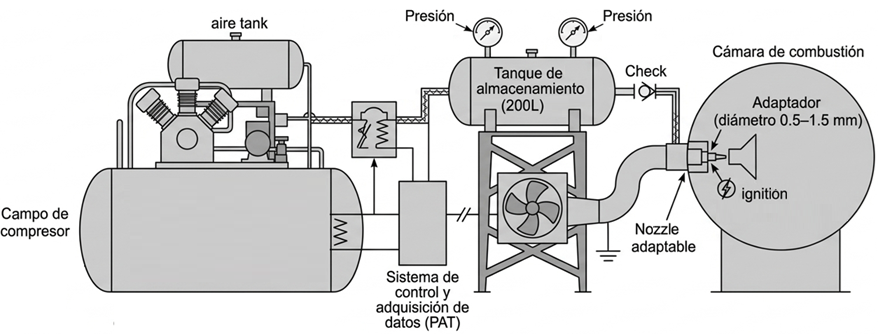
En la industria metalúrgica, el uso de combustibles fósiles genera altos costos operativos y emisiones contaminantes. Paralelamente, residuos líquidos como aceites usados, por su alta viscosidad, suelen ser desechados sin valorización energética. El objetivo de este estudio fue implementar un sistema de combustión para procesos de manufactura que utilice combustibles residuales caracterizados, garantizando eficiencia térmica, reducción de emisiones y viabilidad económica. La metodología incluyó: caracterización fisicoquímica del combustible residual (viscosidad, poder calorífico, composición química), diseño e integración de un sistema de inyección adaptado a combustibles viscosos, simulación CFD del flujo y la combustión, y pruebas piloto en líneas de producción evaluando temperatura, consumo y emisiones. Los resultados mostraron combustión estable del combustible residual, alcanzando temperaturas óptimas (850–1,050 °C) para procesos metalúrgicos no ferrosos. Se logró una reducción del 62–80% en costos energéticos y una disminución significativa de emisiones de CO₂ y partículas. El sistema demostró ser económicamente viable, adaptable y escalable. Se concluye que el aprovechamiento de combustibles residuales es una alternativa que contribuye a la sostenibilidad industrial, reduciendo costos y minimizando impactos ambientales.
Descargas
Referencias
[1] International Energy Agency (IEA), Energy Efficiency and Emissions Reduction in Industrial Thermal Processes. Paris, France: IEA, 2023. [Online]. Available: https://www.iea.org/reports
[2] X. Peng, Y. Jiang, Z. Chen, A. I. Osman, M. Farghali, and D. W. Rooney, “Recycling municipal, agricultural and industrial waste into energy,” Environmental Chemistry Letters, vol. 21, pp. 765-801, 2023, doi: 10.1007/s10311-022-01551-5.
[3] C. Hagelüken and D. Goldmann, “Recycling and circular economy: Towards closed metal loops,” Mineral Economics, vol. 35, pp. 539-562, 2022, doi: 10.1007/s13563-022-00319-1.
[4] K. Vershinina, G. Nyashina, and P. Strizhak, “Combustion, pyrolysis, and gasification of waste-derived fuel slurries,” Applied Sciences, vol. 12, no. 3, Art. no. 1039, 2022, doi: 10.3390/app12031039.
[5] P. Sharma, P. N. Sheth, and B. N. Mohapatra, “Refuse-derived fuel co-processing in industrial kilns,” Waste and Biomass Valorization, vol. 13, pp. 4347-4374, 2022, doi: 10.1007/s12649-022-01840-8.
[6] L. Lombardi and M. J. Castaldi, “Energy recovery from residual municipal solid waste,” Energies, vol. 17, no. 2, Art. no. 395, 2024, doi: 10.3390/en17020395.
[7] Jafar, J. Al-Naffakh, M. R. Al-Qassab, and Z. M. Al-Makhzoomi, “Comparative Analysis of Combustion Properties between Waste Automotive Oil and Light Diesel Oil as Alternative Fuels,” Acta Technica Corviniensis Bulletin of Engineering, vol. XVII, no. 2, pp. 15-22,
2024. [Online]. Available: https://acta.fih.upt.ro/pdf/2024-2/ACTA-2024-2-03.pdf.
[8] D. M. Cecílio, M. Mateus, and A. I. Ferreiro, “Industrial rotary kiln burner performance using CFD,” Fuels, vol. 4, no. 4, pp. 454-468, 2023, doi: 10.3390/fuels4040028.
[9] P. K. Verma, "Advancements in Pressurized Oxy-Combustion Process: Pollutant Control and Process Development," Journal Article, vol. N/A, art. no. 10.7936/91pv-v467, 2023. DOI: 10.7936/91pv-v467.
[10] E. Anderson, F. Tesfaye, and C. O. Iloeje, “Computational modeling of metallurgical furnaces,” JOM, vol. 74, pp. 1485-1487, 2022, doi: 10.1007/s11837-022-05205-3.
[11] M. A. Cano-Figueroa et al., “CFD-Experimental Analysis of Combustion and Energy Performance in an IDR Metallurgical Furnace Fueled with a Residual Oil-Solvent Blend,” Journal of Manufacturing and Materials Processing, vol. 10, no. 4, Art. no. 124, 2026, doi: 10.3390/jmmp10040124.
[12] H. Lefebvre and V. G. McDonell, Atomization and Sprays, 2nd ed. Boca Raton, FL, USA: CRC Press, 2022. doi: 10.1201/9781003145044.
[13] X. P. V. Maldague, Theory and Practice of Infrared Technology for Nondestructive Testing. Hoboken, NJ, USA: Wiley, 2020. doi: 10.1002/9781119549133.
[14] D. C. Montgomery, Design and Analysis of Experiments, 10th ed. Hoboken, NJ, USA: Wiley, 2020.
[15] P. Neugebauer, R. Huber, and S. Innerhofer, “Process analytical technology in downstream processing,” International Journal of Pharmaceutics, 2024, Art. no. 124412, doi: 10.1016/j.ijpharm.2024.124412.
[16] Vallan et al., “Temperature measurements as PAT,” Processes, vol. 11, no. 2, Art. no. 471, 2023, doi: 10.3390/pr11020471.
[17] ANSYS Inc., ANSYS Fluent Theory Guide. Canonsburg, PA, USA, 2023. [Online]. Available: https://www.ansys.com
[18] H. Jiao et al., “Refuse-Derived Fuel (RDF) for Low-Carbon Waste-to-Energy: Advances in Preparation Technologies, Thermochemical Behavior, and High-Efficiency Combustion Systems,” Energies, vol. 19, no. 3, Art. no. 751, 2026, doi: 10.3390/en19030751.
[19] ISO/IEC, ISO/IEC 17025:2017 General Requirements for the Competence of Testing and Calibration Laboratories. Geneva, Switzerland: ISO, 2017.
[20] S. R. Turns, *An Introduction to Combustion*, 3rd ed. New York, NY, USA: McGraw-Hill, 2021.
[21] M. Pisciotta, H. Pilorgé, J. Feldmann, R. Jacobson, J. Davids, et al., “Current state of industrial heating and opportunities for decarbonization,” Progress in Energy and Combustion Science, vol. 91, Art. no. 100982, 2022, doi: 10.1016/j.pecs.2021.100982.
[22] U. Arena, “Process and technological aspects of solid waste gasification: A review,” Waste Management, vol. 32, no. 4, pp. 625-639, 2012, doi: 10.1016/j.wasman.2011.09.025.
[23] J. Dong, Y. Chi, M. Tang, J. Ni, K. Nzihou, and E. Weiss-Hortala, “Partitioning of heavy metals in municipal solid waste pyrolysis, gasification, and incineration,” Fuel, vol. 94, pp. 616-625, 2012, doi: 10.1016/j.fuel.2011.10.063.
[24] Z. Mansouri, A. Al-Ghamdi, and M. A. Nemitallah, "CFD study of flameless combustion in a real industrial reheating furnace considering different H2/NG blends as fuel," Fuel, vol. 351, p. 128761, nov. 2023. doi: 10.1016/j.fuel.2023.128761.
[25] K. K. Kuo and R. Acharya, Fundamentals of Turbulent and Multiphase Combustion. Hoboken, NJ, USA: Wiley, 2020.
[26] E. A. E. Yañez, H. Meerman, A. Ramirez, E. Castillo, and A. Faaij, “Fully integrated CO2 mitigation strategy for an existing refinery: A case study in Colombia,” Applied Energy, vol. 313, pp. 118771–118771, May 2022, doi: 10.1016/j.apenergy.2022.118771.
[27] F. Ardolino, F. Parrillo, and U. Arena, “Biogas-to-biomethane upgrading: A comparative review and assessment in a life cycle perspective,” Renewable and Sustainable Energy Reviews, vol. 139, Art. no. 110588, 2021, doi: 10.1016/j.rser.2020.110588.
[28] European Commission, Best Available Techniques (BAT) Reference Document for the Non-Ferrous Metals Industries. Luxembourg: Publications Office of the European Union, 2020. [Online]. Available: https://eippcb.jrc.ec.europa.eu
[29] United States Environmental Protection Agency (EPA), Emission Factors for Greenhouse Gas Inventories. Washington, DC, USA: EPA, 2022. [Online]. Available: https://www.epa.gov
[30] X. Wang, S. Shan, Z. Wang, Z. Zhou, and K. Cen, “Review on thermal-science fundamental research of pressurized oxy-fuel combustion technology,” Frontiers in Energy, vol. 18, no. 6, pp. 760-784, 2024, doi: 10.1007/s11708-024-0931-y.
[31] X. Zheng, J. Wang, L. Zhang, and X. Yu, "Decarbonizing Industrial Heat: A Comparative Analysis of Waste Incineration and Clean Energy Scenarios," Sustainability, vol. 16, no. 7, p. 2702, mar. 2024. doi: 10.3390/su16072702.
[32] ASTM International, ASTM D445-21: Standard Test Method for Kinematic Viscosity of Transparent and Opaque Liquids. West Conshohocken, PA, USA, 2021.
[33] ASTM International, ASTM D240-20: Standard Test Method for Heat of Combustion of Liquid Hydrocarbon Fuels by Bomb Calorimeter. West Conshohocken, PA, USA, 2020.
[34] ASTM International, ASTM D1298-19: Standard Test Method for Density, Relative Density, or API Gravity of Crude Petroleum and Liquid Petroleum Products. West Conshohocken, PA, USA, 2019.
[35] ASTM International, ASTM D4294-22: Standard Test Method for Sulfur in Petroleum and Petroleum Products by Energy Dispersive X-Ray Fluorescence Spectrometry. West Conshohocken, PA, USA, 2022.
[36] ASTM International, ASTM D93-18: Standard Test Methods for Flash Point by Pensky-Martens Closed Cup Tester. West Conshohocken, PA, USA, 2018.
[37] ASTM International, ASTM D95-20: Standard Test Method for Water in Petroleum Products and Bituminous Materials by Distillation. West Conshohocken, PA, USA, 2020.
[38] M. F. Al-Hajri and H. M. S. Al-Maamary, "Life Cycle Assessment of a Waste-to-Energy Plant Based on a Pyrolysis and Gasification System," Applied Sciences, vol. 11, no. 11, p. 5160, jun. 2021. doi: 10.3390/app11115160.
[39] International Energy Agency (IEA), Industrial Heat and Decarbonisation. Paris, France: IEA, 2022. [Online]. Available: https://www.iea.org
[40] ISO, ISO 14040:2019 Environmental Management—Life Cycle Assessment—Principles and Framework. Geneva, Switzerland: ISO, 2019.
[41] M. H. Ali and I. Abustan, “A new novel index for evaluating model performance,” Journal of Natural Resources and Development, vol. 4, pp. 1-9, 2021, doi: 10.5027/jnrd.v4i0.01.
[42] J. E. Nash and J. V. Sutcliffe, “River flow forecasting through conceptual models. Part I: A discussion of principles,” Journal of Hydrology, vol. 10, no. 3, pp. 282-290, 1970, doi: 10.1016/0022-1694(70)90255-6.
Publicado
Declaración de disponibilidad de datos
Los datos se encuentran disponibles al público
Número
Sección
Categorías
Licencia
Derechos de autor 2026 Martha Angélica Cano-Figueroa, Hugo Arcos-Gutiérrez, Víctor Hugo Mercado-Lemus, José Antonio Betancourt-Cantera, Marco Antonio Márquez-Vera

Esta obra está bajo una licencia internacional Creative Commons Atribución 4.0.
Los autores/as que publiquen en esta revista aceptan las siguientes condiciones:
- Los autores/as conservan los derechos de autor y ceden a la revista el derecho de la primera publicación, con el trabajo registrado con la licencia de atribución de Creative Commons 4.0, que permite a terceros utilizar lo publicado siempre que mencionen la autoría del trabajo y a la primera publicación en esta revista.
- Los autores/as pueden realizar otros acuerdos contractuales independientes y adicionales para la distribución no exclusiva de la versión del artículo publicado en esta revista (p. ej., incluirlo en un repositorio institucional o publicarlo en un libro) siempre que indiquen claramente que el trabajo se publicó por primera vez en esta revista.
- Se permite y recomienda a los autores/as a compartir su trabajo en línea (por ejemplo: en repositorios institucionales o páginas web personales) antes y durante el proceso de envío del manuscrito, ya que puede conducir a intercambios productivos, a una mayor y más rápida citación del trabajo publicado (vea The Effect of Open Access).
Cómo citar