Metallurgical transformation using residual fuels: A case study in energy efficiency
DOI:
https://doi.org/10.37636/recit.v9n4e475Keywords:
Waste fuels, Energy efficiency, Conversion systems, Waste-to-energy, CFDAbstract
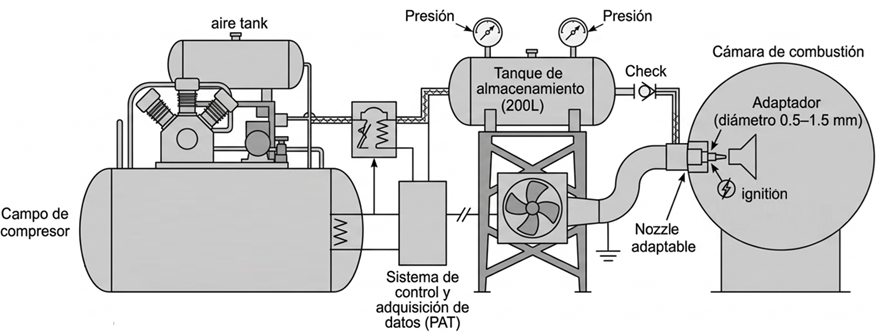
In the metallurgical industry, the use of fossil fuels generates high operating costs and pollutant emissions. At the same time, liquid waste streams—such as used oils—are often discarded without energy recovery due to their high viscosity. The objective of this study was to implement a combustion system for manufacturing processes that utilizes characterized waste fuels, ensuring thermal efficiency, emission reductions, and economic viability. The methodology included: physicochemical characterization of the waste fuel (viscosity, calorific value, chemical composition); design and integration of an injection system adapted for viscous fuels; CFD simulation of flow and combustion; and pilot tests on production lines to evaluate temperature, consumption, and emissions. The results demonstrated stable combustion of the waste fuel, achieving optimal temperatures (850–1,050 °C) for non-ferrous metallurgical processes. A 62–80% reduction in energy costs was achieved, along with a significant decrease in CO₂ and particulate emissions. The system proved to be economically viable, adaptable, and scalable. It is concluded that the utilization of waste fuels is an alternative that contributes to industrial sustainability by reducing costs and minimizing environmental impacts.
Downloads
References
[1] International Energy Agency (IEA), Energy Efficiency and Emissions Reduction in Industrial Thermal Processes. Paris, France: IEA, 2023. [Online]. Available: https://www.iea.org/reports
[2] X. Peng, Y. Jiang, Z. Chen, A. I. Osman, M. Farghali, and D. W. Rooney, “Recycling municipal, agricultural and industrial waste into energy,” Environmental Chemistry Letters, vol. 21, pp. 765-801, 2023, doi: 10.1007/s10311-022-01551-5.
[3] C. Hagelüken and D. Goldmann, “Recycling and circular economy: Towards closed metal loops,” Mineral Economics, vol. 35, pp. 539-562, 2022, doi: 10.1007/s13563-022-00319-1.
[4] K. Vershinina, G. Nyashina, and P. Strizhak, “Combustion, pyrolysis, and gasification of waste-derived fuel slurries,” Applied Sciences, vol. 12, no. 3, Art. no. 1039, 2022, doi: 10.3390/app12031039.
[5] P. Sharma, P. N. Sheth, and B. N. Mohapatra, “Refuse-derived fuel co-processing in industrial kilns,” Waste and Biomass Valorization, vol. 13, pp. 4347-4374, 2022, doi: 10.1007/s12649-022-01840-8.
[6] L. Lombardi and M. J. Castaldi, “Energy recovery from residual municipal solid waste,” Energies, vol. 17, no. 2, Art. no. 395, 2024, doi: 10.3390/en17020395.
[7] Jafar, J. Al-Naffakh, M. R. Al-Qassab, and Z. M. Al-Makhzoomi, “Comparative Analysis of Combustion Properties between Waste Automotive Oil and Light Diesel Oil as Alternative Fuels,” Acta Technica Corviniensis Bulletin of Engineering, vol. XVII, no. 2, pp. 15-22,
2024. [Online]. Available: https://acta.fih.upt.ro/pdf/2024-2/ACTA-2024-2-03.pdf.
[8] D. M. Cecílio, M. Mateus, and A. I. Ferreiro, “Industrial rotary kiln burner performance using CFD,” Fuels, vol. 4, no. 4, pp. 454-468, 2023, doi: 10.3390/fuels4040028.
[9] P. K. Verma, "Advancements in Pressurized Oxy-Combustion Process: Pollutant Control and Process Development," Journal Article, vol. N/A, art. no. 10.7936/91pv-v467, 2023. DOI: 10.7936/91pv-v467.
[10] E. Anderson, F. Tesfaye, and C. O. Iloeje, “Computational modeling of metallurgical furnaces,” JOM, vol. 74, pp. 1485-1487, 2022, doi: 10.1007/s11837-022-05205-3.
[11] M. A. Cano-Figueroa et al., “CFD-Experimental Analysis of Combustion and Energy Performance in an IDR Metallurgical Furnace Fueled with a Residual Oil-Solvent Blend,” Journal of Manufacturing and Materials Processing, vol. 10, no. 4, Art. no. 124, 2026, doi: 10.3390/jmmp10040124.
[12] H. Lefebvre and V. G. McDonell, Atomization and Sprays, 2nd ed. Boca Raton, FL, USA: CRC Press, 2022. doi: 10.1201/9781003145044.
[13] X. P. V. Maldague, Theory and Practice of Infrared Technology for Nondestructive Testing. Hoboken, NJ, USA: Wiley, 2020. doi: 10.1002/9781119549133.
[14] D. C. Montgomery, Design and Analysis of Experiments, 10th ed. Hoboken, NJ, USA: Wiley, 2020.
[15] P. Neugebauer, R. Huber, and S. Innerhofer, “Process analytical technology in downstream processing,” International Journal of Pharmaceutics, 2024, Art. no. 124412, doi: 10.1016/j.ijpharm.2024.124412.
[16] Vallan et al., “Temperature measurements as PAT,” Processes, vol. 11, no. 2, Art. no. 471, 2023, doi: 10.3390/pr11020471.
[17] ANSYS Inc., ANSYS Fluent Theory Guide. Canonsburg, PA, USA, 2023. [Online]. Available: https://www.ansys.com
[18] H. Jiao et al., “Refuse-Derived Fuel (RDF) for Low-Carbon Waste-to-Energy: Advances in Preparation Technologies, Thermochemical Behavior, and High-Efficiency Combustion Systems,” Energies, vol. 19, no. 3, Art. no. 751, 2026, doi: 10.3390/en19030751.
[19] ISO/IEC, ISO/IEC 17025:2017 General Requirements for the Competence of Testing and Calibration Laboratories. Geneva, Switzerland: ISO, 2017.
[20] S. R. Turns, *An Introduction to Combustion*, 3rd ed. New York, NY, USA: McGraw-Hill, 2021.
[21] M. Pisciotta, H. Pilorgé, J. Feldmann, R. Jacobson, J. Davids, et al., “Current state of industrial heating and opportunities for decarbonization,” Progress in Energy and Combustion Science, vol. 91, Art. no. 100982, 2022, doi: 10.1016/j.pecs.2021.100982.
[22] U. Arena, “Process and technological aspects of solid waste gasification: A review,” Waste Management, vol. 32, no. 4, pp. 625-639, 2012, doi: 10.1016/j.wasman.2011.09.025.
[23] J. Dong, Y. Chi, M. Tang, J. Ni, K. Nzihou, and E. Weiss-Hortala, “Partitioning of heavy metals in municipal solid waste pyrolysis, gasification, and incineration,” Fuel, vol. 94, pp. 616-625, 2012, doi: 10.1016/j.fuel.2011.10.063.
[24] Z. Mansouri, A. Al-Ghamdi, and M. A. Nemitallah, "CFD study of flameless combustion in a real industrial reheating furnace considering different H2/NG blends as fuel," Fuel, vol. 351, p. 128761, nov. 2023. doi: 10.1016/j.fuel.2023.128761.
[25] K. K. Kuo and R. Acharya, Fundamentals of Turbulent and Multiphase Combustion. Hoboken, NJ, USA: Wiley, 2020.
[26] E. A. E. Yañez, H. Meerman, A. Ramirez, E. Castillo, and A. Faaij, “Fully integrated CO2 mitigation strategy for an existing refinery: A case study in Colombia,” Applied Energy, vol. 313, pp. 118771–118771, May 2022, doi: 10.1016/j.apenergy.2022.118771.
[27] F. Ardolino, F. Parrillo, and U. Arena, “Biogas-to-biomethane upgrading: A comparative review and assessment in a life cycle perspective,” Renewable and Sustainable Energy Reviews, vol. 139, Art. no. 110588, 2021, doi: 10.1016/j.rser.2020.110588.
[28] European Commission, Best Available Techniques (BAT) Reference Document for the Non-Ferrous Metals Industries. Luxembourg: Publications Office of the European Union, 2020. [Online]. Available: https://eippcb.jrc.ec.europa.eu
[29] United States Environmental Protection Agency (EPA), Emission Factors for Greenhouse Gas Inventories. Washington, DC, USA: EPA, 2022. [Online]. Available: https://www.epa.gov
[30] X. Wang, S. Shan, Z. Wang, Z. Zhou, and K. Cen, “Review on thermal-science fundamental research of pressurized oxy-fuel combustion technology,” Frontiers in Energy, vol. 18, no. 6, pp. 760-784, 2024, doi: 10.1007/s11708-024-0931-y.
[31] X. Zheng, J. Wang, L. Zhang, and X. Yu, "Decarbonizing Industrial Heat: A Comparative Analysis of Waste Incineration and Clean Energy Scenarios," Sustainability, vol. 16, no. 7, p. 2702, mar. 2024. doi: 10.3390/su16072702.
[32] ASTM International, ASTM D445-21: Standard Test Method for Kinematic Viscosity of Transparent and Opaque Liquids. West Conshohocken, PA, USA, 2021.
[33] ASTM International, ASTM D240-20: Standard Test Method for Heat of Combustion of Liquid Hydrocarbon Fuels by Bomb Calorimeter. West Conshohocken, PA, USA, 2020.
[34] ASTM International, ASTM D1298-19: Standard Test Method for Density, Relative Density, or API Gravity of Crude Petroleum and Liquid Petroleum Products. West Conshohocken, PA, USA, 2019.
[35] ASTM International, ASTM D4294-22: Standard Test Method for Sulfur in Petroleum and Petroleum Products by Energy Dispersive X-Ray Fluorescence Spectrometry. West Conshohocken, PA, USA, 2022.
[36] ASTM International, ASTM D93-18: Standard Test Methods for Flash Point by Pensky-Martens Closed Cup Tester. West Conshohocken, PA, USA, 2018.
[37] ASTM International, ASTM D95-20: Standard Test Method for Water in Petroleum Products and Bituminous Materials by Distillation. West Conshohocken, PA, USA, 2020.
[38] M. F. Al-Hajri and H. M. S. Al-Maamary, "Life Cycle Assessment of a Waste-to-Energy Plant Based on a Pyrolysis and Gasification System," Applied Sciences, vol. 11, no. 11, p. 5160, jun. 2021. doi: 10.3390/app11115160.
[39] International Energy Agency (IEA), Industrial Heat and Decarbonisation. Paris, France: IEA, 2022. [Online]. Available: https://www.iea.org
[40] ISO, ISO 14040:2019 Environmental Management—Life Cycle Assessment—Principles and Framework. Geneva, Switzerland: ISO, 2019.
[41] M. H. Ali and I. Abustan, “A new novel index for evaluating model performance,” Journal of Natural Resources and Development, vol. 4, pp. 1-9, 2021, doi: 10.5027/jnrd.v4i0.01.
[42] J. E. Nash and J. V. Sutcliffe, “River flow forecasting through conceptual models. Part I: A discussion of principles,” Journal of Hydrology, vol. 10, no. 3, pp. 282-290, 1970, doi: 10.1016/0022-1694(70)90255-6.
Downloads
Published
Data Availability Statement
The data are available to the public.
Issue
Section
Categories
License
Copyright (c) 2026 Martha Angélica Cano-Figueroa, Hugo Arcos-Gutiérrez, Víctor Hugo Mercado-Lemus, José Antonio Betancourt-Cantera, Marco Antonio Márquez-Vera

This work is licensed under a Creative Commons Attribution 4.0 International License.
The authors who publish in this journal accept the following conditions:
The authors retain the copyright and assign to the journal the right of the first publication, with the work registered with the Creative Commons Attribution license 4.0, which allows third parties to use what is published as long as they mention the authorship of the work and the first publication in this magazine.
Authors may make other independent and additional contractual agreements for the non-exclusive distribution of the version of the article published in this journal (eg, include it in an institutional repository or publish it in a book) as long as they clearly indicate that the work it was first published in this magazine.
Authors are allowed and encouraged to share their work online (for example: in institutional repositories or personal web pages) before and during the manuscript submission process, as it can lead to productive exchanges, greater and more quick citation of published work (see The Effect of Open Access).
How to Cite