A comparative study of approximations to the RG model in a differential photoacoustic system in reflection mode
DOI:
https://doi.org/10.37636/recit.v9n3e478Keywords:
Thermal effusivity, Photocoustic response, Approximations of complex relative pressure, Differential photoacoustic cellAbstract
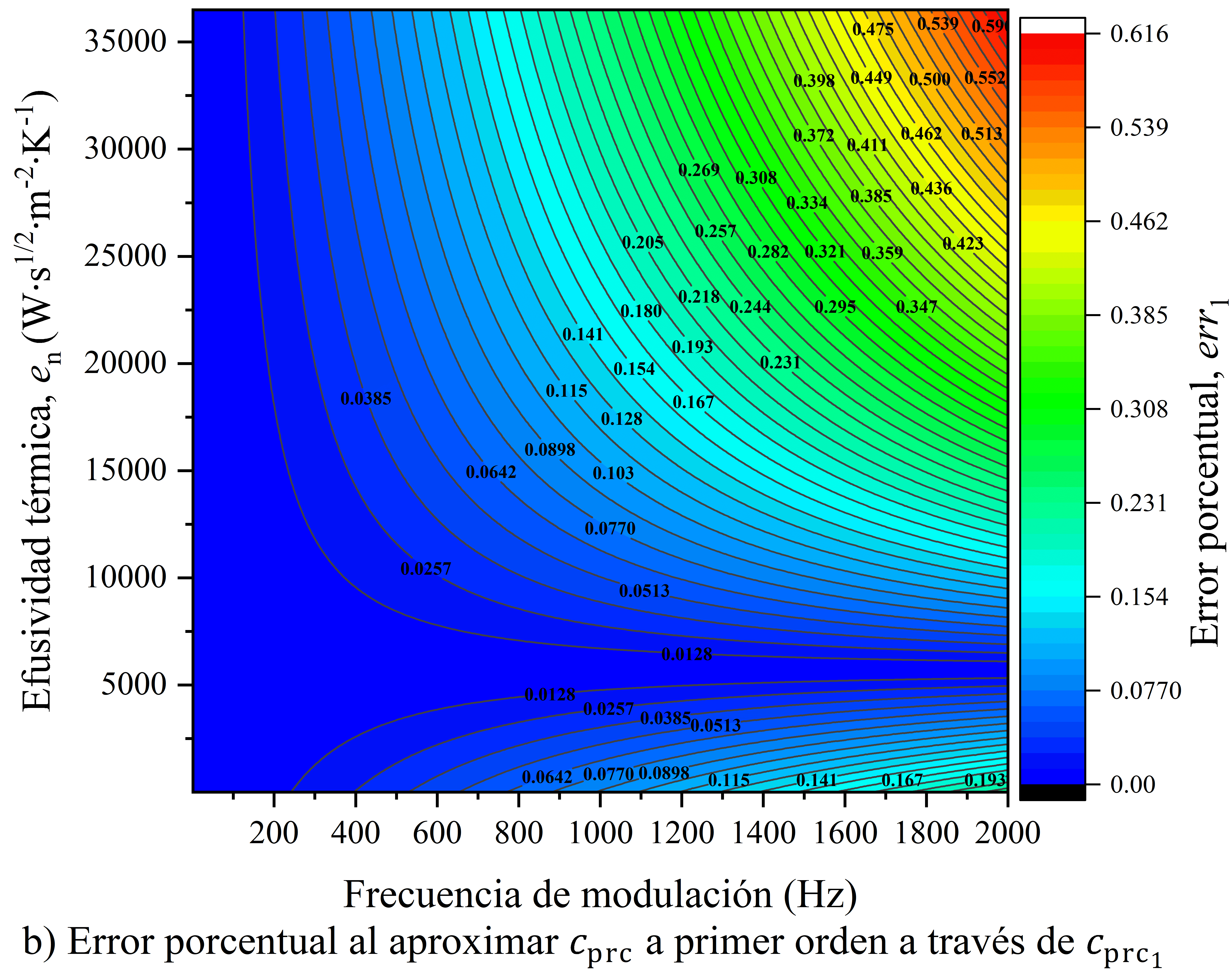
This paper presents a comparative study of approximations to the photoacoustic response obtained from the Rosencwaig-Gersho (RG) model for a differential photoacoustic cell in reflection mode, and in this way to evaluate its use in determining thermal effusivity. An integrated configuration consisting of two identical conventional photoacoustic cells is proposed, in which the ratio of the photoacoustic responses allows a reduction in the number of geometric, optical, and thermal parameters, simplifying the mathematical treatment. Zero-order, first-order, and second-order approximations are developed for the ratio of complex relative pressures, and their performance is evaluated by the percentage error with respect to the complete expression of the RG model. The analysis is performed for modulation frequencies between 1 and 2000 Hz, using air as the working gas and aluminum as the thermal transducer in both cells, and, in one cell, steel is used as support material and as a reference, while in the other cell, thermal effusivities between 5.85 and 36500 Wꞏs1/2ꞏm-2ꞏK-1 are worked on in the support material under study. The results show that the zero-order approximation exhibits significant deviations, while the first-order approximation offers an optimal balance between simplicity and accuracy, making it the most suitable for describing the photoacoustic response of the differential system. The proposed method constitutes a non-intrusive, reproducible, and low-cost alternative for the thermal characterization of materials, with potential applications in liquid systems, cooling processes, biomaterials, and various engineering fields.
Downloads
References
[1] L. Mota, R. Toledo, F. Machado, J. Holanda, H. Vargas, and R. Faria, “Thermal characterization of red clay from the Northern Region of Rio de Janeiro State, Brazil using an open photoacoustic cell, in relation to structural changes on firing,” Appl. Clay Sci., vol. 42, no. 1–2, pp. 168–174, Dec. 2008. DOI: https://doi.org/10.1016/j.clay.2008.01.010
[2] T. A. El-Brolossy and S. S. Ibrahim, “Photoacoustic measurement of thermal properties of polystyrene metal oxide composites,” Thermochim. Acta, vol. 509, no. 1–2, pp. 46–49, Oct. 2010. DOI: https://doi.org/10.1016/j.tca.2010.05.020
[3] M. Sarkar and K. Kumar, “Fabrication of photoacoustic cell and thermal diffusivity measurement of coal carbon black using it,” Mater. Today: Proc., Nov. 2021, doi: 10.1016/j.matpr.2021.11.467. DOI: https://doi.org/10.1016/j.matpr.2021.11.467
[4] A. Bedoya, E. Marín, M. Mansanares, M. A. Zambrano-Arjona, I. Riech, and A. Calderón, “On the thermal characterization of solids by photoacoustic calorimetry: thermal diffusivity and linear thermal expansion coefficient,” Thermochim. Acta, vol. 614, pp. 52–58, Aug. 2015, doi: 10.1016/j.tca.2015.06.009.
[5] K. Herrmann, W. Pech-May, and M. Retsch, “Photoacoustic thermal characterization of low thermal diffusivity thin films,” Photoacoustics, vol. 22, p. 100246, Jun. 2021, doi: 10.1016/j.pacs.2021.100246. DOI: https://doi.org/10.1016/j.pacs.2021.100246
[6] F. Agresti et al., “Temperature controlled photoacoustic device for thermal diffusivity measurements of liquids and nanofluids,” Thermochim. Acta, vol. 619, pp. 48–52, Nov. 2015, doi: 10.1016/j.tca.2015.09.017. DOI: https://doi.org/10.1016/j.tca.2015.09.017
[7] J. Soldner and K. Stephan, “Measurement of thermal diffusivities with the photoacoustic effect,” Chem. Eng. Process.: Process Intensif., vol. 38, no. 4–6, pp. 585–591, Dec. 1999, doi: 10.1016/S0255-2701(99)00056-2. DOI: https://doi.org/10.1016/S0255-2701(99)00056-2
[8] G. A. López-Muñoz, R. F. López-González, J. A. Balderas-López, and L. Martínez-Pérez, “Thermal-diffusivity measurements of Mexican citrus essential oils using photoacoustic methodology in the transmission configuration,” Int. J. Thermophys., vol. 32, no. 5, pp. 1006–1012, May 2011, doi: 10.1007/s10765-011-0983-1. DOI: https://doi.org/10.1007/s10765-011-0983-1
[9] D. Soares-Velasco, M. Luciano-Baesso, A. Neto-Medina, D. Danijel-Bicanic, and R. Koehorst, “Thermal diffusivity of periderm from tomatoes of different maturity stages as determined by the concept of the frequency-domain open photoacoustic cell,” J. Appl. Phys., vol. 109, no. 3, p. 034703, Feb. 2011, doi: 10.1063/1.3530735. DOI: https://doi.org/10.1063/1.3530735
[10] C. M. Gao, S. Y. Zhang, Z. Zhang, and X. J. Shui, “Thermal diffusivity of porcine tissues characterized by photoacoustic piezoelectric technique,” J. Phys. IV France, vol. 125, pp. 777–779, Jun. 2005, doi: 10.1051/jp4:2005125179. DOI: https://doi.org/10.1051/jp4:2005125179
[11] F. B. G. Astrath, N. G. C. Astrath, M. L. Baesso, A. C. Bento, and J. C. S. Moraes, “Open photoacoustic cell for thermal diffusivity measurements of a fast hardening cement used in dental restoring,” J. Appl. Phys., vol. 111, no. 1, p. 014701, Jan. 2012, doi: 10.1063/1.3673873. DOI: https://doi.org/10.1063/1.3673873
[12] A. Rosencwaig and A. Gersho, “Theory of the photoacoustic effect with solids,” J. Appl. Phys., vol. 47, no. 1, pp. 64–69, Jan. 1976, doi: 10.1063/1.322296. DOI: https://doi.org/10.1063/1.322296
[13] J. Pelzl, S. Chotikaprakhan, Dietzel D, B. K. Bein, E. Neubauer, and M. Chirtoc, “The thermal contact problem in nano- and micro-scale photothermal measurements,” Eur. Phys. J. Spec. Top., vol. 153, no. 1, pp. 335–342, Jan. 2008, doi: 10.1140/epjst/e2008-00457-9. DOI: https://doi.org/10.1140/epjst/e2008-00457-9
[14] M. Manivannan, S. Balachandar, M. Jose, S. A. Martin Britto Dhas, and A. Saranraj, “Investigation on thermo-physical properties of L-valinium picrate single crystal for industrial applications,” Mater. Lett. X, vol. 12, p. 100108, Dec. 2021, doi: 10.1016/j.mlblux.2021.100108. DOI: https://doi.org/10.1016/j.mlblux.2021.100108
[15] M. G. Fernández-Olaya, "Análisis por medio de ondas térmicas de películas poliméricas delgadas y determinación de las propiedades ópticas, térmicas y eléctricas de óxidos de titanio (Ti2O3 y TiO2)," Tesis doctoral, Dept. Física Aplicada, CINVESTAV Unidad Mérida, Mérida, México, 2023.
[16] C. Hernandez-Aguilar et al., “Photoacoustic characterization of wheat bread mixed with Moringa oleífera,” Curr. Res. Food Sci., vol. 4, pp. 521–531, Jan. 2021, doi: 10.1016/j.crfs.2021.07.008. DOI: https://doi.org/10.1016/j.crfs.2021.07.008
[17] H. S. Bennett and R. A. Forman, “Frequency dependence of photoacoustic spectroscopy: Surface and bulk absorption coefficients,” J. Appl. Phys., vol. 48, no. 4, pp. 1432–1436, Apr. 1977, doi: 10.1063/1.323815. DOI: https://doi.org/10.1063/1.323883
[18] D. Cahen, “Photoacoustic cell for reflection and transmission measurements,” Rev. Sci. Instrum., vol. 52, no. 9, pp. 1306–1310, Sep. 1981, doi: 10.1063/1.1136780. DOI: https://doi.org/10.1063/1.1136788
[19] F. G. C. Bijnen, J. Reuss, and F. J. M. Harren, “Geometrical optimization of a longitudinal resonant photoacoustic cell for sensitive and fast trace gas detection,” Rev. Sci. Instrum., vol. 67, no. 8, pp. 2914–2923, Aug. 1996, doi: 10.1063/1.1147124. DOI: https://doi.org/10.1063/1.1147072
[20] D. I. Kovsh, D. J. Hagan, and E. W. Van Stryland, “Numerical modeling of thermal refraction in liquids in the transient regime,” Opt. Express, vol. 4, no. 8, pp. 315–329, Apr. 1999, doi: 10.1364/OE.4.000315. DOI: https://doi.org/10.1364/OE.4.000315
[21] M. Nägele and M. W. Sigrist, “Mobile laser spectrometer with novel resonant multipass photoacoustic cell for trace-gas sensing,” Appl. Phys. B, vol. 70, no. 6, pp. 895–901, Jun. 2000, doi: 10.1007/s003400000251. DOI: https://doi.org/10.1007/PL00021151
[22] L. C. Aamodt, J. C. Murphy, and J. G. Parker, “Size considerations in the design of cells for photoacoustic spectroscopy,” J. Appl. Phys., vol. 48, no. 3, pp. 927–933, Mar. 1977, doi: 10.1063/1.323719. DOI: https://doi.org/10.1063/1.323710
[23] L. C. Aamodt and J. C. Murphy, “Size considerations in the design of cells for photoacoustic spectroscopy. II. Pulsed excitation response,” J. Appl. Phys., vol. 49, no. 6, pp. 3036–3045, Jun. 1978, doi: 10.1063/1.325299. DOI: https://doi.org/10.1063/1.325318
[24] F. A. McDonald and G. C. Wetsel, “Generalized theory of the photoacoustic effect,” J. Appl. Phys., vol. 49, no. 4, pp. 2313–2322, Apr. 1978, doi: 10.1063/1.325116. DOI: https://doi.org/10.1063/1.325116
[25] C. L. Cesar, H. Vargas, J. A. Meyer, and L. C. M. Miranda, “Photoacoustic effect in solids,” Phys. Rev. Lett., vol. 42, no. 23, pp. 1570–1573, Jun. 1979, doi: 10.1103/PhysRevLett.42.1570. DOI: https://doi.org/10.1103/PhysRevLett.42.1570
[26] R. S. Quimby and W. M. Yen, “On the adequacy of one‐dimensional treatments of the photoacoustic effect,” J. Appl. Phys., vol. 51, no. 2, pp. 1252–1253, Feb. 1980, doi: 10.1063/1.327668. DOI: https://doi.org/10.1063/1.327700
[27] N. C. Fernelius, “Extension of the Rosencwaig‐Gersho photoacoustic spectroscopy theory to include effects of a sample coating,” J. Appl. Phys., vol. 51, no. 1, pp. 650–654, Jan. 1980, doi: 10.1063/1.327318. DOI: https://doi.org/10.1063/1.327320
[28] P. Poulet, J. Chambron, and R. Unterreiner, “Quantitative photoacoustic spectroscopy applied to thermally thick samples,” J. Appl. Phys., vol. 51, no. 3, pp. 1738–1742, Mar. 1980, doi: 10.1063/1.327814. DOI: https://doi.org/10.1063/1.327785
[29] G. Rousset, F. Lepoutre, and L. Bertrand, “Influence of thermoelastic bending on photoacoustic experiments related to measurements of thermal diffusivity of metals,” J. Appl. Phys., vol. 54, no. 5, pp. 2383–2391, May 1983, doi: 10.1063/1.332352. DOI: https://doi.org/10.1063/1.332352
[30] A. Somer et al., “The thermoelastic bending and thermal diffusion processes influence on photoacoustic signal generation using open photoacoustic cell technique,” J. Appl. Phys., vol. 114, no. 6, p. 063503, Aug. 2013, doi: 10.1063/1.4817916. DOI: https://doi.org/10.1063/1.4817655
[31] A. Bedoya et al., “On the thermal characterization of solids by photoacoustic calorimetry: thermal diffusivity and linear thermal expansion coefficient,” Thermochim. Acta, vol. 614, pp. 52–58, Aug. 2015, doi: 10.1016/j.tca.2015.06.009. DOI: https://doi.org/10.1016/j.tca.2015.06.009
[32] M. E. Rodríguez-García et al., “Differential photoacoustic cell for electrochemical and dynamic process with temperature control,” Rev. Sci. Instrum., vol. 78, no. 3, p. 034904, Mar. 2007, doi: 10.1063/1.2712790.
[33] T. Starecki and A. Geras, “Investigation of Properties of a Microfluidic Photoacoustic Cell,” Int. J. Thermophys., vol. 35, no. 12, pp. 2259–2266, Dec. 2014, doi: 10.1007/s10765-014-1715-4. DOI: https://doi.org/10.1007/s10765-014-1570-z
[34] M. E. Rodríguez-García, R. Velásquez-Hernández, M. L. Mendoza-López, D. M. Hurtado-Castañeda, K. M. Brieño-Enríquez, y J. J. Pérez-Bueno, “Differential Photoacoustic Cell for Electrochemical and Dynamic Process with Temperature Control,” Rev. Sci. Instrum., vol. 78, no. 3, p. 034904, Mar. 2007, doi: 10.1063/1.2712790. DOI: https://doi.org/10.1063/1.2715916
[35] E. Gutiérrez-Cortez et al., “Effect of processing temperature on structural and physicochemical properties of corn tortillas mixed with several nixtamalized corn flours,” J. Cereal Sci., vol. 51, no. 1, pp. 81–86, Jan. 2010, doi: 10.1016/j.jcs.2009.10.003. DOI: https://doi.org/10.1016/j.jcs.2009.10.003
Downloads
Published
Data Availability Statement
Se puede contactar directamente al Contacto principal
License
Copyright (c) 2026 Luis David Vargas Sotelo, Sergio Marcial Palma, Salvador Manuel Malagón-Soldara, Francisco Javier García-Rodríguez, David Gasca-Figueroa

This work is licensed under a Creative Commons Attribution 4.0 International License.
The authors who publish in this journal accept the following conditions:
The authors retain the copyright and assign to the journal the right of the first publication, with the work registered with the Creative Commons Attribution license 4.0, which allows third parties to use what is published as long as they mention the authorship of the work and the first publication in this magazine.
Authors may make other independent and additional contractual agreements for the non-exclusive distribution of the version of the article published in this journal (eg, include it in an institutional repository or publish it in a book) as long as they clearly indicate that the work it was first published in this magazine.
Authors are allowed and encouraged to share their work online (for example: in institutional repositories or personal web pages) before and during the manuscript submission process, as it can lead to productive exchanges, greater and more quick citation of published work (see The Effect of Open Access).
How to Cite