Characterization, Design, and Potential Resource Recovery through an Integrated 5S Model: A Case Study in a Health Sciences Faculty
DOI:
https://doi.org/10.37636/recit.v9n4e507Keywords:
Campus sustainability, Integrated waste management, 5S methodology, Biological-infectious waste, Circular economy, Higher educationAbstract
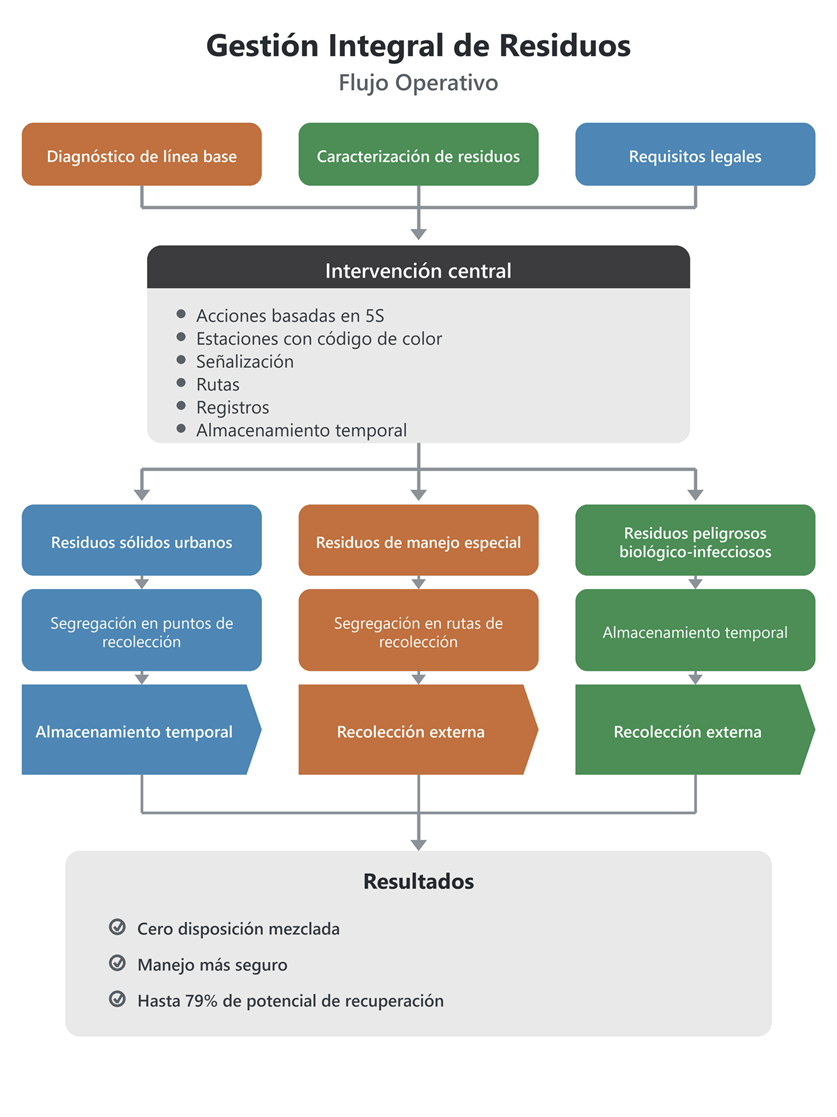
This case study reports the development and assessment of a 5S-based integrated waste management model for a public university health sciences faculty in central Mexico, where municipal, special handling and biological-infectious hazardous waste streams coexist. The research followed a single-case design comprising baseline diagnosis, technical waste characterization, design of an operational model structured around the 5S methodology (Seiri, Seiton, Seiso, Seiketsu, Shitsuke), pilot implementation and evaluation. The diagnosis estimated a generation of approximately 2,200 kg of waste per month under mixed-disposal conditions and zero effective recovery, while characterization showed that up to 79% of the stream had recovery potential if segregation were properly applied. The model translated each 5S stage into concrete waste-management actions, including colour-coded stations, internal routes, temporary storage criteria, hazard signage based on the Globally Harmonized System, differentiated containers for biological-infectious residues, and basic records. Evaluation focused on operational order, segregation effectiveness, safety and regulatory alignment with Mexican standards (NOM-161-SEMARNAT-2011 and NOM-087-SEMARNAT-SSA1-2002). The intervention produced a coherent operating architecture that converts the identified recovery potential into routine practice, while reducing exposure risks and improving compliance. The main contribution is a low-cost, replicable faculty-level framework that connects campus sustainability goals with daily operations, particularly in health-related academic settings of resource-constrained public institutions in Latin America.
Downloads
References
[1] M. C. Oliveira and J. Proença, "Sustainable Campus Operations in Higher Education Institutions: A Systematic Literature Review," Sustainability, vol. 17, no. 2, art. 607, 2025.
[2] W. Leal Filho et al., “Sustainable Development Goals and sustainability teaching at universities: Falling behind or getting ahead of the pack?,” Journal of Cleaner Production, vol. 232, pp. 285–294, 2019. https://doi.org/10.1016/j.jclepro.2019.05.309
[3] E. Nolasco, P. H. Vieira Durães, J. Pereira Gonçalves, M. C. de Oliveira, L. Monteiro de Abreu, and A. Nascimento de Almeida, "Characterization of solid wastes as a tool to implement waste management strategies in a university campus," International Journal of Sustainability in Higher Education, vol. 22, no. 2, pp. 217–236, 2021.
[4] M. Hindiyeh, M. Jaradat, A. Albatayneh, B. Alabdellat, Y. Al-Mitwali, and B. Hammad, "Sustainable Green University: Waste Auditing, German Jordanian University as a Case Study," Frontiers in Built Environment, vol. 8, art. 884656, 2022.
[5] S. Dahlawi and M. F. El Sharkawy, "Assessment of solid waste management practice in the university campus," International Journal of Sustainability in Higher Education, vol. 22, no. 3, pp. 561–575, 2021.
[6] A. Jakimiuk, Y. Matsui, A. Podlasek, E. Koda, V. S. N. S. Goli, and S. Voběrková, "Closing the loop: A case study on pathways for promoting sustainable waste management on university campuses," Science of the Total Environment, vol. 892, art. 164349, 2023.
[7] A. Gallardo, N. Edo-Alcón, M. Carlos, and M. Renau, “The determination of waste generation and composition as an essential tool to improve the waste management plan of a university,” Waste Management, vol. 53, pp. 3–11, 2016. https://doi.org/10.1016/j.wasman.2016.04.013
[8] Cámara de Diputados del H. Congreso de la Unión, Ley General para la Prevención y Gestión Integral de los Residuos (Última Reforma DOF 18-01-2021). México: Diario Oficial de la Federación, 2021.
[9] SEMARNAT, Norma Oficial Mexicana NOM-161-SEMARNAT-2011, que establece los criterios para clasificar a los residuos de manejo especial y determinar cuáles están sujetos a plan de manejo. México: Diario Oficial de la Federación, 1 de febrero de 2013.
[10] SSA, Norma Oficial Mexicana NOM-087-SEMARNAT-SSA1-2002, Protección ambiental — Salud ambiental — Residuos peligrosos biológico-infecciosos — Clasificación y especificaciones de manejo. México: Diario Oficial de la Federación, 17 de febrero de 2003.
[11] P. Ghisellini, C. Cialani, and S. Ulgiati, “A review on circular economy: The expected transition to a balanced interplay of environmental and economic systems,” Journal of Cleaner Production, vol. 114, pp. 11–32, 2016. https://doi.org/10.1016/j.jclepro.2015.09.007
[12] L. Salguero-Puerta, J. C. Leyva-Díaz, F. J. Cortés-García, and V. Molina-Moreno, "Sustainability Indicators Concerning Waste Management for Implementation of the Circular Economy Model on the University of Lomé (Togo) Campus," International Journal of Environmental Research and Public Health, vol. 16, no. 12, art. 2234, 2019.
[13] International Organization for Standardization, ISO 14001:2015 Environmental management systems — Requirements with guidance for use. Geneva, Switzerland: ISO, 2015.
[14] H. Hirano, 5 Pillars of the Visual Workplace: The Sourcebook for 5S Implementation. Portland, OR, EE. UU.: Productivity Press, 1995.
[15] T. Osada, The 5S’s: Five Keys to a Total Quality Environment. Tokyo, Japón: Asian Productivity Organization, 1991.
[16] M. Jiménez, L. Romero, M. Domínguez, and M. del M. Espinosa, "5S methodology implementation in the laboratories of an industrial engineering university school," Safety Science, vol. 78, pp. 163–172, 2015. https://doi.org/10.1016/j.ssci.2015.04.022
[17] M. de L. F. Oliveira et al., "5S System in a university clinical laboratory as an important tool for quality assurance in work and learning-teaching environments," Brazilian Journal of Health Review, vol. 8, no. 6, art. e84735, 2025. https://doi.org/10.34119/bjhrv8n6-374
[18] S. Kanamori, A. Shibanuma, and M. Jimba, "Applicability of the 5S management method for quality improvement in health-care facilities: a review," Tropical Medicine and Health, vol. 44, art. 21, 2016. https://doi.org/10.1186/s41182-016-0022-9
[19] H. Ishijima, N. Miyamoto, F. Masaule, and R. John, "Improvements to healthcare waste management at regional referral hospitals in Tanzania using the KAIZEN approach," The TQM Journal, vol. 34, no. 5, pp. 939–956, 2022. https://doi.org/10.1108/TQM-10-2020-0254
[20] S. Hammami, F. Hmida, H. Gharbi, A. Ben Salah, and C. Hamouda, "Implementation of the 5S-KAIZEN-TQM approach in a public hospital in Tunisia," Tunisie Médicale, vol. 100, no. 7, pp. 503–513, 2022.
[21] H. Ishijima, K. Nishikido, M. Teshima, S. Nishikawa, and E. A. Gawad, "Introducing the ‘5S-KAIZEN-TQM’ approach into public hospitals in Egypt," International Journal of Health Care Quality Assurance, vol. 33, no. 1, pp. 89–109, 2019.
https://doi.org/10.1108/IJHCQA-06-2018-0143
[22] E. Çetin, A. Hussein, and S. Güneş-Durak, "Advancing Sustainable Medical Waste Management: A Case Study on Waste Generation and Classification in a University Hospital Microbiology Laboratory," Sustainability, vol. 17, no. 10, art. 4325, 2025.
[23] D. A. Salas, P. Criollo, and A. D. Ramirez, "The role of higher education institutions in the implementation of circular economy in Latin America," Sustainability, vol. 13, no. 17, art. 9805, 2021. https://doi.org/10.3390/su13179805
[24] R. K. Yin, Case Study Research and Applications: Design and Methods, 6th ed. Thousand Oaks, CA, EE. UU.: SAGE, 2018.
[25] A. Prüss-Üstün, E. Giroult, and P. Rushbrook, Safe Management of Wastes from Health-Care Activities, 2nd ed. Geneva, Switzerland: World Health Organization, 2013.
[26] W. E. Deming, Out of the Crisis. Cambridge, MA, EE. UU.: MIT Center for Advanced Engineering Study, 1986.
[27] Secretaría del Trabajo y Previsión Social, Norma Oficial Mexicana NOM-018-STPS-2015, Sistema Armonizado para la Identificación y Comunicación de Peligros y Riesgos por Sustancias Químicas Peligrosas en los Centros de Trabajo. Ciudad de México, México: Diario Oficial de la Federación, 2015.
[28] Secretaría de Medio Ambiente y Recursos Naturales, Norma Oficial Mexicana NOM-052-SEMARNAT-2005, Que Establece las Características, el Procedimiento de Identificación, Clasificación y los Listados de los Residuos Peligrosos. Ciudad de México, México: Diario Oficial de la Federación, 2005.
[29] Cámara de Diputados del H. Congreso de la Unión, Ley General del Equilibrio Ecológico y la Protección al Ambiente. Ciudad de México, México: Diario Oficial de la Federación, 1988 (última reforma).
[30] J. P. Womack and D. T. Jones, Lean Thinking: Banish Waste and Create Wealth in Your Corporation, 2nd ed. New York, NY, EE. UU.: Free Press, 2003.
Downloads
Published
Issue
Section
Categories
License
Copyright (c) 2026 Iván Avila-Raya, Martha Angélica Lemus-Solorio, Luis Enrique Rosas-Avalos, José Luis Rivera-Rojas, Luis Jesús Villarreal-Gómez, María Esther Carcamo-Escalera, Alfonso Lemus-Solorio

This work is licensed under a Creative Commons Attribution 4.0 International License.
The authors who publish in this journal accept the following conditions:
The authors retain the copyright and assign to the journal the right of the first publication, with the work registered with the Creative Commons Attribution license 4.0, which allows third parties to use what is published as long as they mention the authorship of the work and the first publication in this magazine.
Authors may make other independent and additional contractual agreements for the non-exclusive distribution of the version of the article published in this journal (eg, include it in an institutional repository or publish it in a book) as long as they clearly indicate that the work it was first published in this magazine.
Authors are allowed and encouraged to share their work online (for example: in institutional repositories or personal web pages) before and during the manuscript submission process, as it can lead to productive exchanges, greater and more quick citation of published work (see The Effect of Open Access).
How to Cite