Creativity workshop to integrate co-creation with AI in university entrepreneurship ecosystems
DOI:
https://doi.org/10.37636/recit.v9n2e446Keywords:
Creativity, Artificial intelligence (AI), Entrepreneurial ecosystem, Higher education, BrainstormingAbstract
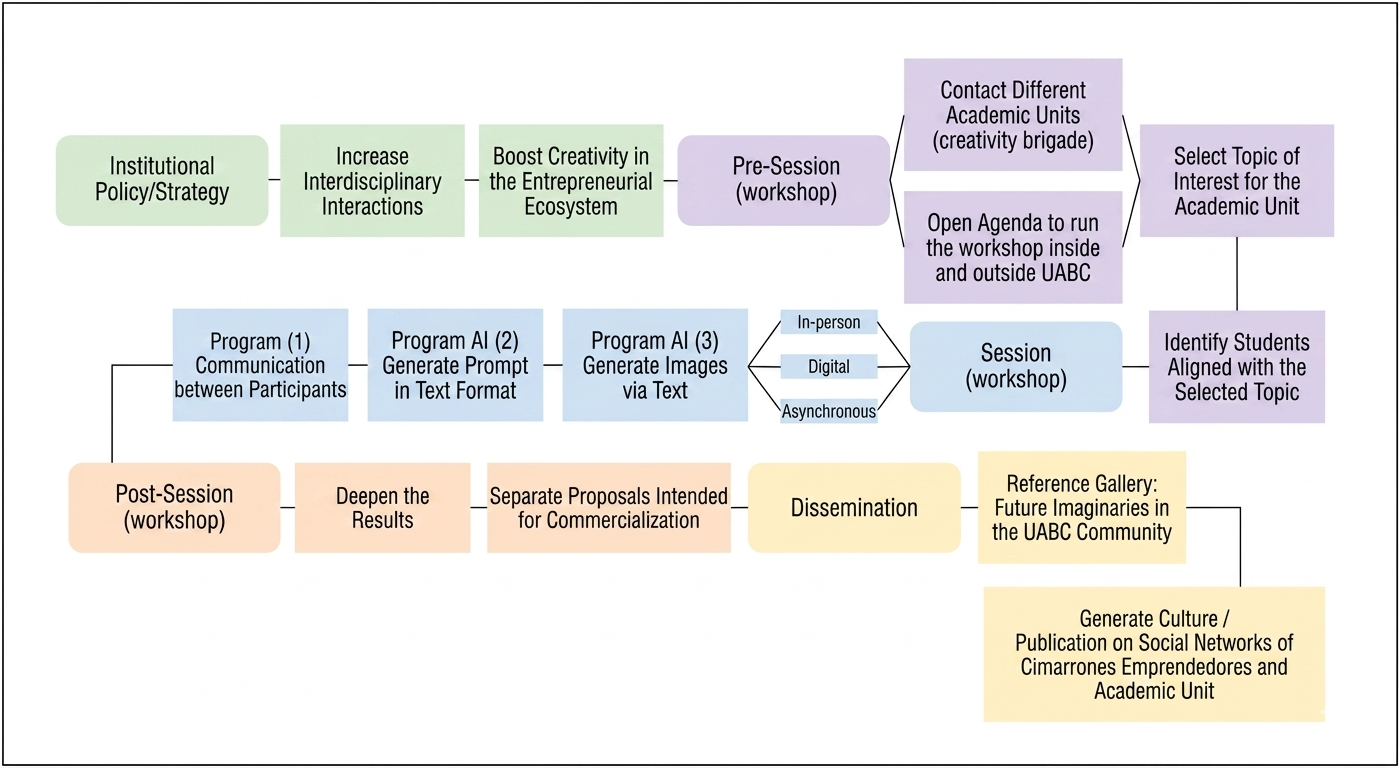
In a context of growing adoption of artificial intelligence (AI), this exploratory study with a qualitative approach aimed to design a pilot AI-assisted brainstorming workshop, focused on the ideation stage of the entrepreneurial process, within the Cimarrones Emprendedores program of the Universidad Autónoma de Baja California (UABC). The workshop focused on video game cover design due to its relevance to the educational interest of the Faculty of Architecture and Design (FAD), campus Mexicali of the same institution. The workshop lasted one hour and involved six students in the final stage of their respective degree programs: two Industrial Design students, two Graphic Design students, and two Architects students. Using techniques such as participant observation and observation guide, the performance of the workshop participants was documented. The findings suggest the need to strengthen AI literacy and promote mechanisms that facilitate interdisciplinary interactions among students. As a contribution, a simplified methodological structure is proposed to implement similar workshops in university entrepreneurial ecosystems, with an emphasis on documenting the creative process.
Downloads
References
[1] B. L. Liu et al., “Harnessing the era of artificial intelligence in higher education: a primer for higher education stakeholders. Caracas, Venezuela: UNESCO International Institute for Higher Education in Latin America and the Caribbean, 2023, Doc. ED/HE/IESALC/IP/2023/27, [Online]. Available: https://unesdoc.unesco.org/ark:/48223/pf0000386670.
[2] M. S. Khan, H. Umer, and F. Faruqe, “Artificial intelligence for low-income countries,” Humanities and Social Sciences Communications, vol. 11, Art. no. 1422, pp 1-13, Oct. 2024, doi: 10.1057/s41599-024-03947-w. DOI: https://doi.org/10.1057/s41599-024-03947-w
[3] UNESCO, “The right to education: past, present and future directions”. United Nations Educational, Scientific and Cultural Organization, París, France, 2025. [Online]. https://unesdoc.unesco.org/ark:/48223/pf0000396613
[4] K. J. Chávez Vera, M. Boscán Carroz, and A. del V. Calanchez Urribarri, “Emprendimiento universitario y desarrollo sostenible: un enfoque desde la teoría del comportamiento planificado”, Producción + Limpia, vol. 20, no. 1, pp. 39–54, Jul. 2025, doi: 10.22507/pml.v20n1a3631. DOI: https://doi.org/10.22507/pml.v20n1a3631
[5] M. Obschonka et al., “Artificial Intelligence and Entrepreneurship: A Call for Research to Prospect and Establish the Scholarly AI Frontiers,” Entrepreneurship Theory and Practice, vol. 49, no. 3, pp. 620–641, April. 2025, doi: 10.1177/10422587241304676. DOI: https://doi.org/10.1177/10422587241304676
[6] M. Medina Romero, R. Rojas León, W. Bustamante Hoces, R. Loaiza Carrasco, C. Martel Carranza, and R. Castillo Acobo, “Metodología de la investigación: Técnicas e instrumentos de investigación.”. Primera edición digital. Puno, Perú. Instituto Universitario de Innovación Ciencia y Tecnología Inudi Perú S.A.C, Feb. 2023, doi: 10.35622/inudi.b.080 DOI: https://doi.org/10.35622/inudi.b.080
[7] L. Greif, F. Röckel, A. Kimmig, et al., “A systematic review of current AI techniques used in the context of the SDGs,” Int J Environ Res, vol. 19, no. 1, pp. 1-36, (2025), https://doi.org/10.1007/s41742-024-00668-5 DOI: https://doi.org/10.1007/s41742-024-00668-5
[8] S. Ocen, J. Elasu, S. M. Aarakit, and C. Olupot, “Artificial intelligence in higher education institutions: Review of innovations, opportunities and challenges,” Frontiers in Education, vol. 10, art.1530247, pp. 1-12, Mar. 2025, doi: 10.3389/feduc.2025.1530247. DOI: https://doi.org/10.3389/feduc.2025.1530247
[9] A. R. Doshi and O. P. Hauser, “Generative AI enhances individual creativity but reduces the collective diversity of novel content,” Science Advances, vol. 10, no.28, art.5290, pp. 1-9, Jul. 2024, doi: 10.1126/sciadv.adn5290. DOI: https://doi.org/10.1126/sciadv.adn5290
[10] S. Abubakar, A. Jeilani, and M. Yusuf, “The role of over-reliance on AI in the negative consequences of student learning: The moderating effects of ethical concerns and institutional policies,” Cogent Education, vol. 12, no. 1, art. no. 2591503, Dic. 2025, doi: 10.1080/2331186X.2025.2591503. DOI: https://doi.org/10.1080/2331186X.2025.2591503
[11] Y. Walter, “Embracing the future of Artificial Intelligence in the classroom: The relevance of AI literacy, prompt engineering, and critical thinking in modern education,” Int J Educ Technol High Educ, vol. 21, no. 15, Feb. 2024, doi: 10.1186/s41239-024-00448-3. DOI: https://doi.org/10.1186/s41239-024-00448-3
[12] H. Zhang, I. Lee, S. Ali, D. DiPaola, Y. Cheng, and C.Breazeal, “Integrating Ethics and Career Futures with Technical Learning to Promote AI Literacy for Middle School Students: An Exploratory Study,” Int J Artif Intell Educ, vol. 33, no. 2 pp. 290–324, Jun. 2023, doi: 10.1007/s40593-022-00293-3. DOI: https://doi.org/10.1007/s40593-022-00293-3
[13] M. Pinski and A. Benlian, “AI literacy for users – A comprehensive review and future research directions of learning methods, components, and effects,” Computers in Human Behavior: Artificial Humans, vol. 2, no. 1, art. no. 100062, Mar. 2024, doi: 10.1016/j.chbah.2024.100062. DOI: https://doi.org/10.1016/j.chbah.2024.100062
[14] K. Stolpe and J. Hallström, “Artificial intelligence literacy for technology education,” Computers and Education Open, vol. 6, no. 3, art. 100159, pp. 1-8, Jun. 2024, doi: 10.1016/j.caeo.2024.100159. DOI: https://doi.org/10.1016/j.caeo.2024.100159
[15] A. Zhuk, “Artificial Intelligence Impact on the Environment: Hidden Ecological Costs and Ethical-Legal Issues,” Journal of Digital Technologies and Law, vol. 1, no. 4, pp. 932–954, Dec. 2023, doi: 10.21202/jdtl. 2023.40. DOI: https://doi.org/10.21202/jdtl.2023.40
[16] L. Aperribai, M. F. Morais, L. Cortabarria, and F. Machado, “Barreras para la creatividad personal en estudiantes universitarios españoles y portugueses”, EducXX1, vol. 27, no.1, pp. 81–104, Ene. 2024. https://doi.org/10.5944/educxx1.35761 DOI: https://doi.org/10.5944/educxx1.35761
[17] W. Karunarathne and A. Calma, “Assessing creative thinking skills in higher education: Deficits and improvements,” Studies in Higher Education, vol. 49, no. 1, pp. 157–177, Jun. 2024, doi: 10.1080/03075079.2023.2225532. DOI: https://doi.org/10.1080/03075079.2023.2225532
[18] D. Ramalingam, P. Anderson, D. Duckworth, C. Scoular, and J. Heard, “Creative thinking: Definition and structure,” Australian Council for Educational Research, Feb. 2020. ISBN: 978-1-74286-588-1. [Online]. Available: https://research.acer.edu.au/cgi/viewcontent.cgi?article=1038&context=ar_misc
[19] OECD, “PISA 2022 Assessment and Analytical Framework,” PISA. Paris, France: OECD Publishing, Aug. 2023, doi: 10.1787/dfe0bf9c-en. DOI: https://doi.org/10.1787/dfe0bf9c-en
[20] C. Chamorro-Troncos, M. Sainz-Gómez, R. Bermejo-García, and M. J. Ruiz-Melero, “PIC-Potenciando Ideas Creativas: Una propuesta educativa para el desarrollo de la creatividad,” 593 Digital Publisher CEIT, vol. 9, no. 2, pp. 15–28, Mar. 2024, doi: 10.33386/593dp.2024.2.2213. DOI: https://doi.org/10.33386/593dp.2024.2.2213
[21] A. Villalobos, A. Sepúlveda, D. Díaz y M. Opazo, “Indicadores de creatividad presentes en los textos escolares de ciencias naturales para la educación básica chilena,” Rev. Científica, vol. 46, no. 1, pp. 147–161, Feb. 2023, doi: 10.14483/23448350.19804. DOI: https://doi.org/10.14483/23448350.19804
[22] B. Tregenza, J. Torrington, S. Nykvist, and S. Prestridge, “Creativity and creative thinking,” in M. Bower and B. Von Mengersen, Eds., Creative Technologies Education: Students as Digital Designers, 1st ed. London: Routledge, Jul. 2025, pp. 29–43, doi: 10.4324/9781003490715-3. DOI: https://doi.org/10.4324/9781003490715-3
[23] V. Díaz Abrahan y N. Justel, “Creatividad. Una revisión descriptiva sobre nuestra capacidad de invención e innovación”, rev. CES psicol., vol. 12, no. 3, pp. 35–49, May. 2019, https://doi.org/10.21615/cesp.12.3.3. DOI: https://doi.org/10.21615/cesp.12.3.3
[24] Y. Eshet and A. Margaliot, “Does creative thinking contribute to the academic integrity of education students?” Frontiers in Psychology, vol. 13, art. 925195, pp. 1-10, Ago. 2022, doi: 10.3389/fpsyg. 2022.925195. DOI: https://doi.org/10.3389/fpsyg.2022.925195
[25] Lin and Q. Chen, “Artificial intelligence (AI)-integrated educational applications and college students’ creativity and academic emotions: Students and teachers’ perceptions and attitudes,” BMC Psychology, vol. 12, Art. no. 487, pp. 1-16, Sep. 2024, doi: 10.1186/s40359-024-01979-0. DOI: https://doi.org/10.1186/s40359-024-01979-0
[26] M. P. Correia, C. S. Marques, R. Silva, V. Ramadani, “Academic Entrepreneurship Ecosystems: Systematic Literature Review and Future Research Directions,” Journal of the Knowledge Economy, vol. 15, no. 4, pp. 17498–17528, Feb. 2024, doi: 10.1007/s13132-024-01819-x. DOI: https://doi.org/10.1007/s13132-024-01819-x
[27] G. Secundo, G. Mele, P. Del Vecchio and G. Degennaro, “Knowledge spillover creation in university-based entrepreneurial ecosystem: The role of the Italian ‘Contamination Labs’,” Knowledge Management Research & Practice, vol. 19, no. 1, pp. 137–151, Ene. 2021, doi: 10.1080/14778238.2020.1785347. DOI: https://doi.org/10.1080/14778238.2020.1785347
[28] E. A. Chávez Moreno, “Las incubadoras de negocios universitarias: el caso de la incubadora de negocios de la Universidad Autónoma de Baja California,” RIDE Revista Iberoamericana para la Investigación y el Desarrollo Educativo, vol. 14, no. 28, Jun. 2024, doi: 10.23913/ride.v14i28.1774. DOI: https://doi.org/10.23913/ride.v14i28.1774
[29] V. Molina and W. S. Valbuena Buitrago, “Mapping creativity and design within the entrepreneurship ecosystem,” Kindai Management Review, vol. 7, no. 39, pp. 39–53, Abr. 2019. [Online]. Available: https://www.researchgate.net/publication/334068031_Mapping_Creativity_and_Design_within_the_Entrepreneurship_Ecosystem.
[30] N. Castelo, Z. Katona, P. Li, and M. Sarvary, “How AI Outperforms Humans at Creative Idea Generation,” SSRN, pp. 1-35, Mar. 2024, doi: 10.2139/ssrn.4751779. DOI: https://doi.org/10.2139/ssrn.4751779
[31] H. Alsharah, “Innovative horizons: The impact of AI on entrepreneurial performance,” Cogent Business & Management, vol. 12, no. 1, pp. 1-24, Jul. 2025, doi: 10.1080/23311975.2025.2533433. DOI: https://doi.org/10.1080/23311975.2025.2533433
[32] Y. Li, J. K. Ring, D. Jin, and S. Bajaba, “Elevating entrepreneurship with generative artificial intelligence,” Journal of Innovation & Knowledge, vol. 10, no. 6, art. 100820, Dic. 2025, doi: 10.1016/j.jik.2025.100820. DOI: https://doi.org/10.1016/j.jik.2025.100820
[33] Y. Xie and S. Wang, “Generative artificial intelligence in entrepreneurship education enhances entrepreneurial intention through self-efficacy and university support”, Scientific Reports, Vol. 15, Art. No. 24079, Jul. 2025, https://doi.org/10.1038/s41598-025-09545-3 DOI: https://doi.org/10.1038/s41598-025-09545-3
[34]A. Kovari, “A systematic review of AI-powered collaborative learning in higher education: Trends and outcomes from the last decade”, Social Sciences & Humanities Open, vol. 11, Art. No. 101335, Feb. 2025, https://doi.org/10.1016/j.ssaho.2025.101335. DOI: https://doi.org/10.1016/j.ssaho.2025.101335
[35] L. Zhang, “Integrating AI with innovation and entrepreneurship education in universities”, Discover Artificial Intelligence, Vol. 5, Art. No. 282, Oct. 2025, https://doi.org/10.1007/s44163-025-00538-9 DOI: https://doi.org/10.1007/s44163-025-00538-9
[36] L. Tang, et al. “The role of IA and entrepreneurial ecosystem in shaping students’ digital entrepreneurship intentions: evidence from a multi-group analysis, Asia Pacific Journal of Education. pp. 1-25, Oct. 2025, doi:10.1080/02188791.2025.2577334. DOI: https://doi.org/10.1080/02188791.2025.2577334
[37] C.-P. Lin and P.-C. Chen, “Human-AI collaborative teaching for entrepreneurship learning in vocational higher education,” Innovations in Education and Teaching International, pp. 1-17, Sep. 2025, doi: 10.1080/14703297.2025.2563761 DOI: https://doi.org/10.1080/14703297.2025.2563761
[38] A. Kriz, Z. Cao, N. Hartley, M.-L. Verreynne, M. Indulska, and V. Vegh, “University–industry collaboration for AI-driven service innovation,” Journal of Service Management, pp. 1–29, Mar. 2026, doi: 10.1108/JOSM-12-2024-0545 DOI: https://doi.org/10.1108/JOSM-12-2024-0545
[39] D. Kariv, I. Attar, Y. Haber, and Z. Elyoseph, “AI-simulated entrepreneurship under uncertainty: forecasting university-driven capability evolution,” The Journal of Technology Transfer, Nov. 2025, doi: 10.1007/s10961-025-10306-7. DOI: https://doi.org/10.1007/s10961-025-10306-7
[40] O. Hamilton and E. Thatcher, “Empowering entrepreneurial ecosystems through digital technology: Driving innovation and sustainable growth,” Journal of Entrepreneurship & Organization Management, vol. 13, no. 5, Art. no. 495, Oct. 2024, doi: 10.37421/2169-026X.2024.13.495 DOI: https://doi.org/10.1007/978-981-97-8923-8_2
[41] C. D. Duong, “How AI-enabled drivers inspire sustainability-oriented entrepreneurial intentions: Unraveling the (in)congruent effects of perceived desirability and feasibility from the entrepreneurial event model perspective,” Sustainable Development, vol. 33, no. 4, pp. 6228–6246, Abr. 2025, doi: 10.1002/sd.3461 DOI: https://doi.org/10.1002/sd.3461
[42] I. B. N. Mantra, N. D. Handayani, A. A. I. Y. Pramawati, and I. A. M. S. Widiastuti, “Brainstorming Combined With Project-Based Learning as an Effective Learning Strategy in Writing Classrooms,” Journal of Language Teaching and Research, vol. 14, no. 6, pp. 1590–1596, Nov. 2023, doi: 10.17507/jltr. 1406.17. DOI: https://doi.org/10.17507/jltr.1406.17
[43] S. G. Bouschery, V. Blazevic, and F. T. Piller, “Artificial Intelligence-Augmented Brainstorming: How Humans and AI Beat Humans Alone,” SSRN, art. 4724068, pp. 1-47, Mar. 2024, doi: 10.2139/ssrn. 4724068. DOI: https://doi.org/10.2139/ssrn.4724068
[44] L. Memmert, I. Cvetkovic, N. Tavanapour, and E. Bitter, “Brainstorming with a generative language model: Effect of exposure to AI ideas on brainstorming performance and cognitive load,” Business & Information Systems Engineering, pp. 1-25, Nov. 2025, doi: 10.1007/s12599-025-00974-y. DOI: https://doi.org/10.1007/s12599-025-00974-y
[45] G. E. Valencia Mendoza, R. del L. Barragán Merino, S. C. Ledesma Trujillo y P. Moraima Peña, “Impacto de la inteligencia artificial generativa en la creatividad de los estudiantes universitarios,” Technology Rain Journal, vol. 3, no. 1, e33, May. 2024, doi: 10.55204/trj.v3i1.e33. DOI: https://doi.org/10.55204/trj.v3i1.e33
[46] G. Rahman, E. A. A. Almutairi, B. A. Mudhsh and Y. Alyafaei, “Harnessing generative AI for collaborative creativity: A study of university students’ engagement and innovation,” International Journal of Innovative Research and Scientific Studies, vol. 8, no. 3, pp. 3284–3296, May. 2025, doi: 10.53894/ijirss.v8i3.7227. DOI: https://doi.org/10.53894/ijirss.v8i3.7227
[47] B. Sankar and D. Sen, “A novel idea generation tool using a structured conversational AI (CAI) system,” Artificial Intelligence for Engineering Design, Analysis and Manufacturing, vol. 39, e11, pp. 1-23, Abr. 2025, doi: 10.1017/S089006042500006X. DOI: https://doi.org/10.1017/S089006042500006X
[48] M. M. Bangerl, L. Disch, T. David, and V. Pammer-Schindler, “Creative Collaboration? Users’ Misjudgment of AI-Creativity Affects Their Collaborative Performance,” in Proc. CHI Conf. Human Factors Comput. System. (CHI’25). Yokohama, Japan, art. 195, pp. 1-17, Art. no. 195, pp. 1–17, Apr. 2025, doi: 10.1145/3706598.3713886. DOI: https://doi.org/10.1145/3706598.3713886
[49] J. A. Hidalgo Toledo and E. Portas Ruiz, “Productividad y creatividad: explorando el uso y la apropiación de la inteligencia artificial en la comunicación contemporánea en México,” Comysoc, vol. 22, e8769, pp. 1-31, Feb. 2025, https://doi.org/10.32870/cys.v2025.8769. DOI: https://doi.org/10.32870/cys.v2025.8769
[50] Gaceta UABC, “Invitan a ser Cimarrones Emprendedores”, Gaceta UABC, Ene. 27, 2020. [Online]. Available: https://gaceta.uabc.mx/notas/academia/invitan-ser-cimarrones-emprendedores. [Accessed: Ene. 11, 2026].
[51] Gaceta UABC, “Inauguran en campus Ensenada espacio que impulsa el espíritu emprendedor cimarrón”, Gaceta UABC, Sep. 4, 2025. [Online]. Available: https://gaceta.uabc.mx/notas/institucional/inauguran-en-campus-ensenada-espacio-que-impulsa-el-espiritu-emprendedor . [Accessed: Ene. 11, 2026].
[52] Q. H. Thai, K. N. Mai and T. T. Do, “An evolution of entrepreneurial ecosystem studies: A systematic literature review and future research agenda,” SAGE Open, vol. 13, no. 1, pp. 1-24, Mar. 2023, doi: 10.1177/21582440231153060. DOI: https://doi.org/10.1177/21582440231153060
[53] B. Asdecker, “Travel-related influencer content on Instagram: How social media fuels wanderlust and how to mitigate the effect,” Sustainability, vol. 14, no. 2, art. 855, pp. 1-20, Ene. 2022, doi: 10.3390/su14020855. DOI: https://doi.org/10.3390/su14020855
Downloads
Published
Data Availability Statement
The observation guide used in the study is available within the same document.
Issue
Section
Categories
License
Copyright (c) 2026 Miguel Angel Dominguez Cruz, Alejandro José Peimbert Duarte, Carolina Medina Zavala, David Alejandro Becerril Varela, Nadia Marisol Camarillo Ramos

This work is licensed under a Creative Commons Attribution 4.0 International License.
The authors who publish in this journal accept the following conditions:
The authors retain the copyright and assign to the journal the right of the first publication, with the work registered with the Creative Commons Attribution license 4.0, which allows third parties to use what is published as long as they mention the authorship of the work and the first publication in this magazine.
Authors may make other independent and additional contractual agreements for the non-exclusive distribution of the version of the article published in this journal (eg, include it in an institutional repository or publish it in a book) as long as they clearly indicate that the work it was first published in this magazine.
Authors are allowed and encouraged to share their work online (for example: in institutional repositories or personal web pages) before and during the manuscript submission process, as it can lead to productive exchanges, greater and more quick citation of published work (see The Effect of Open Access).
How to Cite