Essential tremor analysis with Kinovea and MSC Adams View for characterization and simulation
DOI:
https://doi.org/10.37636/recit.v9n4e499Keywords:
Essential tremor, Parkinson’s disease, Tremor analysis, Motion tracking, Kinovea softwareAbstract
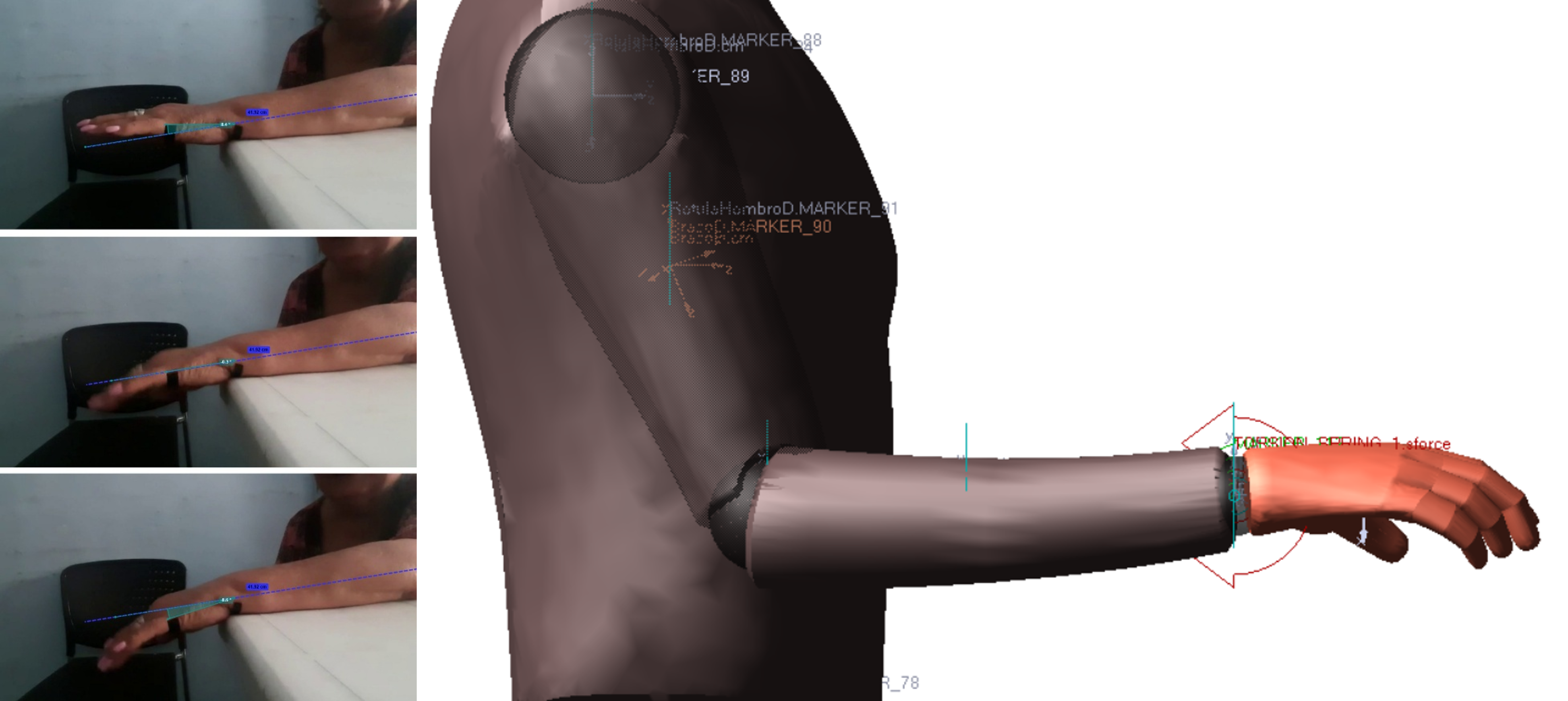
Hand tremor is the most common involuntary movement, caused by neurodegenerative age-related diseases and movement disorders, as Parkinson's disease and essential tremor, recognized as the most common movement disorder among the elderly, affecting 0.9% of world's population, the main essential tremor's characteristic, is the kinetic tremor, which appears in the realization of voluntary movements in daily activities, such as, writing, eating and drinking. In this paper we present the analysis of hand tremor captured in video using Kinovea software, this analysis is used then to develop a virtual environment of simulation in MSC Adams View software, aiming to integrate these programs in the development of prototypes and control techniques for hand tremor suppression, in this paper it was simulated the influence of tremor in wrist in rest and during a voluntary action, also it was simulated the action of an exoskeleton by implementing a PD control to suppress the tremor, obtaining a 99.63% of suppression in movements with frequencies in tremor characteristic range (4 to 12Hz).
Downloads
References
[1] K. Adabi and W. G. Ondo, “Shaking up Essential tremor: Peripheral devices and mechanical strategies to reduce tremor,” Tremor and Other Hyperkinetic Movements, vol. 14, no. 1, p. 55, Jan. 2024, doi: 10.5334/tohm.930.
[2] J. Mo and R. Priefer, “Medical Devices for Tremor Suppression: Current status and future directions,” Biosensors, vol. 11, no. 4, p. 99, Mar. 2021, doi: 10.3390/bios11040099.
[3] E. D. Louis, “Essential tremor,” New England Journal of Medicine, vol. 345, no. 12, pp. 887–891, Sep. 2001, doi: 10.1056/nejmcp010928.
[4] E. D. Louis and D. G. Machado, “Tremor-related quality of life: A comparison of essential tremor vs. Parkinson’s disease patients,” Parkinsonism & Related Disorders, vol. 21, no. 7, pp. 729–735, Apr. 2015, doi: 10.1016/j.parkreldis.2015.04.019.
[5] J. K. Monin et al., “Psychological Suffering in Essential Tremor: A study of patients and those who are close to them,” Tremor and Other Hyperkinetic Movements, vol. 7, no. 0, p. 526, Dec. 2017, doi: 10.5334/tohm.338.
[6] T. A. Zesiewicz et al., “Practice Parameter: Therapies for essential tremor [RETIRED],” Neurology, vol. 64, no. 12, pp. 2008–2020, Jun. 2005, doi: 10.1212/01.wnl.0000163769.28552.cd.
[7] T. A. Zesiewicz et al., “Evidence-based guideline update: Treatment of essential tremor,” Neurology, vol. 77, no. 19, pp. 1752–1755, Oct. 2011, doi: 10.1212/wnl.0b013e318236f0fd.
[8] D. Haubenberger and M. Hallett, “Essential tremor,” New England Journal of Medicine, vol. 378, no. 19, pp. 1802–1810, May 2018, doi: 10.1056/nejmcp1707928.
[9] J. Kim, T. Wichmann, O. T. Inan, and S. P. Deweerth, “A wearable system for attenuating essential tremor based on peripheral nerve stimulation,” IEEE Journal of Translational Engineering in Health and Medicine, vol. 8, pp. 1–11, Jan. 2020, doi: 10.1109/jtehm.2020.2985058.
[10] A. Yi, B. Zhang, N. Lau, and D. Zhang, “A hand exoskeleton with linear motors (HELM) for pathological tremor suppression of fingers,” Intelligent Sports and Health, vol. 1, no. 2, pp. 86–97, Apr. 2025, doi: 10.1016/j.ish.2025.03.002.
[11] A. Velisar et al., “Dual threshold neural closed-loop deep brain stimulation in Parkinson disease patients,” Brain Stimulation, vol. 12, no. 4, pp. 868–876, Feb. 2019, doi: 10.1016/j.brs.2019.02.020.
[12] G. Weerasinghe, B. Duchet, H. Cagnan, P. Brown, C. Bick, and R. Bogacz, “Predicting the effects of deep brain stimulation using a reduced coupled oscillator model,” PLoS Computational Biology, vol. 15, no. 8, p. e1006575, Aug. 2019, doi: 10.1371/journal.pcbi.1006575.
[13] J. S. Lora-Millan, G. Delgado-Oleas, J. Benito-León, and E. Rocon, “A review on Wearable Technologies for tremor Suppression,” Frontiers in Neurology, vol. 12, p. 700600, Aug. 2021, doi: 10.3389/fneur.2021.700600.
[14] E. Rocon, J. M. Belda-Lois, A. F. Ruiz, M. Manto, J. C. Moreno, and J. L. Pons, “Design and validation of a rehabilitation robotic exoskeleton for tremor assessment and suppression,” IEEE Transactions on Neural Systems and Rehabilitation Engineering, vol. 15, no. 3, pp. 367–378, Sep. 2007, doi: 10.1109/tnsre.2007.903917.
[15] Manzanares Quirós, Luis A.; Blanco Ortega, Andrés; Colín Ocampo, Jorge; Abúndez Pliego, Arturo; Cortés García, Claudia; Santana Camilo, José A. A Review on Control Devices for Hand Tremor Suppression. Tecnología y Ciencia Aplicada, 2025. Vol.8, No. 1.
[16] J. J. Hathaliya, H. Modi, R. Gupta, S. Tanwar, P. Sharma, and R. Sharma, “Parkinson and essential tremor classification to identify the
patient’s risk based on tremor severity,” Computers & Electrical Engineering, vol. 101, p. 107946, Apr. 2022, doi: 10.1016/j.compeleceng.2022.107946.
[17] T. Ando, M. Watanabe, K. Nishimoto, Y. Matsumoto, M. Seki, and M. G. Fujie, “Myoelectric-Controlled Exoskeletal Elbow Robot to suppress essential tremor: extraction of elbow flexion movement using STFTs and TDNN,” Journal of Robotics and Mechatronics, vol. 24, no. 1, pp. 141–149, Feb. 2012, doi: 10.20965/jrm.2012.p0141.
[18] T. Akıncı, N. Başçı, A. Gündüz, and M. E. Kızıltan, “Tremor analysis using surface electromyography: Is it required?,” Cerrahpasa Medical Journal, vol. 48, no. 3, pp. 272–274, Dec. 2024, doi: 10.5152/cjm.2024.24015.
[19] S. Williams, H. Fang, J. Alty, R. Qahwaji, P. Patel, and C. D. Graham, “A smartphone camera reveals an ‘invisible’ Parkinsonian tremor: a potential pre-motor biomarker?,” Journal of Neurology, vol. 265, no. 12, pp. 3017–3018, Sep. 2018, doi: 10.1007/s00415-018-9060-z.
[20] G. Deuschl, “Essential tremor and cerebellar dysfunction: Clinical and kinematic analysis of intention tremor,” Brain, vol. 123, no. 8, pp. 1568–1580, Aug. 2000, doi: 10.1093/brain/123.8.1568.
[21] F. Vial, P. Kassavetis, S. Merchant, D. Haubenberger, and M. Hallett, “How to do an electrophysiological study of tremor,” Clinical Neurophysiology Practice, vol. 4, pp. 134–142, Jan. 2019, doi: 10.1016/j.cnp.2019.06.002.
[22] B. Adlou, C. Wilburn, and W. Weimar, “Motion capture Technologies for Athletic Performance Enhancement and Injury Risk Assessment: A Review for Multi-Sport Organizations,” Sensors, vol. 25, no. 14, p. 4384, Jul. 2025, doi: 10.3390/s25144384.
[23] J. Dorado et al., “A computer-vision-based system for at-home rheumatoid arthritis rehabilitation,” International Journal of Distributed Sensor Networks, vol. 15, no. 9, p. 155014771987564, Sep. 2019, doi: 10.1177/1550147719875649.
[24] T. Hellsten, J. Karlsson, M. Shamsuzzaman, and G. Pulkkis, “The potential of Computer Vision-Based Marker-Less Human Motion Analysis for rehabilitation,” Rehabilitation Process and Outcome, vol. 10, p. 11795727211022330, Jan. 2021, doi: 10.1177/11795727211022330.
[25] K. Mills. “Motion analysis in the clinic: There’s an app for that”. Journal of Physiotherapy. vol. 61, no. 1, p. 49–50. 2015. doi: 10.1016/J.JPHYS.2014.11.014
[26] T. V. Ilić, S. Milanović, V. Potkonjak, A. Rodić, J. Santos-Victor, and S. Spasojević, “Combined vision and wearable sensors-based system for movement analysis in rehabilitation,” Methods of Information in Medicine, vol. 56, no. 02, pp. 95–111, Dec. 2016, doi: 10.3414/me16-02-0013.
[27] X. Suo, W. Tang, and Z. Li, “Motion capture Technology in sports scenarios: A survey,” Sensors, vol. 24, no. 9, p. 2947, May 2024, doi: 10.3390/s24092947.
[28] P. Fernández-González, A. Koutsou, A. Cuesta-Gómez, M. Carratalá-Tejada, J. C. Miangolarra-Page, and F. Molina-Rueda, “Reliability of Kinovea® Software and Agreement with a Three-Dimensional Motion System for Gait Analysis in Healthy Subjects,” Sensors, vol. 20, no. 11, p. 3154, Jun. 2020, doi: 10.3390/s20113154.
[29] C.H. Guzmán; A. Blanco; M.A. Oliver; J.L. Carrera, “Therapeutic Motion Analysis of Lower Limbs Using Kinovea.” International Journal of Soft Computing and Engineering (IJSCE), vol. 3, no. 2, 2013.
[30] Blanco-Ortega, Andrés, Colin-Ocampo, Jorge, Abúndez-Pliego, Arturo, Santana Camilo José A., Lara Barrios, Carlos M. y Vargas Ortiz, Miltón U. Rehabilitation movement analysis in upper limbs with Kinovea. Revista de Ingeniería y Tecnologías para el Desarrollo Sustentable. 13 (2025) 1 – 9.
[31] F. Zsarnoczky-Dulhazi, S. Agod, S. Szarka, K. Tuza, & B. Kopper. “AI-Based Motion Analysis Software for Sport and Physical Therapy Assessment”. Revista Brasileira de Medicina do Esporte. 2024. doi: 10.1590/1517-8692202430012022_0020i.
[32] R. Contini, R. J. Drillis, and M. Bluestein, “Determination of body segment parameters,” Human Factors: The Journal of the Human Factors and Ergonomics Society, vol. 5, no. 5, pp. 493–504, Oct. 1963, doi: 10.1177/001872086300500508.
[33] P. De Leva, “Adjustments to Zatsiorsky-Seluyanov’s segment inertia parameters,” Journal of Biomechanics, vol. 29, no. 9, pp. 1223–1230, Sep. 1996, doi: 10.1016/0021-9290(95)00178-6.
[34] N. Hogan, “Impedance Control: An Approach to Manipulation: Part II—Implementation,” Journal of Dynamic Systems Measurement and Control, vol. 107, no. 1, pp. 8–16, Mar. 1985, doi: 10.1115/1.3140713.
[35] H. Gomi and M. Kawato, “Human arm stiffness and equilibrium-point trajectory during multi-joint movement,” Biological Cybernetics, vol. 76, no. 3, pp. 163–171, Apr. 1997, doi: 10.1007/s004220050329.
[36] E. J. Perreault, R. F. Kirsch, and A. M. Acosta, “Multiple-input, multiple-output system identification for characterization of limb stiffness dynamics,” Biological Cybernetics, vol. 80, no. 5, pp. 327–337, May 1999, doi: 10.1007/s004220050529.
[37] S. Das et al., “Quantitative measurement of motor symptoms in Parkinson’s disease: A study with full-body motion capture data,” 33rd Annual International Conference of the IEEE EMBS, vol. 2011, pp. 6789–6792, Aug. 2011, doi: 10.1109/iembs.2011.6091674.
[38] P. M. Pecoraro, L. Marsili, A. J. Espay, M. Bologna, and L. Di Biase, “Computer Vision Technologies in Movement Disorders: A Systematic Review,” Movement Disorders Clinical Practice, vol. 12, no. 9, pp. 1229–1243, May 2025, doi: 10.1002/mdc3.70123.
[39] J. Shin et al., “Classification of Hand-Movement disabilities in Parkinson’s Disease using a Motion-Capture device and machine learning,” IEEE Access, vol. 12, pp. 52466–52479, Jan. 2024, doi: 10.1109/access.2024.3386367.
[40] P. Wegner et al., “Markerless motion capture reveals movement abnormalities in isolated REM sleep behavior disorder,” medRxiv, Sep. 2026, doi: 10.64898/2026.08.28.26361609.
[41] M. Delrobaei, S. Memar, M. Pieterman, T. W. Stratton, K. McIsaac, and M. Jog, “Towards remote monitoring of Parkinson’s disease tremor using wearable motion capture systems,” Journal of the Neurological Sciences, vol. 384, pp. 38–45, Nov. 2017, doi: 10.1016/j.jns.2017.11.004.
[42] P. Khwaounjoo et al., “Non-Contact hand movement analysis for optimal configuration of smart sensors to capture Parkinson’s disease hand tremor,” Sensors, vol. 22, no. 12, p. 4613, Jun. 2022, doi: 10.3390/s22124613.
[43] S. L. Pintea, J. Zheng, X. Li, P. J. M. Bank, J. J. Van Hilten, and J. C. Van Gemert, “Hand-Tremor frequency estimation in videos,” Lecture Notes in Computer Science, pp. 213–228, Jan. 2019, doi: 10.1007/978-3-030-11024-6_14.
[44] Y. Zhou, M. E. Jenkins, M. D. Naish, and A. L. Trejos, “The measurement and analysis of Parkinsonian hand tremor,” IEEE-EMBS International Conference on Biomedical and Health Informatics (BHI ...), pp. 414–417, Feb. 2016, doi: 10.1109/bhi.2016.7455922.
[45] Y. Zhou, M. E. Jenkins, M. D. Naish, and A. L. Trejos, “Characterization of Parkinsonian hand tremor and validation of a High-Order Tremor estimator,” IEEE Transactions on Neural Systems and Rehabilitation Engineering, vol. 26, no. 9, pp. 1823–1834, Jul. 2018, doi: 10.1109/tnsre.2018.2859793.
[46] L. Ferrigno et al., “A real-time tracking system for tremor and trajectory estimation in Parkinson’s disease-affected patients,” IEEE International Symposium on Medical Measurements and Applications (MeMeA), pp. 1–6, Jun. 2020, doi: 10.1109/memea49120.2020.9137210.
Downloads
Published
Data Availability Statement
The data supporting the findings of this study are available upon reasonable request from the corresponding author.
Issue
Section
Categories
License
Copyright (c) 2026 Luis Alfonso Manzanares Quirós, Andrés Blanco-Ortega, Rafael Campos Amezcua, Enrique Alcudia-Zacarías, Arturo Abúndez Pliego, Arturo Javier Martínez Mata

This work is licensed under a Creative Commons Attribution 4.0 International License.
The authors who publish in this journal accept the following conditions:
The authors retain the copyright and assign to the journal the right of the first publication, with the work registered with the Creative Commons Attribution license 4.0, which allows third parties to use what is published as long as they mention the authorship of the work and the first publication in this magazine.
Authors may make other independent and additional contractual agreements for the non-exclusive distribution of the version of the article published in this journal (eg, include it in an institutional repository or publish it in a book) as long as they clearly indicate that the work it was first published in this magazine.
Authors are allowed and encouraged to share their work online (for example: in institutional repositories or personal web pages) before and during the manuscript submission process, as it can lead to productive exchanges, greater and more quick citation of published work (see The Effect of Open Access).
How to Cite