Micromodeling strategy for reinforced concrete columns: validation against cyclic tests
DOI:
https://doi.org/10.37636/recit.v9n3e474Keywords:
Micromodeling, Reinforced concrete, Hysteretic energyAbstract
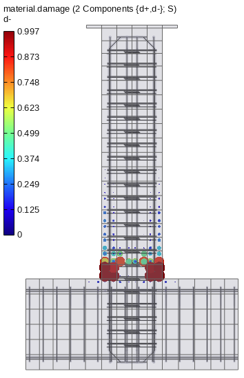
Simulating the cyclic behavior of reinforced concrete columns using fiber or lumped plasticity models requires calibrations to capture the effects of confinement, shear, or localized failure modes. This article proposes a micromodeling strategy implemented in OpenSees, characterized by simplified parameterization where the constitutive properties are derived exclusively from the concrete's compressive strength and the steel's yield strength. The concrete is represented by a plastic damage model with fracture energy regularization, while the reinforcing steel incorporates post-yield buckling and cyclic degradation. The methodology was validated against six experimental specimens with axial load ratios between 0.00 and 0.22. The results demonstrate average fit indices of 0.90. The model captured the formation of the plastic hinge and post-peak degradation, confirming that mechanical interaction and confinement emerge naturally from the formulation without the need for predefined damage hypotheses or plastic regions.
Downloads
References
[1] T. B. Panagiotakos y M. N. Fardis, “A displacement-based seismic design procedure for RC buildings and comparison with EC8”, Earthq. Eng. Struct. Dyn., vol. 30, núm. 10, pp. 1439–1462, 2001, doi: 10.1002/eqe.71. DOI: https://doi.org/10.1002/eqe.71
[2] J. Coleman y E. Spacone, “Localization Issues in Force-Based Frame Elements”, J. Struct. Eng., vol. 127, núm. 11, p. 1257, 2001, doi: 10.1061/(ASCE)0733-9445(2001)127:11(1257). DOI: https://doi.org/10.1061/(ASCE)0733-9445(2001)127:11(1257)
[3] L. Pelà, M. Cervera, y P. Roca, “Continuum damage model for orthotropic materials: Application to masonry”, Comput. Methods Appl. Mech. Eng., vol. 200, núm. 9–12, pp. 917–930, feb. 2011, doi: 10.1016/j.cma.2010.11.010. DOI: https://doi.org/10.1016/j.cma.2010.11.010
[4] F. Di Trapani, M. Di Benedetto, M. Petracca, y G. Camata, “Infill-frame interaction: Refined modelling for the analysis and the estimation of the internal forces in seismic assessment of RC building structures”, en COMPDYN Proceedings, National Technical University of Athens, 2023. doi: 10.7712/120123.10607.21394. DOI: https://doi.org/10.7712/120123.10607.21394
[5] H. García, J. Jiménez-Pacheco, y J. Ulloa, “Effective properties of masonry structures and macro-model analysis with experimental verification”, Results in Engineering, vol. 23, sep. 2024, doi: 10.1016/j.rineng.2024.102546. DOI: https://doi.org/10.1016/j.rineng.2024.102546
[6] S. Villar, M. Di Benedetto, A. P. Sberna, M. Petracca, G. Camata, y F. Di Trapani, “Seismic Response of Masonry Aggregate Buildings by Explicit Modelling Different Interconnection Degrees”, en Lecture Notes in Civil Engineering, Springer Science and Business Media Deutschland GmbH, 2025, pp. 183–192. doi: 10.1007/978-3-031-90690-9_16. DOI: https://doi.org/10.1007/978-3-031-90690-9_16
[7] B. Alfarah, F. López-Almansa, y S. Oller, “New methodology for calculating damage variables evolution in Plastic Damage Model for RC structures”, Eng. Struct., vol. 132, pp. 70–86, feb. 2017, doi: 10.1016/j.engstruct.2016.11.022. DOI: https://doi.org/10.1016/j.engstruct.2016.11.022
[8] G. Fawaz y J. Murcia-Delso, “Three-dimensional finite element modeling of RC columns subjected to cyclic lateral loading”, Eng. Struct., vol. 239, jul. 2021, doi: 10.1016/j.engstruct.2021.112291. DOI: https://doi.org/10.1016/j.engstruct.2021.112291
[9] L. Jason, M. Choinska, G. Pijaudier-Cabot, S. Ghavamian, y A. Huerta, “Validation of a Damage Plasticity Model for Concrete in Tension and in Compression”, en VIII International Conference on Computational Plasticity, 2005. [En línea]. Disponible en: http://www.cea.fr
[10] L. Benedetti, M. Cervera, y M. Chiumenti, “3D numerical modelling of twisting cracks under bending and torsion of skew notched beams”, Eng. Fract. Mech., vol. 176, pp. 235–256, may 2017, doi: 10.1016/j.engfracmech.2017.03.025. DOI: https://doi.org/10.1016/j.engfracmech.2017.03.025
[11] F. McKenna, G. Fenves, y M. Scott, “Open System for Earthquake Engineering Simulation”, Pacific Earthquake Engineering Research Center, University of California, Berkeley, California, 2000.
[12] M. Berry, M. Parrish, y M. Eberhard, “PEER Structural Performance Database User’s Manual (Version 1.0)”, Pacific Earthquake Engineering Research Center, University of California, Berkeley, California, 2004.
[13] J. Ruiz Carmona, “Study of cracking processes in reinforced concrete elements”, Tesis doctoral, 2006.
[14] H. D. Kang, K. Willam, B. Shing, y E. Spacone, “Failure analysis of R/C columns using a triaxial concrete model”, Comput. Struct., vol. 77, núm. 5, pp. 423–440, 2000, doi: 10.1016/S0045-7949(00)00006-7. DOI: https://doi.org/10.1016/S0045-7949(00)00006-7
[15] G. Markou y M. Papadrakakis, “Computationally efficient 3D finite element modeling of RC structures”, Computers and Concrete, vol. 12, núm. 4, pp. 443–498, oct. 2013, doi: 10.12989/cac.2013.12.4.443. DOI: https://doi.org/10.12989/cac.2013.12.4.443
[16] M. Moharrami y I. Koutromanos, “Finite element analysis of damage and failure of reinforced concrete members under earthquake loading”, Earthq. Eng. Struct. Dyn., vol. 46, núm. 15, pp. 2811–2829, dic. 2017, doi: 10.1002/eqe.2932. DOI: https://doi.org/10.1002/eqe.2932
[17] T. Shamsi y Y. Sümer, “A Finite Element Modeling Approach for Analyzing the Cyclic Behavior of RC Frames”, Arab. J. Sci. Eng., vol. 49, núm. 10, pp. 13749–13768, oct. 2024, doi: 10.1007/s13369-024-08788-y. DOI: https://doi.org/10.1007/s13369-024-08788-y
[18] M. Petracca, G. Camata, E. Spacone, y L. Pelà, “Efficient Constitutive Model for Continuous Micro-Modeling of Masonry Structures”, International Journal of Architectural Heritage, vol. 17, núm. 1, pp. 134–146, 2022, doi: 10.1080/15583058.2022.2124133. DOI: https://doi.org/10.1080/15583058.2022.2124133
[19] R. K. Abu Al-Rub y S. M. Kim, “Computational applications of a coupled plasticity-damage constitutive model for simulating plain concrete fracture”, Eng. Fract. Mech., vol. 77, núm. 10, pp. 1577–1603, jul. 2010, doi: 10.1016/j.engfracmech.2010.04.007. DOI: https://doi.org/10.1016/j.engfracmech.2010.04.007
[20] U. Häussler-Combe y J. Hartig, “Formulation and numerical implementation of a constitutive law for concrete with strain-based damage and plasticity”, Int. J. Non. Linear. Mech., vol. 43, núm. 5, pp. 399–415, jun. 2008, doi: 10.1016/j.ijnonlinmec.2008.01.005. DOI: https://doi.org/10.1016/j.ijnonlinmec.2008.01.005
[21] J. B. Mander, M. J. N. Priestley, y R. Park, “Theoretical Stress-Strain Model for Confined Concrete”, J. Struct. Eng., vol. 114, núm. 8, p. 1804, 1988, doi: 10.1061/(ASCE)0733-9445(1988)114:8(1804). DOI: https://doi.org/10.1061/(ASCE)0733-9445(1988)114:8(1804)
[22] E. Hognestad, “A study of combined bending and axial load in reinforced concrete members”, 1951.
[23] American Concrete Institute (ACI), Requisitos de Reglamento para Concreto Estructural (ACI 318-19). 2019.
[24] CEB-FIB, The fib Model Code for Concrete Structures. International Federation for Structural Concrete, 2010.
[25] P. Feenstra y R. De Borst, “A composite plasticity model for concrete”, Int. J. Solids Struct., 1996, doi: 10.1016/0020-7683(95)00060-N. DOI: https://doi.org/10.1016/0020-7683(95)00060-N
[26] A. Hillerborg, M. Modéer, y P.-E. Petersson, “Analysis of Crack Formation and Crack Growth in Concrete by Means of Fracture Mechanics and Finite Elements”, Cem. Concr. Res., vol. 6, núm. 6, pp. 773–782, 1976, doi: 10.1016/0008-8846(76)90007-7. DOI: https://doi.org/10.1016/0008-8846(76)90007-7
[27] J. Oliver, “A Consistent Characteristic Length for Smeared Cracking Models”, Int. J. Numer. Methods Eng., vol. 28, pp. 461–474, 1989, doi: 10.1002/nme.1620280214. DOI: https://doi.org/10.1002/nme.1620280214
[28] R. P. Dhakal y K. Maekawa, “Modeling for Postyield Buckling of Reinforcement”, J. Struct. Eng., vol. 128, núm. 9, pp. 1139–1147, sep. 2002, doi: 10.1061/(asce)0733-9445(2002)128:9(1139). DOI: https://doi.org/10.1061/(ASCE)0733-9445(2002)128:9(1139)
[29] F. C. Filippou, E. P. Popov, y V. V. Bertero, “Effects of bond deterioration on hysteretic behavior of reinforced concrete joints”, Report EERC 83-19, Earthquake Engineering Research Center, University of California, Berkeley, 1983.
[30] M. M. Kashani, L. N. Lowes, A. J. Crewe, y N. A. Alexander, “Nonlinear fibre element modelling of RC bridge piers considering inelastic buckling of reinforcement”, Eng. Struct., vol. 116, pp. 163–177, jun. 2016, doi: 10.1016/j.engstruct.2016.02.051. DOI: https://doi.org/10.1016/j.engstruct.2016.02.051
[31] M. Petracca, L. Pelà, R. Rossi, S. Zaghi, G. Camata, y E. Spacone, “Micro-scale continuous and discrete numerical models for nonlinear analysis of masonry shear walls”, Constr. Build. Mater., vol. 149, pp. 296–314, sep. 2017, doi: 10.1016/j.conbuildmat.2017.05.130. DOI: https://doi.org/10.1016/j.conbuildmat.2017.05.130
[32] Applied Technology Council, Guidelines for Cyclic Seismic Testing of Components of Steel Structures, ATC-24. Redwood City, CA, 1992.
[33] Y. L. Mo y S. J. Wang, “Seismic behavior of RC columns with various tie configurations”, J. Struct. Eng., vol. 126, núm. 10, p. 1122, 2000, doi: 10.1061/(ASCE)0733-9445(2000)126:10(1122). DOI: https://doi.org/10.1061/(ASCE)0733-9445(2000)126:10(1122)
[34] M. Saatcioglu y G. Ozcebe, “Response of Reinforced Concrete Columns to Simulated Seismic Loading”, ACI Struct. J., vol. 86, núm. 1, pp. 3–12, 1989, doi: 10.14359/2607. DOI: https://doi.org/10.14359/2607
[35] J. Zhao y S. Sritharan, “Modeling of Strain Penetration Effects in Fiber-Based Analysis of Reinforced Concrete Structures”, ACI Struct. J., vol. 104, núm. 2, pp. 133–141, 2007, doi: 10.14359/18525. DOI: https://doi.org/10.14359/18525
Downloads
Published
Data Availability Statement
The data that support the findings of this study are available from the corresponding author upon reasonable request.
Issue
Section
Categories
License
Copyright (c) 2026 Esteban Mateo Narváez Vázquez, Edén Bojórquez Mora, Pablo David Quinde Martínez

This work is licensed under a Creative Commons Attribution 4.0 International License.
The authors who publish in this journal accept the following conditions:
The authors retain the copyright and assign to the journal the right of the first publication, with the work registered with the Creative Commons Attribution license 4.0, which allows third parties to use what is published as long as they mention the authorship of the work and the first publication in this magazine.
Authors may make other independent and additional contractual agreements for the non-exclusive distribution of the version of the article published in this journal (eg, include it in an institutional repository or publish it in a book) as long as they clearly indicate that the work it was first published in this magazine.
Authors are allowed and encouraged to share their work online (for example: in institutional repositories or personal web pages) before and during the manuscript submission process, as it can lead to productive exchanges, greater and more quick citation of published work (see The Effect of Open Access).
How to Cite