Comparison of LEO satellite constellation systems for global broadband communications
DOI:
https://doi.org/10.37636/10.37636/recit.v9n3e449Keywords:
LEO constellations, Global broadband communications, Network architecture, Coverage modeling, Latency performance, System comparison.Abstract
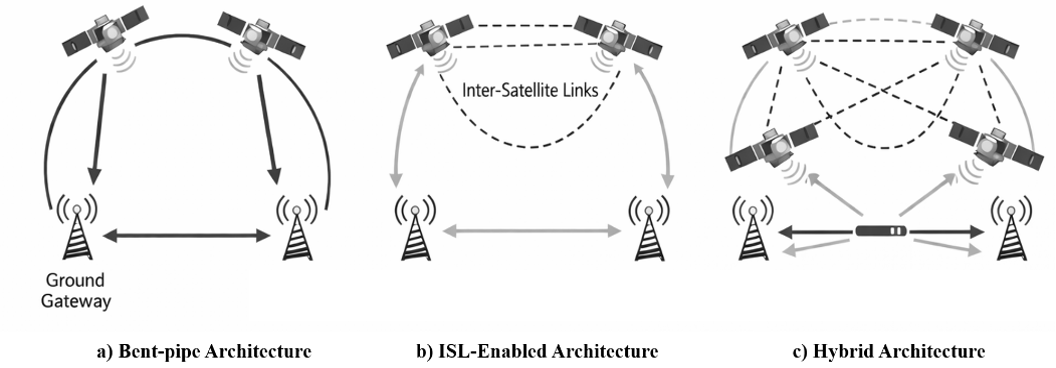
This paper introduces a quantitative framework designed to evaluate and compare Low Earth Orbit (LEO) satellite constellations for global broadband communications. The analysis considers four representative systems: Starlink, OneWeb, Telesat, and Amazon’s Project Kuiper, capturing both orbital configuration and network architecture as key design characteristics. The proposed methodology integrates a geometric coverage model together with a latency formulation that accounts for propagation delay and routing effects including Inter-Satellite Links (ISL). In addition, a service density metric is introduced to characterize the spatial distribution of satellites and its impact on system capacity. These metrics are combined into a normalized multi-criteria performance index, allowing a consistent and reproducible system-level comparison. The results reveal that, while coverage is primarily governed by orbital altitude, network architecture plays a dominant role in effective latency, with ISL-enabled constellations achieving improved routing efficiency compared to bent-pipe designs. The integrated performance index shows that low altitude, high-density constellations achieve superior overall performance under latency sensitive scenarios. Starlink ranking highest due to its reduced delay and high spatial density. Project Kuiper exhibits balanced performance across all metrics, while OneWeb and Telesat are constrained by higher latency and lower density despite their broader coverage.
Downloads
References
[1] O. Kodheli et al., “Satellite Communications in the New Space Era: A Survey and Future Challenges,” IEEE Communications Surveys & Tutorials, vol. 23, no. 1, pp. 70–109, 2021, doi: 10.1109/COMST.2020.3028247. DOI: https://doi.org/10.1109/COMST.2020.3028247
[2] M. Giordani, M. Polese, M. Mezzavilla, S. Rangan, and M. Zorzi, “Toward 6G Networks: Use Cases and Technologies,” IEEE Communications Magazine, vol. 58, no. 3, pp. 55–61, Mar. 2020, doi: 10.1109/MCOM.001.1900411. DOI: https://doi.org/10.1109/MCOM.001.1900411
[3] B. Di, L. Song, Y. Li, and H. V. Poor, “Ultra-Dense LEO: Integration of Satellite Access Networks into 5G and Beyond,” IEEE Wirel. Commun., vol. 26, no. 2, pp. 62–69, Apr. 2019, doi: 10.1109/MWC.2019.1800301. DOI: https://doi.org/10.1109/MWC.2019.1800301
[4] X. Lin et al., “5G New Radio Evolution Meets Satellite Communications: Opportunities, Challenges, and Solutions,” in 5G and Beyond, Cham: Springer International Publishing, 2021, pp. 517–531. doi: 10.1007/978-3-030-58197-8_18. DOI: https://doi.org/10.1007/978-3-030-58197-8_18
[5] L. J. Ippolito, Satellite Communications Systems Engineering. Wiley, 2017. doi: 10.1002/9781119259411. DOI: https://doi.org/10.1002/9781119259411
[6] P. Techavijit, P. Sukchalerm, N. Wongphuangfuthaworn, A. Plodpai, S. Manuthasna, and S. Chivapreecha, “Internet Network in Space for Small Satellites: Concept and Experiments,” Sensors and Materials, vol. 30, no. 10, p. 2295, Oct. 2018, doi: 10.18494/SAM.2018.1854. DOI: https://doi.org/10.18494/SAM.2018.1854
[7] E. Lagunas, S. Chatzinotas, and B. Ottersten, “Low-Earth orbit satellite constellations for global communication network connectivity,” Nature Reviews Electrical Engineering, vol. 1, no. 10, pp. 656–665, Sep. 2024, doi: 10.1038/s44287-024-00088-9. DOI: https://doi.org/10.1038/s44287-024-00088-9
[8] J. Zheng et al., “Low Earth Orbit Satellite Networks: Architecture, Key Technologies, Measurement, and Open Issues,” IEEE Netw., vol. 40, no. 2, pp. 295–303, Mar. 2026, doi: 10.1109/MNET.2025.3572141. DOI: https://doi.org/10.1109/MNET.2025.3572141
[9] D.-H. Jung, J.-G. Ryu, W.-J. Byun, and J. Choi, “Performance Analysis of Satellite Communication System Under the Shadowed-Rician Fading: A Stochastic Geometry Approach,” IEEE Transactions on Communications, vol. 70, no. 4, pp. 2707–2721, Apr. 2022, doi: 10.1109/TCOMM.2022.3142290. DOI: https://doi.org/10.1109/TCOMM.2022.3142290
[10] S. Cakaj, “The Parameters Comparison of the ‘Starlink’ LEO Satellites Constellation for Different Orbital Shells,” Frontiers in Communications and Networks, vol. 2, May 2021, doi: 10.3389/frcmn.2021.643095. DOI: https://doi.org/10.3389/frcmn.2021.643095
[11] G. Yang, D. Zhu, P. Huang, and X. He, “Latency-Efficient Server Placement for LEO Satellite Edge Computing,” IEEE Internet Things J., vol. 12, no. 23, pp. 49543–49554, Dec. 2025, doi: 10.1109/JIOT.2025.3603964. DOI: https://doi.org/10.1109/JIOT.2025.3603964
[12] K. Kashiwagi and K. Tsukamoto, “Orbital Prediction Based Routing for ISL-Enabled LEO Satellite Networks,” in 2026 IEEE 23rd Consumer Communications & Networking Conference (CCNC), IEEE, Jan. 2026, pp. 1–6. doi: 10.1109/CCNC65079.2026.11366576. DOI: https://doi.org/10.1109/CCNC65079.2026.11366576
[13] Z. Yang, H. Liu, J. Jin, and F. Tian, “A Cooperative Routing Scheme Using Inter-Satellite Links to Assist Data Downloading for LEO Satellite Networks,” Sensors, vol. 22, no. 20, p. 7986, Oct. 2022, doi: 10.3390/s22207986. DOI: https://doi.org/10.3390/s22207986
[14] X. Cao, Y. Li, X. Xiong, and J. Wang, “Dynamic Routings in Satellite Networks: An Overview,” Sensors, vol. 22, no. 12, p. 4552, Jun. 2022, doi: 10.3390/s22124552. DOI: https://doi.org/10.3390/s22124552
[15] J. Lee, S. Noh, S. Jung, and N. Lee, “Coverage Analysis of LEO Satellite Downlink Networks: Orbital Geometry Dependent Approach,” IEEE Access, vol. 12, pp. 196939–196953, 2024, doi: 10.1109/ACCESS.2024.3522377. DOI: https://doi.org/10.1109/ACCESS.2024.3522377
[16] S. Cakaj, B. Kamo, A. Lala, and A. Rakipi, “The Coverage Analysis for Low Earth Orbiting Satellites at Low Elevation,” International Journal of Advanced Computer Science and Applications, vol. 5, no. 6, 2014, doi: 10.14569/IJACSA.2014.050602. DOI: https://doi.org/10.14569/IJACSA.2014.050602
[17] M. Handley, “Delay is Not an Option,” in Proceedings of the 17th ACM Workshop on Hot Topics in Networks, New York, NY, USA: ACM, Nov. 2018, pp. 85–91. doi: 10.1145/3286062.3286075. DOI: https://doi.org/10.1145/3286062.3286075
[18] J. Liu, “Overview of Low Earth Orbit Satellite Communication Systems,” Applied and Computational Engineering, vol. 145, no. 1, pp. 1–6, Apr. 2025, doi: 10.54254/2755-2721/2025.21920. DOI: https://doi.org/10.54254/2755-2721/2025.21920
[19] M. Mishra, G. Vijayalakshmi, B. Reddy, M. Manjula, S. R. Rathi, and S. Hemelatha, “Design and Analysis of Satellite Constellation Systems for Global Coverage and Capacity,” in 2024 15th International Conference on Computing Communication and Networking Technologies (ICCCNT), IEEE, Jun. 2024, pp. 1–6. doi: 10.1109/ICCCNT61001.2024.10724262. DOI: https://doi.org/10.1109/ICCCNT61001.2024.10724262
[20] M. Beyaz, “Satellite Communications with 5G, B5G, and 6G: Challenges and Prospects,” International Journal of Communications, Network and System Sciences, vol. 17, no. 03, pp. 31–49, 2024, doi: 10.4236/ijcns.2024.173003. DOI: https://doi.org/10.4236/ijcns.2024.173003
[21] J. C. McDowell, “The Low Earth Orbit Satellite Population and Impacts of the SpaceX Starlink Constellation,” Astrophys. J. Lett., vol. 892, no. 2, p. L36, Apr. 2020, doi: 10.3847/2041-8213/ab8016. DOI: https://doi.org/10.3847/2041-8213/ab8016
[22] Z. Yang, F. Tian, J. Jin, and H. Liu, “Rethinking LEO Mega-Constellation Routing to Provide Fast Internet Access Services,” Sensors, vol. 23, no. 6, p. 3207, Mar. 2023, doi: 10.3390/s23063207. DOI: https://doi.org/10.3390/s23063207
[23] H. Li, D. Shi, W. Wang, D. Liao, T. R. Gadekallu, and K. Yu, “Secure routing for LEO satellite network survivability,” Computer Networks, vol. 211, p. 109011, Jul. 2022, doi: 10.1016/j.comnet.2022.109011. DOI: https://doi.org/10.1016/j.comnet.2022.109011
[24] E. Yaacoub and M.-S. Alouini, “A Key 6G Challenge and Opportunity—Connecting the Base of the Pyramid: A Survey on Rural Connectivity,” Proceedings of the IEEE, vol. 108, no. 4, pp. 533–582, Apr. 2020, doi: 10.1109/JPROC.2020.2976703. DOI: https://doi.org/10.1109/JPROC.2020.2976703
[25] G. Kim, S. Lee, H. Lim, B. C. Jung, and S. H. Chae, “Coverage Probability Analysis of LEO Satellite Communication Systems with Directional Beamforming,” in 2023 Fourteenth International Conference on Ubiquitous and Future Networks (ICUFN), IEEE, Jul. 2023, pp. 243–247. doi: 10.1109/ICUFN57995.2023.10200817. DOI: https://doi.org/10.1109/ICUFN57995.2023.10200817
[26] Z. Zhu, Z. Rao, S. Xiao, Y. Yao, Y. Xu, and W. Meng, “Intelligent routing methods for low-Earth orbit satellite networks based on machine learning: A comprehensive survey,” Ad Hoc Networks, vol. 178, p. 103995, Nov. 2025, doi: 10.1016/j.adhoc.2025.103995. DOI: https://doi.org/10.1016/j.adhoc.2025.103995
[27] E. Elbehiry, H. TagElDien, A. Fares, and B. ElHalawany, “Survey on Routing Algorithms for LEO Constellations Network,” Fayoum University Journal of Engineering, vol. 7, no. 2, pp. 89–99, Mar. 2024, doi: 10.21608/fuje.2024.343800. DOI: https://doi.org/10.21608/fuje.2024.343800
[28] R. do N. M. Macambira, C. B. Carvalho, and J. F. de Rezende, “Energy-efficient routing in LEO satellite networks for extending satellites lifetime,” Comput. Commun., vol. 195, pp. 463–475, Nov. 2022, doi: 10.1016/j.comcom.2022.09.009. DOI: https://doi.org/10.1016/j.comcom.2022.09.009
[29] H. Yang, W. Liu, H. Li, and J. Li, “Maximum Flow Routing Strategy for Space Information Network With Service Function Constraints,” IEEE Trans. Wirel. Commun., vol. 21, no. 5, pp. 2909–2923, May 2022, doi: 10.1109/TWC.2021.3116983. DOI: https://doi.org/10.1109/TWC.2021.3116983
[30] Y. Sun, B. Di, R. Deng, and L. Song, “On an Ultra-Dense LEO-Satellite-Based Computing Network Constellation Design,” Engineering, vol. 54, pp. 103–114, Nov. 2025, doi: 10.1016/j.eng.2025.06.007. DOI: https://doi.org/10.1016/j.eng.2025.06.007
[31] X. Bian, C. Xiao, S. Song, and M. Wu, “Progress in Atmospheric Density Inversion Based on LEO Satellites and Preliminary Experiments for SWARM-A,” Remote Sens. (Basel)., vol. 17, no. 5, p. 793, Feb. 2025, doi: 10.3390/rs17050793. DOI: https://doi.org/10.3390/rs17050793
[32] T. Ma, B. Qian, X. Qin, X. Liu, H. Zhou, and L. Zhao, “Satellite-Terrestrial Integrated 6G: An Ultra-Dense LEO Networking Management Architecture,” IEEE Wirel. Commun., vol. 31, no. 1, pp. 62–69, Feb. 2024, doi: 10.1109/MWC.011.2200198. DOI: https://doi.org/10.1109/MWC.011.2200198
[33] R. Deng, B. Di, H. Zhang, and L. Song, “Ultra-Dense LEO Satellite Constellation Design for Global Coverage in Terrestrial-Satellite Networks,” in GLOBECOM 2020 - 2020 IEEE Global Communications Conference, IEEE, Dec. 2020, pp. 1–6. doi: 10.1109/GLOBECOM42002.2020.9322362. DOI: https://doi.org/10.1109/GLOBECOM42002.2020.9322362
[34] S. Heine, C. Hofmann, and A. Knopp, “End-to-end latency evaluation of LEO satellite IoT systems,” IET Conference Proceedings, vol. 2023, no. 48, pp. 216–221, Mar. 2024, doi: 10.1049/icp.2024.0850. DOI: https://doi.org/10.1049/icp.2024.0850
[35] A. Castro-Carrera, “A systematic review of LEO satellite services for IoT,” Multidisciplinary Reviews, vol. 8, no. 3, p. 2025083, Oct. 2024, doi: 10.31893/multirev.2025083. DOI: https://doi.org/10.31893/multirev.2025083
[36] B. Shang, X. Li, C. Li, and Z. Li, “Coverage in Cooperative LEO Satellite Networks,” Journal of Communications and Information Networks, vol. 8, no. 4, pp. 329–340, Dec. 2023, doi: 10.23919/JCIN.2023.10387244. DOI: https://doi.org/10.23919/JCIN.2023.10387244
[37] M. Bakırcı, “Modeling and simulation of earth coverage of a low earth orbit (LEO) satellite,” European Mechanical Science, vol. 8, no. 2, pp. 85–92, Jun. 2024, doi: 10.26701/ems.1466031. DOI: https://doi.org/10.26701/ems.1466031
Published
Data Availability Statement
.
License
Copyright (c) 2026 Kleiverg Eulalio Encino Morales, Miguel Ángel Sidón Ayala, Rolando Díaz Castillo

This work is licensed under a Creative Commons Attribution 4.0 International License.
The authors who publish in this journal accept the following conditions:
The authors retain the copyright and assign to the journal the right of the first publication, with the work registered with the Creative Commons Attribution license 4.0, which allows third parties to use what is published as long as they mention the authorship of the work and the first publication in this magazine.
Authors may make other independent and additional contractual agreements for the non-exclusive distribution of the version of the article published in this journal (eg, include it in an institutional repository or publish it in a book) as long as they clearly indicate that the work it was first published in this magazine.
Authors are allowed and encouraged to share their work online (for example: in institutional repositories or personal web pages) before and during the manuscript submission process, as it can lead to productive exchanges, greater and more quick citation of published work (see The Effect of Open Access).
How to Cite