Remoción de arsénico y fluoruro del agua mediante filtros con arena, hierro y destilación solar
DOI:
https://doi.org/10.37636/recit.v9n3e491Palabras clave:
Filtros, Remoción, Arsénico, Fluoruro, Agua, Destilación solarResumen
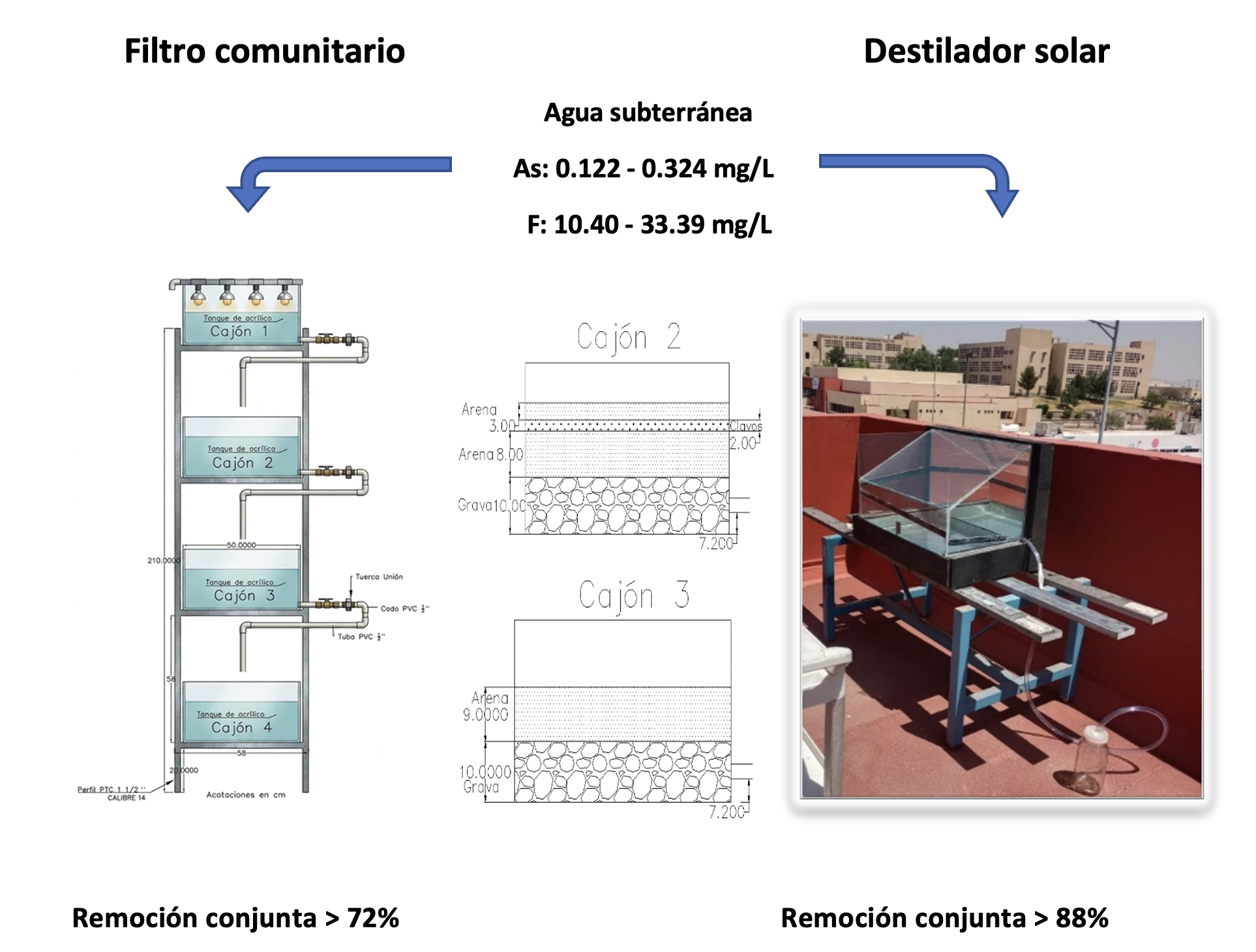
Los prototipos para potabilizar agua son una opción económica y ambiental viable al alcance de una vivienda o sectores urbanos. Esta propuesta se alinea con el derecho humano al agua establecido por la ONU y los Objetivos de Desarrollo Sostenible 6 y 11 de la Agenda 2030. El objetivo del presente estudio es evaluar la eficiencia de tres prototipos para la remoción de arsénico (As) y fluoruro (F) del agua en una comunidad del Estado de Chihuahua. Se hizo la propuesta de diseño, construcción y operación de dos filtros de arenas con clavos de hierro y un destilador solar. Las concentraciones de As (0.0307–0.4527 mg/L) y F (2.32–8.75 mg/L) registradas en el acuífero Meoqui-Delicias son comparables con las del pozo San José de la comunidad La Regina, donde la concentración máxima de As fue de 0.324 mg/L y de F de 33.39 mg/L. Con el filtro casero se alcanzó hasta 96% de remoción de As y 95% de F; para el filtro comunitario, la eficiencia conjunta de As y F fue de más del 72%, y el destilador solar de más del 88%. La eficiencia dependió de la cantidad y tamaño de los clavos, tiempos de filtrado y tipo de arena. El filtro casero en la prueba 2 alcanzó un valor de As (0.009 mg/L), y el destilador solar en la prueba 17 As y F (0.002 y 0.86 mg/L), respectivamente; sin embargo, el agua tratada aún no es potable. El reto actual es involucrar a las comunidades para adaptar y operar estos sistemas.
Descargas
Referencias
[1] P. Singh, S. M. Andrabi, D. B. Raina, and A. Kumar, “Three-stage integrated community-based water filter system for potable water by effective removal of contaminants from groundwater,” Journal of Water Process Engineering, vol. 49, Oct. 2022, doi: 10.1016/j.jwpe.2022.103044. DOI: https://doi.org/10.1016/j.jwpe.2022.103044
[2] E. E. Cañas Kurz, U. Hellriegel, A. Figoli, B. Gabriele, J. Bundschuh, and J. Hoinkis, “Small-scale membrane-based arsenic removal for decentralized applications–Developing a conceptual approach for future utilization,” May 15, 2021, Elsevier Ltd. doi: 10.1016/j.watres.2021.116978. DOI: https://doi.org/10.1016/j.watres.2021.116978
[3] M. A. Armienta-Hernández et al., “Evaluation of the Use of Limestones for the Removal of Arsenic from Groundwater,” Water (Switzerland), vol. 17, no. 11 de junio de 2025, doi: 10.3390/w17111687. DOI: https://doi.org/10.3390/w17111687
[4] L. D. Senanu, G. Kranjac-Berisavljevic, and S. J. Cobbina, “The use of local materials to remove heavy metals for household-scale drinking water treatment: A review,” Feb. 01, 2023, Elsevier B.V. doi: 10.1016/j.eti.2023.103005. DOI: https://doi.org/10.1016/j.eti.2023.103005
[5] P. E. Silva-Escalante et al., “Hydrochar from Sotol bagasse for groundwater remediation of arsenic and fluoride contaminants,” Groundw. Sustain. Dev., vol. 30, p. 101471, ago. 2025, doi: 10.1016/J.GSD.2025.101471. DOI: https://doi.org/10.1016/j.gsd.2025.101471
[6] J. Liu, B. Wang, M. Chen, P. Wu, M. Hassan, and X. Zhang, “Synergistic removal of arsenic and fluoride in water by engineered phosphogypsum-biochar composite: Adsorption behavior and mechanisms,” 2025. [En línea]. Available: https://ssrn.com/abstract=5237281. doi: 10.1016/j.jece.2025.118316. DOI: https://doi.org/10.2139/ssrn.5237281
[7] Salma Akter Mou Md Humayun Kabir Sabina Yasmin Shamim Ahmed, “Arsenic Mitigation Technologies from Ground Water: A Brief Review,” American Journal of Pure and Applied Biosciences, pp. 139–158, Oct. 2020, doi: 10.34104/ajpab.020.01390158. DOI: https://doi.org/10.34104/ajpab.020.01390158
[8] M. Tiwari, K. K. Mandal, and T. Raychoudhury, “Evaluation of injection schedule for synthesizing iron-sulfide within the porous media for immobilizing arsenite: In-situ remediation approach for arsenic in groundwater,” Groundw. Sustain. Dev., vol. 10, Apr. 2020, doi: 10.1016/j.gsd.2019.100320. DOI: https://doi.org/10.1016/j.gsd.2019.100320
[9] T. Türk, T. Boyraz, and I. Alp, “Fe-based layered double hydroxides for removing arsenic from water: Sorption–desorption–regeneration,” J. Water Health, vol. 19, no. 3, pp. 457–467, Jun. 2021, doi: 10.2166/WH.2021.026. DOI: https://doi.org/10.2166/wh.2021.026
[10] M. Muongpak, S. Khaodhiar, and J. Lohwacharin, “Iron oxide coated activated carbons for arsenate adsorption from groundwater *,” no. January, 2017.
[11] J. Ortiz-Letechipia, J. González-Trinidad, H. E. Júnez-Ferreira, C. Bautista-Capetillo, and S. Dávila-Hernández, “Evaluation of groundwater quality for human consumption and irrigation in relation to arsenic concentration in flow systems in a semi-arid mexican region,” Int. J. Environ. Res. Public Health, vol. 18, no. 15, Aug. 2021, doi: 10.3390/ijerph18158045. DOI: https://doi.org/10.3390/ijerph18158045
[12] J. Ortiz Letechipia et al., “Aqueous Arsenic Speciation with Hydrogeochemical Modeling and Correlation with Fluorine in Groundwater in a Semiarid Region of Mexico,” Water (Switzerland), vol. 14, no. 4, Feb. 2022, doi: 10.3390/w14040519. DOI: https://doi.org/10.3390/w14040519
[13] P. S. K. Knappett et al., “Changing recharge pathways within an intensively pumped aquifer with high fluoride concentrations in Central Mexico,” Science of the Total Environment, vol. 622–623, pp. 1029–1045, 2018, doi: 10.1016/j.scitotenv.2017.12.031. DOI: https://doi.org/10.1016/j.scitotenv.2017.12.031
[14] M. Gutiérrez, M. S. Espino Valdés, M. T. Alarcón Herrera, A. Pinales Munguía, and H. Silva Hidalgo, “Arsénico y flúor en agua subterránea de Chihuahua: su origen, enriquecimiento, y tratamientos posibles,” TECNOCIENCIA Chihuahua, vol. 15, no. 2, pp. 95–108, Sep. 2021, doi: 10.54167/tecnociencia. v15i2.828. DOI: https://doi.org/10.54167/tecnociencia.v15i2.828
[15] G. Bianchini et al., “Origin of fluoride and arsenic in the main ethiopian rift waters,” Minerals, vol. 10, no. 5, 2020, doi: 10.3390/min10050453. DOI: https://doi.org/10.3390/min10050453
[16] I. Quino Lima et al., “Hydrogeochemical contrasts in the shallow aquifer systems of the Lower Katari Basin and Southern Poopó Basin, Bolivian Altiplano,” J. South Am. Earth Sci., vol. 105, Jan. 2021, doi: 10.1016/j.jsames.2020.102914. DOI: https://doi.org/10.1016/j.jsames.2020.102914
[17] N. Saha and M. S. Rahman, “Groundwater hydrogeochemistry and probabilistic health risk assessment through exposure to arsenic-contaminated groundwater of Meghna floodplain, central-east Bangladesh,” Ecotoxicol. Environ. Saf., vol. 206, Dec. 2020, doi: 10.1016/j.ecoenv.2020.111349. DOI: https://doi.org/10.1016/j.ecoenv.2020.111349
[18] J. Podgorski and M. Berg, “Global threat of arsenic in groundwater,” Science (1979)., vol. 368, no. 6493, pp. 845–850, 2020, doi: 10.1126/science.aba1510. DOI: https://doi.org/10.1126/science.aba1510
[19] P. J. S. Kumar, “Groundwater fluoride contamination in Coimbatore district: a geochemical characterization, multivariate analysis, and human health risk perspective,” Environ. Earth Sci., vol. 80, no. 6, Mar. 2021, doi: 10.1007/s12665-021-09521-w. DOI: https://doi.org/10.1007/s12665-021-09521-w
[20] S. A. Lone, G. Jeelani, A. Mukherjee, and P. Coomar, “Arsenic fate in upper Indus river basin (UIRB) aquifers: Controls of hydrochemical processes, provenances and water-aquifer matrix interaction,” Science of the Total Environment, vol. 795, Nov. 2021, doi: 10.1016/j.scitotenv.2021.148734. DOI: https://doi.org/10.1016/j.scitotenv.2021.148734
[21] S. Madhav, N. J. Raju, A. Ahamad, A. K. Singh, P. Ram, and W. Gossel, “Hydrogeochemical assessment of groundwater quality and associated potential human health risk in Bhadohi environs, India,” Environ. Earth Sci., vol. 80, no. 17, Sep. 2021, doi: 10.1007/s12665-021-09824-y. DOI: https://doi.org/10.1007/s12665-021-09824-y
[22] S. K. Yadav, A. L. Ramanathan, M. Kumar, S. Chidambaram, Y. P. Gautam, and C. Tiwari, “Assessment of arsenic and uranium co-occurrences in groundwater of central Gangetic Plain, Uttar Pradesh, India,” Environ. Earth Sci., vol. 79, no. 6, 2020, doi: 10.1007/s12665-020-8892-x. DOI: https://doi.org/10.1007/s12665-020-8892-x
[23] A. Aullón Alcaine et al., “Hydrogeochemical controls on the mobility of arsenic, fluoride and other geogenic co-contaminants in the shallow aquifers of northeastern La Pampa Province in Argentina,” Science of the Total Environment, vol. 715, May 2020, doi: 10.1016/j.scitotenv.2020.136671. DOI: https://doi.org/10.1016/j.scitotenv.2020.136671
[24] E. E. Mariño, G. T. Ávila, P. Bhattacharya, and C. J. Schulz, “The occurrence of arsenic and other trace elements in groundwaters of the southwestern Chaco-Pampean plain, Argentina,” J. South Am. Earth Sci., vol. 100, Jun. 2020, doi: 10.1016/j.jsames.2020.102547. DOI: https://doi.org/10.1016/j.jsames.2020.102547
[25] A. C. Meneguelli-Souza et al., “Arsenic in groundwater in Paraíba do Sul river, Brazil: sources, hydrogeochemistry, and correlation with redox parameters,” Environ. Earth Sci., vol. 79, no. 9, May 2020, doi: 10.1007/s12665-020-08934-3. DOI: https://doi.org/10.1007/s12665-020-08934-3
[26] A. F. Rusydi et al., “Groundwater salinity and its effect on elevated concentrations of other contaminants in a coastal plain: A perspective for infrastructure protection,” in IOP Conference Series: Earth and Environmental Science, Institute of Physics, 2022. doi: 10.1088/1755-1315/1065/1/012054. DOI: https://doi.org/10.1088/1755-1315/1065/1/012054
[27] S. A. Talpur et al., “Hydrogeochemical signatures and suitability assessment of groundwater with elevated fluoride in unconfined aquifers, Badin district, Sindh, Pakistan,” SN Appl. Sci. 2, 175 (2020). Sci., vol. 2, no. 6 de junio de 2020, doi: 10.1007/s42452-020-2821-1. DOI: https://doi.org/10.1007/s42452-020-2821-1
[28] Natasha et al., “Hydrogeochemical and health risk evaluation of arsenic in shallow and deep aquifers along the different floodplains of Punjab, Pakistan,” J. Hazard. Mater., vol. 402, Jan. 2021, doi: 10.1016/j.jhazmat.2020.124074. DOI: https://doi.org/10.1016/j.jhazmat.2020.124074
[29] A. Parvaiz, J. A. Khattak, I. Hussain, N. Masood, T. Javed, and A. Farooqi, “Salinity enrichment, sources and its contribution to elevated groundwater arsenic and fluoride levels in Rachna Doab, Punjab Pakistan: Stable isotope (δ2H and δ18O) approach as an evidence,” Environmental Pollution, vol. 268, Jan. 2021, doi: 10.1016/j.envpol.2020.115710. DOI: https://doi.org/10.1016/j.envpol.2020.115710
[30] V. Amiri, P. Bhattacharya, and M. Nakhaei, “The hydrogeochemical evaluation of groundwater resources and their suitability for agricultural and industrial uses in an arid area of Iran,” Groundw. Sustain. Dev., vol. 12, Feb. 2021, doi: 10.1016/j.gsd.2020.100527. DOI: https://doi.org/10.1016/j.gsd.2020.100527
[31] Y. Zheng, “Global solutions to a silent poison,” May 22, 2020, American Association for the Advancement of Science. doi: 10.1126/science.abb9746. DOI: https://doi.org/10.1126/science.abb9746
[32] Jones, M.C., Credo, J.M., Ingram, J.C., Baldwin, J.A., Trotter, R.T., Jr. and Propper, C.R. (2020), Arsenic Concentrations in Ground and Surface Waters across Arizona Including Native Lands. Journal of Contemporary Water Research & Education, 169: 44-60. doi: 10.1111/j.1936-704X.2020.03331.x DOI: https://doi.org/10.1111/j.1936-704X.2020.03331.x
[33] S. R. Kanel et al., “Arsenic Contamination in Groundwater: Geochemical Basis of Treatment Technologies,” May 17, 2023, American Chemical Society. doi: 10.1021/acsenvironau.2c00053. DOI: https://doi.org/10.1021/acsenvironau.2c00053
[34] Secretaría de Salud (SSA). (2021). NOM-127-SSA1-2021, Agua para uso y consumo humano. Límites permisibles de la calidad del agua: SSA.
[35] A. Bretzler et al., “Arsenic removal with zero-valent iron filters in Burkina Faso: Field and laboratory insights,” Science of the Total Environment, vol. 737, Oct. 2020, doi: 10.1016/j.scitotenv.2020.139466. DOI: https://doi.org/10.1016/j.scitotenv.2020.139466
[36] D. A. Padilla-Reyes et al., “Arsenic and fluoride in groundwater triggering a high risk: Probabilistic results using Monte Carlo simulation and species sensitivity distribution,” Chemosphere, vol. 359, Jul. 2024, doi: 10.1016/j.chemosphere.2024.142305. DOI: https://doi.org/10.1016/j.chemosphere.2024.142305
[37] V. Karanikola, A. F. Corral, P. Mette, H. Jiang, R. G. Arnoldand, and W. P. Ela, “Solar membrane distillation: Desalination for the Navajo Nation,” Rev. Environ. Health, vol. 29, no. 1–2, pp. 67–70, 2014, doi: 10.1515/reveh-2014-0019. DOI: https://doi.org/10.1515/reveh-2014-0019
Publicado
Declaración de disponibilidad de datos
Los autores no han puesto al público los datos de la investigación
Número
Sección
Categorías
Licencia
Derechos de autor 2026 Juan Carlos Burillo Montúfar, Antonio Cardona Benavides, Gilberto Wenglas Lara, Jorge Márquez Balderrama

Esta obra está bajo una licencia internacional Creative Commons Atribución 4.0.
Los autores/as que publiquen en esta revista aceptan las siguientes condiciones:
- Los autores/as conservan los derechos de autor y ceden a la revista el derecho de la primera publicación, con el trabajo registrado con la licencia de atribución de Creative Commons 4.0, que permite a terceros utilizar lo publicado siempre que mencionen la autoría del trabajo y a la primera publicación en esta revista.
- Los autores/as pueden realizar otros acuerdos contractuales independientes y adicionales para la distribución no exclusiva de la versión del artículo publicado en esta revista (p. ej., incluirlo en un repositorio institucional o publicarlo en un libro) siempre que indiquen claramente que el trabajo se publicó por primera vez en esta revista.
- Se permite y recomienda a los autores/as a compartir su trabajo en línea (por ejemplo: en repositorios institucionales o páginas web personales) antes y durante el proceso de envío del manuscrito, ya que puede conducir a intercambios productivos, a una mayor y más rápida citación del trabajo publicado (vea The Effect of Open Access).
Cómo citar