Criterio de selección de registros sísmicos inspirado en Np: aplicación a un edificio de C/R con diferente capacidad de ductilidad
DOI:
https://doi.org/10.37636/recit.v9n3e455Palabras clave:
Selecci´on de registros sísmicos, Parámetro de forma espectral Np, Respuesta sísmica, Edificios de concreto reforzadoResumen
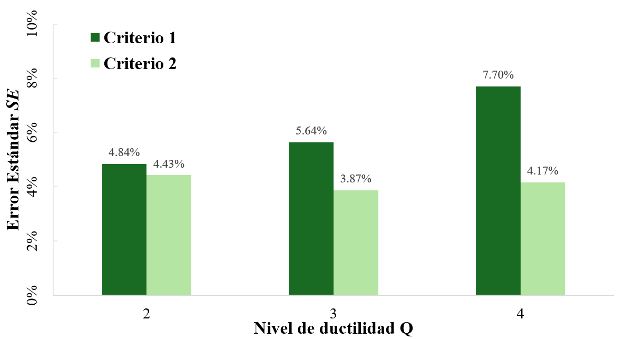
La selección de registros sísmicos constituye un paso fundamental en el análisis dinámico no lineal, herramienta esencial para la evaluación sísmica de edificios; sin embargo, bajo los criterios normativos actuales este procedimiento suele derivar en una dispersión apreciable de la respuesta estructural. Por lo anterior, en este trabajo se propone un criterio de selección de registros sísmicos inspirado en el parámetro de forma espectral Np. La metodología se aplica a un edificio de concreto reforzado (C/R) de ocho niveles diseñado para tres niveles de ductilidad (Q = 2, 3 y 4) de acuerdo con el Reglamento de Construcciones para el Distrito Federal. Para demostrar las ventajas de utilizar el parámetro de forma espectral Np, se realizan análisis dinámicos incrementales (ADI) de las tres versiones del edificio de C/R. Para los análisis sísmicos se utilizan 50 registros sísmicos obtenidos de suelo blando de la Ciudad de México y se obtienen los valores de Np asociados a cada registro y caso particular de estructura. Los resultados muestran que el procedimiento basado en Np disminuye el error estándar de la respuesta estructural, medido en términos de la distorsión máxima de entrepiso en todos los casos estudiados. En particular, se observa una reducción de hasta el 45% respecto a la metodología normativa, lo que permite una estimación más certera del desempeño estructural de las edificaciones. Por lo tanto, el parámetro de forma espectral Np puede aplicarse eficazmente en la selección de registros sísmicos.
Descargas
Referencias
[1] Instituto para la seguridad de las construcciones en la Ciudad de México, Normas Técnicas Complementarias (NTC-2023). Ciudad de México, México: Gaceta oficial de la Ciudad de México, 2023. Disponible: https://www.isc.cdmx.gob.mx/directores-res/cursos-de-actualizacion-2022/normas-tecnicas-complementarias-2023
[2] M. Fragiadakis, D. Vamvatsikos, “Seismic assessment of structures and lifelines” J. Sound and Vib., vol. 334, pp. 29–56, 2015. https://doi.org/10.1016/j.jsv.2013.12.031 DOI: https://doi.org/10.1016/j.jsv.2013.12.031
[3] R. Medina, H. Krawinkler, “Seismic Demands for Nondeteriorating Frame Structures and Their Dependence on Ground Motions”, Pacific Earthquake Engineering Research Center, Stanford University, PEER Report 2003/15, Stanford, CA, 2004. Disponible: https://peer.berkeley.edu/publications/2003-15
[4] J. J. Bommer, A. B. Acevedo, “The use of real earthquake accelerograms as input to dynamic analysis”, J. Earthq. Eng., Vol. 8, no. 1, pp. 43-91, 2004. https://doi.org/10.1080/13632460409350521 DOI: https://doi.org/10.1080/13632460409350521
[5] I. Iervolino, C. A. Cornell, “Record selection for nonlinear seismic analysis of structures,” Earthq. Spectra, vol. 21, no. 3, pp. 685–713, 2005. https://doi.org/10.1193/1.1990199 DOI: https://doi.org/10.1193/1.1990199
[6] J. W. Baker and C. A. Cornell, “Spectral shape, epsilon and record selection,” Earthq. Eng. & Str. Dyn., vol. 35, pp. 1077–1095, 2006. https://doi.org/10.1002/eqe.571 DOI: https://doi.org/10.1002/eqe.571
[7] E. Bojórquez, I. Iervolino y G. Manfredi, “Spectral shape proxies and nonlinear structural response”, Soil Dyn. and Earthq. Eng., vol. 31, no. 7, pp. 996-1008, 2011. https://doi.org/10.1016/j.soildyn.2011.03.006 DOI: https://doi.org/10.1016/j.soildyn.2011.03.006
[8] N. Shome, C. A. Cornell, P. Bazzurro, J. E. Carballo, "Earthquake, Records and Nonlinear MDOF Responses", Dept. of Civil Eng., Stanford University; Stanford, CA, USA, Rep. RMS-29, 1997. https://searchworks.stanford.edu/view/yn623sv4192
[9] N. Shome, C. A. Cornell, “Probabilistic Seismic Demand Analysis of Nonlinear Structures”, Dept. of Civil Eng., Stanford University; Stanford, CA, USA, Rep. RMS-35, 1999. https://nehrpsearch.nist.gov/static/files/NSF/PB99143372.pdf
[10] R. P. Kennedy, et al., "Engineering characterization of ground motions--task I: effects of characteristics of free-field motion on structural response." NUREG/CR-3805, vol. 1, 1984. Disponible: https://www.osti.gov/servlets/purl/6848574 DOI: https://doi.org/10.2172/6848574
[11] CEN, Eurocode 8: Design of structures for earthquake resistance – Part 1: General rules, seismic actions and rules for buildings. Brussels, Belgium: European Standard EN 1998-1, 2004.
[12] American Society of Civil Engineers (ASCE), ASCE/SEI 7-22: Minimum Design Loads and Associated Criteria for Buildings and Other Structures, Reston, VA: ASCE, 2022.
[13] J. W. Baker, C. A. Cornell, “Vector-valued intensity measures incorporating spectral shape for prediction of structural response”, J. of Earthq. Eng., vol. 12, no. 4, pp. 534-554, 2008. https://doi.org/10.1080/13632460701673076 DOI: https://doi.org/10.1080/13632460701673076
[14] P. P. Córdova, G. G. Deierlein, S. S. F. Mehanny, and C. A. Cornell, “Development of a two-parameter seismic intensity measure and probabilistic assessment procedure”, J. of Eng. and Applied Sc., vol. 51, pp. 1–20, 2001. Disponible:
[15] N. Buratti, “A comparison of the performances of various ground-motion intensity measures” in Proc. 15th World Conf. on Earthquake Engineering, Lisbon, Portugal, 2012. Disponible:
https://www.iitk.ac.in/nicee/wcee/article/WCEE2012_5499.pdf
[16] E. Bojórquez, I. Iervolino, G. Manfredi, “Evaluating a new proxy for spectral shape to be used as an intensity measure”, in Seismic Engineering International Conference commemorating the 1908 Messina and Reggio Calabria Earthquake (MERCEA’08), Reggio Calabria, Italy, 2008, pp. 8-11. https://doi.org/10.1063/1.2963788 DOI: https://doi.org/10.1063/1.2963788
[17] E. Bojórquez, R. Chávez, A. Reyes-Salazar, S. Ruiz, J. Bojórquez, “A new ground motion intensity measure IB”, Soil Dyn. and Earthq. Eng., vol. 199, pp. 97–107, 2017. https://doi.org/10.1016/j.soildyn.2017.05.011 DOI: https://doi.org/10.1016/j.soildyn.2017.05.011
[18] J. W. Baker and C. A. Cornell, “A vector-valued ground motion intensity measure consisting of spectral acceleration and epsilon”, Earthq. Eng. & Struct. Dyn., vol. 34, pp. 1193–1217, 2005.
https://doi.org/10.1002/eqe.474 DOI: https://doi.org/10.1002/eqe.474
[19] C. Smerzini, C. Galasso, I. Iervolino y R. Paolucci, “Ground Motion Record Selection Based on Broadband Spectral Compatibility”, Earthq. Spectra, vol. 30, no. 4, pp. 1427-1448, 2014.
https://doi.org/10.1193/052312EQS197M DOI: https://doi.org/10.1193/052312EQS197M
[20] S. Yaghmaei-Sabegh,S. Karami, M. Hosseini-Moghadam, “Selection and scaling of spectrum-compatible ground motion records using hybrid coded genetic algorithms”, Sci. Iran. A., vol. 24, no. 3, pp. 910-925, 2017. https://doi.org/10.24200/sci.2017.4075 DOI: https://doi.org/10.24200/sci.2017.4075
[21] M. Georgioudakis, M. Fragiadakis, M. Papadrakakis, “Multi-criteria selection and scaling of ground motion records using Evolutionary Algorithms”, In Proc. 10th International Conf. on Structural Dynamics, EURODYN, Rome, Italy, 2017. https://doi.org/10.1016/j.proeng.2017.09.504 DOI: https://doi.org/10.1016/j.proeng.2017.09.504
[22] E. Bojórquez, “A New Spectral Shape-Based Record Selection Approach Using Np and Genetic Algorithms” Math. Prob. in Engineering, vol. 2013, no. 679026, 2013. https://doi.org/10.1155/2013/679026 DOI: https://doi.org/10.1155/2013/679026
[23] E. Bojórquez, et al. “Optimal Acceleration and Energy-Based Record Selection Using Artificial Intelligence Approaches and Np” J. Earthq. Eng., vol. 28, no. 2, pp. 582-601, 2023. DOI: https://doi.org/10.1080/13632469.2023.2220035
[24] E. Bojórquez, I. Iervolino, A. Reyes-Salazar y S. Ruiz, “Comparing vector-valued intensity measures for fragility analysis of steel frames in the case of narrow-band ground motions”, Eng. Struct., vol. 45, 472-480, 2012.
https://doi.org/10.1016/j.engstruct.2012.07.002 DOI: https://doi.org/10.1016/j.engstruct.2012.07.002
[25] P. Tothong, N. Luco, “Probabilistic seismic demand analysis using advanced ground motion intensity measures”, Earthq. Eng. and Struct. Dyn., vol. 36, no. 13, pp. 1837–1860, 2007. https://doi.org/10.1002/eqe.696 DOI: https://doi.org/10.1002/eqe.696
[26] E. Bojórquez, J. Carvajal, S. E. Ruiz y J. Bojórquez, “Reliability-based ductility reduction factors surfaces using the generalized Bojorquez ground motion intensity measure IBg”, R. in Eng., vol. 23, no. 102756, 2024. https://doi.org/10.1016/j.rineng.2024.102756 DOI: https://doi.org/10.1016/j.rineng.2024.102756
[27] G. W. Housner, "Spectrum Intensities of Strong Motion Earthquakes", in Proc. Symposium on Earthquake and Blast Effects on Structures, Los Angeles, CA, 1952, pp. 20-36. Disponible: https://authors.library.caltech.edu/records/x3jjd-y5366
[28] J. L. Von-Thun, L. H. Roehm, G. A. Scott y J. A. Wilson, "Earthquake Ground Motions for Design and Analysis of Dams", in Earthquake Engineering and Soil Dynamics II - Recent Advance in Ground-Motion Evaluation, Geotechnical Special Publication 20. NY, New York, USA: ASCE, 1988, pp. 463-481.
[29] E. Bojórquez, V. Baca, J. Bojórquez, A. Reyes-Salazar, R. Chávez, and M. Barraza, “A simplified procedure to estimate peak drift demands for mid-rise steel and R/C frames under narrow-band motions in terms of the spectral-shape-based intensity measure "I" _("N" _"p" )”, Eng. Struct., vol. 150, pp. 334–345, 2017. https://doi.org/10.1016/j.engstruct.2017.07.046 DOI: https://doi.org/10.1016/j.engstruct.2017.07.046
[30] E. Bojórquez, L. Astorga, A. Reyes-Salazar, A. Terán-Gilmore, J. Velázquez, J. Bojórquez, y L. Rivera, “Prediction of hysteretic energy demands in steel frames using vector-valued IMs”, Steel and Composite Struct., vol. 19, no. 3, pp. 697–711, 2015.
https://doi.org/10.12989/scs.2015.19.3.697 DOI: https://doi.org/10.12989/scs.2015.19.3.697
[31] M. Kaplán, “Optimización de la intensidad generalizada de Bojórquez para maximizar el desempeño sísmico de edificaciones de concreto reforzado”, Tesis de Maestría, Universidad Autónoma de Sinaloa, Sinaloa, Mexico, 2025.
[32] Vamvatsikos D, Cornell CA, “Incremental dynamic analysis”, Earthq. Eng. and Struct. Dyn., vol. 31, no. 3, pp. 491–514, 2002. https://doi.org/10.1002/eqe.141 DOI: https://doi.org/10.1002/eqe.141
[33] A.J. Carr, Ruaumoko3D: Inelastic three-dimensional analysis program, Christchurch, New Zealand: University of Canterbury 2007.
[34] T. Takeda, M. A. Sozen y N. N. Nielsen, “Reinforced concrete response to simulated earthquakes”, J. Struct. Div. ASCE, vol. 96, no. 12, pp. 2557-2573, 1970. https://doi.org/10.1061/JSDEAG.0002765 DOI: https://doi.org/10.1061/JSDEAG.0002765
[35] H. Aslani, E. Miranda, “Probabilistic response assessment for building-specific loss estimation”, PEER Report 2003/03, Pacific Earthquake Engineering Research Center, University of California at Berkeley, Berkeley, California, pp. 49, 2003. Disponible:
https://peer.berkeley.edu/sites/default/files/0303_e._miranda_h._aslani.pdf
Publicado
Declaración de disponibilidad de datos
Los conjuntos de datos generados y/o analizados durante el presente estudio están disponibles a través del autor de correspondencia bajo petición.
Número
Sección
Categorías
Licencia
Derechos de autor 2026 Jesús David Tirado Ibarría, Edén Bojórquez Mora, Jesús Prisciliano Romo Villa, Juan Bojórquez Mora

Esta obra está bajo una licencia internacional Creative Commons Atribución 4.0.
Los autores/as que publiquen en esta revista aceptan las siguientes condiciones:
- Los autores/as conservan los derechos de autor y ceden a la revista el derecho de la primera publicación, con el trabajo registrado con la licencia de atribución de Creative Commons 4.0, que permite a terceros utilizar lo publicado siempre que mencionen la autoría del trabajo y a la primera publicación en esta revista.
- Los autores/as pueden realizar otros acuerdos contractuales independientes y adicionales para la distribución no exclusiva de la versión del artículo publicado en esta revista (p. ej., incluirlo en un repositorio institucional o publicarlo en un libro) siempre que indiquen claramente que el trabajo se publicó por primera vez en esta revista.
- Se permite y recomienda a los autores/as a compartir su trabajo en línea (por ejemplo: en repositorios institucionales o páginas web personales) antes y durante el proceso de envío del manuscrito, ya que puede conducir a intercambios productivos, a una mayor y más rápida citación del trabajo publicado (vea The Effect of Open Access).
Cómo citar