Carbon Footprint Estimation of a Higher Education Institution as a Baseline for Sustainable Technological Management: The FIMAZ-UAS Case
DOI:
https://doi.org/10.37636/recit.v9n4e511Keywords:
Carbon footprint, Higher education institutions, Greenhouse gasses, Environmental management, University mobilityAbstract
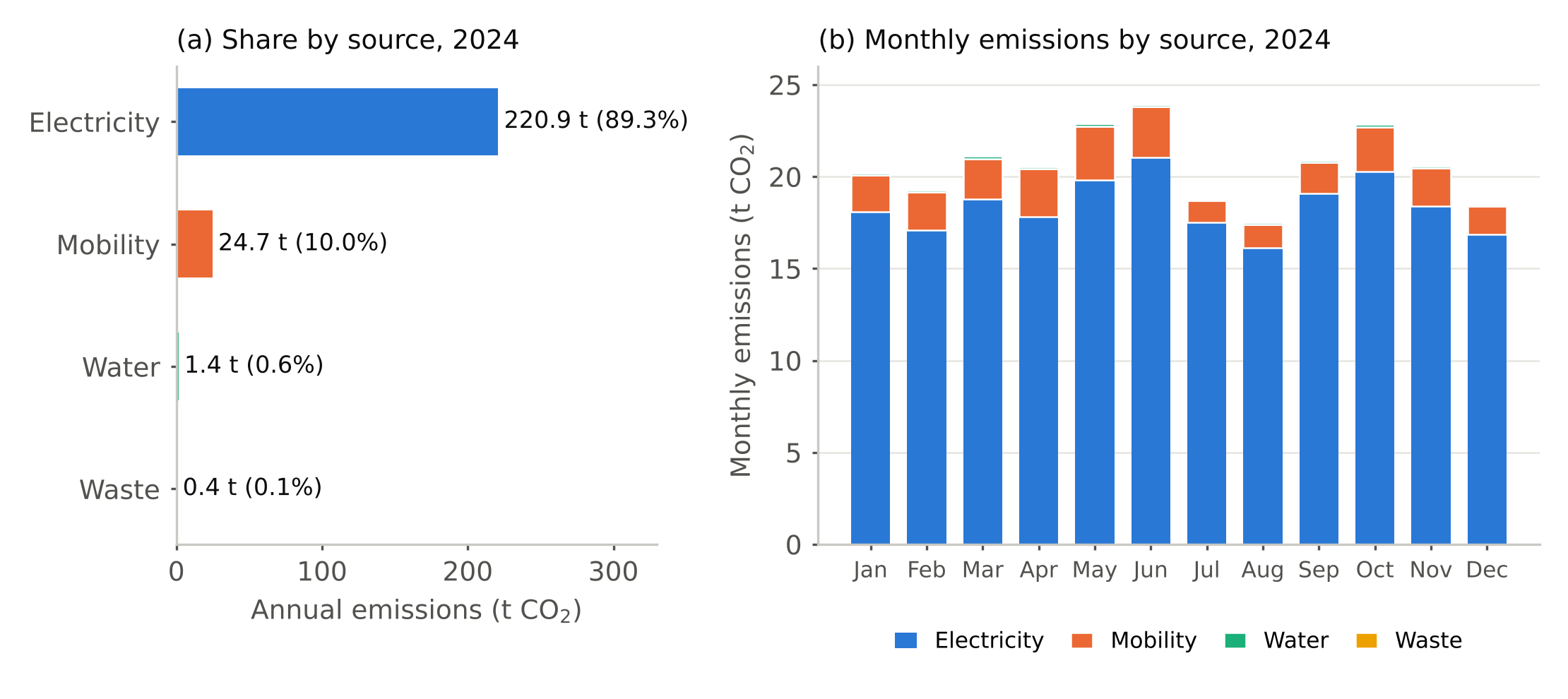
The carbon footprint has positioned itself as a fundamental tool for the evaluation and management of greenhouse gas (GHG) emissions in higher education institutions, due to their patterns of energy consumption, resource use, and mobility, which present dynamics comparable to those of small urban areas. In this context, the objective of the present study was to estimate and analyze the institutional carbon footprint of the Faculty of Computer Science Mazatlán (FIMAZ) of the Autonomous University of Sinaloa (UAS), considering the consumption of electricity, drinking water, solid waste generation, and the mobility of students and faculty during the period from January to December 2024. The research was conducted using a quantitative approach, with a non-experimental, descriptive, and longitudinal design, employing a case study based on the guidelines of the GHG Protocol and the ISO 14064-1:2018 standard. The quantification of emissions was carried out using activity data obtained from institutional records and mobility surveys, which were combined with reference emission factors at the national and international levels, allowing for a systematic estimation of the emissions generated by each analyzed source. The results show that electricity consumption is the main source of emissions, with an annual footprint of 220,887.24 kg of CO₂, associated with the intensive use of computing equipment and climate control systems. University mobility constitutes the second largest contribution, with 24,810.15 kg of CO₂, highlighting the private vehicle as the main emitter. The consumption of water and the generation of solid waste contributed 1,422.36 kg of CO₂ and 362.75 kg of CO₂, respectively, related to the intensity of academic activity. These findings allow for the establishment of a technical baseline, the guidance of mitigation strategies, and the strengthening of comprehensive sustainable university environmental management.
Downloads
References
[1] Intergovernmental Panel on Climate Change, Climate Change 2021: The Physical Science Basis. Cambridge, U.K.: Cambridge Univ. Press, 2021. [Online]. Available: https://www.ipcc.ch/report/ar6/wg1/
[2] K. N. Paredes-Canencio, A. Lasso, R. Castrillón, J. R. Vidal-Medina, and E. C. Quispe, “Carbon footprint of higher education institutions,” Environment, Development and Sustainability, vol. 26, pp. 30239–30272, 2024, https://doi.org/10.1007/s10668-024-04596-4 DOI: https://doi.org/10.1007/s10668-024-04596-4
[3] UNESCO and UNESCO International Institute for Higher Education in Latin America and the Caribbean (IESALC), General Guidelines for the Implementation of Sustainability in Higher Education Institutions. Paris, France: UNESCO, 2023. [Online]. Available: https://unesdoc.unesco.org/ark:/48223/pf0000387008
[4] K. Valls-Val and M. D. Bovea, “Carbon footprint in Higher Education Institutions: a literature review and prospects for future research,” Clean Technologies and Environmental Policy, vol. 23, pp. 2523–2542, 2021, https://doi.org/10.1007/s10098-021-02180-2 DOI: https://doi.org/10.1007/s10098-021-02180-2
[5] N. Cano, L. Berrio, E. Carvajal, and S. Arango, “Assessing the carbon footprint of a Colombian university campus using the UNE-ISO 14064–1 and WRI/WBCSD GHG Protocol Corporate Standard,” Environmental Science and Pollution Research, vol. 30, no. 2, pp. 3980–3996, 2023, https://doi.org/10.1007/s11356-022-22119-4 DOI: https://doi.org/10.1007/s11356-022-22119-4
[6] R. Mendoza-Flores, R. Quintero-Ramírez, and I. Ortiz, “The carbon footprint of a public university campus in Mexico City,” Carbon Management, vol. 10, no. 5, pp. 501–511, 2019, https://doi.org/10.1080/17583004.2019.1642042 DOI: https://doi.org/10.1080/17583004.2019.1642042
[7] J. R. Calderon Maya, C. E. Barrera Diaz, N. A. Colin Mercado, Y. Montoya Garcia, and F. J. Rosas Ferrusca, “Towards the neutralization of the carbon footprint at the Autonomous University of the State of Mexico,” Journal of Sustainability Perspectives, vol. 4, no. 1, pp. 98–108, 2024, https://doi.org/10.14710/jsp.2024.24795 DOI: https://doi.org/10.14710/jsp.2024.24795
[8] S. Üstün Odabaşı, “Reducing carbon footprint: a sustainable and green campus case study,” International Journal of Global Warming, vol. 31, no. 4, pp. 454–469, 2023, https://doi.org/10.1504/IJGW.2023.134913 DOI: https://doi.org/10.1504/IJGW.2023.134913
[9] Universidad Autónoma de Sinaloa, Plan de Desarrollo Institucional y Misión Universitaria (in Spanish). Sinaloa, Mexico: Universidad Autónoma de Sinaloa, 2022. [Online]. Available: http://transparencia.uasnet.mx/institucional/Documentos/PDI_con_vision_de_futuro_2025.pdf
[10] International Organization for Standardization, ISO 14064-1:2018 Greenhouse Gases—Part 1: Specification with Guidance at the Organization Level for Quantification and Reporting of Greenhouse Gas Emissions and Removals. Geneva, Switzerland: ISO, 2018. [Online]. Available: https://www.iso.org/standard/66453.html
[11] World Resources Institute and World Business Council for Sustainable Development, The Greenhouse Gas Protocol: A Corporate Accounting and Reporting Standard, revised ed., 2015. [Online]. Available: https://ghgprotocol.org/corporate-standard
[12] D. Archer, Global Warming: Understanding the Forecast, 2nd ed. Hoboken, NJ, USA: John Wiley & Sons, 2012. [Online]. Available: https://www.wiley.com/en-us/global-warming-understanding-the-forecast-2nd-edition-p-9781118213971
[13] United Nations Framework Convention on Climate Change, “GHG inventory data,” 2022. [Online]. Available: https://unfccc.int/process-and-meetings/transparency-and-reporting/greenhouse-gas-data/ghg-inventory-data
[14] UNESCO, Education for Sustainable Development Goals: Learning Objectives. Paris, France: UNESCO Publishing, 2017. [Online]. Available: https://unesdoc.unesco.org/ark:/48223/pf0000247444
[15] S. Mo, Y. Wang, F. Xiong, C. Ai, D. Wang, y G. Y. A. Tan, "Changes of asphalt fumes in hot-mix asphalt pavement recycling," J. Clean. Prod., vol. 258, p. 120586, jun. 2020, https://doi.org/10.1016/j.jclepro.2020.120586 DOI: https://doi.org/10.1016/j.jclepro.2020.120586
[16] Y. Z. Alharthi, M. K. Siddiki, and G. M. Chaudhry, “Resource Assessment and Techno-Economic Analysis of a Grid-Connected Solar PV System,” Sustainability, vol. 10, no. 10, p. 3690, Oct. 2018, https://doi.org/10.3390/su10103690 DOI: https://doi.org/10.3390/su10103690
[17] Red de Indicadores de Sustentabilidad en las Universidades Mexicanas, Avances y Desafíos de la Sustentabilidad Universitaria en México (in Spanish). Mexico, 2024. [Online]. Available: https://revistaidentidad.uaemex.mx/article/view/25261
[18] R. Hernández-Sampieri, C. Fernández-Collado, and M. P. Baptista-Lucio, Metodología de la Investigación (in Spanish), 6th ed. Mexico City, Mexico: McGraw-Hill Education, 2018. [Online]. Available: http://www.biblioteca.cij.gob.mx/Archivos/Materiales_de_consulta/Drogas_de_Abuso/Articulos/Sampieri6aEdicion.pdf
[19] K. Valls-Val and M. D. Bovea, “Carbon footprint assessment tool for universities: CO2UNV,” Sustainable Production and Consumption, vol. 29, pp. 791–804, 2022, https://doi.org/10.1016/j.spc.2021.11.020 DOI: https://doi.org/10.1016/j.spc.2021.11.020
[20] IPCC, “AR6 Working Group III: Mitigation of climate change – Chapter 10: Transport,” Intergovernmental Panel on Climate Change, 2022. [Online]. Available: https://www.ipcc.ch/report/ar6/wg3/chapter/chapter-10/
[21] International Energy Agency, “Emission factors and electricity generation,” 2023. [Online]. Available: https://www.iea.org
[22] Secretaría de Medio Ambiente y Recursos Naturales, Factores de Emisión para la Estimación de GEI en México (in Spanish). Mexico City, Mexico: SEMARNAT, 2022. [Online]. Available: https://www.gob.mx/semarnat
[23] M. Noussan, E. Campisi, and M. Jarre, “Carbon intensity of passenger transport modes: A review of emission factors, their variability and the main drivers,” Sustainability, vol. 14, no. 17, p. 10652, 2022, https://doi.org/10.3390/su141710652 DOI: https://doi.org/10.3390/su141710652
[24] Statista, “Greenhouse gas emissions by mode of transport (grams of CO₂ equivalent per passenger kilometer),” 2024. [Online]. Available: https://www.statista.com/chart/32350/greenhouse-gas-emissions-by-mode-of-transport/
[25] European Environment Agency, EMEP/EEA Air Pollutant Emission Inventory Guidebook 2023: Road Transport Emission Factors, 2023. [Online]. Available: https://www.eea.europa.eu/en/analysis/publications/emep-eea-guidebook-2023
Published
Data Availability Statement
No
Issue
Section
Categories
License
Copyright (c) 2026 Lucio Guadalupe Quirino Rodríguez, Héctor Luis López López

This work is licensed under a Creative Commons Attribution 4.0 International License.
The authors who publish in this journal accept the following conditions:
The authors retain the copyright and assign to the journal the right of the first publication, with the work registered with the Creative Commons Attribution license 4.0, which allows third parties to use what is published as long as they mention the authorship of the work and the first publication in this magazine.
Authors may make other independent and additional contractual agreements for the non-exclusive distribution of the version of the article published in this journal (eg, include it in an institutional repository or publish it in a book) as long as they clearly indicate that the work it was first published in this magazine.
Authors are allowed and encouraged to share their work online (for example: in institutional repositories or personal web pages) before and during the manuscript submission process, as it can lead to productive exchanges, greater and more quick citation of published work (see The Effect of Open Access).
How to Cite