Systematization of variables to evaluate water benefits of green infrastructure through volumetric water accounting
DOI:
https://doi.org/10.37636/recit.v9n3e452Keywords:
Water systems management, Green infrastructure, Volumetric water accountingAbstract
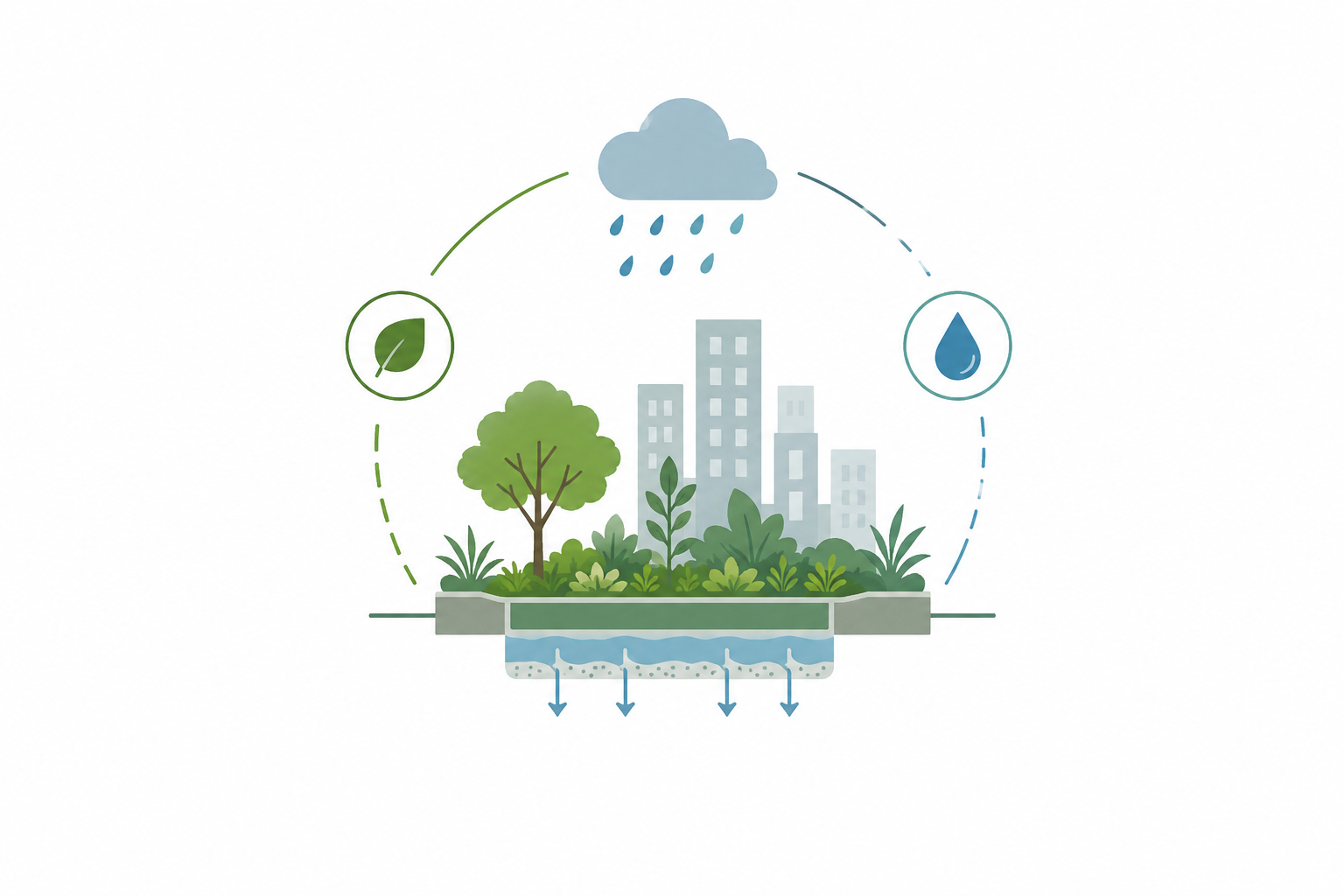
The increasing incorporation of green infrastructure in urban contexts demands tools to measure the water benefits these solutions generate. However, existing water accounting methodologies employ diverse sets of variables, hindering their standardization and practical application in projects. This study aims to analyze volumetric water accounting methodologies to identify and systematize the variables involved in evaluating water benefits related to green infrastructure, using a comparative analysis matrix. This was achieved through a systematic literature review and the analysis of nine methodological frameworks on water accounting. Three methodologies published between 2019 and 2025 by the World Resources Institute (WRI) were selected to identify and compare the indicators used in evaluating water benefits in urban contexts. These methodologies were chosen based on their academic relevance, their application in integrated water management, and their recent development. In this regard, the analysis was conducted using the PRISMA 2020 method, considering Volumetric Water Benefits Accounting (VWBA), Volumetric Water Benefits Accounting 2.0 (VWBA 2.0), and the Water Quality Benefits Accounting Guide (WQBA). The results revealed that the VWBA and VWBA 2.0 methodologies share fundamental variables such as mean annual precipitation, catchment area, runoff coefficient, and captured volume, forming the basis for quantifying volumetric benefits. Furthermore, it was determined that the main methodological difference lies in the incorporation of water quality variables by the WQBA methodology, which broadens its scope but increases its information requirements. In this context, a methodological and conceptual framework of variables oriented toward urban flood control is proposed, contributing to more comprehensive, comparable, and replicable assessments in future green infrastructure projects.
Downloads
References
[1] P. Babuna, X. Yang, R. X. Supe Tulcan, B. Dehui, M. Takase, B. Y. Guba, C. Han, D. A. Awudi and M. Li, “Modeling water inequality and water security: The role of water governance,” Journal of Environmental Management, vol. 326, p. 116815, 2023. doi: https://doi.org/10.1016/j.jenvman.2022.116815 DOI: https://doi.org/10.1016/j.jenvman.2022.116815
[2] M. Saldaña Almazán, A. P. Leyva Zuñiga, E. Moreno Mendoza, M. P. Calderón Arellanes and S. Suastegui Cruz, “Community Management and Sustainability of Water Supply in a Rural Area of Guerrero, Mexico,” Sustainability, vol. 17, no. 10, p. 4633, 2025. doi: https://doi.org/10.3390/su17104633 DOI: https://doi.org/10.3390/su17104633
[3] C. Lei, C. Guo, Y. Yu, X. Zhou, Y. Fu, S. Wang, Y. Ma and Z. Shen, “Optimization of green infrastructures for sustaining urban stormwater quality and quantity: An integrated resilience evaluation,” Journal of Hydrology, vol. 640, p. 131682, 2024. doi: https://doi.org/10.1016/j.jhydrol.2024.131682 DOI: https://doi.org/10.1016/j.jhydrol.2024.131682
[4] J. Hack, L. Ojeda-Revah, M. P. Rubí, G. Pradilla, M. Borbor-Cordova, G. Burgueño, A. A. Eleuterio, D. Rivera and A. Vásquez, “Avances de infraestructura verde urbana para la gestión de agua en América Latina,” Cuadernos de Geografía: Revista Colombiana de Geografía, vol. 33, no. 1, pp. 139–160, 2024. doi: https://doi.org/10.15446/rcdg.v33n1.101947 DOI: https://doi.org/10.15446/rcdg.v33n1.101947
[5] N. Liu and F. Zhang, “Urban green spaces and flood disaster management: Toward sustainable urban design,” Frontiers in Public Health, 2025. doi: https://doi.org/10.3389/fpubh.2025.1583978 DOI: https://doi.org/10.3389/fpubh.2025.1583978
[6] J.-Y. Lee, “A Review of Urban Flooding: Causes, Impacts, and Mitigation Strategies,” The Journal of Engineering Geology, vol. 33, no. 3, pp. 489–502, 2023. doi: https://doi.org/10.9720/kseg.2023.3.489
[7] Comisión Nacional del Agua, “Estadísticas del agua en México 2023,” 2023. [En línea]. Disponible: https://sinav30.conagua.gob.mx:8080/Descargas/pdf/EAM2023_f.pdf
[8] Cámara de Diputados del H. Congreso de la Unión, “Ley de Aguas Nacionales,” 2023. [En línea]. Disponible: https://www.diputados.gob.mx/LeyesBiblio/pdf/LAN.pdf
[9] Cámara de Diputados del H. Congreso de la Unión, “Constitución Política de los Estados Unidos Mexicanos,” 2024. [En línea]. Disponible: https://www.diputados.gob.mx/LeyesBiblio/pdf/CPEUM.pdf
[10] Comisión Nacional de los Derechos Humanos, “El derecho humano al agua potable y saneamiento,” 2014. [En línea]. Disponible: https://www.cndh.org.mx/sites/default/files/documentos/2019-08/derecho-humano-agua-ps.pdf
[11] Naciones Unidas, “Informe de los Objetivos de Desarrollo Sostenible 2023,” 2023. [En línea]. Disponible: https://unstats.un.org/sdgs/report/2023/The-Sustainable-Development-Goals-Report-2023_Spanish.pdf
[12] M. Khodadad, I. Aguilar-Barajas and A. Khan, “Green infrastructure for urban flood resilience: A review of recent literature on bibliometrics, methodologies, and typologies,” Water, vol. 15, no. 3, p. 523, 2023. doi: https://doi.org/10.3390/w15030523 DOI: https://doi.org/10.3390/w15030523
[13] M. Zarei and S. Shahab, “Nature-Based Solutions in Urban Green Infrastructure: A Systematic Review of Success Factors and Implementation Challenges,” Land, vol. 14, no. 4, p. 818, 2025. doi: https://doi.org/10.3390/land14040818 DOI: https://doi.org/10.3390/land14040818
[14] S. Apostolaki, “Nature-based solutions: From flood defense to addressing water scarcity and climate change risks,” Nature-Based Solutions, vol. 7, p. 100233, 2025. doi: https://doi.org/10.1016/j.nbsj.2025.100233 DOI: https://doi.org/10.1016/j.nbsj.2025.100233
[15] J. I. Guano Merino and F. R. Morales Fiallos, “Análisis del impacto de infraestructura verde: modelos hidrológicos y soluciones arquitectónicas sostenibles,” Revista Multidisciplinar de Estudios Generales, vol. 4, no. 2, 2025. doi: https://doi.org/10.70577/reg.v4i2.124 DOI: https://doi.org/10.70577/reg.v4i2.124
[16] M. Mul, P. Karimi, H. M. Coerver, S. Pareeth and L. M. Rebelo, “Water productivity and water accounting methodology manual.” IHE Delft Institute for Water Education & International Water Management Institute, 2020. [En línea]. Disponible: https://www.wateraccounting.org/files/projects/adb/phase2/IHE_IWMI_WP_WA_Methodology_Manual.pdf
[17] Asamblea General de las Naciones Unidas, “Transformar nuestro mundo: la Agenda 2030 para el Desarrollo Sostenible,” 2015. [En línea]. Disponible: https://unctad.org/system/files/official-document/ares70d1_es.pdf
[18] Naciones Unidas, “Informe del Secretario General sobre los Objetivos de Desarrollo Sostenible 2025,” 2025. [En línea]. Disponible: https://unstats.un.org/sdgs/files/report/2025/secretary-general-sdg-report-2025--ES.pdf
[19] M. J. Page, J. E. McKenzie, P. M. Bossuyt, I. Boutron, T. C. Hoffmann, C. D. Mulrow, L. Shamseer, J. M. Tetzlaff, E. A. Akl, S. E. Brennan, R. Chou, J. Glanville, J. M. Grimshaw, A. Hróbjartsson, M. M. Lalu, T. Li, E. W. Loder, E. Mayo-Wilson, S. McDonald and D. Moher, “The PRISMA 2020 statement: An updated guideline for reporting systematic reviews,” BMJ, vol. 372, p. n71, 2021. doi: https://doi.org/10.1136/bmj.n71 DOI: https://doi.org/10.1136/bmj.n71
[20] S. Arias Orozco and D. C. Ávila Ramírez, “Gestión hídrica en las acciones urbanísticas en México,” Estudios y Perspectivas. Revista Científica y Académica, vol. 4, no. 3, 2024. doi: https://doi.org/10.61384/r.c.a..v4i3.667 DOI: https://doi.org/10.61384/r.c.a..v4i3.667
[21] E. Ríos-Badilla, P. Boj-Coti and C. Alfaro Chinchilla, “Evaluación de la huella de agua y la gestión del recurso hídrico en las industrias,” Biocenosis, vol. 33, no. 1, pp. 57–71, 2022. doi: https://doi.org/10.22458/rb.v33i1.4287 DOI: https://doi.org/10.22458/rb.v33i1.4287
[22] B. Duarte-Abadía, L. Galarza Suárez and J. Hidalgo-Bastidas, “¿Seguridad hídrica urbano-rural en los fondos de agua?,” Journal of Political Ecology, vol. 30, no. 1, pp. 391–400, 2023. doi: https://doi.org/10.2458/jpe.5295 DOI: https://doi.org/10.2458/jpe.5295
[23] E. Giannotti, A. Vásquez, E. Galdámez, P. Velásquez and C. Devoto, “Planificación de infraestructura verde para la emergencia climática,” Cuadernos de Geografía: Revista Colombiana de Geografía, vol. 30, no. 2, pp. 359–375, 2021. doi: https://doi.org/10.15446/rcdg.v30n2.88749 DOI: https://doi.org/10.15446/rcdg.v30n2.88749
[24] J. Santiago Ramos and C. Hurtado Rodríguez, “Análisis de servicios ecosistémicos para la configuración de una infraestructura verde,” ACE: Architecture, City and Environment, vol. 16, no. 46, p. 9884, 2021. doi: http://dx.doi.org/10.5821/ace.16.46.9884 DOI: https://doi.org/10.5821/ace.16.46.9884
[25] P. Reig, W. Larson, S. Vionnet and J.-B. Bayart, “Volumetric water benefit accounting (VWBA): A method for implementing and valuing water stewardship activities.” World Resources Institute, 2019. [En línea]. Disponible: https://www.wri.org/research/volumetric-water-benefit-accounting-vwba-method-implementing-and-valuing-water-stewardship
[26] N. Collins, M. Dettmann, T. Gartner, S. Walker, W. Larson, P. Moskus, P. Selvendiran, L. Weintraub, P. Reig, J. Stewart, S. Hoversten, S. McCaulou, T. Reeve and R. Warren, “Volumetric water benefit accounting 2.0: Guidance for implementing, evaluating, and claiming volumetric water benefits of water stewardship projects.” World Resources Institute, 2025. doi: https://doi.org/10.46830/wrigb.23.00112 DOI: https://doi.org/10.46830/wrigb.23.00112
[27] S. Walker, D. Schlea, S. Skripnik, L. Weintraub, N. Ofosu-Amaah and K. Vigerstol, “Water quality benefit accounting: Guidance for implementing, evaluating, and claiming water quality benefits of water stewardship projects.” World Resources Institute, 2025. doi: https://doi.org/10.46830/wrigb.23.00147 DOI: https://doi.org/10.46830/wrigb.23.00147
[28] Sustainability Directory, “Water footprint accounting,” s.f. [En línea]. Disponible: https://lifestyle.sustainability-directory.com/term/water-footprint-accounting/
[29] Agencia Vasca del Agua (URA), “Sistemas de control de los volúmenes de agua derivados por los aprovechamientos de agua del dominio público hidráulico en las cuencas internas del País Vasco,” s.f. [En línea]. Disponible: https://www.uragentzia.euskadi.eus/sistemas-de-control-de-los-volumenes-de-agua-derivados-por-los-aprovechamientos-de-agua-del-dominio-publico-hidraulico-en-las-cuencas-internas-del-pais-vasco/webura00-0305usos/es/
[30] IHE Delft Institute for Water Education, “Water Accounting+ framework,” s.f. [En línea]. Disponible: https://wateraccounting.un-ihe.org/en/wa-framework
[31] Food and Agriculture Organization of the United Nations (FAO), International Water Management Institute (IWMI) and IHE Delft Institute for Water Education, Water Accounting+ methodology manual, 2018. [En línea]. Disponible: https://www.wateraccounting.org/files/projects/adb/phase2/IHE_IWMI_WP_WA_Methodology_Manual.pdf
[32] Food and Agriculture Organization of the United Nations (FAO), Water productivity and water accounting methodology manual, 2020. [En línea]. Disponible: https://openknowledge.fao.org/server/api/core/bitstreams/77718913-2394-47a5-b8ad-3b91017612e6/content
[33] Agrow Analytics, “Volumetric water benefit accounting (VWBA): Midiendo el impacto real de la gestión corporativa del agua,” 2023. [En línea]. Disponible: https://agrowanalytics.com/waterwise-insights/volumetric-water-benefit-accounting-vwba-midiendo-el-impacto-real-de-la-gestion-corporativa-del-agua/
Downloads
Published
Data Availability Statement
Yes, the authors make their research data publicly available.
Issue
Section
Categories
License
Copyright (c) 2026 Ericka Michell Ochoa Nuño, Jorge Armando Gutiérrez-Valencia , Francisco José Martín del Campo Saray, María Silvia del Rocío Covarrubias Ruesga, Ignacio Barajas-Ávalos

This work is licensed under a Creative Commons Attribution 4.0 International License.
The authors who publish in this journal accept the following conditions:
The authors retain the copyright and assign to the journal the right of the first publication, with the work registered with the Creative Commons Attribution license 4.0, which allows third parties to use what is published as long as they mention the authorship of the work and the first publication in this magazine.
Authors may make other independent and additional contractual agreements for the non-exclusive distribution of the version of the article published in this journal (eg, include it in an institutional repository or publish it in a book) as long as they clearly indicate that the work it was first published in this magazine.
Authors are allowed and encouraged to share their work online (for example: in institutional repositories or personal web pages) before and during the manuscript submission process, as it can lead to productive exchanges, greater and more quick citation of published work (see The Effect of Open Access).
How to Cite