Análisis y mejora en el área de extrusión del proceso de telares en una empresa textil
DOI:
https://doi.org/10.37636/recit.v9n3e506Palabras clave:
Availability, Maintenance, Winding units, Extrusion, Polypropylene yarn, Textile industryResumen
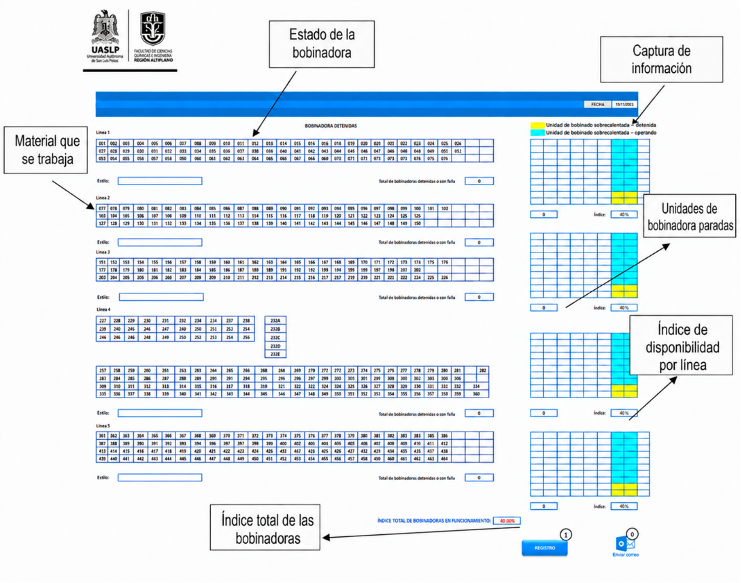
Low availability of winding units can disrupt production continuity and hinder maintenance decision-making in textile processes. At the textile company studied in Matehuala, San Luis Potosí, equipment monitoring relied mainly on manual records and references associated with physical location, limiting traceability, historical failure analysis, and intervention prioritization. This study aimed to develop and implement a structured, low-cost method to strengthen maintenance management of winding units in the extrusion area. The research was conducted as an applied case study using a quantitative approach and descriptive scope. The method integrated maintenance-process diagnosis, direct observation, time studies, root-cause analysis, thermographic inspections, individual identification of winding units, failure classification, critical-equipment prioritization, digital data capture, and evaluation through availability indicators. Record management and indicator calculation were automated using a Microsoft Excel® tool developed with Visual Basic for Applications. The Top 10 analysis identified 40 critical positions and 579 downtime recurrences. After implementation, the overall availability of the evaluated production lines reached 93.7%, exceeding the company's 86.0% target. The results show that the structured integration of equipment identification, prioritization, traceability, and automated indicator analysis provides a practical and low-cost approach to support maintenance management under real industrial operating conditions.
Descargas
Referencias
[1] C. E. David, R. Uche, O. Nwufo, D. A. Ekpechi, and C. C. Kingsley, “Integrating machine availability and preventive maintenance to improve productive efficiency in a manufacturing industry,” Asian Journal of Current Research, vol. 9, no. 2, pp. 91–109, 2024, doi: 10.56557/ajocr/2024/v9i28610.
[2] J. M. Wakiru, L. Pintelon, P. Muchiri, and P. Chemweno, “Integrated maintenance policies for performance improvement of a multi-unit repairable, one product manufacturing system,” Production Planning & Control, vol. 32, no. 5, pp. 347–367, 2021, doi: 10.1080/09537287.2020.1736684.
[3] E. Tovar Porras, “Tipos de mantenimiento industrial,” monografía de pregrado, Universidad Nacional de Educación Enrique Guzmán y Valle, Lima, Perú, 2021. [Online]. Available: https://repositorio.une.edu.pe/items/96312717-9e73-4acf-a695-006062a06de3. [Accessed: Dic. 15, 2025].
[4] M. Holgado, M. Macchi, and S. Evans, “Exploring the impacts and contributions of maintenance function for sustainable manufacturing,” International Journal of Production Research, vol. 58, no. 23, pp. 7292–7310, 2020, doi: 10.1080/00207543.2020.1808257.
[5] F. Rodriguez and L. Gomez Bravo, Indicadores de calidad y productividad de la empresa. Caracas, Venezuela: CAF, 1991. [Online]. Available: https://scioteca.caf.com/handle/123456789/863. [Accessed: Dic. 15, 2025].
[6] J. T. Selvik and E. P. Ford, “Down time terms and information used for assessment of equipment reliability and maintenance performance,” in System Reliability, C. Volosencu, Ed. IntechOpen, 2017, doi: 10.5772/intechopen.71503.
[7] M. Hodkiewicz and M. T.-W. Ho, “Cleaning historical maintenance work order data for reliability analysis,” Journal of Quality in Maintenance Engineering, vol. 22, no. 2, pp. 146–163, 2016, doi: 10.1108/JQME-04-2015-0013.
[8] ISO 14224:2016, Petroleum, Petrochemical and Natural Gas Industries—Collection and Exchange of Reliability and Maintenance Data for Equipment, 3rd ed. Geneva, Switzerland: International Organization for Standardization, 2016. [Online]. Available: https://www.iso.org/standard/64076.html. [Accessed: Jun. 25, 2026].
[9] G. Alemayehu, M. Avvari, B. Alemu, and A. M. Gebrekidan, “Performance evaluation of Faffa Food Share Company through computerized maintenance management system (CMMS),” Journal of Engineering, vol. 2023, Art. no. 4856457, 2023, doi: 10.1155/2023/4856457.
[10] A. Labib, “World-class maintenance using a computerised maintenance management system,” Journal of Quality in Maintenance Engineering, vol. 4, no. 1, pp. 66–75, 1998, doi: 10.1108/13552519810207470.
[11] Microsoft, “Automatizar tareas con la grabadora de macros,” Microsoft Support. [Online]. Available: https://support.microsoft.com/es-es/excel/automate-tasks-with-the-macro-recorder. [Accessed: Oct. 15, 2025].
[12] Y.-J. Lu, W.-C. Lee, and C.-H. Wang, “Using data mining technology to explore causes of inaccurate reliability data and suggestions for maintenance management,” Journal of Loss Prevention in the Process Industries, vol. 83, Art. no. 105063, Jul. 2023, doi: 10.1016/j.jlp.2023.105063.
[13] A. Salonen, M. Bengtsson, and V. Fridholm, “The possibilities of improving maintenance through CMMS data analysis,” in SPS2020: Proceedings of the Swedish Production Symposium, October 7–8, 2020, K. Säfsten and F. Elgh, Eds., Advances in Transdisciplinary Engineering, vol. 13, pp. 249–260, 2020, doi: 10.3233/ATDE200163.
[14] S. Lukens, M. Naik, K. Saetia, and X. Hu, “Best practices framework for improving maintenance data quality to enable asset performance analytics,” Annual Conference of the PHM Society, vol. 11, no. 1, 2019, doi: 10.36001/phmconf.2019.v11i1.836.
[15] C. Rauwendaal, Polymer Extrusion, 5th ed. Munich, Germany: Carl Hanser Verlag, 2014, doi: 10.3139/9781569905395.
[16] S. Hube, M. Behr, S. Elgeti, M. Schön, J. Sasse, and C. Hopmann, “Numerical design of distributive mixing elements,” Finite Elements in Analysis and Design, vol. 204, Art. no. 103733, 2022, doi: 10.1016/j.finel.2022.103733.
[17] I. El Hassani, C. El Mazgualdi, and T. Masrour, “Artificial intelligence and machine learning to predict and improve efficiency in manufacturing industry,” arXiv preprint arXiv:1901.02256, 2019. [Online]. Available: https://arxiv.org/abs/1901.02256. [Accessed: Sep. 10, 2025].
[18] T. Zonta, C. A. da Costa, R. da R. Righi, M. J. de Lima, E. S. da Trindade, and G. P. Li, “Predictive maintenance in the Industry 4.0: A systematic literature review,” Computers & Industrial Engineering, vol. 150, Art. no. 106889, 2020, doi: 10.1016/j.cie.2020.106889.
[19] L. Silvestri, A. Forcina, V. Introna, A. Santolamazza, and V. Cesarotti, “Maintenance transformation through Industry 4.0 technologies: A systematic literature review,” Computers in Industry, vol. 123, Art. no. 103335, 2020, doi: 10.1016/j.compind.2020.103335.
[20] J. Bokrantz, A. Skoogh, C. Berlin, T. Wuest, and J. Stahre, “Smart Maintenance: A research agenda for industrial maintenance management,” International Journal of Production Economics, vol. 224, Art. no. 107547, 2020, doi: 10.1016/j.ijpe.2019.107547.
[21] K. Mahlamäki and M. Nieminen, “Analysis of manual data collection in maintenance context,” Journal of Quality in Maintenance Engineering, vol. 26, no. 1, pp. 104–119, 2020, doi: 10.1108/JQME-12-2017-0091
[22] R. F. da Silva and G. F. M. de Souza, “Modeling a maintenance management framework for asset management based on ISO 55000 series guidelines,” Journal of Quality in Maintenance Engineering, vol. 28, no. 4, pp. 915–937, 2022, doi: 10.1108/JQME-08-2020-0082.
[23] P. Muchiri and L. Pintelon, “Performance measurement using overall equipment effectiveness (OEE): Literature review and practical application discussion,” International Journal of Production Research, vol. 46, no. 13, pp. 3517–3535, 2008, doi: 10.1080/00207540601142645.
[24] T. Ylipää, A. Skoogh, J. Bokrantz, and M. Gopalakrishnan, “Identification of maintenance improvement potential using OEE assessment,” International Journal of Productivity and Performance Management, vol. 66, no. 1, pp. 126–143, 2017, doi: 10.1108/IJPPM-01-2016-0028.
[25] M. M. Schiraldi and M. Varisco, “Overall Equipment Effectiveness: Consistency of ISO standard with literature,” Computers & Industrial Engineering, vol. 145, Art. no. 106518, 2020, doi: 10.1016/j.cie.2020.106518
[26] H. N. Teixeira, I. Lopes, and A. C. Braga, “Condition-based maintenance implementation: A literature review,” Procedia Manufacturing, vol. 51, pp. 228–235, 2020, doi: 10.1016/j.promfg.2020.10.033
[27] P. Venegas, E. Ivorra, M. Ortega, and I. Sáez de Ocáriz, “Towards the automation of infrared thermography inspections for industrial maintenance applications,” Sensors, vol. 22, no. 2, Art. no. 613, 2022, doi: 10.3390/s22020613.
[28] R. Wang, X. Zhan, H. Bai, E. Dong, Z. Cheng, and X. Jia, “A review of fault diagnosis methods for rotating machinery using infrared thermography,” Micromachines, vol. 13, no. 10, Art. no. 1644, 2022, doi: 10.3390/mi13101644.
[29] R.-I. Chang, C.-Y. Lee, and Y.-H. Hung, “Cloud-based analytics module for predictive maintenance of the textile manufacturing process,” Applied Sciences, vol. 11, no. 21, Art. no. 9945, 2021, doi: 10.3390/app11219945.
[30] Y.-H. Hung, “Developing an improved ensemble learning approach for predictive maintenance in the textile manufacturing process,” Sensors, vol. 22, no. 23, Art. no. 9065, 2022, doi: 10.3390/s22239065
[31] I. Errandonea, S. Beltrán, and S. Arrizabalaga, “Digital Twin for maintenance: A literature review,” Computers in Industry, vol. 123, Art. no. 103316, 2020, doi: 10.1016/j.compind.2020.103316.
[32] T. P. Carvalho, F. A. A. M. N. Soares, R. Vita, R. da P. Francisco, J. P. Basto, and S. G. S. Alcalá, “A systematic literature review of machine learning methods applied to predictive maintenance,” Computers & Industrial Engineering, vol. 137, Art. no. 106024, 2019, doi: 10.1016/j.cie.2019.106024.
[33] M. Pech, J. Vrchota, and J. Bednář, “Predictive maintenance and intelligent sensors in smart factory: Review,” Sensors, vol. 21, no. 4, Art. no. 1470, 2021, doi: 10.3390/s21041470
[34] G. M. Sang, L. Xu, and P. de Vrieze, “A predictive maintenance model for flexible manufacturing in the context of Industry 4.0,” Frontiers in Big Data, vol. 4, Art. no. 663466, 2021, doi: 10.3389/fdata.2021.663466.
[35] C. Franciosi, A. Voisin, S. Miranda, S. Riemma, and B. Iung, “Measuring maintenance impacts on sustainability of manufacturing industries: From a systematic literature review to a framework proposal,” Journal of Cleaner Production, vol. 260, Art. no. 121065, 2020, doi: 10.1016/j.jclepro.2020.121065.
Publicado
Declaración de disponibilidad de datos
No aplica
Número
Sección
Categorías
Licencia
Derechos de autor 2026 Yesenia Kiabeth Chairez Saucedo, Pedro Cruz Alcantar

Esta obra está bajo una licencia internacional Creative Commons Atribución 4.0.
Los autores/as que publiquen en esta revista aceptan las siguientes condiciones:
- Los autores/as conservan los derechos de autor y ceden a la revista el derecho de la primera publicación, con el trabajo registrado con la licencia de atribución de Creative Commons 4.0, que permite a terceros utilizar lo publicado siempre que mencionen la autoría del trabajo y a la primera publicación en esta revista.
- Los autores/as pueden realizar otros acuerdos contractuales independientes y adicionales para la distribución no exclusiva de la versión del artículo publicado en esta revista (p. ej., incluirlo en un repositorio institucional o publicarlo en un libro) siempre que indiquen claramente que el trabajo se publicó por primera vez en esta revista.
- Se permite y recomienda a los autores/as a compartir su trabajo en línea (por ejemplo: en repositorios institucionales o páginas web personales) antes y durante el proceso de envío del manuscrito, ya que puede conducir a intercambios productivos, a una mayor y más rápida citación del trabajo publicado (vea The Effect of Open Access).
Cómo citar