Diagnosis of heat stress conditions in artisanal bakeries: the case of Misantla, Veracruz
DOI:
https://doi.org/10.37636/recit.v9n4e495Keywords:
Occupational hazard, Heat source, Thermal conditions, MSMEs, WBGTAbstract
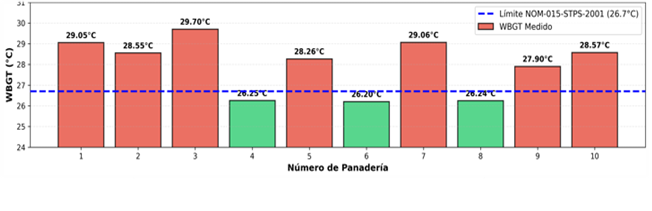
Heat stress (HS) is an emerging risk that affects the health, safety, and productivity of workers in micro, small, and medium-sized enterprises (MSMEs), particularly those that work with heat sources such as artisanal bakeries. According to INEGI’s National Statistical Directory of Economic Units (DENUE), there are approximately 59,881 traditional bakeries in Mexico, distributed throughout the country. Veracruz ranks among the states with the highest concentration of such establishments, ranking second in the country, highlighting their importance as small-scale economic units. These establishments are characterized by having ovens, small spaces, and poor ventilation, which increases the thermal load. Heat stress occurs when the body is unable to dissipate the heat generated by metabolism or received from the environment; this raises body temperature and begins to cause immediate health damage, causing mild effects and can even lead to death. This highlights the importance of studying working conditions in these environments. According to the Undersecretariat of Health and Population Welfare Policies, in 2024 there were 4,007 reported cases in the country due to heatstroke, dehydration, and burns, as well as 306 deaths resulting from high temperatures during the hot season. The objective of this project is to conduct a preliminary assessment of the working conditions of workers exposed to high temperatures in bakeries in the city of Misantla, Ver., to identify critical scenarios. The methodological approach for this research consists of a field study to gather information on work organization and operating conditions, as well as to measure the Wet Bulb Globe Temperature (WBGT) index in representative areas during working hours, in accordance with NOM-015-STPS-2001. The results indicate that 70% of the establishments exceed the permissible WBGT limits for moderate-to-high work, reflecting hazardous thermal conditions. Critical points related to oven radiation and moisture accumulation were identified, intensifying the physiological risk for workers, considering that they work an average of 8 hours per day. These results indicate the need for further research to identify the effects that promote exposure to conditions of heat stress and establish thermal control measures.
Downloads
References
[1] A. Nath, S. Sahu, and J. K. W. Lee, “An umbrella review of systematic reviews and meta-analyses on occupational heat exposure, health risks, and productivity losses worldwide,” Curr. Environ. Health Rep., 2026, https://doi.org/10.1007/s40572-025-00520-8
[2] J. Ballester, M. Quijal Zamorano, R. F. Méndez Turrubiates, F. Pegenaute, F. R. Herrmann, J. M. Robine, X. Basagaña, C. Tonne, J. M. Antó, y H. Achebak, “Heat-related mortality in Europe during the summer of 2022,” Nat. Med., vol. 29, no. 7, pp. 1857–1866, 2023, https://www.nature.com/articles/s41591-023-02419-zf
[3] O. Aleksandrowicz and D. Pearlmutter, “The significance of shade provision in reducing street-level summer heat stress in a hot Mediterranean climate,” Landscape Urban Plan., vol. 232, p. 104588, 2023, https://doi.org/10.1016/j.landurbplan.2022.104588
[4] International Labour Organization, Working on a warmer planet: The impact of heat stress on labour productivity and decent work, Geneva, Switzerland, 2019. [Online]. Available: https://www.ilo.org
[5] World Health Organization, “Climate change and heat and health,” 2024. [Online]. Available:https://www.who.int/news-room/fact-sheets/detail/climate-change-heat-and-health [Accessed: Apr. 14, 2026].
[6] B. Jacklitsch, W. Williams, K. Musolin, A. Coca, J.-H. Kim, y N. Turner, Criteria for a Recommended Standard: Occupational Exposure to Heat and Hot Environments, NIOSH Publ. No. 2016-106, National Institute for Occupational Safety and Health (NIOSH), 2016. [Online]. Available: https://www.cdc.gov/niosh/docs/2016-106
[7] M. N. Cramer, D. Gagnon, O. Laitano, and C. G. Crandall, “Human temperature regulation under heat stress in health, disease, and injury,” Physiol. Rev., vol. 102, no. 4, pp. 1907–1989, 2022, https://doi.org/10.1152/physrev.00047.2021
[8] T. A. Rojas-Valencia, J. Glaser, K. Lemery, y R. J. Johnson, “Heat stress, dehydration, and kidney function in agricultural workers,” Kidney International Reports, vol. 5, no. 9, pp. 1482–1490, 2020, doi: 10.1016/j.ekir.2020.06.021.
[9] D. B. Cahyarani et al., “Physiological response of the body to heat exposure in workers,” Int. J. Health Sci., vol. 5, no. 3, pp. 371–379, 2025, https://doi.org/10.55606/ijhs.v5i3.6240
[10] Z. Mousavi, H. Ehsani, H. Elahi, S. Etemadinezhad, A. Hossein Nataj, y S. E. Samaei, "The cognitive and physiologic effects of occupational heat exposure on operational field workers: An exploratory study," J. Res. Health, vol. 15, no. 3, pp. 311–318, 2025, doi:10.32598/JRH.15.3.2433.1
[11] American Conference of Governmental Industrial Hygienists, Threshold Limit Values (TLVs®) and Biological Exposure Indices (BEIs®), 2025 ed., ACGIH, 2025.
[12] Tustin, A. W., Cannon, D. L., Arbury, S. B., Thomas, R. J., & Hodgson, M. J. (2018). Evaluation of occupational exposure limits for heat stress in outdoor workers — United States, 2011–2016. MMWR. Morbidity and Mortality Weekly Report, 67(26), 733–737. https://doi.org/10.15585/mmwr.mm6726a1
[13] International Labour Organization, Ensuring Safety and Health at Work in a Changing Climate. Geneva, Switzerland: ILO, 2024. [Online]. Available: https://www.ilo.org/publications/ensuring-safety-and-health-work-changing-climate
[14] Secretaría del Trabajo y Previsión Social, NOM-015-STPS-2001, Condiciones térmicas elevadas o abatidas, Diario Oficial de la Federación, 2001. [Online]. Available: www.stps.gob.mx/bp/secciones/dgsst/normatividad/normas/Nom-015.pdf
[15] G. Moreno Martín and J. Inglés Torruella, “Impacto en la salud laboral de la exposición al calor extremo: una revisión sistemática,” Rev. Habanera Cienc. Méd., 2023,[Online].Available: https://revhabanera.sld.cu/index.php/rhab/article/view/5328
[16] S. Saif et al., “Evaluation of occupational indoor heat stress impact on health and kidney functions among kitchen workers,” 2022, https://doi.org/10.21608/ejom.2022.118594.1263
[17] Z. Mirsanei et al., “The influence of occupational heat stress on serum inflammatory cytokines among traditional bakery workers in Iran,” PLoS ONE, 2024. doi: 10.1371/journal.pone.0302847
[18] D. G. Costabile, V. Fuccillo, and C. De Marco, “The effects of climate change on the health and safety of pasta industry workers: assessment of heat stress using WBGT index,” Journal of Advanced Health Care, vol. 5, no. 4, 2023. [Online]. Available: https://www.semanticscholar.org/paper/The-effects-of-climate-change-on-the-health-and-of-Costabile-Fuccillo/15c2d602b8daa68060231f3e8cb8d820da63f635
[19] M. Sharma, M. S. Alam, N. M. Suri, and S. Kant, “Occupational heat stress under high-heat furnace work environments: A comprehensive review on developing countries,” Journal of Thermal Engineering, vol. 7, no. 6, pp. 1303–1320, 2021. doi: 10.18186/thermal.1051603
[20] R. Cabanillas, “Solar energy industry workers under climate change: A risk assessment of the level of heat stress experienced by a worker based on measured data,” Safety Science, vol. 118, pp. 33–47, 2019. doi: 10.1016/j.ssci.2019.04.042
[21] R. S. Wagoner, N. I. López-Gálvez, J. G. de Zapien, S. C. Griffin, R. A. Canales, and P. I. Beamer, “An occupational heat stress and hydration assessment of agricultural workers in North Mexico,” International Journal of Environmental Research and Public Health, vol. 17, no. 6, p. 2102, 2020. doi: 10.3390/ijerph17062102
[22] A. G. Romero Osuna, “Vulnerabilidad térmica del sector de la construcción ante el calor extremo: evaluación del índice WBGT en Chihuahua, México,” presented at the Congreso Virtual de Medio Ambiente: Ecología y Biodiversidad, UAdeC, 2025. [Online]. Available:https://ojs.brazilianjournals.com.br/ojs/index.php/BJAER/article/view/84762/57824
[23] M. Gámez Orea, “El Real Decreto-Ley 4/2023 o la visibilidad normativa del estrés térmico laboral,” Revista de Derecho de la Seguridad Social, Laborum, vol. 36, pp. 235–252, 2023. [Online]. Available: https://dialnet.unirioja.es/servlet/articulo?codigo=9133570
[24] M. Revueltas Agüero, E. Molina Esquivel, and M. Hernández Sánchez, “La salud humana frente al estrés térmico por el cambio climático,” Arch Med Camagüey, vol. 27, p. e9073, 2023. [Online]. Available: http://scielo.sld.cu/pdf/amc/v27/1025-0255-amc-27-e9073.pdf
[25] CEIEG, Cuadernillos Municipales 2023, Comité de Información Estadística y Geografía del Estado de Veracruz. [Online]. Available: https://ceieg.veracruz.gob.mx/2023/08/31/cuadernillos-municipales-2023/ (accessed Jan. 10, 2026)
Downloads
Published
Data Availability Statement
The data supporting the findings of this study are available from the corresponding author upon reasonable request.
Issue
Section
Categories
License
Copyright (c) 2026 Yensy Fernández Pentón, Rodrigo Vivar Ocampo, Ana Roselyn Pérez Méndez, Rubén Omar Gutiérrez Salazar , Yodaira Borroto Pentón, David Reyes González

This work is licensed under a Creative Commons Attribution 4.0 International License.
The authors who publish in this journal accept the following conditions:
The authors retain the copyright and assign to the journal the right of the first publication, with the work registered with the Creative Commons Attribution license 4.0, which allows third parties to use what is published as long as they mention the authorship of the work and the first publication in this magazine.
Authors may make other independent and additional contractual agreements for the non-exclusive distribution of the version of the article published in this journal (eg, include it in an institutional repository or publish it in a book) as long as they clearly indicate that the work it was first published in this magazine.
Authors are allowed and encouraged to share their work online (for example: in institutional repositories or personal web pages) before and during the manuscript submission process, as it can lead to productive exchanges, greater and more quick citation of published work (see The Effect of Open Access).
How to Cite