C-Waste: educación ambiental para el desarrollo sustentable en comunidades urbanas
DOI:
https://doi.org/10.37636/recit.v9n3e462Palabras clave:
Desarrollo sustentable, Educación ambiental, Residuos sólidos urbanosResumen
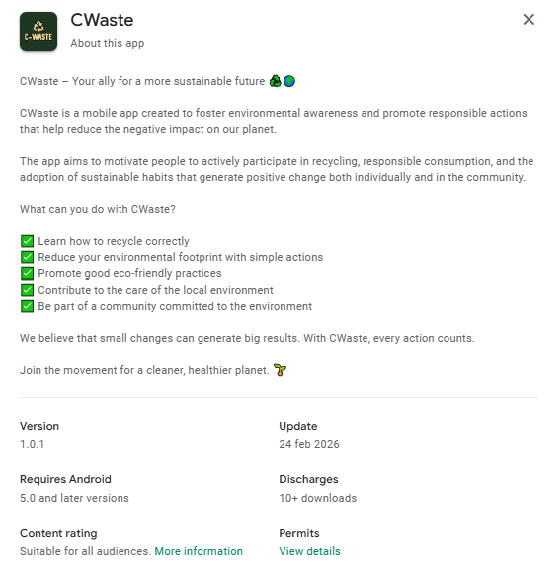
La gestión de residuos sólidos urbanos es un desafío global crítico que requiere una transición hacia enfoques de economía circular y educación ambiental. Este artículo presenta el desarrollo y análisis de C-Waste, una aplicación móvil de educación ambiental diseñada para promover prácticas sostenibles de gestión de residuos y consumo responsable en comunidades urbanas, específicamente en Tecate, Baja California, México. El objetivo principal es evaluar cómo las tecnologías digitales pueden facilitar el cambio de comportamiento ecológico. Adoptando una metodología de estudio de caso a partir de una prueba piloto llevada a cabo en el Centro Comunitario El Florido IV Seccion dirigida a una población de 500 usuarios, la investigación abarca cuatro etapas: el diseño de un Modelo Canvas (BMC), el desarrollo de la aplicación móvil, su difusión pública multicanal y un análisis preliminar. Los resultados demuestran la estructuración de un BMC viable que alinea los recursos tecnológicos con los objetivos socioambientales. La aplicación traduce eficazmente los datos ecológicos en una herramienta que integra ludificación y el marco de las 5R (rechazar, repensar, reducir, reutilizar, reciclar). Además, se implementó una estrategia digital en plataformas como YouTube, Instagram y Facebook para maximizar la participación social. En conclusión, la iniciativa C-Waste ilustra que integrar herramientas digitales, modelos pedagógicos y alianzas multisectoriales cierra efectivamente la brecha entre información y acción, empoderando a los ciudadanos para adoptar hábitos sostenibles.
Descargas
Referencias
[1] J. Kirchherr and K. Hartley, “Is circular economy a failing sustainability paradigm? Not necessarily,” Journal of Industrial Ecology, vol. 29, pp. 1051–1059, 2025, doi: 10.1111/jiec.70055. DOI: https://doi.org/10.1111/jiec.70055
[2] J. Kirchherr, N.-H. N. Yang, F. Schulze-Spüntrup, M. J. Heerink, and K. Hartley, “Conceptualizing the Circular Economy (Revisited): An Analysis of 221 Definitions,” Resources, Conservation and Recycling, vol. 194, Art. no. 107001, 2023, doi: 10.1016/j.resconrec.2023.107001. DOI: https://doi.org/10.1016/j.resconrec.2023.107001
[3] M. Hajj-Hassan, R. Chaker, and A.-M. Cederqvist, “Environmental Education: A Systematic Review on the Use of Digital Tools for Fostering Sustainability Awareness,” Sustainability, vol. 16, no. 9, Art. no. 3733, 2024, doi: 10.3390/su16093733. DOI: https://doi.org/10.3390/su16093733
[4] A. T. Rosário and J. C. Dias, “Sustainability and the Digital Transition: A Literature Review,” Sustainability, vol. 14, no. 7, Art. no. 4072, 2022, doi: 10.3390/su14074072. DOI: https://doi.org/10.3390/su14074072
[5] C. Strzelecka, “Green-digital transition in municipal waste management: Ethnographic perspective on ‘smart’ waste monitoring and management system,” Environmental Science & Policy, vol. 167, Art. no. 104037, 2025, doi: 10.1016/j.envsci.2025.104037. DOI: https://doi.org/10.1016/j.envsci.2025.104037
[6] A. García-Hernández, A. García-Valcárcel Muñoz-Repiso, S. Casillas-Martín, and M. Cabezas-González, “Sustainability in Digital Education: A Systematic Review of Innovative Proposals,” Education Sciences, vol. 13, no. 1, Art. no. 33, 2023, doi: 10.3390/educsci13010033. DOI: https://doi.org/10.3390/educsci13010033
[7] W. M. Lim, M. Das, W. Sharma, A. Verma, and R. Kumra, “Gamification for sustainable consumption: A state-of-the-art overview and future agenda,” Business Strategy and the Environment, vol. 34, no. 1, pp. 1510–1549, 2025, doi: 10.1002/bse.4021. DOI: https://doi.org/10.1002/bse.4021
[8] E. Jaska, A. Werenowska, and A. Balińska, “The usefulness of mobile applications in shaping responsible consumption,” International Journal of Management and Economics, vol. 61, no. 1, pp. 70–82, 2025, doi: 10.2478/ijme-2024-0020. DOI: https://doi.org/10.2478/ijme-2024-0020
[9] W. Czekała, J. Drozdowski, and P. Łabiak, “Modern Technologies for Waste Management: A Review,” Applied Sciences, vol. 13, no. 15, Art. no. 8847, 2023, doi: 10.3390/app13158847. DOI: https://doi.org/10.3390/app13158847
[10] R. Haas, H. Aşan, O. Doğan, C. R. Michalek, Ö. Karaca Akkan, and Z. A. Bulut, “Designing and Implementing the MySusCof App—A Mobile App to Support Food Waste Reduction,” Foods, vol. 11, no. 15, Art. no. 2222, 2022, doi: 10.3390/foods11152222. DOI: https://doi.org/10.3390/foods11152222
[11] H. Oe, Y. Yamaoka, and H. Ochiai, “A Qualitative Assessment of Community Learning Initiatives for Environmental Awareness and Behaviour Change,” International Journal of Environmental Research and Public Health, vol. 19, no. 6, Art. no. 3528, 2022, doi: 10.3390/ijerph19063528. DOI: https://doi.org/10.3390/ijerph19063528
[12] D. Szpilko, A. de la Torre Gallegos, F. Jimenez Naharro, A. Rzepka, and A. Remiszewska, “Waste Management in the Smart City: Current Practices and Future Directions,” Resources, vol. 12, no. 10, Art. no. 115, 2023, doi: 10.3390/resources12100115. DOI: https://doi.org/10.3390/resources12100115
[13] W. Xu, L. Wang, and S. Xu, “Sustainability Education Through Digital Platforms: Evaluating Digital Tools for Eco-Conscious Behavior Promotion,” Pakistan Journal of Life & Social Sciences, vol. 23, no. 1, 2025, doi: 10.57239/PJLSS-2025-23.1.00111. DOI: https://doi.org/10.57239/PJLSS-2025-23.1.00111
[14] S. Hanif, A. Bakar, and M. A. Nawaz, “Relationship between Information and Communication Technologies and Sustainable Development,” IRASD Journal of Economics, vol. 4, no. 3, pp. 517–526, 2022, doi: 10.52131/joe.2022.0403.0096. DOI: https://doi.org/10.52131/joe.2022.0403.0096
[15] V. Koval, I. Mikhno, R. Tamosiuniene, H. Kryshtal, Y. Kovalenko-Marchenkova, and H. Gui, “Ensuring Sustainable Consumption Behaviours in Circular Economy Engagement,” Transformations in Business & Economics, vol. 22, no. 2, pp. 161–177, 2023.
[16] I. M. Pacheco, E. van der Werff, and L. Steg, “Circular citizenship behaviors: How individuals can promote systemic change toward a circular economy,” iScience, vol. 28, no. 7, 2025, doi: 10.1016/j.isci.2025.112906. DOI: https://doi.org/10.1016/j.isci.2025.112906
[17] L. V. Trevisan, J. H. P. P. Eustachio, B. G. Dias, W. L. Filho, and E. Á. Pedrozo, “Digital transformation towards sustainability in higher education,” Environment, Development and Sustainability, vol. 26, no. 2, pp. 2789–2810, 2024, doi: 10.1007/s10668-022-02874-7. DOI: https://doi.org/10.1007/s10668-022-02874-7
[18] M. M. Ahmed, E. Hassanien, and A. E. Hassanien, “IoT-based intelligent waste management system,” Neural Computing and Applications, vol. 35, no. 32, pp. 23551–23579, 2023, doi: 10.1007/s00521-023-08970-7. DOI: https://doi.org/10.1007/s00521-023-08970-7
[19] C. P. Gumbheer, K. K. Khedo, and A. Bungaleea, “Personalized and Adaptive Context-Aware Mobile Learning,” Education and Information Technologies, vol. 27, no. 6, pp. 7491–7517, 2022, doi: 10.1007/s10639-022-10942-8. DOI: https://doi.org/10.1007/s10639-022-10942-8
[20] F. M. Alshammary and W. S. Alhalafawy, “Digital Platforms and the Improvement of Learning Outcomes,” Sustainability, vol. 15, no. 2, Art. no. 1305, 2023, doi: 10.3390/su15021305. DOI: https://doi.org/10.3390/su15021305
[21] J. Ferreira-Santos and L. Pombo, “Education on Sustainable Development Through Built Heritage and Technology,” Proceedings, vol. 113, no. 1, Art. no. 17, 2025, doi: 10.3390/proceedings2025113017. DOI: https://doi.org/10.3390/proceedings2025113017
[22] U. Awan and R. Sroufe, “Sustainability in the Circular Economy,” Applied Sciences, vol. 12, no. 3, Art. no. 1521, 2022, doi: 10.3390/app12031521. DOI: https://doi.org/10.3390/app12031521
[23] M. Sharma, J. Shah, S. Joshi, A. B. Youssef, and A. Misra, “Digital Innovation and Sustainability Driven Consumer Behavior,” Preprints, 2023, doi: 10.20944/preprints202306.1604.v1. DOI: https://doi.org/10.20944/preprints202306.1604.v1
[24] O. Mont, M. Lehner, and C. Dalhammar, “Sustainable consumption through policy intervention,” Frontiers in Sustainability, vol. 3, Art. no. 921477, 2022, doi: 10.3389/frsus.2022.921477. DOI: https://doi.org/10.3389/frsus.2022.921477
[25] F. Huang, Q. Chen, W. Ma, and R. Evans, “Promoting public engagement with household waste separation through government social media,” Journal of Environmental Management, vol. 320, Art. no. 115825, 2022, doi: 10.1016/j.jenvman.2022.115825. DOI: https://doi.org/10.1016/j.jenvman.2022.115825
[26] V. Hrei, D. Otych, N. Krivokulska, Y. Bohach, and L. Homlia, “The Role of Communication in Developing Environmental Awareness,” Grassroots Journal of Natural Resources, vol. 7, no. 3, pp. s270–s289, 2024, doi: 10.33002/nr2581.6853.0703ukr14. DOI: https://doi.org/10.33002/nr2581.6853.0703ukr14
[27] T. Adams, S. M. Jameel, and J. Goggins, “Education for Sustainable Development: Mapping the SDGs to University Curricula,” Sustainability, vol. 15, no. 10, Art. no. 8340, 2023, doi: 10.3390/su15108340. DOI: https://doi.org/10.3390/su15108340
[28] Q. Islam and S. M. F. A. Khan, “Sustainability-infused learning environments,” International Journal of Learning, Teaching and Educational Research, vol. 23, no. 1, pp. 519–548, 2024, doi: 10.26803/ijlter.23.1.25. DOI: https://doi.org/10.26803/ijlter.23.1.25
[29] S. Nesmachnow, D. Rossit, and P. Moreno-Bernal, “A Literature Review of Recent Advances on Innovative Computational Tools for Waste Management in Smart Cities,” Urban Science, vol. 9, no. 1, Art. no. 16, 2025, doi: 10.3390/urbansci9010016. DOI: https://doi.org/10.3390/urbansci9010016
[30] J. A. Aristizábal Cuellar, E. Puerto-Rojas, S. N. Correa-Galindo, and M. C. Sierra Puentes, “A Community-Based Intervention Proposal for Municipal Solid Waste Management,” Sustainability, vol. 17, no. 13, Art. no. 6206, 2025, doi: 10.3390/su17136206. DOI: https://doi.org/10.3390/su17136206
[31] T. Mäkitie, J. Hanson, S. Damman, and M. Wardeberg, “Digital innovation’s contribution to sustainability transitions,” Technology in Society, vol. 73, Art. no. 102255, 2023, doi: 10.1016/j.techsoc.2023.102255. DOI: https://doi.org/10.1016/j.techsoc.2023.102255
[32] N. Mesiranta, M. Mattila, O. Koskinen, and E. Närvänen, “Circular Consumption Practices as Matters of Care,” Journal of Business Ethics, vol. 200, no. 1, pp. 13–30, 2025, doi: 10.1007/s10551-024-05888-5. DOI: https://doi.org/10.1007/s10551-024-05888-5
[33] H. Rau, S. Nicolai, and S. Stoll-Kleemann, “A systematic review to assess behavior change interventions for pro-environmental behavior,” Frontiers in Psychology, vol. 13, Art. no. 901927, 2022, doi: 10.3389/fpsyg.2022.901927. DOI: https://doi.org/10.3389/fpsyg.2022.901927
[34] R. Venn, P. Perez, and V. Vandenbussche, “Competencies of Sustainability Professionals,” Sustainability, vol. 14, no. 9, Art. no. 4916, 2022, doi: 10.3390/su14094916. DOI: https://doi.org/10.3390/su14094916
[35] E. Duda et al., “Encouraging Pro-environmental Behaviour Through an Educational Mobile Application,” International Journal of Pedagogy, Innovation and New Technologies, vol. 10, no. 1, pp. 64–78, 2023, doi: 10.5604/01.3001.0053.9400. DOI: https://doi.org/10.5604/01.3001.0053.9400
[36] A. Wiek, L. Withycombe, and C. L. Redman, “Key competencies in sustainability,” Sustainability Science, vol. 6, no. 2, pp. 203–218, 2011, doi: 10.1007/s11625-011-0132-6. DOI: https://doi.org/10.1007/s11625-011-0132-6
[37] K. Brundiers et al., “Key competencies in sustainability in higher education,” Sustainability Science, vol. 16, no. 1, pp. 13–29, 2021, doi: 10.1007/s11625-020-00838-2. DOI: https://doi.org/10.1007/s11625-020-00838-2
[38] M. Rieckmann, “Future-oriented higher education,” Futures, vol. 44, no. 2, pp. 127–135, 2012, doi: 10.1016/j.futures.2011.09.005. DOI: https://doi.org/10.1016/j.futures.2011.09.005
[39] A. Corres, M. Rieckmann, A. Espasa, and I. Ruiz-Mallén, “Educator Competences in Sustainability Education,” Sustainability, vol. 12, no. 23, Art. no. 9858, 2020, doi: 10.3390/su12239858. DOI: https://doi.org/10.3390/su12239858
[40] J. van de Wetering, P. Leijten, J. Spitzer, and S. Thomaes, “Does environmental education benefit environmental outcomes in children and adolescents?” Journal of Environmental Psychology, vol. 81, Art. no. 101782, 2022, doi: 10.1016/j.jenvp.2022.101782. DOI: https://doi.org/10.1016/j.jenvp.2022.101782
[41] M. Monroe, R. Plate, A. Oxarart, A. Bowers, and W. A. Chaves, “Identifying effective climate change education strategies,” Environmental Education Research, vol. 25, no. 6, pp. 791–812, 2019, doi: 10.1080/13504622.2017.1360842. DOI: https://doi.org/10.1080/13504622.2017.1360842
[42] D. Bolscho and K. Hauenschild, “From environmental education to Education for Sustainable Development in Germany,” Environmental Education Research, vol. 12, no. 1, pp. 7–18, 2006, doi: 10.1080/13504620500526297. DOI: https://doi.org/10.1080/13504620500526297
[43] P. Acosta and A. Queiruga-Dios, “From environmental education to education for sustainable development in higher education,” International Journal of Sustainability in Higher Education, vol. 23, no. 3, pp. 622–644, 2022, doi: 10.1108/IJSHE-04-2021-0167. DOI: https://doi.org/10.1108/IJSHE-04-2021-0167
[44] G. Cebrián and M. Junyent, “Competencies in Education for Sustainable Development,” Sustainability, vol. 7, no. 3, pp. 2768–2786, 2015, doi: 10.3390/su7032768. DOI: https://doi.org/10.3390/su7032768
[45] M. Adomssent et al., “Developing key competencies for sustainable development in higher education,” International Journal of Sustainability in Higher Education, vol. 8, no. 4, pp. 416–430, 2007, doi: 10.1108/14676370710823582. DOI: https://doi.org/10.1108/14676370710823582
[46] T. Hammer and A. L. Lewis, “Which competencies should be fostered in education for sustainable development at higher education institutions?” Discover Sustainability, vol. 4, no. 1, Art. no. 19, 2023, doi: 10.1007/s43621-023-00134-w. DOI: https://doi.org/10.1007/s43621-023-00134-w
[47] R. Lozano, M. Y. Merrill, K. Sammalisto, K. Ceulemans, and F. J. Lozano, “Connecting Competences and Pedagogical Approaches for Sustainable Development in Higher Education,” Sustainability, vol. 9, no. 10, Art. no. 1889, 2017, doi: 10.3390/su9101889. DOI: https://doi.org/10.3390/su9101889
[48] M. Geissdoerfer, P. Savaget, N. M. P. Bocken, and E. J. Hultink, “The Circular Economy – A new sustainability paradigm?” Journal of Cleaner Production, vol. 143, pp. 757–768, 2017, doi: 10.1016/j.jclepro.2016.12.048. DOI: https://doi.org/10.1016/j.jclepro.2016.12.048
[49] P. Ghisellini, C. Cialani, and S. Ulgiati, “A review on circular economy,” Journal of Cleaner Production, vol. 114, pp. 11–32, 2016, doi: 10.1016/j.jclepro.2015.09.007. DOI: https://doi.org/10.1016/j.jclepro.2015.09.007
[50] B. Su, A. Heshmati, Y. Geng, and X. Yu, “A review of the circular economy in China,” Journal of Cleaner Production, vol. 42, pp. 215–227, 2013, doi: 10.1016/j.jclepro.2012.11.020. DOI: https://doi.org/10.1016/j.jclepro.2012.11.020
[51] J. Kirchherr, D. Reike, and M. Hekkert, “Conceptualizing the circular economy,” Resources, Conservation and Recycling, vol. 127, pp. 221–232, 2017, doi: 10.1016/j.resconrec.2017.09.005. DOI: https://doi.org/10.1016/j.resconrec.2017.09.005
[52] J. Korhonen, A. Honkasalo, and J. Seppälä, “Circular Economy: The Concept and its Limitations,” Ecological Economics, vol. 143, pp. 37–46, 2018, doi: 10.1016/j.ecolecon.2017.06.041. DOI: https://doi.org/10.1016/j.ecolecon.2017.06.041
[53] J. Korhonen, C. Nuur, A. Feldmann, and S. E. Birkie, “Circular economy as an essentially contested concept,” Journal of Cleaner Production, vol. 175, pp. 544–552, 2018, doi: 10.1016/j.jclepro.2017.12.111. DOI: https://doi.org/10.1016/j.jclepro.2017.12.111
[54] J. Kirchherr et al., “Barriers to the Circular Economy,” Ecological Economics, vol. 150, pp. 264–272, 2018, doi: 10.1016/j.ecolecon.2018.04.028. DOI: https://doi.org/10.1016/j.ecolecon.2018.04.028
[55] A. de Jesus and S. Mendonça, “Lost in Transition?” Ecological Economics, vol. 145, pp. 75–89, 2018, doi: 10.1016/j.ecolecon.2017.08.001. DOI: https://doi.org/10.1016/j.ecolecon.2017.08.001
[56] N. M. P. Bocken, I. de Pauw, C. Bakker, and B. van der Grinten, “Product design and business model strategies for a circular economy,” Journal of Industrial and Production Engineering, vol. 33, no. 5, pp. 308–320, 2016, doi: 10.1080/21681015.2016.1172124. DOI: https://doi.org/10.1080/21681015.2016.1172124
[57] M. Moreno, C. De los Rios, Z. Rowe, and F. Charnley, “A Conceptual Framework for Circular Design,” Sustainability, vol. 8, no. 9, Art. no. 937, 2016, doi: 10.3390/su8090937. DOI: https://doi.org/10.3390/su8090937
[58] A. Diaz, J.-P. Schöggl, T. Reyes, and R. Baumgartner, “Sustainable product development in a circular economy,” Sustainable Production and Consumption, vol. 26, pp. 1031–1045, 2021, doi: 10.1016/j.spc.2020.12.044. DOI: https://doi.org/10.1016/j.spc.2020.12.044
[59] M. Andersen, “An introductory note on the environmental economics of the circular economy,” Sustainability Science, vol. 2, no. 1, pp. 133–140, 2007, doi: 10.1007/s11625-006-0013-6. DOI: https://doi.org/10.1007/s11625-006-0013-6
[60] G. Dash, C. Sharma, and S. Sharma, “Sustainable Marketing and the Role of Social Media,” Sustainability, vol. 15, no. 6, Art. no. 5443, 2023, doi: 10.3390/su15065443. DOI: https://doi.org/10.3390/su15065443
[61] L. Gooding and R. Phillips, “Aligning Digital Futures with Ecological Citizenship for Sustainability,” Sustainability, vol. 17, no. 18, Art. no. 8102, 2025, doi: 10.3390/su17188102. DOI: https://doi.org/10.3390/su17188102
[62] H. Si, J. G. Shi, D. Tang, S. Wen, W. Miao, and K. Duan, “Application of the Theory of Planned Behavior in Environmental Science,” International Journal of Environmental Research and Public Health, vol. 16, no. 15, Art. no. 2788, 2019, doi: 10.3390/ijerph16152788. DOI: https://doi.org/10.3390/ijerph16152788
[63] D. Cevallos Andrade and F. L. Del Blanco García, “Designing a Phygital Prosthesis for Urban Spaces,” Street Art & Urban Creativity, vol. 11, no. 1, pp. 163–178, 2025, doi: 10.62161/sauc.v11.5684. DOI: https://doi.org/10.62161/sauc.v11.5684
[64] J. Lee, C. C. Chen, and A. Basu, “From Novelty to Knowledge: A Longitudinal Investigation of the Novelty Effect on Learning Outcomes in Virtual Reality,” IEEE Transactions on Visualization and Computer Graphics, vol. 31, no. 5, pp. 3204–3212, 2025, doi: 10.1109/TVCG.2025.3549897. DOI: https://doi.org/10.1109/TVCG.2025.3549897
[65] T. R. Merlo, F. Fard, and S. Hawamdeh, “Cloud Computing’s Impact on the Digital Transformation of the Enterprise,” Sustainability, vol. 17, no. 13, Art. no. 5755, 2025, doi: 10.3390/su17135755. DOI: https://doi.org/10.3390/su17135755
[66] A. Gallego-Schmid et al., “Circular economy in Latin America and the Caribbean,” Sustainable Production and Consumption, vol. 51, pp. 118–136, 2024, doi: 10.1016/j.spc.2024.09.006. DOI: https://doi.org/10.1016/j.spc.2024.09.006
Descargas
Publicado
Declaración de disponibilidad de datos
Todos los datos pertinentes que respaldan los hallazgos de este estudio, incluidos el diseño conceptual y el modelo de negocio (Business Model Canvas) de la aplicación C-Waste, están disponibles en el artículo. No se generaron conjuntos de datos externos adicionales durante esta fase de la investigación.
Número
Sección
Categorías
Licencia
Derechos de autor 2026 Edgar Armando Chavez-Moreno, Maria Virginia Flores-Ortiz

Esta obra está bajo una licencia internacional Creative Commons Atribución 4.0.
Los autores/as que publiquen en esta revista aceptan las siguientes condiciones:
- Los autores/as conservan los derechos de autor y ceden a la revista el derecho de la primera publicación, con el trabajo registrado con la licencia de atribución de Creative Commons 4.0, que permite a terceros utilizar lo publicado siempre que mencionen la autoría del trabajo y a la primera publicación en esta revista.
- Los autores/as pueden realizar otros acuerdos contractuales independientes y adicionales para la distribución no exclusiva de la versión del artículo publicado en esta revista (p. ej., incluirlo en un repositorio institucional o publicarlo en un libro) siempre que indiquen claramente que el trabajo se publicó por primera vez en esta revista.
- Se permite y recomienda a los autores/as a compartir su trabajo en línea (por ejemplo: en repositorios institucionales o páginas web personales) antes y durante el proceso de envío del manuscrito, ya que puede conducir a intercambios productivos, a una mayor y más rápida citación del trabajo publicado (vea The Effect of Open Access).
Cómo citar