Inteligencia artificial como agente mediador del aprendizaje arquitectónico: una perspectiva transdisciplinar
DOI:
https://doi.org/10.37636/recit.v9n2e458Palabras clave:
Aprendizaje arquitectónico, Inteligencia artificial, Transdisciplinariedad, Mediación pedagógica, Cognición proyectualResumen
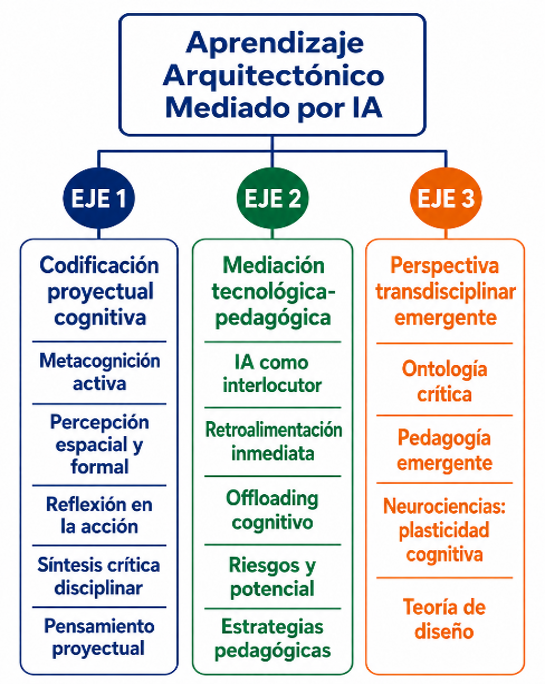
La incorporación de la Inteligencia Artificial (IA) en los entornos educativos ha modificado de forma acelerada los procesos de aprendizaje en arquitectura y ha transformado los métodos de diseño, las formas de pensamiento y la generación de nuevo conocimiento disciplinar. El presente artículo presenta una revisión crítica de literatura y un análisis conceptual de la IA como agente mediador del aprendizaje arquitectónico contemporáneo, desarrollado desde una perspectiva transdisciplinar y bajo el marco interpretativo de la ontología crítica, el cual estructura la realidad educativa en tres capas: lo subjetivo, lo intersubjetivo y lo objetivo. El estudio problematiza la fragmentación curricular emergente, derivada de la ausencia de lineamientos pedagógicos que orienten el uso responsable de esta tecnología. Como resultado central del análisis, se formula una propuesta epistemológica articulada en tres dimensiones: la cognitiva (síntesis crítica y metacognición), la intersubjetiva (normativa y ética compartida) y la objetiva (datos, algoritmos y métricas). Esta arquitectura conceptual constituye el conducto adecuado para integrar la IA en los procesos formativos, siempre que se cumplan cuatro condiciones pedagógicas específicas que preserven el pensamiento crítico, la creatividad proyectual y la autonomía intelectual del arquitecto en formación.
Descargas
Referencias
[1] E. Kasneci et al., “ChatGPT for good? On opportunities and challenges of large language models for education,” Learning and Individual Differences, vol. 103, Art. no. 102274, 2023, doi: 10.1016/j.lindif.2023.102274. DOI: https://doi.org/10.1016/j.lindif.2023.102274
[2] D. Komatina, M. Miletic, and M. Mosurovic Ruzicic, “Embracing artificial intelligence (AI) in architectural education: A step towards sustainable practice?,” Buildings, vol. 14, no. 8, Art. no. 2578, 2024, doi: 10.3390/buildings14082578. DOI: https://doi.org/10.3390/buildings14082578
[3] Chaos and Architizer, “The state of AI in architecture: Insights from 1,200+ architects and designers,” Chaos Group, 2025. [Online]. Available: https://blog.chaos.com/the-state-of-ai-in-architecture-survey-insights
[4] Higher Education Policy Institute and Kortext, “Student academic experience survey 2025,” HEPI, 2025.
[5] C.-K. Y. Chan and H. Y. Hu, “Students use of large language models in Hong Kong,” Computers and Education: Artificial Intelligence, vol. 6, Art. no. 100224, 2023, doi: 10.1016/j.caeai.2023.100224.
[6] H. Crompton and D. Burke, “Artificial intelligence in higher education: The state of the field,” Computers and Education: Artificial Intelligence, vol. 4, 2023, doi: 10.1016/j.caeai.2023.100124. DOI: https://doi.org/10.1186/s41239-023-00392-8
[7] S. Hejazi, M. Shafaei, and M. Hafezi, “The gap between architecture education and architectural profession in Iran,” International Journal of Architectural Research and Practice, vol. 7, no. 2, pp. 45–62, 2019.
[8] R. Oxman, “Thinking difference: Theories and models of parametric design thinking,” Design Studies, vol. 52, pp. 4–39, 2017, doi: 10.1016/j.destud.2017.06.001. DOI: https://doi.org/10.1016/j.destud.2017.06.001
[9] M. Butt et al., “Transdisciplinary engineering design education: Ontology for a generic product design process,” Procedia CIRP, vol. 70, pp. 338–343, 2018, doi: 10.1016/j.procir.2018.02.019. DOI: https://doi.org/10.1016/j.procir.2018.02.019
[10] UNESCO, Artificial Intelligence and Education: Guidance for Policy-Makers. Paris, France: UNESCO Publishing, 2021. [Online]. Available: https://unesdoc.unesco.org/ark:/48223/pf0000376709
[11] E. Jaakkola, “Designing conceptual articles: Four approaches,” AMS Review, vol. 10, pp. 18–26, 2020, doi: 10.1007/s13162-020-00161-0. DOI: https://doi.org/10.1007/s13162-020-00161-0
[12] F. Ouyang and P. Jiao, “Artificial intelligence in education: The three paradigms,” Computers and Education: Artificial Intelligence, vol. 2, Art. no. 100020, 2021, doi: 10.1016/j.caeai.2021.100020. DOI: https://doi.org/10.1016/j.caeai.2021.100020
[13] D. A. Schön, The Reflective Practitioner: How Professionals Think in Action. New York, NY, USA: Basic Books, 1983.
[14] D. A. Kolb, Experiential Learning: Experience as the Source of Learning and Development. Englewood Cliffs, NJ, USA: Prentice Hall, 1984.
[15] U. Hettithanthri and P. Hansen, “Design studio practice in the context of architectural education: A narrative literature review,” International Journal of Technology and Design Education, 2022, doi: 10.1007/s10798-021-09694-2. DOI: https://doi.org/10.1007/s10798-021-09694-2
[16] A. M. Salama, Spatial Design Education: New Directions for Pedagogy in Architecture and Beyond. London, U.K.: Routledge, 2015, doi: 10.4324/9781315610276. DOI: https://doi.org/10.4324/9781315610276
[17] R. Oxman, “Theories of the digital in architecture,” Architectural Design, vol. 87, no. 5, pp. 10–17, 2017. DOI: https://doi.org/10.1002/ad.2233
[18] L. Floridi, The Logic of Information: A Theory of Philosophy as Conceptual Design. Oxford, U.K.: Oxford Univ. Press, 2019. DOI: https://doi.org/10.1093/oso/9780198833635.001.0001
[19] K. Holstein, V. Aleven, and N. Rummel, “A conceptual framework for human-AI hybrid adaptivity in education,” in Proc. 21st Int. Conf. Artificial Intelligence in Education (AIED), 2020, pp. 290–304, doi: 10.1007/978-3-030-52237-7_20. DOI: https://doi.org/10.1007/978-3-030-52237-7_20
[20] L. S. Vygotsky, Mind in Society: The Development of Higher Psychological Processes. Cambridge, MA, USA: Harvard Univ. Press, 1978.
[21] N. Selwyn, Education and Technology: Key Issues and Debates, 2nd ed. London, U.K.: Bloomsbury, 2022. DOI: https://doi.org/10.5040/9781350145573
[22] A. Ghimire and J. Edwards, “From guidelines to governance: A study of AI policies in education,” AI and Ethics, vol. 5, no. 2, pp. 143–159, 2024, doi: 10.1007/s43681-024-00487-9.
[23] L. Tan, “Pedagogical ethics of AI mediation: Rebalancing autonomy and automation in higher education,” Teaching in Higher Education, vol. 29, no. 5, pp. 723–741, 2024, doi: 10.1080/13562517.2024.1190104. DOI: https://doi.org/10.1080/13562517.2023.2298841
[24] E. Morin, On Complexity. Cresskill, NJ, USA: Hampton Press, 2008.
[25] B. Nicolescu, “Methodology of transdisciplinarity,” World Futures, vol. 70, no. 3–4, pp. 186–199, 2014, doi: 10.1080/02604027.2014.934631. DOI: https://doi.org/10.1080/02604027.2014.934631
[26] G. Yazici and F. Dogan, “Fostering metacognition in the design studio: The effect of minimal interventions on architectural students metacognitive awareness,” Thinking Skills and Creativity, 2024, doi: 10.1016/j.tsc.2024.101651. DOI: https://doi.org/10.1016/j.tsc.2024.101651
[27] R. Williams, “Two modes of being together: The levels of intersubjectivity and their relevance for education,” Frontiers in Psychology, 2022, doi: 10.3389/fpsyg.2022.919929. DOI: https://doi.org/10.3389/fnhum.2022.981366
[28] R. Razzouk and V. Shute, “What is design thinking and why is it important?,” Review of Educational Research, vol. 82, no. 3, pp. 330–348, 2012, doi: 10.3102/0034654312457429. DOI: https://doi.org/10.3102/0034654312457429
[29] C. Panayi, E. Roussou, and N. Charalambous, “Architectural design studio: Embracing a transdisciplinary approach,” in School of Architecture(s) - New frontiers of architectural education, M. Barosio et al., Eds. Cham, Switzerland: Springer, 2024, pp. 273–282, doi: 10.1007/978-3-031-71959-2_30. DOI: https://doi.org/10.1007/978-3-031-71959-2_30
[30] M. Salih, “Data-informed design: Using AI to enhance reflective learning in architecture,” Automation in Construction, vol. 164, Art. no. 105489, 2024, doi: 10.1016/j.autcon.2024.105489. DOI: https://doi.org/10.1016/j.autcon.2024.105489
[31] T. Bellwether, “Ethical frameworks for AI integration in higher education: From governance to pedagogy,” Computers and Education, vol. 205, Art. no. 104913, 2025, doi: 10.1016/j.compedu.2025.104913.
[32] P. Boddington, Towards a Code of Ethics for Artificial Intelligence. Cham, Switzerland: Springer, 2017. DOI: https://doi.org/10.1007/978-3-319-60648-4
[33] X. Li, “Integrating generative AI tools into architectural design pedagogy: A reflective framework for higher education,” Frontiers in Educational Technology, vol. 10, no. 1, pp. 1–14, 2025.
[34] C.-K. Y. Chan, K. H. Cheng, and M. Lee, “A comprehensive AI policy education framework for university governance and practice,” International Journal of Educational Technology in Higher Education, vol. 20, no. 1, Art. no. 45, 2023, doi: 10.1186/s41239-023-00383-1. DOI: https://doi.org/10.1186/s41239-023-00408-3
[35] A. Villanueva and R. Rahbarianyazd, “Perceptions of AI adoption in architectural design: Investigating social inequalities in technology access,” Journal of Digital Architectural Studies, vol. 5, no. 2, pp. 112–130, 2024.
[36] A. Alshahrani, “Enhancing the use of artificial intelligence in architectural education,” Frontiers in Built Environment, 2025. DOI: https://doi.org/10.3389/fbuil.2025.1610709
[37] K. Holstein, B. McLaren, and V. Aleven, “A conceptual framework for human-AI hybrid adaptivity,” International Journal of Artificial Intelligence in Education, vol. 30, no. 4, pp. 1–27, 2020, doi: 10.1007/s40593-020-00213-2.
[38] L. Chiapello, “Dewey, Schön and reflection-in-action: Re-examining reflective practice in contemporary design education,” in Proc. Design Research Society (DRS) Conf., 2022. DOI: https://doi.org/10.21606/drs.2022.349
[39] O. Zawacki-Richter, V. I. Marin, M. Bond, and F. Gouverneur, “Systematic review of research on artificial intelligence applications in higher education,” International Journal of Educational Technology in Higher Education, vol. 18, Art. no. 39, 2021, doi: 10.1186/s41239-021-00237-8.
[40] W. Holmes et al., Artificial Intelligence and Education: A Critical View Through the Lens of Human Rights, Democracy and the Rule of Law. Strasbourg, France: Council of Europe, 2022.
Publicado
Declaración de disponibilidad de datos
Los datos de la investigacion del articulo pertenecen a una investigación en curso en el Doctorado en arquitectura y urbanismo de la UV de Xalapa, dicha investigacion doctoral está a cargo del Arq. Thadee Birzavitt Garcia Quintero, y está en etapas iniciales de desarrollo.
Número
Sección
Categorías
Licencia
Derechos de autor 2026 Thadee Birzavitt Garcia Quintero, Pedro Martinez Olivarez, Moises Barrera Sanchez, Carlos Cesar Morales Guzman

Esta obra está bajo una licencia internacional Creative Commons Atribución 4.0.
Los autores/as que publiquen en esta revista aceptan las siguientes condiciones:
- Los autores/as conservan los derechos de autor y ceden a la revista el derecho de la primera publicación, con el trabajo registrado con la licencia de atribución de Creative Commons 4.0, que permite a terceros utilizar lo publicado siempre que mencionen la autoría del trabajo y a la primera publicación en esta revista.
- Los autores/as pueden realizar otros acuerdos contractuales independientes y adicionales para la distribución no exclusiva de la versión del artículo publicado en esta revista (p. ej., incluirlo en un repositorio institucional o publicarlo en un libro) siempre que indiquen claramente que el trabajo se publicó por primera vez en esta revista.
- Se permite y recomienda a los autores/as a compartir su trabajo en línea (por ejemplo: en repositorios institucionales o páginas web personales) antes y durante el proceso de envío del manuscrito, ya que puede conducir a intercambios productivos, a una mayor y más rápida citación del trabajo publicado (vea The Effect of Open Access).
Cómo citar