Development of a machining allowance model for rectangular pocket milling operations
DOI:
https://doi.org/10.37636/recit.v9n3e498Keywords:
Machining allowance, Pocket milling, Multi-objective optimization, Energy consumption, Cutting forceAbstract
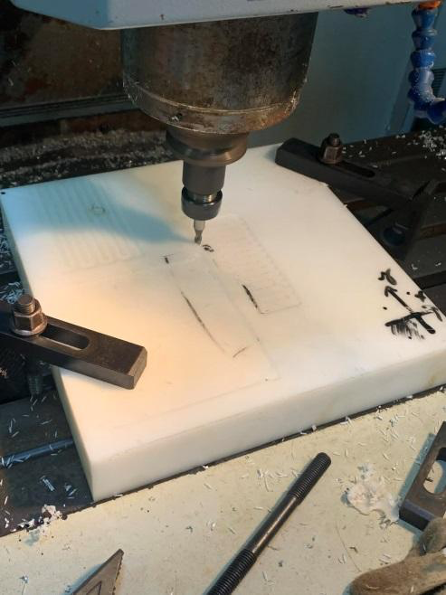
Machining allowance plays a critical role in determining productivity, energy consumption, cutting force, and dimensional accuracy in pocket milling operations, yet it is commonly selected empirically in industrial practice. This study proposes an analytical, optimization-based framework for determining an efficient machining allowance for rectangular pocket milling. Mathematical models are developed to quantify total energy consumption, machining time, and peripheral cutting force as functions of cutting parameters and allowance distribution between rough and finish milling stages. A multi-objective optimization problem is formulated and solved using the Non-dominated Sorting Genetic Algorithm II (NSGA-II) to simultaneously minimize energy consumption, machining time, and cutting force. Experimental validation is conducted on polymer workpieces and compared with CAM-recommended parameters. The results show that the balanced Pareto-optimal solution reduces machining time from 5 min 58.52 s to 2 min 26.47 s, corresponding to an approximate 59% reduction, and decreases the peripheral cutting force from 698.18 N to 382.73 N, corresponding to an approximate 45% reduction, while achieving the target pocket depth of approximately 22 mm and eliminating the ~2 mm over-machining observed under CAM-default settings. A minimum-energy solution further reduces energy consumption from 0.44 kWh to 0.267 kWh, but at the cost of a significantly increased cutting force (1203.45 N). These results indicate that treating machining allowance as an optimization variable enables systematic trade-offs among productivity, energy consumption, cutting force, and dimensional accuracy, offering a practical alternative to conventional CAM-based parameter selection.
Downloads
References
[1] A. De Bartolomeis, D. A. Axinte, S. J. Pickering, and L. Zhou, "Future research directions in the machining of Inconel 718," Journal of Materials Processing Technology, vol. 297, p. 117260, 2021, doi: 10.1016/j.jmatprotec.2021.117260. DOI: https://doi.org/10.1016/j.jmatprotec.2021.117260
[2] N. T. Anh, N. X. Quynh, and T. T. Tung, "A Milling Technique for the Fabrication of Mechanical Parts with Thin-Walled Ribs," Eng. Technol. Sci. Res., vol. 15, no. 4, pp. 24815–24819, Aug. 2025, doi: 10.48084/etasr.11136. DOI: https://doi.org/10.48084/etasr.11136
[3] M. Soori, M. Asmael, and D. Solyalı, "Sustainable CNC machining operations, a review," Sustainable Operations and Computers, vol. 5, pp. 73–87, 2024, doi: 10.1016/j.susoc.2024.01.001. DOI: https://doi.org/10.1016/j.susoc.2024.01.001
[4] M. Hourmand, A. A. D. Sarhan, and M. Sayuti, "A Comprehensive Review on Machining of Titanium Alloys," Arab J Sci Eng, vol. 46, pp. 7087–7123, 2021, doi: 10.1007/s13369-021-05420-1. DOI: https://doi.org/10.1007/s13369-021-05420-1
[5] N. T. Anh and T. T. Tung, "Development and validation of finite element model of milling thin-walled part," Applications in Engineering Science, vol. 25, p. 100285, 2026, doi: 10.1016/j.apples.2025.100285. DOI: https://doi.org/10.1016/j.apples.2025.100285
[6] G. Wang, W. -L. Li, C. Jiang, and H. Ding, "Machining Allowance Calculation for Robotic Edge Milling an Aircraft Skin Considering the Deformation of Assembly Process," IEEE/ASME Transactions on Mechatronics, vol. 27, no. 5, pp. 3350–3361, Oct. 2022, doi: 10.1109/TMECH.2021.3131309. DOI: https://doi.org/10.1109/TMECH.2021.3131309
[7] B. Wu, Y. Zhang, G. Liu, and Z. Wang, "Feedrate optimization method based on machining allowance optimization and constant power constraint," Int J Adv Manuf Technol, vol. 115, pp. 3345–3360, 2021, doi: 10.1007/s00170-021-07381-z. DOI: https://doi.org/10.1007/s00170-021-07381-z
[8] M. Belhadj, R. Kromer, S. Werda, S. Leleu, and A. El Mansori, "Effect of cold metal transfer-based wire arc additive manufacturing parameters on geometry and machining allowance," Int J Adv Manuf Technol, vol. 131, pp. 739–748, 2024, doi: 10.1007/s00170-023-11835-x. DOI: https://doi.org/10.1007/s00170-023-11835-x
[9] B. Burhanudin, M. Margono, E. Suryono, N. T. Atmoko, and Z. Zainuddin, "The Effect of Finishing Allowance and Milling Methode on Surface Roughness in the Finishing Process of Al5052 and Al7075," KEM, vol. 935, pp. 63–71, Nov. 2022, doi: 10.4028/p-yt2516. DOI: https://doi.org/10.4028/p-yt2516
[10] I. Daniyan, K. Mpofu, and F. Fameso, "Computer-aided modelling and experimental evaluation of the pocket milling operation for alloy tool steel (AISI D3)," Int J Adv Manuf Technol, vol. 122, pp. 4453–4466, 2022, doi: 10.1007/s00170-022-09979-3. DOI: https://doi.org/10.1007/s00170-022-09979-3
[11] R. Mellacheruvu and M. Venkateswara Rao, "Application of artificial neural networks and genetic algorithm for optimizing process parameters in pocket milling of AA7075," Journal of Scientific & Industrial Research, vol. 81, no. 9, pp. 911–921, 2022, doi: 10.56042/jsir.v81i09.55874. DOI: https://doi.org/10.56042/jsir.v81i09.55874
[12] Z. Chen, C. H. E. N., X. C. H. E. N., and Y. L. I. U., "Framework and development of data-driven physics based model with application in dimensional accuracy prediction in pocket milling," Chinese Journal of Aeronautics, vol. 34, no. 6, pp. 162–177, 2021, doi: 10.1016/j.cja.2020.09.011. DOI: https://doi.org/10.1016/j.cja.2020.09.011
[13] Z. Duan, C. Li, W. Ding, Y. Ning, and M. Yang, "Milling Force Model for Aviation Aluminum Alloy: Academic Insight and Perspective Analysis," Chin. J. Mech. Eng., vol. 34, no. 1, p. 18, 2021, doi: 10.1186/s10033-021-00536-9. DOI: https://doi.org/10.1186/s10033-021-00536-9
[14] N. T. Anh and T. T. Tung, "Cutting force prediction in end milling processes: Analytical models and applications," Applications in Engineering Science, vol. 23, p. 100250, 2025, doi: 10.1016/j.apples.2025.100250. DOI: https://doi.org/10.1016/j.apples.2025.100250
[15] B. Yan, B. Wang, L. Zhu, C. Zhang, P. Wang, and G. Zhao, "Towards high milling accuracy of turbine blades: A review," Mechanical Systems and Signal Processing, vol. 170, p. 108727, 2022, doi: 10.1016/j.ymssp.2021.108727. DOI: https://doi.org/10.1016/j.ymssp.2021.108727
[16] J. H. Navarro-Devia, Y. Chen, and D. V. Dao, "Chatter detection in milling processes—a review on signal processing and condition classification," Int J Adv Manuf Technol, vol. 125, pp. 3943–3980, 2023, doi: 10.1007/s00170-023-10969-2. DOI: https://doi.org/10.1007/s00170-023-10969-2
[17] M. S. El-Eskandarany, A. Al-Hazza, L. A. Al-Hajji, N. Ali, A. A. Al-Duweesh, M. Banyan, and F. Al-Ajmi, "Mechanical Milling: A Superior Nanotechnological Tool for Fabrication of Nanocrystalline and Nanocomposite Materials," Nanomaterials, vol. 11, no. 10, p. 2484, 2021, doi: 10.3390/nano11102484. DOI: https://doi.org/10.3390/nano11102484
[18] Rahul A. Mali, T. V. K. Gupta, and J. Ramkumar, "A comprehensive review of free-form surface milling—Advances over a decade," Journal of Manufacturing Processes, vol. 62, pp. 132–167, 2021, doi: 10.1016/j.jmapro.2020.12.014. DOI: https://doi.org/10.1016/j.jmapro.2020.12.014
[19] Z. H. A. O. Guolong, "Cutting force model and damage formation mechanism in milling of 70wt% Si/Al composite," Chinese Journal of Aeronautics, vol. 36, no. 7, pp. 114–128, 2023, doi: 10.1016/j.cja.2022.07.018. DOI: https://doi.org/10.1016/j.cja.2022.07.018
[20] José David Pérez-Ruiz, "On the relationship between cutting forces and anisotropy features in the milling of LPBF Inconel 718 for near net shape parts," International Journal of Machine Tools and Manufacture, vol. 170, p. 103801, 2021, doi: 10.1016/j.ijmachtools.2021.103801. DOI: https://doi.org/10.1016/j.ijmachtools.2021.103801
[21] Markus Brillinger, "Energy prediction for CNC machining with machine learning," CIRP Journal of Manufacturing Science and Technology, vol. 35, pp. 715–723, 2021, doi: 10.1016/j.cirpj.2021.07.014. DOI: https://doi.org/10.1016/j.cirpj.2021.07.014
[22] Yuying Yang, "Mechanical performance of 316 L stainless steel by hybrid directed energy deposition and thermal milling process," Journal of Materials Processing Technology, vol. 291, p. 117023, 2021, doi: 10.1016/j.jmatprotec.2020.117023. DOI: https://doi.org/10.1016/j.jmatprotec.2020.117023
[23] Vincent Aizebeoje Balogun and Paul Tarisai Mativenga, "Modelling of direct energy requirements in mechanical machining processes," Journal of Cleaner Production, vol. 41, pp. 179–186, 2013, doi: 10.1016/j.jclepro.2012.10.015. DOI: https://doi.org/10.1016/j.jclepro.2012.10.015
[24] K. He, H. Hong, R. Tang, and J. Wei, "Analysis of Multi-Objective Optimization of Machining Allowance Distribution and Parameters for Energy Saving Strategy," Sustainability, vol. 12, no. 16, p. 638, 2020, doi: 10.3390/su12060638. DOI: https://doi.org/10.3390/su12020638
[25] A. Pajaziti, O. Tafilaj, A. Gjelaj, and B. Berisha, "Optimization of Toolpath Planning and CNC Machine Performance in Time-Efficient Machining," Machines, vol. 13, no. 1, p. 65, 2025, doi: 10.3390/machines13010065. DOI: https://doi.org/10.3390/machines13010065
[26] R. Saravanan and V. Janakiraman, "Study on Reduction of Machining Time in CNC Turning Centre by Genetic Algorithm," in International Conference on Computational Intelligence and Multimedia Applications (ICCIMA 2007), Sivakasi, India, 2007, pp. 481–486, doi: 10.1109/ICCIMA.2007.92. DOI: https://doi.org/10.1109/ICCIMA.2007.92
[27] K. He, R. Tang, Z. Zhang, and W. Sun, "Energy Consumption Prediction System of Mechanical Processes Based on Empirical Models and Computer-Aided Manufacturing," ASME J. Comput. Inf. Sci. Eng., vol. 16, no. 4, p. 041008, Dec. 2016, doi: 10.1115/1.4033921. DOI: https://doi.org/10.1115/1.4033921
[28] Wu Deng, "An enhanced fast non-dominated solution sorting genetic algorithm for multi-objective problems," Information Sciences, vol. 585, pp. 441–453, 2022, doi: 10.1016/j.ins.2021.11.052. DOI: https://doi.org/10.1016/j.ins.2021.11.052
[29] W. Zheng and B. Doerr, "Approximation Guarantees for the Nondominated Sorting Genetic Algorithm II (NSGA-II)," IEEE Transactions on Evolutionary Computation, vol. 29, no. 4, pp. 891–905, Aug. 2025, doi: 10.1109/TEVC.2024.3402996. DOI: https://doi.org/10.1109/TEVC.2024.3402996
[30] M. Babor, L. Pedersen, U. Kidmose, O. Paquet-Durand, and B. Hitzmann, "Application of Non-Dominated Sorting Genetic Algorithm (NSGA-II) to Increase the Efficiency of Bakery Production: A Case Study," Processes, vol. 10, no. 8, p. 1623, 2022, doi: 10.3390/pr10081623. DOI: https://doi.org/10.3390/pr10081623
[31] M. Moshref, R. Al-Sayyed, and S. Al-Sharaeh, "An Enhanced Multi-Objective Non-Dominated Sorting Genetic Routing Algorithm for Improving the QoS in Wireless Sensor Networks," IEEE Access, vol. 9, pp. 149176–149195, 2021, doi: 10.1109/ACCESS.2021.3122526. DOI: https://doi.org/10.1109/ACCESS.2021.3122526
[32] Y. -C. Chang, K. -H. Chang, and C. -P. Zheng, "Application of a Non-Dominated Sorting Genetic Algorithm to Solve a Bi-Objective Scheduling Problem Regarding Printed Circuit Boards," Mathematics, vol. 10, no. 12, p. 2305, 2022, doi: 10.3390/math10122305. DOI: https://doi.org/10.3390/math10132305
Published
Data Availability Statement
The data supporting the findings of this study are available from the corresponding author upon reasonable request.
Issue
Section
Categories
License
Copyright (c) 2026 Tran Thanh Tung, Nguyen Thi Anh, Nguyen Xuan Quynh, Tran Vu Minh

This work is licensed under a Creative Commons Attribution 4.0 International License.
The authors who publish in this journal accept the following conditions:
The authors retain the copyright and assign to the journal the right of the first publication, with the work registered with the Creative Commons Attribution license 4.0, which allows third parties to use what is published as long as they mention the authorship of the work and the first publication in this magazine.
Authors may make other independent and additional contractual agreements for the non-exclusive distribution of the version of the article published in this journal (eg, include it in an institutional repository or publish it in a book) as long as they clearly indicate that the work it was first published in this magazine.
Authors are allowed and encouraged to share their work online (for example: in institutional repositories or personal web pages) before and during the manuscript submission process, as it can lead to productive exchanges, greater and more quick citation of published work (see The Effect of Open Access).
How to Cite