Risk analysis of human health from arsenic intake present in purified water in Zinapécuaro, Michoacán: A probabilistic approach
DOI:
https://doi.org/10.37636/recit.v9n3e464Keywords:
Toxicity, Risk, ArsenicAbstract
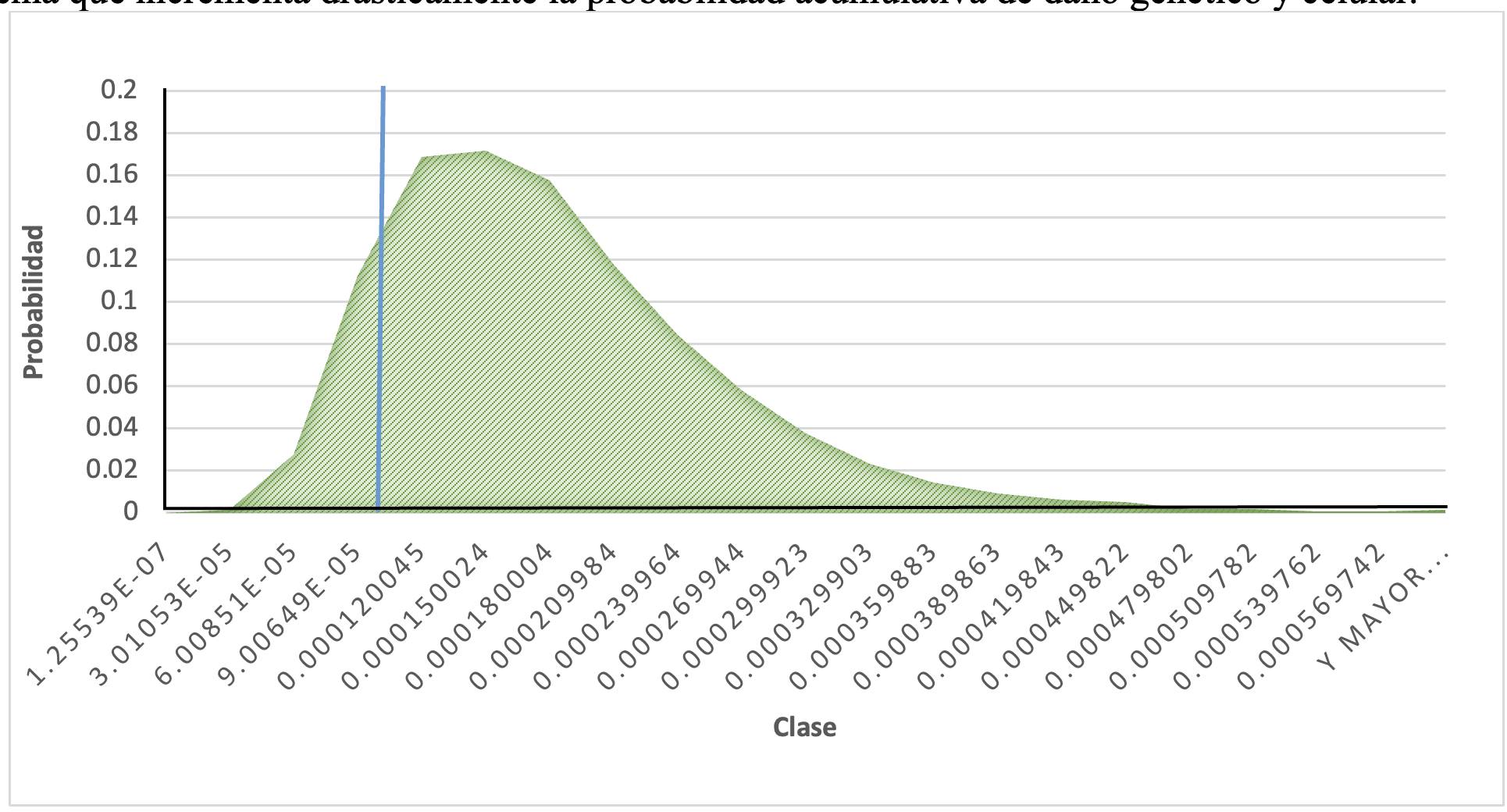
Arsenic (As), a toxic element, occurs naturally in geothermal regions of Mexico. In the Zinapécuaro area, located in Michoacán, concentrations exceeding the health standard of 10 μg/L have been detected, particularly in groundwater and spring water. In this study, sampling was conducted at six different water refilling stations to determine the concentrations of inorganic arsenic present. The objective of this study is to assess the risk to human health, particularly among children—considered a highly vulnerable population—from the consumption of purified water in the city of Zinapécuaro, Michoacán. A quantitative approach from the Environmental Protection Agency (EPA) was applied, which includes characterizing toxin concentrations, calculating exposure, and performing a probabilistic analysis using Monte Carlo simulation. Water samples were collected in consecutive months at the six selected businesses and analyzed by atomic absorption spectroscopy. The As levels obtained in the water samples ranged from 0.00034 to 0.03695 mg/L. The reference doses listed by the EPA were used to evaluate the point estimate of the hazard quotient (HQ) and cancer risk (CR) for ingestion, the results of which are shown below, respectively, with the measured data: M1(3.73,0.00014), M2(3.001, 0.00012), M3(4.45, 0.00017), M4(3.81, 0.00015), M5(1.56, 0.000058), M6(1.83, 0.000068). After using Monte Carlo simulation for the HQ values, the following 5% and 95% percentiles were obtained. M1(2.76, 4.7), M2(2.57, 3.45), M3(3.50, 5.34), M4(2.92, 4.70), M5(1.27, 1.87), M6(1.52, 2.14) and for the CR, they were M1(0.00010, 0.00018), M2(0.000095, 0.00018), M3 (0.00013, 0.00020), M4 (0.00010, 0.00018), M5 (0.000047, 0.000069), M6 (0.000057, 0.000079).
According to the HQ results, an intake greater than 1 indicates that there is a non-carcinogenic potential for illness due to water consumption at the evaluated sites, and according to the CR intake results, the carcinogenic risk at these sites is acceptable.
Translated with DeepL.com (free version)
Downloads
References
[1] International Agency for Research on Cancer (IARC), “Arsenic, metals, fibres and dusts,” IARC Monographs on the Evaluation of Carcinogenic Risks to Humans, vol. 100C, pp. 11–465, 2012.
[2] J. Podgorski and M. Berg, “Global threat of arsenic in groundwater,” Science, vol. 368, no. 6493, pp. 845–850, 2020. DOI: https://doi.org/10.1126/science.aba1510
[3] E. Shaji et al., “Arsenic contamination of groundwater: Global synopsis,” Geoscience Frontiers, vol. 12, no. 3, 2021. DOI: https://doi.org/10.1016/j.gsf.2020.08.015
[4] M. Berg et al., “Arsenic contamination in groundwater systems,” Annual Review of Earth and Planetary Sciences, vol. 49, pp. 191–216, 2021.
[6] National Research Council, Arsenic in Drinking Water: 2001 Update. Washington, DC: National Academies Press, 2001.
[7] World Health Organization, “Guidelines for drinking-water quality,” 4th ed., Geneva: WHO Press, 2018.
[8] M. A. Armienta and N. Segovia, “Arsenic and fluoride in the groundwater of Mexico,” Environmental Geochemistry and Health, vol. 30, no. 4, pp. 345–353, 2008. DOI: https://doi.org/10.1007/s10653-008-9167-8
[9] J. Bundschuh et al., “One century of arsenic exposure in Latin America: A review of history and occurrence from 14 countries,” Science of the Total Environment, vol. 429, pp. 2–35, 2012. DOI: https://doi.org/10.1016/j.scitotenv.2011.06.024
[10] P. Birkle, J. Bundschuh, and O. Sracek, “Mechanisms of arsenic enrichment in geothermal systems,” Water Research, vol. 44, pp. 5605–5617, 2010. DOI: https://doi.org/10.1016/j.watres.2010.05.046
[11] National Research Council, Science and Decisions: Advancing Risk Assessment. Washington, DC: National Academies Press, 2009.
[12] G. C. Saha et al., “Probabilistic human health risk assessment of heavy metals in environmental matrices,” Journal of Hazardous Materials, vol. 403, p. 123724, 2021.
[13] B. Rajasekhar, I. M. Nambi, and S. K. Govindarajan, “Human health risk assessment for exposure using deterministic and probabilistic methods,” Environmental Pollution, vol. 265, p. 114814, 2020. DOI: https://doi.org/10.1016/j.envpol.2020.114814
[14] International Agency for Research on Cancer (IARC), “Arsenic and inorganic arsenic compounds,” 2012.
[15] National Research Council, Arsenic in Drinking Water, Washington, DC, 2001.
[16] J. Bundschuh et al., “Arsenic in Latin America: Occurrence and health effects,” Science of the Total Environment, vol. 429, pp. 2–35, 2012. DOI: https://doi.org/10.1016/j.scitotenv.2012.04.047
[17] M. A. Armienta and N. Segovia, “Arsenic and fluoride in Mexico’s groundwater,” Environmental Geochemistry and Health, 2008. DOI: https://doi.org/10.1007/s10653-008-9167-8
[18] C. C. Osuna-Martínez et al., “Arsenic in waters, soils, sediments, and biota from Mexico: An environmental review,” Science of the Total Environment, vol. 752, p. 142062, 2021. DOI: https://doi.org/10.1016/j.scitotenv.2020.142062
[19] J. L. Mendoza-Lagunas and M. M. Meza-Montenegro, “Health risk assessment of children exposed to arsenic,” Environmental Geochemistry and Health, vol. 41, pp. 2807–2819, 2019.
[20] M. A. Martínez-Cinco et al., “Evaluación del riesgo por exposición infantil a arsénico en agua purificada,” PeerJ, 2023.
[21] L. N. Rodríguez-Cantú et al., “Monte Carlo probabilistic method for arsenic exposure,” Human and Ecological Risk Assessment, vol. 28, pp. 408–432, 2022. DOI: https://doi.org/10.1080/10807039.2022.2054771
[22] R. Hurtado-Jiménez and J. L. Gardea-Torresdey, “Arsenic in drinking water in Los Altos de Jalisco,” Revista Panamericana de Salud Pública, vol. 20, no. 4, pp. 236–247, 2006. DOI: https://doi.org/10.1590/S1020-49892006000900004
[23] A. H. Smith et al., “Increased mortality from lung cancer after arsenic exposure,” Environmental Health Perspectives, vol. 126, no. 6, 2018.
[24] United States Environmental Protection Agency, “Risk Assessment Guidance for Superfund,” Washington, DC, 1989.
[25] M. A. Martínez-Cinco et al., “Presencia de arsénico en agua purificada en Zinapécuaro, Michoacán,” La Sociedad Académica, vol. 31, no. 61, pp. 135–137, 2024.
[26] ENSANUT, “Encuesta Nacional de Salud y Nutrición,” Instituto Nacional de Salud Pública, México, 2018.
[27] J. C. Ruiz García, “Evaluación de la acumulación de arsénico en especies del lago de Cuitzeo,” Tesis de Maestría, Univ. Michoacana de San Nicolás de Hidalgo, 2014.
[28] M. M. Maldonado et al., “Exposición infantil a metales en comunidades vulnerables,” Revista Internacional de Contaminación Ambiental, vol. 34, no. 2, pp. 277–294, 2018.
[29] P. Rugen and B. Callahan, “An overview of Monte Carlo,” Human and Ecological Risk Assessment, vol. 2, no. 4, pp. 671–680, 1996. DOI: https://doi.org/10.1080/10807039609383647
[30] U.S. Environmental Protection Agency, “Policy for use of probabilistic analysis in risk assessment at the U.S. Environmental Protection Agency,” EPA/630/R-97/001, Washington, DC, 1997.
[31] J. Fernández-Macías et al., “Probabilistic human health risk assessment associated with fluoride and arsenic,” Environmental Monitoring and Assessment, vol. 192, p. 712, 2020. DOI: https://doi.org/10.1007/s10661-020-08675-7
[32] H. Rezaei et al., “Health risk assessment of heavy metals in groundwater,” Toxicology and Environmental Health Sciences, vol. 11, pp. 54–62, 2019. DOI: https://doi.org/10.1007/s13530-019-0388-2
[33] X. Zeng et al., “Health risk assessment of trace elements in surface water,” Environmental Science and Pollution Research, vol. 22, pp. 9400–9412, 2015. DOI: https://doi.org/10.1007/s11356-014-4064-4
[34] United States Environmental Protection Agency, “Risk Assessment Guidance for Superfund,” 1989.
[35] Y. Huang et al., “Health risk assessment using Monte Carlo simulation,” Journal of Hazardous Materials, vol. 415, p. 125629, 2021. DOI: https://doi.org/10.1016/j.jhazmat.2021.125629
[36] United States Environmental Protection Agency, “Probabilistic Risk Assessment Guidelines,” 2001.
[37] American Public Health Association, Standard Methods for the Examination of Water and Wastewater, 23rd ed., Washington, DC, 2017.
Downloads
Published
Data Availability Statement
Si en el contenido del articulo vienen los datos con los cuales se trabajo en esta investigación.
Issue
Section
Categories
License
Copyright (c) 2026 Alexis Calderón Herrera, Dr. Marco Antonio Martínez Cinco, Dr. José Leopoldo Mendoza Lagunas, Dra. Laura Nelly Rodríguez Cantú , Dra. María Mercedes Meza Montenegro, Dra. María del Mar Navarro Farfán, Jesús Ávila Guzmán

This work is licensed under a Creative Commons Attribution 4.0 International License.
The authors who publish in this journal accept the following conditions:
The authors retain the copyright and assign to the journal the right of the first publication, with the work registered with the Creative Commons Attribution license 4.0, which allows third parties to use what is published as long as they mention the authorship of the work and the first publication in this magazine.
Authors may make other independent and additional contractual agreements for the non-exclusive distribution of the version of the article published in this journal (eg, include it in an institutional repository or publish it in a book) as long as they clearly indicate that the work it was first published in this magazine.
Authors are allowed and encouraged to share their work online (for example: in institutional repositories or personal web pages) before and during the manuscript submission process, as it can lead to productive exchanges, greater and more quick citation of published work (see The Effect of Open Access).
How to Cite