Control robusto mediante redes neuronales y técnica de backstepping para el sistema de orientación de un satélite
DOI:
https://doi.org/10.37636/recit.v9n3e485Palabras clave:
Satélite, Control de orientación, Redes neuronales, Backstepping, Sistemas no linealesResumen
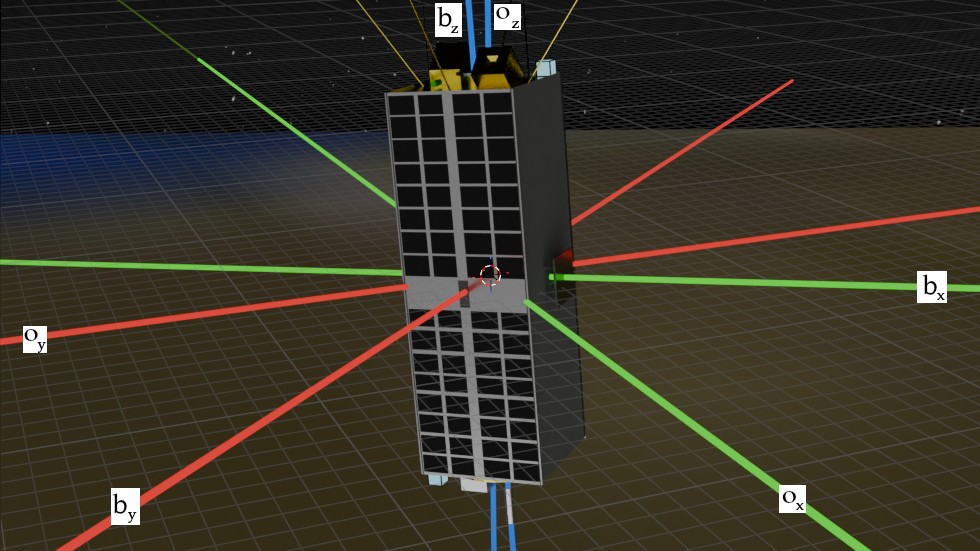
En la actualidad, los satélites se han consolidado como los pilares de la infraestructura global. Desde la navegación GPS y las telecomunicaciones de banda ancha hasta el monitoreo climático crítico, el uso de estos dispositivos es esencial para las actividades diarias. En este trabajo se presenta una propuesta de control adaptable basada en redes neuronales, la cual se diseña haciendo uso de la teoría de control por backstepping. El esquema de control propuesto simplifica la implementación al mismo tiempo que agrega robustez al sistema en lazo cerrado. Para validar el desempeño del controlador, se realizaron simulaciones numéricas considerando el modelo matemático del satélite ESEO. Durante dicha validación, se incluye un caso de estudio donde el sistema en lazo cerrado se ve afectado por una perturbación externa. Los resultados de la simulación muestran el correcto funcionamiento del esquema de control propuesto donde el satélite alcanza una orientación deseada y se mantiene en ella a pesar de la presencia de la perturbación. El desempeño se compara con un control por backstepping y valores RMS obtenidos de las señales de error sustentan las ventajas del control propuesto. Adicionalmente, se describe un sistema de animación desarrollado para mostrar los resultados de simulación de una manera más clara a personas que no son especialistas en el tema.
Descargas
Referencias
[1] European Space Agency, "Lanzado con éxito el satélite estudiantil ESEO," 2018. [Online]. Available: https://www.esa.int/Space_in_Member_States/Spain/Lanzado_con_exito_el_satelite_estudiantil_ESEO. Accessed: Jun. 18, 2025.
[2] R. Kristiansen and P. J. Nicklasson, "Satellite attitude control by quaternion-based backstepping," in Proc. American Control Conference (ACC), Portland, OR, USA, 2005, pp. 907–912, doi: 10.1109/ACC.2005.1470075. DOI: https://doi.org/10.1109/ACC.2005.1470075
[3] X. Cao, B. Jiang, and P. Shi, “Neural network approximation-based backstepping sliding mode control for spacecraft with input saturation and dynamics uncertainty,” Acta Astronautica, vol. 191, pp. 1–10, 2022, doi: 10.1016/j.actaastro.2021.10.035. DOI: https://doi.org/10.1016/j.actaastro.2021.10.035
[4] C. Li, W. Wang, Z. Liu, Y. Wang, and Z. Shi, "Adaptive neural network based fixed-time attitude tracking control of spacecraft considering input saturation," Aerospace Science and Technology, vol. 155, Art. no. 109746, 2024, doi: 10.1016/j.ast.2024.109746. DOI: https://doi.org/10.1016/j.ast.2024.109746
[5] S. You, “Adaptive Learning Gain-Based Robust Attitude Control for Satellites with Time-Varying External Disturbances,” Electronics, vol. 14, no. 16, p. 3298, 2025. doi: 10.3390/electronics14163298. DOI: https://doi.org/10.3390/electronics14163298
[6] K. Madhana Mohan, U. Anitha, and K. Anbumani, "Cubesat attitude control by implementation of PID controller using Python," in Proc. 2023 12th International Conference on Advanced Computing (ICoAC), 2023, pp. 1–5, doi: 10.1109/ICoAC59537.2023.10249887. DOI: https://doi.org/10.1109/ICoAC59537.2023.10249887
[7] Y. Qi, H. Jing, and X. Wu, “Variable structure pid controller for satellite attitude control considering actuator failure,” Applied Sciences, vol. 12, no. 10, 2022. doi:10.3390/app12105273. DOI: https://doi.org/10.3390/app12105273
[8] Y. Li and D. Ye, “Robust pid controller for flexible satellite attitude control under angular velocity and control torque constraint,” Asian Journal of Control, vol. 22, no. 3, pp. 1327–1344, 2020. doi: 10.1002/asjc.1999. DOI: https://doi.org/10.1002/asjc.1999
[9] L. Sun, S. Duan, H. Huang, T. Zhang, and X. Zhao, “Attitude maneuver planning and robust tracking control for flexible satellite,” The Aeronautical Journal, vol. 128, no. 1328, pp. 2374–2392, 2024. DOI: https://doi.org/10.1017/aer.2024.18
[10] S. Kumar and S. Chakraborty, “Uncertainty and disturbance-observer based robust attitude control for satellites,” International Journal of Control, vol. 96, no. 5, pp. 1245–1260, 2023. doi:10.1080/00207179.2022.2038390. DOI: https://doi.org/10.1080/00207179.2022.2038390
[11] H. Liu, M. Cheng, Q. Meng, Y. Tian, and X. Li, “Robust fault-tolerant attitude synchronization control for formation flying satellites,” International Journal of Adaptive Control and Signal Processing, vol. 36, no. 3, pp. 503–520, 2022. doi: 10.1002/acs.3352. DOI: https://doi.org/10.1002/acs.3352
[12] A. Bello, K. Olfe, J. Rodrı́guez, J. Ezquerro, and V. Lapuerta, “Experimental verification and comparison of fuzzy and PID controllers for attitude control of nanosatellites,” Advances in Space Research, vol. 71, no. 9, pp. 3613–3630, 2023. doi: 10.1016/j.asr.2022.05.055. DOI: https://doi.org/10.1016/j.asr.2022.05.055
[13] B. Wang, S. Li, Q. Zhang, and M. Xin, “Combined fuzzy sliding-mode attitude stabilization and energy storage for small satellite,” IEEE Transactions on Aerospace and Electronic Systems, vol. 59, no. 6, pp. 7725–7738, 2023. doi:10.1109/TAES.2023.3294170. DOI: https://doi.org/10.1109/TAES.2023.3294170
[14] M. Navabi, N. S. Hashkavaei, and M. Reyhanoglu, “Satellite attitude control using optimal adaptive and fuzzy controllers,” Acta Astronautica, vol. 204, pp. 434–442, 2023. doi: 10.1016/j.actaastro.2023.01.005. DOI: https://doi.org/10.1016/j.actaastro.2023.01.005
[15] H. Ma, X. Zhang, Z. Lu, and W. Liao, “An improved central difference kalman filter for satellite attitude estimation with state mutation,” International Journal of Robust and Nonlinear Control, vol. 32, no. 6, pp. 3442–3468, 2022. doi: 10.1002/rnc.5981. DOI: https://doi.org/10.1002/rnc.5981
[16] J. Yang, J. Zhang, J. Wang, and W. Tao, “Kalman filter-based model predictive control for drag-free satellite under actuator failures and input saturations,” Review of Scientific Instruments, vol. 94, no. 3, 2023. doi: 10.1063/5.0136994. DOI: https://doi.org/10.1063/5.0136994
[17] M. Zarourati, M. Mirshams, and M. Tayefi, “Active underactuation fault-tolerant backstepping attitude tracking control of a satellite with interval error constraints,” Advanced Control for Applications: Engineering and Industrial Systems, vol. 6, no. 3, p. e215, 2024. doi: 10.1002/adc2.215. DOI: https://doi.org/10.1002/adc2.215
[18] K. Saathvika, A. Das, S. R. Kumar, and D. K. Giri, “Adaptive satellite attitude control with coulombic actuator using backstepping approach,” in Proc. 2025 American Control Conference (ACC), pp. 4287–4292, 2025. doi:10.23919/ACC63710.2025.11107546. DOI: https://doi.org/10.23919/ACC63710.2025.11107546
[19] H. Boussadia, A. M. Si Mohammed, N. Boughanmi, and A. Meche, “Sliding mode control based on backstepping approach for microsatellite attitude pointing,” Engineering Proceedings, vol. 14, no. 1, p. 24, 2022. doi: 10.3390/engproc2022014024. DOI: https://doi.org/10.3390/engproc2022014024
[20] Y. Ren and A. Xing, “Finite-time attitude tracking control for spacecraft based on backstepping method with input saturation,” PLOS ONE, vol. 20, no. 6, e0326150, 2025. doi: 10.1371/journal.pone.0326150. DOI: https://doi.org/10.1371/journal.pone.0326150
[21] F. L. Lewis, S. S. Jagannathan, and A. Yesildirek, Neural Network Control of Robot Manipulators and Non-Linear Systems. London, U.K.: Taylor & Francis, 1998.
[22] X. Wang, B. Xu, and Y. Pan, “Neural network-based sliding mode control for satellite attitude tracking,” Advances in Space Research, vol. 71, no. 9, pp. 3565–3573, 2023. doi: 10.1016/j.asr.2022.04.047. DOI: https://doi.org/10.1016/j.asr.2022.04.047
[23] M. Ezabadi, M. Zahmatkesh, S. A. Emami, and P. Castaldi, “Robust neuro-adaptive command-filtered back-stepping fault-tolerant control of satellite using composite learning,” Advances in Space Research, vol. 75, no. 1, pp. 1231–1244, 2025. doi: 10.1016/j.asr.2024.09.041. DOI: https://doi.org/10.1016/j.asr.2024.09.041
[24] L. Sun, Z. Zhao, X. Zhao, and Y. Liu, "Adaptive attitude maneuver control of a rigid-flexible satellite based on deep reinforcement learning," IEEE Transactions on Aerospace and Electronic Systems, pp. 1–18, 2026, doi: 10.1109/TAES.2026.3672419. DOI: https://doi.org/10.1109/TAES.2026.3672419
[25] D. Yadava, R. Hosangadi, S. Krishna, P. Paliwal, and A. Jain, “Attitude control of a nanosatellite system using reinforcement learning and neural networks,” in Proc. 2018 IEEE Aerospace Conference, pp. 1–8, doi:10.1109/AERO.2018.8396409. DOI: https://doi.org/10.1109/AERO.2018.8396409
[26] M. D. Shuster, "A survey of attitude representations," Journal of the Astronautical Sciences, vol. 41, no. 4, pp. 439–517, Oct.-Dec. 1993.
[27] P. C. Hughes, Spacecraft Attitude Dynamics. Mineola, NY, USA: Dover Publications, 2004.
[28] “Spacecraft attitude control based on generalised dynamic inversion with adaptive neural network,” The Aeronautical Journal, vol. 128, no. 1321, pp. 504–516, 2024. doi: 10.1017/aer.2023.78. DOI: https://doi.org/10.1017/aer.2023.78
[29] I. Newton, Philosophiæ Naturalis Principia Mathematica. London, U.K.: Royal Society, 1687. DOI: https://doi.org/10.5479/sil.52126.39088015628399
[30] F. L. Markley and J. L. Crassidis, Fundamentals of Spacecraft Attitude Determination and Control. New York, NY, USA: Springer, 2014, doi: 10.1007/978-1-4939-0802-8. DOI: https://doi.org/10.1007/978-1-4939-0802-8
[31] H. Gui, L. Jin, and S. Xu, "A novel single-thruster control strategy for spacecraft attitude stabilization," Acta Astronautica, vol. 86, pp. 55–67, May–Jun. 2013, doi: 10.1016/j.actaastro.2012.12.018. DOI: https://doi.org/10.1016/j.actaastro.2012.12.018
[32] A. Khosravi and P. Sarhadi, “Tuning of Pulse-Width Pulse-Frequency Modulator Using PSO: An Engineering Approach to Spacecraft Attitude Controller Design,” in Proc. 2016. doi: 10.7305/automatika.2016.07.618. DOI: https://doi.org/10.7305/automatika.2016.07.618
[33] R. S. McClelland, Spacecraft Attitude Control System Performance Using Pulse-Width Pulse-Frequency Modulated Thrusters, Defense Technical Information Center (DTIC), 1994. [Online]. Available: https://apps.dtic.mil/sti/tr/pdf/ADA291803.pdf.
[34] G. Song and B. N. Agrawal, “Vibration Suppression of Flexible Spacecraft During Attitude Control,” Acta Astronautica, vol. 49, no. 2, pp. 73–83, 2001. doi: 10.1016/S0094-5765(00)00163-6. DOI: https://doi.org/10.1016/S0094-5765(00)00163-6
[35] H. K. Khalil, Nonlinear Systems, 3rd ed. Upper Saddle River, NJ, USA: Prentice Hall, 2002.
Publicado
Declaración de disponibilidad de datos
Los datos que respaldan las conclusiones de este estudio están disponibles a solicitud razonable del autor correspondiente.
Número
Sección
Categorías
Licencia
Derechos de autor 2026 Francisco Emmanuel Vázquez Dueñas, Ricardo Ramón Pérez Alcocer, Luis Arturo García Delgado

Esta obra está bajo una licencia internacional Creative Commons Atribución 4.0.
Los autores/as que publiquen en esta revista aceptan las siguientes condiciones:
- Los autores/as conservan los derechos de autor y ceden a la revista el derecho de la primera publicación, con el trabajo registrado con la licencia de atribución de Creative Commons 4.0, que permite a terceros utilizar lo publicado siempre que mencionen la autoría del trabajo y a la primera publicación en esta revista.
- Los autores/as pueden realizar otros acuerdos contractuales independientes y adicionales para la distribución no exclusiva de la versión del artículo publicado en esta revista (p. ej., incluirlo en un repositorio institucional o publicarlo en un libro) siempre que indiquen claramente que el trabajo se publicó por primera vez en esta revista.
- Se permite y recomienda a los autores/as a compartir su trabajo en línea (por ejemplo: en repositorios institucionales o páginas web personales) antes y durante el proceso de envío del manuscrito, ya que puede conducir a intercambios productivos, a una mayor y más rápida citación del trabajo publicado (vea The Effect of Open Access).
Cómo citar