Evaluación multidimensional de los protocolos de seguridad en laboratorios académicos: estudio de caso en una Facultad de Ingeniería
DOI:
https://doi.org/10.37636/recit.v9n1e426Palabras clave:
Seguridad institucional, Laboratorios académicos, Infraestructura educativa, Planes de emergenciaResumen
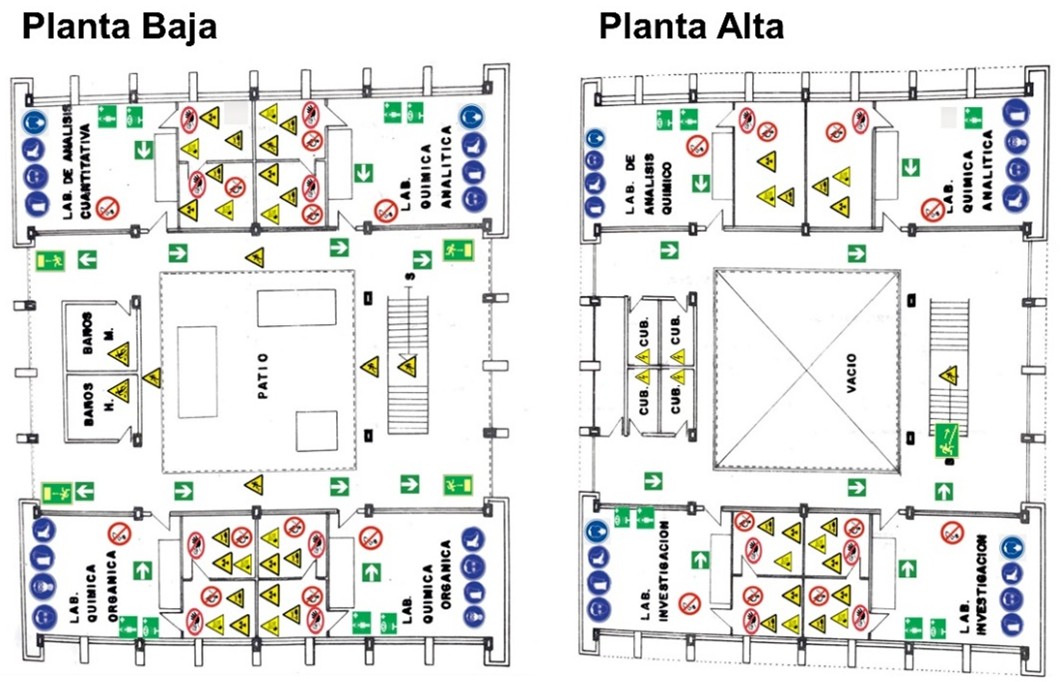
Este trabajo presenta una evaluación multidimensional de los protocolos de seguridad aplicados en laboratorios académicos, desarrollada como estudio de caso en el Edificio “E1” de una facultad de ingeniería. El estudio se realizó mediante un enfoque observacional y descriptivo con enfoque aplicado, considerando seis dimensiones: infraestructura, inventario de equipos de seguridad, estrategias de mejora continua, evaluación económica, bienestar de los usuarios y efectividad de la implementación. La recolección de datos incluyó observación estructurada, revisión documental, encuestas y entrevistas semiestructuradas aplicadas a un total de 692 usuarios. Los resultados identifican limitaciones en la adecuación de la infraestructura, heterogeneidad en la disponibilidad de equipos de seguridad y áreas de oportunidad en capacitación y cultura preventiva, así como implicaciones económicas asociadas a la prevención. El estudio aporta un diagnóstico integral que puede servir como herramienta de apoyo para la toma de decisiones orientadas al fortalecimiento de la seguridad en laboratorios universitarios.
Descargas
Referencias
[1] Organización Internacional del Trabajo, "Seguridad y salud en el centro del futuro del trabajo: Aprovechar 100 años de experiencia," OIT, 2019. [Online]. Available: https://www.ilo.org/es/publications/seguridad-y-salud-en-el-centro-del-futuro-del-trabajo-aprovechar-100-a%C3%B1os
[2] ENCICLO GRAFICA, "Señales de seguridad en el trabajo" [Imagen], Sitographics, 2013. [Online]. Available: https://www.sitographics.com/enciclog/seguridad/index.html
[3] Naciones Unidas, "Transformar nuestro mundo: la Agenda 2030 para el Desarrollo Sostenible," 2015. [Online]. Available: https://sdgs.un.org/es/goals
[4] Secretaría de Gobernación, "NOM-003-SEGOB-2011: Señalización y medios de escape en inmuebles - Condiciones y requisitos," Diario Oficial de la Federación, México, 2011. [Online]. Available: https://dof.gob.mx/nota_detalle.php?codigo=5226545&fecha=23/12/2011&print=true
[5] National Fire Protection Association, "NFPA 10: Standard for Portable Fire Extinguishers," NFPA, 2020. [Online]. Available: https://www.nfpa.org/codes-and-standards/nfpa-10-standard-development/10
[6] Secretaría del Trabajo y Previsión Social, "NOM-026-STPS-2008: Colores y señales de seguridad e higiene, e identificación de riesgos por fluidos conducidos en tuberías," Diario Oficial de la Federación, México, 2008. [Online]. Available: https://www.diariooficial.gob.mx/normasOficiales.php?codp=3541&view=si
[7] Secretaría del Trabajo y Previsión Social, "Guía de referencia II: Brigadas de emergencia y consideraciones generales sobre la planeación de los simulacros de incendio (NOM-002-STPS-2010)," STPS, 2010. [Online]. Available: https://www.stps.gob.mx/bp/secciones/dgsst/publicaciones/guias/Guia_002.pdf
[8] International Organization for Standardization, "ISO 45001:2018 - Occupational health and safety management systems - Requirements with guidance for use," ISO, 2018. [Online]. Available: https://www.iso.org/standard/63787.html
[9] Instituto Mexicano del Seguro Social, "Informe al Ejecutivo Federal y al Congreso de la Unión sobre la situación financiera y los riesgos del Instituto Mexicano del Seguro Social 2019-2020 (incluye estadísticas del Seguro de Riesgos de Trabajo)," IMSS, 2020. [Online]. Available: https://www.imss.gob.mx/sites/all/statics/pdf/informes/20192020/21-InformeCompleto.pdf
[10] Consejo Nacional de Ciencia y Tecnología, "Avance y resultados 2021," CONACYT, 2021. [Online]. Available: https://www.gob.mx/cms/uploads/attachment/file/735990/38_PI_CONACyT_AyR21.pdf
[11] Secretaría del Trabajo y Previsión Social, "NOM-020-STPS-2011: Recipientes sujetos a presión, recipientes criogénicos y generadores de vapor o calderas - Funcionamiento - Condiciones de seguridad," Diario Oficial de la Federación, México, 2011. [Online]. Available: https://www.gob.mx/cms/uploads/attachment/file/138731/NOM-020-STPS-2011.pdf
[12] Secretaría del Trabajo y Previsión Social, "NOM-002-STPS-2010: Condiciones de seguridad - Prevención y protección contra incendios en los centros de trabajo," Diario Oficial de la Federación, México, 2010. [Online]. Available: https://dof.gob.mx/nota_detalle_popup.php?codigo=5170410
[13] J. W. Creswell and V. L. Plano Clark, Diseño y desarrollo de investigaciones mixtas, 3.ª ed. Pearson Educación, 2018. [Online]. Available: https://books.google.com.ec/books?id=A39ZDwAAQBAJ
[14] R. Hernández Sampieri, C. Fernández Collado, and P. Baptista Lucio, Metodología de la investigación, 6.ª ed. McGraw-Hill, 2014. [Online]. Available: https://books.google.com/books?id=oLbjoQEACAAJ
[15] R. Muñoz, "Objetivo 4: Educación de calidad (ODS)" [Imagen], Otra educación, Sep. 8, 2015. [Online]. Available: https://otra-educacion.blogspot.com/2015/09/objetivo-4-educacion-ODS.html
[16] Secretaría de Medio Ambiente y Recursos Naturales, "NOM-052-SEMARNAT-2005: Identificación, clasificación y manejo de los residuos peligrosos," Diario Oficial de la Federación, México, 2006. [Online]. Available: https://www.dof.gob.mx/normasOficiales/1055/SEMARNA/SEMARNA.htm
[17] National Research Council, Prudent Practices in the Laboratory: Handling and Management of Chemical Hazards, Updated Version. Washington, DC, USA: The National Academies Press, 2011. doi: 10.17226/12654. [Online]. Available: https://doi.org/10.17226/12654 DOI: https://doi.org/10.17226/12654
[18] National Research Council, Safe Science: Promoting a Culture of Safety in Academic Chemical Research. Washington, DC, USA: The National Academies Press, 2014. doi: 10.17226/18706. [Online]. Available: https://doi.org/10.17226/18706 DOI: https://doi.org/10.17226/18706
[19] National Academies of Sciences, Engineering, and Medicine, Chemical Laboratory Safety and Security: A Guide to Developing Standard Operating Procedures. Washington, DC, USA: The National Academies Press, 2016. doi: 10.17226/21918. [Online]. Available: https://doi.org/10.17226/21918 DOI: https://doi.org/10.17226/21918
[20] American Chemical Society, Guidelines for Chemical Laboratory Safety in Academic Institutions. Washington, DC, USA: ACS Committee on Chemical Safety, 2016. [Online]. Available: https://www.acs.org/content/dam/acsorg/about/governance/committees/chemicalsafety/publications/acs-safety-guidelines-academic.pdf
[21] American Chemical Society, Safety in Academic Chemistry Laboratories, Student Edition. Washington, DC, USA: ACS Committee on Chemical Safety, 2017. [Online]. Available: https://www.acs.org/content/dam/pldp/center/lab-safety/publications/safety-in-academic-chemistry-laboratories-students.pdf
[22] Occupational Safety and Health Administration, "29 CFR 1910.1450 - Occupational exposure to hazardous chemicals in laboratories." [Online]. Available: https://www.osha.gov/laws-regs/regulations/standardnumber/1910/1910.1450
[23] World Health Organization, Laboratory Biosafety Manual, 4th ed. Geneva, Switzerland: WHO, 2020. [Online]. Available: https://www.who.int/publications/i/item/9789240011311
[24] Centers for Disease Control and Prevention and National Institutes of Health, Biosafety in Microbiological and Biomedical Laboratories (BMBL), 6th ed. Washington, DC, USA: U.S. Department of Health and Human Services, 2020. [Online]. Available: https://www.cdc.gov/labs/pdf/SF__19_308133-A_BMBL6_00-BOOK-WEB-final-3.pdf
[25] International Organization for Standardization, "ISO 31000:2018 - Risk management - Guidelines," ISO, 2018. [Online]. Available: https://www.iso.org/standard/65694.html
[26] Organización Internacional del Trabajo, Directrices relativas a los sistemas de gestión de la seguridad y la salud en el trabajo (OIT-SST 2001). Ginebra: OIT, 2001. [Online]. Available: https://www.ilo.org/es/media/270606/download
[27] United Nations Economic Commission for Europe, Globally Harmonized System of Classification and Labelling of Chemicals (GHS), 9th rev. ed. United Nations, 2021. [Online]. Available: https://unece.org/transport/dangerous-goods/ghs-rev9-2021
[28] National Fire Protection Association, NFPA 45: Standard on Fire Protection for Laboratories Using Chemicals. Quincy, MA, USA: NFPA, 2024. [Online]. Available: https://link.nfpa.org/all-publications/45/2024
[29] American Chemical Society Institute, "What is RAMP?" [Online]. Available: https://institute.acs.org/acs-center/lab-safety/safety-basics-and-ramp/what-is-ramp.html
[30] D. C. Finster, "RAMP: A Safety Tool for Chemists and Chemistry Students," J. Chem. Educ., vol. 98, no. 1, pp. 19-24, 2021, doi: 10.1021/acs.jchemed.0c00142. [Online]. Available: https://doi.org/10.1021/acs.jchemed.0c00142 DOI: https://doi.org/10.1021/acs.jchemed.0c00142
[31] H. R. Ayi and C. Y. Hon, "Safety culture and safety compliance in academic laboratories: A Canadian perspective," J. Chem. Health Saf., vol. 25, no. 5, pp. 6-12, 2018, doi: 10.1016/j.jchas.2018.05.002. [Online]. Available: https://doi.org/10.1016/j.jchas.2018.05.002 DOI: https://doi.org/10.1016/j.jchas.2018.05.002
[32] I. Schröder, D. Y. Q. Huang, O. Ellis, J. H. Gibson, and N. L. Wayne, "Laboratory safety attitudes and practices: A comparison of academic, government, and industry researchers," J. Chem. Health Saf., vol. 23, no. 1, pp. 12-23, 2016, doi: 10.1016/j.jchas.2015.03.001. [Online]. Available: https://doi.org/10.1016/j.jchas.2015.03.001 DOI: https://doi.org/10.1016/j.jchas.2015.03.001
[33] G. L. L. Reniers, K. Sörensen, K. van Lerberghe, A. M. van Cuyck, and W. Dullaert, "Higher education chemical lab safety interventions: Choosing the right intervention," J. Chem. Health Saf., vol. 21, no. 1, pp. 4-8, 2014, doi: 10.1016/j.jchas.2013.09.001. [Online]. Available: https://doi.org/10.1016/j.jchas.2013.09.001 DOI: https://doi.org/10.1016/j.jchas.2013.09.001
[34] S. Ezenwa, A. D. Bapuraj, B. G. Hillhouse, D. Y. Q. Huang, and A. L. Rhoten, "Toward Improved Safety Culture in Academic and Industrial Chemical Laboratories," ACS Chem. Health Saf., vol. 29, no. 2, pp. 202-213, 2022, doi: 10.1021/acs.chas.1c00064. [Online]. Available: https://doi.org/10.1021/acs.chas.1c00064 DOI: https://doi.org/10.1021/acs.chas.1c00064
[35] B. Srinivasan, M. U. Iqbal, M. A. Shahab, and R. Srinivasan, "Review of Virtual Reality (VR) Applications To Enhance Chemical Safety: From Students to Plant Operators," ACS Chem. Health Saf., vol. 29, no. 3, pp. 246-262, 2022, doi: 10.1021/acs.chas.2c00006. [Online]. Available: https://doi.org/10.1021/acs.chas.2c00006 DOI: https://doi.org/10.1021/acs.chas.2c00006
Publicado
Número
Sección
Categorías
Licencia
Derechos de autor 2026 Ivan Avila-Raya, Martha Angélica Lemus-Solorio, Alfonso Lemus-Solorio, Rodrigo Gómez-Monge, Luis Enrique Rosas-Avalos, José Nicolás Cardenas-España, José Luis Rivera-Rojas

Esta obra está bajo una licencia internacional Creative Commons Atribución 4.0.
Los autores/as que publiquen en esta revista aceptan las siguientes condiciones:
- Los autores/as conservan los derechos de autor y ceden a la revista el derecho de la primera publicación, con el trabajo registrado con la licencia de atribución de Creative Commons 4.0, que permite a terceros utilizar lo publicado siempre que mencionen la autoría del trabajo y a la primera publicación en esta revista.
- Los autores/as pueden realizar otros acuerdos contractuales independientes y adicionales para la distribución no exclusiva de la versión del artículo publicado en esta revista (p. ej., incluirlo en un repositorio institucional o publicarlo en un libro) siempre que indiquen claramente que el trabajo se publicó por primera vez en esta revista.
- Se permite y recomienda a los autores/as a compartir su trabajo en línea (por ejemplo: en repositorios institucionales o páginas web personales) antes y durante el proceso de envío del manuscrito, ya que puede conducir a intercambios productivos, a una mayor y más rápida citación del trabajo publicado (vea The Effect of Open Access).
Cómo citar