Estudio comparativo de aproximaciones al modelo RG en un sistema fotoacústico diferencial en modo de reflexión
DOI:
https://doi.org/10.37636/recit.v9n3e478Palabras clave:
Efusividad térmica, Respuesta fotoacústica, Aproximaciones de la presión relativa compleja, Celda fotoacústica diferencialResumen
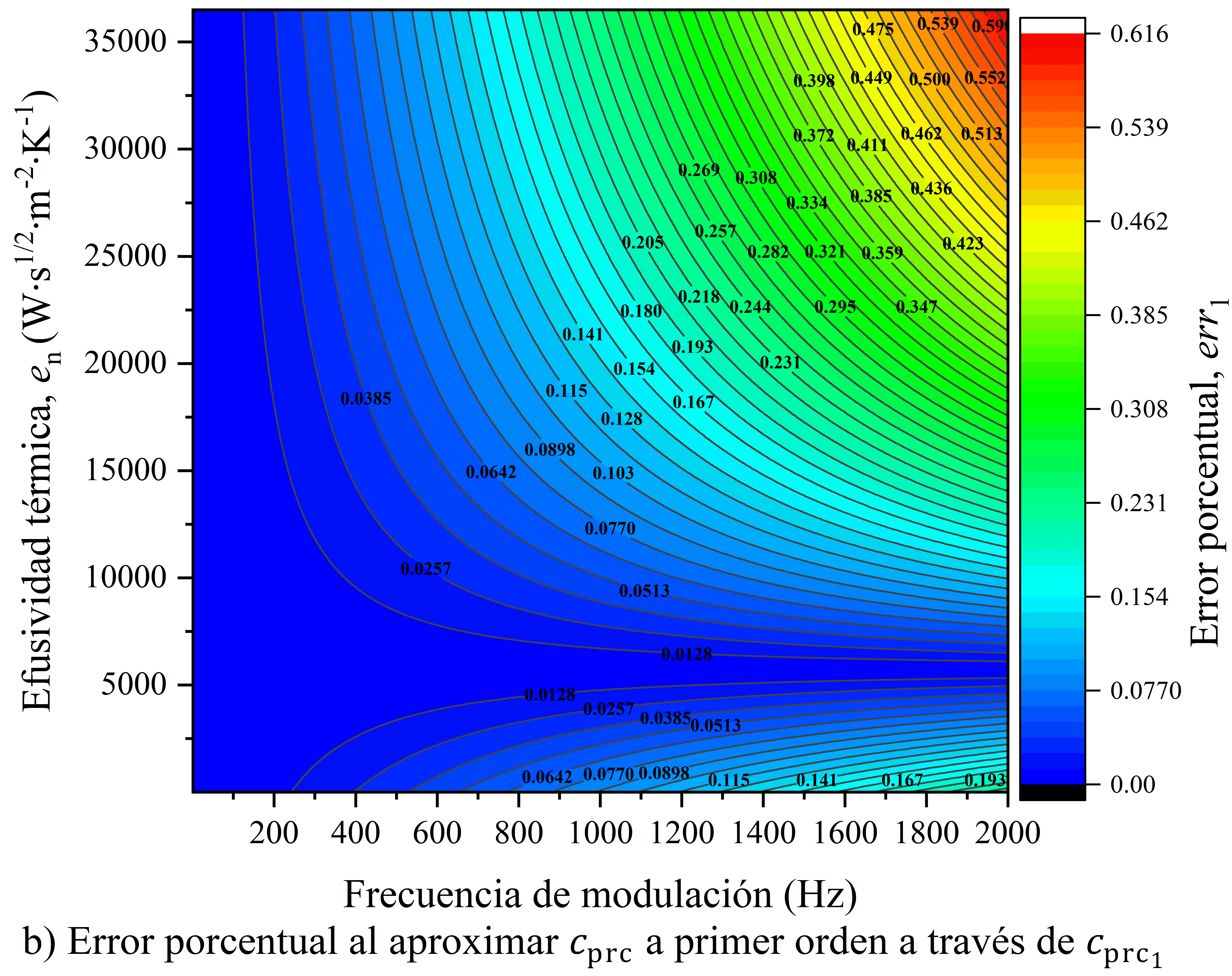
En este trabajo se presenta un estudio comparativo de aproximaciones a la respuesta fotoacústica obtenida del modelo de Rosencwaig – Gersho (RG) para una celda fotoacústica diferencial en modo de reflexión, con el propósito de evaluar su validez en la determinación de la efusividad térmica. Se propone una configuración integrada por dos celdas fotoacústicas convencionales idénticas, en las que la razón de las respuestas fotoacústicas permite reducir el número de parámetros geométricos, ópticos y térmicos, simplificando el tratamiento matemático. Se desarrollan aproximaciones de orden cero, primer y segundo orden para la razón de presiones relativas complejas, y su desempeño se evalúa mediante el error porcentual respecto a la expresión completa del modelo RG. El análisis se realiza para frecuencias de modulación entre 1 y 2000 Hz, utilizando aire como gas de trabajo y aluminio como transductor térmico en ambas celdas y, en una celda, se emplea acero como material de soporte y además se usa como referencia, mientras que en la otra se trabajan efusividades térmicas entre 5.85 y 36500 Wꞏs1/2/m2ꞏK en el material de soporte bajo estudio. Los resultados muestran que la aproximación de orden cero presenta desviaciones significativas, mientras que la aproximación de primer orden ofrece un balance óptimo entre simplicidad y precisión, siendo esta la más adecuada para describir la respuesta fotoacústica del sistema diferencial. El método propuesto constituye una alternativa no intrusiva, reproducible y de bajo costo para la caracterización térmica de materiales, con potencial aplicación en sistemas líquidos, procesos de enfriamiento, biomateriales y diversas áreas de la ingeniería.
Descargas
Referencias
[1] L. Mota, R. Toledo, F. Machado, J. Holanda, H. Vargas, and R. Faria, “Thermal characterization of red clay from the Northern Region of Rio de Janeiro State, Brazil using an open photoacoustic cell, in relation to structural changes on firing,” Appl. Clay Sci., vol. 42, no. 1–2, pp. 168–174, Dec. 2008. DOI: https://doi.org/10.1016/j.clay.2008.01.010
[2] T. A. El-Brolossy and S. S. Ibrahim, “Photoacoustic measurement of thermal properties of polystyrene metal oxide composites,” Thermochim. Acta, vol. 509, no. 1–2, pp. 46–49, Oct. 2010. DOI: https://doi.org/10.1016/j.tca.2010.05.020
[3] M. Sarkar and K. Kumar, “Fabrication of photoacoustic cell and thermal diffusivity measurement of coal carbon black using it,” Mater. Today: Proc., Nov. 2021, doi: 10.1016/j.matpr.2021.11.467. DOI: https://doi.org/10.1016/j.matpr.2021.11.467
[4] A. Bedoya, E. Marín, M. Mansanares, M. A. Zambrano-Arjona, I. Riech, and A. Calderón, “On the thermal characterization of solids by photoacoustic calorimetry: thermal diffusivity and linear thermal expansion coefficient,” Thermochim. Acta, vol. 614, pp. 52–58, Aug. 2015, doi: 10.1016/j.tca.2015.06.009.
[5] K. Herrmann, W. Pech-May, and M. Retsch, “Photoacoustic thermal characterization of low thermal diffusivity thin films,” Photoacoustics, vol. 22, p. 100246, Jun. 2021, doi: 10.1016/j.pacs.2021.100246. DOI: https://doi.org/10.1016/j.pacs.2021.100246
[6] F. Agresti et al., “Temperature controlled photoacoustic device for thermal diffusivity measurements of liquids and nanofluids,” Thermochim. Acta, vol. 619, pp. 48–52, Nov. 2015, doi: 10.1016/j.tca.2015.09.017. DOI: https://doi.org/10.1016/j.tca.2015.09.017
[7] J. Soldner and K. Stephan, “Measurement of thermal diffusivities with the photoacoustic effect,” Chem. Eng. Process.: Process Intensif., vol. 38, no. 4–6, pp. 585–591, Dec. 1999, doi: 10.1016/S0255-2701(99)00056-2. DOI: https://doi.org/10.1016/S0255-2701(99)00056-2
[8] G. A. López-Muñoz, R. F. López-González, J. A. Balderas-López, and L. Martínez-Pérez, “Thermal-diffusivity measurements of Mexican citrus essential oils using photoacoustic methodology in the transmission configuration,” Int. J. Thermophys., vol. 32, no. 5, pp. 1006–1012, May 2011, doi: 10.1007/s10765-011-0983-1. DOI: https://doi.org/10.1007/s10765-011-0983-1
[9] D. Soares-Velasco, M. Luciano-Baesso, A. Neto-Medina, D. Danijel-Bicanic, and R. Koehorst, “Thermal diffusivity of periderm from tomatoes of different maturity stages as determined by the concept of the frequency-domain open photoacoustic cell,” J. Appl. Phys., vol. 109, no. 3, p. 034703, Feb. 2011, doi: 10.1063/1.3530735. DOI: https://doi.org/10.1063/1.3530735
[10] C. M. Gao, S. Y. Zhang, Z. Zhang, and X. J. Shui, “Thermal diffusivity of porcine tissues characterized by photoacoustic piezoelectric technique,” J. Phys. IV France, vol. 125, pp. 777–779, Jun. 2005, doi: 10.1051/jp4:2005125179. DOI: https://doi.org/10.1051/jp4:2005125179
[11] F. B. G. Astrath, N. G. C. Astrath, M. L. Baesso, A. C. Bento, and J. C. S. Moraes, “Open photoacoustic cell for thermal diffusivity measurements of a fast hardening cement used in dental restoring,” J. Appl. Phys., vol. 111, no. 1, p. 014701, Jan. 2012, doi: 10.1063/1.3673873. DOI: https://doi.org/10.1063/1.3673873
[12] A. Rosencwaig and A. Gersho, “Theory of the photoacoustic effect with solids,” J. Appl. Phys., vol. 47, no. 1, pp. 64–69, Jan. 1976, doi: 10.1063/1.322296. DOI: https://doi.org/10.1063/1.322296
[13] J. Pelzl, S. Chotikaprakhan, Dietzel D, B. K. Bein, E. Neubauer, and M. Chirtoc, “The thermal contact problem in nano- and micro-scale photothermal measurements,” Eur. Phys. J. Spec. Top., vol. 153, no. 1, pp. 335–342, Jan. 2008, doi: 10.1140/epjst/e2008-00457-9. DOI: https://doi.org/10.1140/epjst/e2008-00457-9
[14] M. Manivannan, S. Balachandar, M. Jose, S. A. Martin Britto Dhas, and A. Saranraj, “Investigation on thermo-physical properties of L-valinium picrate single crystal for industrial applications,” Mater. Lett. X, vol. 12, p. 100108, Dec. 2021, doi: 10.1016/j.mlblux.2021.100108. DOI: https://doi.org/10.1016/j.mlblux.2021.100108
[15] M. G. Fernández-Olaya, "Análisis por medio de ondas térmicas de películas poliméricas delgadas y determinación de las propiedades ópticas, térmicas y eléctricas de óxidos de titanio (Ti2O3 y TiO2)," Tesis doctoral, Dept. Física Aplicada, CINVESTAV Unidad Mérida, Mérida, México, 2023.
[16] C. Hernandez-Aguilar et al., “Photoacoustic characterization of wheat bread mixed with Moringa oleífera,” Curr. Res. Food Sci., vol. 4, pp. 521–531, Jan. 2021, doi: 10.1016/j.crfs.2021.07.008. DOI: https://doi.org/10.1016/j.crfs.2021.07.008
[17] H. S. Bennett and R. A. Forman, “Frequency dependence of photoacoustic spectroscopy: Surface and bulk absorption coefficients,” J. Appl. Phys., vol. 48, no. 4, pp. 1432–1436, Apr. 1977, doi: 10.1063/1.323815. DOI: https://doi.org/10.1063/1.323883
[18] D. Cahen, “Photoacoustic cell for reflection and transmission measurements,” Rev. Sci. Instrum., vol. 52, no. 9, pp. 1306–1310, Sep. 1981, doi: 10.1063/1.1136780. DOI: https://doi.org/10.1063/1.1136788
[19] F. G. C. Bijnen, J. Reuss, and F. J. M. Harren, “Geometrical optimization of a longitudinal resonant photoacoustic cell for sensitive and fast trace gas detection,” Rev. Sci. Instrum., vol. 67, no. 8, pp. 2914–2923, Aug. 1996, doi: 10.1063/1.1147124. DOI: https://doi.org/10.1063/1.1147072
[20] D. I. Kovsh, D. J. Hagan, and E. W. Van Stryland, “Numerical modeling of thermal refraction in liquids in the transient regime,” Opt. Express, vol. 4, no. 8, pp. 315–329, Apr. 1999, doi: 10.1364/OE.4.000315. DOI: https://doi.org/10.1364/OE.4.000315
[21] M. Nägele and M. W. Sigrist, “Mobile laser spectrometer with novel resonant multipass photoacoustic cell for trace-gas sensing,” Appl. Phys. B, vol. 70, no. 6, pp. 895–901, Jun. 2000, doi: 10.1007/s003400000251. DOI: https://doi.org/10.1007/PL00021151
[22] L. C. Aamodt, J. C. Murphy, and J. G. Parker, “Size considerations in the design of cells for photoacoustic spectroscopy,” J. Appl. Phys., vol. 48, no. 3, pp. 927–933, Mar. 1977, doi: 10.1063/1.323719. DOI: https://doi.org/10.1063/1.323710
[23] L. C. Aamodt and J. C. Murphy, “Size considerations in the design of cells for photoacoustic spectroscopy. II. Pulsed excitation response,” J. Appl. Phys., vol. 49, no. 6, pp. 3036–3045, Jun. 1978, doi: 10.1063/1.325299. DOI: https://doi.org/10.1063/1.325318
[24] F. A. McDonald and G. C. Wetsel, “Generalized theory of the photoacoustic effect,” J. Appl. Phys., vol. 49, no. 4, pp. 2313–2322, Apr. 1978, doi: 10.1063/1.325116. DOI: https://doi.org/10.1063/1.325116
[25] C. L. Cesar, H. Vargas, J. A. Meyer, and L. C. M. Miranda, “Photoacoustic effect in solids,” Phys. Rev. Lett., vol. 42, no. 23, pp. 1570–1573, Jun. 1979, doi: 10.1103/PhysRevLett.42.1570. DOI: https://doi.org/10.1103/PhysRevLett.42.1570
[26] R. S. Quimby and W. M. Yen, “On the adequacy of one‐dimensional treatments of the photoacoustic effect,” J. Appl. Phys., vol. 51, no. 2, pp. 1252–1253, Feb. 1980, doi: 10.1063/1.327668. DOI: https://doi.org/10.1063/1.327700
[27] N. C. Fernelius, “Extension of the Rosencwaig‐Gersho photoacoustic spectroscopy theory to include effects of a sample coating,” J. Appl. Phys., vol. 51, no. 1, pp. 650–654, Jan. 1980, doi: 10.1063/1.327318. DOI: https://doi.org/10.1063/1.327320
[28] P. Poulet, J. Chambron, and R. Unterreiner, “Quantitative photoacoustic spectroscopy applied to thermally thick samples,” J. Appl. Phys., vol. 51, no. 3, pp. 1738–1742, Mar. 1980, doi: 10.1063/1.327814. DOI: https://doi.org/10.1063/1.327785
[29] G. Rousset, F. Lepoutre, and L. Bertrand, “Influence of thermoelastic bending on photoacoustic experiments related to measurements of thermal diffusivity of metals,” J. Appl. Phys., vol. 54, no. 5, pp. 2383–2391, May 1983, doi: 10.1063/1.332352. DOI: https://doi.org/10.1063/1.332352
[30] A. Somer et al., “The thermoelastic bending and thermal diffusion processes influence on photoacoustic signal generation using open photoacoustic cell technique,” J. Appl. Phys., vol. 114, no. 6, p. 063503, Aug. 2013, doi: 10.1063/1.4817916. DOI: https://doi.org/10.1063/1.4817655
[31] A. Bedoya et al., “On the thermal characterization of solids by photoacoustic calorimetry: thermal diffusivity and linear thermal expansion coefficient,” Thermochim. Acta, vol. 614, pp. 52–58, Aug. 2015, doi: 10.1016/j.tca.2015.06.009. DOI: https://doi.org/10.1016/j.tca.2015.06.009
[32] M. E. Rodríguez-García et al., “Differential photoacoustic cell for electrochemical and dynamic process with temperature control,” Rev. Sci. Instrum., vol. 78, no. 3, p. 034904, Mar. 2007, doi: 10.1063/1.2712790.
[33] T. Starecki and A. Geras, “Investigation of Properties of a Microfluidic Photoacoustic Cell,” Int. J. Thermophys., vol. 35, no. 12, pp. 2259–2266, Dec. 2014, doi: 10.1007/s10765-014-1715-4. DOI: https://doi.org/10.1007/s10765-014-1570-z
[34] M. E. Rodríguez-García, R. Velásquez-Hernández, M. L. Mendoza-López, D. M. Hurtado-Castañeda, K. M. Brieño-Enríquez, y J. J. Pérez-Bueno, “Differential Photoacoustic Cell for Electrochemical and Dynamic Process with Temperature Control,” Rev. Sci. Instrum., vol. 78, no. 3, p. 034904, Mar. 2007, doi: 10.1063/1.2712790. DOI: https://doi.org/10.1063/1.2715916
[35] E. Gutiérrez-Cortez et al., “Effect of processing temperature on structural and physicochemical properties of corn tortillas mixed with several nixtamalized corn flours,” J. Cereal Sci., vol. 51, no. 1, pp. 81–86, Jan. 2010, doi: 10.1016/j.jcs.2009.10.003. DOI: https://doi.org/10.1016/j.jcs.2009.10.003
Publicado
Declaración de disponibilidad de datos
Se puede contactar directamente al Contacto principal
Número
Sección
Categorías
Licencia
Derechos de autor 2026 Luis David Vargas Sotelo, Sergio Marcial Palma, Salvador Manuel Malagón-Soldara, Francisco Javier García-Rodríguez, David Gasca-Figueroa

Esta obra está bajo una licencia internacional Creative Commons Atribución 4.0.
Los autores/as que publiquen en esta revista aceptan las siguientes condiciones:
- Los autores/as conservan los derechos de autor y ceden a la revista el derecho de la primera publicación, con el trabajo registrado con la licencia de atribución de Creative Commons 4.0, que permite a terceros utilizar lo publicado siempre que mencionen la autoría del trabajo y a la primera publicación en esta revista.
- Los autores/as pueden realizar otros acuerdos contractuales independientes y adicionales para la distribución no exclusiva de la versión del artículo publicado en esta revista (p. ej., incluirlo en un repositorio institucional o publicarlo en un libro) siempre que indiquen claramente que el trabajo se publicó por primera vez en esta revista.
- Se permite y recomienda a los autores/as a compartir su trabajo en línea (por ejemplo: en repositorios institucionales o páginas web personales) antes y durante el proceso de envío del manuscrito, ya que puede conducir a intercambios productivos, a una mayor y más rápida citación del trabajo publicado (vea The Effect of Open Access).
Cómo citar