Análisis estructural del diseño generativo aplicado a órtesis plantares ergonómicas
DOI:
https://doi.org/10.37636/recit.v9n2e448Palabras clave:
Análisis de elementos finitos, Diseño generativo, Ergonomía, Materiales elastoméricosResumen
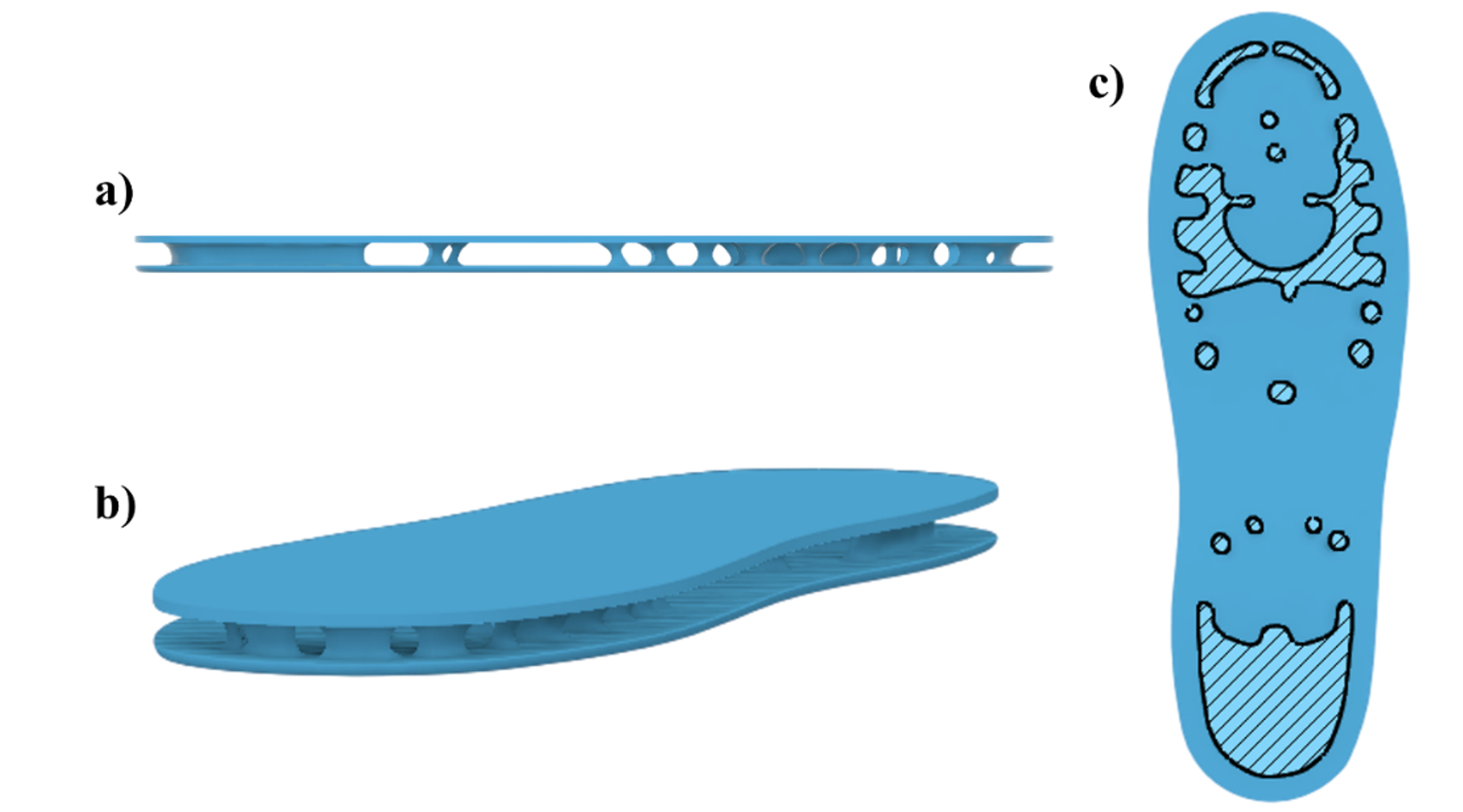
Las órtesis plantares son dispositivos diseñados para proporcionar soporte y corregir la biomecánica del pie. El diseño generativo ofrece un gran potencial para la personalización; sin embargo, el análisis de su comportamiento estructural continúa siendo un desafío significativo. Este estudio tiene como objetivo evaluar la optimización estructural de órtesis diseñadas mediante diseño generativo en comparación con los modelos tradicionales. Se realizó un análisis de 33 hombres adultos de mediana edad clasificados como normopeso, con un peso promedio de 65.32 ± 6.79 kg a partir de una base de datos de baropodometría. Se diseñó mediante modelado paramétrico una órtesis optimizada para evaluar su respuesta mecánica en condiciones de bipedestación estática, utilizando el método de elementos finitos con el material TPU A95. Los resultados indicaron que las estructuras trabeculares producidas mediante diseño generativo absorben más energía (0.3876 J) que una órtesis bilaminada confeccionada con materiales EVA A40 y A15 (0.0362 J). Los niveles de deformación obtenidos (deformación principal máxima = 1.34%, deformación elástica equivalente = 2.14%) indican que la composición del modelo generativo funciona bien dentro del régimen elástico, asegurando la integridad estructural. Sin embargo, los bajos valores de deformación y energía de deformación sugieren un comportamiento relativamente rígido, lo que puede restringir la capacidad de absorción de impactos. La principal contribución de este estudio es demostrar cómo el diseño generativo puede integrarse en metodologías para diseñar órtesis plantares. Explora los posibles beneficios de este enfoque y examina cómo los parámetros generativos del diseño influyen en las respuestas mecánicas. Esta investigación proporciona una base técnica para optimizar las órtesis ergonómicas mediante modelado estructural y diseño generativo. Los hallazgos subrayan el potencial del diseño generativo para crear órtesis optimizadas y destacan la importancia de los parámetros de diseño en los resultados alcanzados. Esta información es valiosa para futuras aplicaciones del diseño generativo en el campo de la ergonomía.
Descargas
Referencias
[1] A. P. Hills, E. M. Hennig, M. McDonald, and O. Bar-Or, “Plantar pressure differences between obese and non-obese adults: A biomechanical analysis,” International Journal of Obesity, vol. 25, no. 11, pp. 1674–1679, 2001, doi: 10.1038/sj.ijo.0801785. DOI: https://doi.org/10.1038/sj.ijo.0801785
[2] W. R. Ledoux and S. Telfer, Foot and ankle biomechanics. Elsevier, 2023. doi: 10.1016/C2017-0-03286-X. DOI: https://doi.org/10.1016/C2017-0-03286-X
[3] J. A. Ramos-Frutos, I. Miguel-Andrés, M. León-Rodríguez, L. A. Ortiz-Lango, S. L. Orozco-Villaseñor, and A. Vidal-Lesso, “Type of feet in a Mexican population: Analysis of the footprint morphology and literature review,” Revista Mexicana de Ingeniería Biomédica, vol. 44, no. 2, pp. 6–15, May 2023, doi: 10.17488/RMIB.44.2.1. DOI: https://doi.org/10.17488/RMIB.44.2.1
[4] J. Anderson, A. E. Williams, and C. J. Nester, “Musculoskeletal disorders, foot health and footwear choice in occupations involving prolonged standing,” International Journal of Industrial Ergonomics, vol. 81, no. 3, p. 103079, Jan. 2021, doi: 10.1016/j.ergon.2020.103079. DOI: https://doi.org/10.1016/j.ergon.2020.103079
[5] K. J. Mickle, J. R. Steele, and B. J. Munro, “Does excess mass affect plantar pressure in young children?,” International Journal of Pediatric Obesity, vol. 1, no. 3, pp. 183–188, 2006, doi: 10.1080/17477160600881734. DOI: https://doi.org/10.1080/17477160600881734
[6] I. Miguel-Andrés, A. E. Rivera-Cisneros, J. J. Mayagoitia-Vázquez, S. L. Orozco-Villaseñor, and A. Rosas-Flores, “Flatfoot index and areas with the highest prevalence of musculoskeletal disorders in young athletes,” Fisioterapia, vol. 42, no. 1, pp. 17–23, 2020, doi: 10.1016/j.ft.2019.08.002. DOI: https://doi.org/10.1016/j.ft.2019.08.002
[7] I. Miguel-Andrés, J. J. J. Mayagoitia-Vázquez, S. L. L. Orozco-Villaseñor, M. León-Rodríguez, and D. Samayoa-Ochoa, “Effect of the morphology of the soles of the feet on plantar pressure distribution in young athletes with different foot types,” Fisioterapia, vol. 43, no. 1, pp. 30–37, Jan. 2021, doi: 10.1016/j.ft.2020.07.003. DOI: https://doi.org/10.1016/j.ft.2020.07.003
[8] P. Buckle, “Ergonomics and musculoskeletal disorders: overview,” Occupational Medicine, vol. 55, no. 3, pp. 164–167, May 2005, doi: 10.1093/occmed/kqi081. DOI: https://doi.org/10.1093/occmed/kqi081
[9] B. Y. S. Tsung, M. Zhang, A. F. T. Mak, and M. W. N. Wong, “Effectiveness of insoles on plantar pressure redistribution,” The Journal of Rehabilitation Research and Development, vol. 41, no. 6 A, pp. 767–774, 2004, doi: 10.1682/JRRD.2003.09.0139. DOI: https://doi.org/10.1682/JRRD.2003.09.0139
[10] P. Hernández-Gandarillas, S. L. Orozco-Villaseñor, J. de Jesús Mayagoitia-Vázquez, I. Miguel-Andrés, J. P. Herrera-Rangel, and K. D. de la Cruz-Alvarado, “Results of the use of personalized insoles for the treatment of cavus foot and comorbidities,” IFMBE Proceedings, vol. 75, pp. 921–932, 2020, doi: 10.1007/978-3-030-30648-9_119. DOI: https://doi.org/10.1007/978-3-030-30648-9_119
[11] A. Rosas-Flores and I. Miguel‐Andrés, “Numerical simulation by finite elements for redistribution of plantar pressure in sport insoles,” in Sociedad Mexicana de Ingeniería Biomédica N°43, 2020, pp. 1–8. doi: dx.doi.org/10.24254/CNIB.20.33.
[12] J. M. Gerrard, D. R. Bonanno, D. R. Bonanno, G. A. Whittaker, G. A. Whittaker, and K. B. Landorf, “Effect of different orthotic materials on plantar pressures: A systematic review,” Journal of Foot and Ankle Research, vol. 13, no. 1, pp. 1–11, 2020, doi: 10.1186/s13047-020-00401-3. DOI: https://doi.org/10.1186/s13047-020-00401-3
[13] K. Van Alsenoy, J. H. Ryu, and O. Girard, “The effect of EVA and TPU custom foot orthoses on running economy, running mechanics, and comfort,” Frontiers in Sports and Active Living, vol. 1, no. September, pp. 1–10, 2019, doi: 10.3389/fspor.2019.00034. DOI: https://doi.org/10.3389/fspor.2019.00034
[14] Y. F. Hudak et al., “A novel workflow to fabricate a patient-specific 3D printed accommodative foot orthosis with personalized latticed metamaterial,” Medical Engineering & Physics, vol. 104, no. November 2021, p. 103802, Jun. 2022, doi: 10.1016/j.medengphy.2022.103802. DOI: https://doi.org/10.1016/j.medengphy.2022.103802
[15] R. Collings, J. Freeman, J. M. Latour, and J. Paton, “Footwear and insole design features for offloading the diabetic at risk foot—A systematic review and meta-analyses,” Endocrinology, Diabetes and Metabolism, vol. 4, no. 1, pp. 1–18, 2021, doi: 10.1002/edm2.132. DOI: https://doi.org/10.1002/edm2.132
[16] A. K. Kundumani-Janarthanan and B. Vaidhyanathan, “Additive manufacturing of smart footwear components for healthcare applications,” Micromachines, vol. 16, no. 1, p. 30, Dec. 2024, doi: 10.3390/mi16010030. DOI: https://doi.org/10.3390/mi16010030
[17] Y. Sun et al., “3D printed sports shoe midsoles: Enhancing comfort and performance through finite element analysis of negative Poisson’s ratio structures,” Materials and Design, vol. 245, no. September, p. 113292, 2024, doi: 10.1016/j.matdes.2024.113292. DOI: https://doi.org/10.1016/j.matdes.2024.113292
[18] H. O. Demirel, M. H. Goldstein, X. Li, and Z. Sha, “Human-centered generative design framework: An early design framework to support concept creation and evaluation,” International Journal of Human-Computer Interaction, vol. 40, no. 4, pp. 933–944, 2024, doi: 10.1080/10447318.2023.2171489. DOI: https://doi.org/10.1080/10447318.2023.2171489
[19] P. R. Shrestha, D. Timalsina, S. Bista, B. P. Shrestha, and T. M. Shakya, “Generative design approach for product development,” The 7th International Conference on Engineering, Applied Sciences and Technology, vol. 2397, no. 1, 2021, doi: https://doi.org/10.1063/5.0065031. DOI: https://doi.org/10.1063/5.0065031
[20] L. Zoboli, D. Bianchi, C. Falcinelli, and A. Gizzi, “Improving the manufacturing of 3D printed insoles through a combined experimental and topology optimization approach,” Mechanics of Advanced Materials and Structures, vol. 31, no. 30, pp. 12636–12650, Nov. 2024, doi: 10.1080/15376494.2024.2326667. DOI: https://doi.org/10.1080/15376494.2024.2326667
[21] N. Ferro, S. Perotto, D. Bianchi, R. Ferrante, and M. Mannisi, “Design of cellular materials for multiscale topology optimization: application to patient-specific orthopedic devices,” Structural and Multidisciplinary Optimization, vol. 65, no. 3, pp. 1–26, 2022, doi: 10.1007/s00158-021-03163-z. DOI: https://doi.org/10.1007/s00158-021-03163-z
[22] M. Davia-Aracil, J. J. Hinojo-Pérez, A. Jimeno-Morenilla, and H. Mora-Mora, “3D printing of functional anatomical insoles,” Computers in Industry, vol. 95, pp. 38–53, Feb. 2018, doi: 10.1016/j.compind.2017.12.001. DOI: https://doi.org/10.1016/j.compind.2017.12.001
[23] R. Jaisawal and V. Agrawal, “Generative design method – A state of art,” IOP Conference Series: Materials Science and Engineering, vol. 1104, no. 1, p. 012036, 2021, doi: 10.1088/1757-899x/1104/1/012036. DOI: https://doi.org/10.1088/1757-899X/1104/1/012036
[24] F. Buonamici, M. Carfagni, R. Furferi, Y. Volpe, and L. Governi, “Generative design: An explorative study,” Computer-Aided Design and Applications, vol. 18, no. 1, pp. 144–155, 2020, doi: 10.14733/cadaps.2021.144-155. DOI: https://doi.org/10.14733/cadaps.2021.144-155
[25] Z. Wang, Z. Cao, F. Fan, and Y. Sun, “Shape optimization of free-form grid structures based on the sensitivity hybrid multi-objective evolutionary algorithm,” Journal of Building Engineering, vol. 44, no. 1, p. 102538, Dec. 2021, doi: 10.1016/j.jobe.2021.102538. DOI: https://doi.org/10.1016/j.jobe.2021.102538
[26] O. Peckham, J. Raines, E. Bulsink, M. Goudswaard, J. Gopsill, and D. Barton, “Artificial intelligence in generative design : A structured review of trends and opportunities in techniques and applications,” Designs, vol. 9, no. 4, 2025, doi: https://doi.org/10.3390/designs9040079. DOI: https://doi.org/10.3390/designs9040079
[27] J. Alcaide-Marzal, J. A. Diego-Mas, and G. Acosta-Zazueta, “A 3D shape generative method for aesthetic product design,” Design Studies, vol. 66, pp. 144–176, Jan. 2020, doi: 10.1016/j.destud.2019.11.003. DOI: https://doi.org/10.1016/j.destud.2019.11.003
[28] H. Ö. Özsoy, “Enhancing industrial product aesthetics, ergonomics , and usability with artificial intelligence-driven generative design,” Journal of Intelligent Systems: Theory and Applications, vol. 8, no. 2, pp. 141–155, 2025, doi: 10.38016/jista.1677535. DOI: https://doi.org/10.38016/jista.1677535
[29] L. Urquhart, A. Wodehouse, B. Loudon, and C. Fingland, “The application of generative algorithms in human-centered product development,” Applied Sciences (Switzerland), vol. 12, no. 7, 2022, doi: 10.3390/app12073682. DOI: https://doi.org/10.3390/app12073682
[30] J. Schneider, S. Essafi, A. Pilar, V. Puerta, A. P. Valerga Puerta, and D. Völz, “Comprehensive generative approach to design insoles,” Current Directions in Biomedical Engineering, vol. 10, no. 4, pp. 555–558, Dec. 2024, doi: 10.1515/cdbme-2024-2136. DOI: https://doi.org/10.1515/cdbme-2024-2136
[31] J. T. M. Cheung and M. Zhang, “Parametric design of pressure-relieving foot orthosis using statistics-based finite element method,” Medical Engineering and Physics, vol. 30, no. 3, pp. 269–277, 2008, doi: 10.1016/j.medengphy.2007.05.002. DOI: https://doi.org/10.1016/j.medengphy.2007.05.002
[32] K. Surmen, F. Ortes, and Y. Z. Arslan, “Design and Production of Subject Specific Insole Using Reverse Engineering and 3D Printing Technology,” International Journal of Engineering Science Intervention, vol. 5, no. 12, pp. 11–15, 2016, [Online]. Available: https://doi.org/10.6084/m9.figshare.19729495
[33] C. Elias, A. Abraham, C. Asrat, T. Yakob, and D. Girma, “Prevalence of overweight/obesity and its association with fast food consumption among adolescents in Southern Ethiopia, 2022: a community-based cross-sectional study,” Frontiers in Nutrition, vol. 11, no. January, 2024, doi: 10.3389/fnut.2024.1475116. DOI: https://doi.org/10.3389/fnut.2024.1475116
[34] K. Khalaf, D. M. Mohan, M. Al Hindi, A. H. Khandoker, and H. F. Jelinek, “Plantar pressure alterations associated with increased BMI in young adults,” Gait & Posture, vol. 98, no. September, pp. 255–260, Oct. 2022, doi: 10.1016/j.gaitpost.2022.09.071. DOI: https://doi.org/10.1016/j.gaitpost.2022.09.071
[35] J. A. Ramos-Frutos et al., “Effect of foot type on plantar pressure distribution in healthy mexicans: Static and dynamic pressure analysis,” Physiologia, vol. 5, no. 3, p. 29, Sep. 2025, doi: 10.3390/physiologia5030029. DOI: https://doi.org/10.3390/physiologia5030029
[36] A. Healy, D. Dunning, and N. Chockalingam, “Effect of insole material on plantar pressure,” Footwear Science, vol. 3, no. sup1, pp. S69–S70, Jun. 2011, doi: 10.1080/19424280.2011.575804. DOI: https://doi.org/10.1080/19424280.2011.575804
[37] M. C. Iacob, D. Popescu, C. Stochioiu, F. Baciu, and A. Hadar, “Compressive behavior of thermoplastic polyurethane with an active agent foaming for 3D-printed customized comfort insoles,” Polymer Testing, vol. 137, no. January, p. 108517, 2024, doi: 10.1016/j.polymertesting.2024.108517. DOI: https://doi.org/10.1016/j.polymertesting.2024.108517
[38] P. Baranowski, A. Kapusta, P. Płatek, and M. Sarzyński, “Influence of 3D-printed cellular shoe soles on plantar pressure during running − Experimental and numerical studies,” Biocybernetics and Biomedical Engineering, vol. 44, no. 4, pp. 858–873, 2024, doi: 10.1016/j.bbe.2024.11.004. DOI: https://doi.org/10.1016/j.bbe.2024.11.004
[39] F. Hashim, I. Surya, A. Rusli, and H. Ismail, “Microstructure-properties of dynamically vulcanized mengkuang leaf fibre/ethylene vinyl acetate/natural rubber thermoplastic elastomer composites,” BioResources, vol. 17, no. 4, pp. 6036–6055, Sep. 2022, doi: 10.15376/biores.17.4.6036-6055. DOI: https://doi.org/10.15376/biores.17.4.6036-6055
[40] J. Xiao and Y. Gao, “The manufacture of 3D printing of medical grade TPU,” Progress in Additive Manufacturing, vol. 2, no. 3, pp. 117–123, 2017, doi: 10.1007/s40964-017-0023-1. DOI: https://doi.org/10.1007/s40964-017-0023-1
[41] I. Bianchi, A. Forcellese, M. Simoncini, and A. Vita, “Mechanical characterization and sustainability assessment of recycled EVA for footwears,” International Journal of Advanced Manufacturing Technology, vol. 126, no. 7–8, pp. 3149–3160, 2023, doi: 10.1007/s00170-023-11332-1. DOI: https://doi.org/10.1007/s00170-023-11332-1
[42] G. Mariotti and L. Vannozzi, “Fabrication, characterization, and properties of poly (ethylene-co-vinyl acetate) composite thin films doped with piezoelectric nanofillers,” Nanomaterials, vol. 9, no. 8, 2019, doi: 10.3390/nano9081182. DOI: https://doi.org/10.3390/nano9081182
[43] V. Marco, G. Massimo, and G. Manuela, “Additive manufacturing of flexible thermoplastic polyurethane (TPU): enhancing the material elongation through process optimisation,” Progress in Additive Manufacturing, vol. 10, no. 4, pp. 2877–2891, 2025, doi: 10.1007/s40964-024-00790-y. DOI: https://doi.org/10.1007/s40964-024-00790-y
[44] Y. H. Lee et al., “Effect of hot pressing/melt mixing on the properties of thermoplastic polyurethane,” Macromolecular Research, vol. 17, no. 8, pp. 616–622, 2009, doi: 10.1007/BF03218918. DOI: https://doi.org/10.1007/BF03218918
[45] J. Perry and J. Burnfield, Gait analysis, 2nd ed. New Jersey: Slack Incorporated, 2010. doi: 10.1201/9781003525592. DOI: https://doi.org/10.1201/9781003525592
[46] J. Schneider and D. Völz, “Advancing diabetic foot care: Incorporating horizontal shear forces in orthopaedic insoles through generative design,” Gerontechnology, vol. 23, no. s, pp. 1–1, Jul. 2024, doi: 10.4017/gt.2024.23.s.978.pp. DOI: https://doi.org/10.4017/gt.2024.23.s.978.pp
[47] T. P. Simarmata, M. Martawidjaja, C. Harito, and C. C. L. Tobing, “Three-dimensional printed auxetic insole orthotics for flat foot patients with quality function development/theory of inventive problem solving/analytical hierarchy process methods,” Designs, vol. 9, no. 1, p. 15, Jan. 2025, doi: 10.3390/designs9010015. DOI: https://doi.org/10.3390/designs9010015
[48] F. Claybrook, M. I. Mohammed, D. Southee, F. R. Claybrook, M. Mohammed, and D. J. Southee, “Investigation of additive manufactured Split-P TPMS elastomeric structures for diabetic foot insoles,” Transactions on Additive Manufacturing Meets Medicine, vol. 4, no. 1, pp. 1–4, 2022, doi: 10.18416/AMMM.2022.2209664.
[49] R. Kumar and S. K. Sarangi, “3D Printed customized diabetic foot insoles with architecture designed lattice structures – a case study,” Biomedical Physics & Engineering Express, vol. 10, no. 1, p. 015019, Jan. 2024, doi: 10.1088/2057-1976/ad1732. DOI: https://doi.org/10.1088/2057-1976/ad1732
Descargas
Publicado
Declaración de disponibilidad de datos
The original contributions presented in this study are included in the article. Further inquiries can be directed to the corresponding author.
Número
Sección
Categorías
Licencia
Derechos de autor 2026 Christian Enrique Nava-Alcantar, Agustín Vidal-Lesso, Marco Antonio Martínez-Bocanegra, Luis Ángel Ortiz-Lango, Juan Carlos García-Valadez, Sergio Alonso-Romero, Israel Miguel-Andres

Esta obra está bajo una licencia internacional Creative Commons Atribución 4.0.
Los autores/as que publiquen en esta revista aceptan las siguientes condiciones:
- Los autores/as conservan los derechos de autor y ceden a la revista el derecho de la primera publicación, con el trabajo registrado con la licencia de atribución de Creative Commons 4.0, que permite a terceros utilizar lo publicado siempre que mencionen la autoría del trabajo y a la primera publicación en esta revista.
- Los autores/as pueden realizar otros acuerdos contractuales independientes y adicionales para la distribución no exclusiva de la versión del artículo publicado en esta revista (p. ej., incluirlo en un repositorio institucional o publicarlo en un libro) siempre que indiquen claramente que el trabajo se publicó por primera vez en esta revista.
- Se permite y recomienda a los autores/as a compartir su trabajo en línea (por ejemplo: en repositorios institucionales o páginas web personales) antes y durante el proceso de envío del manuscrito, ya que puede conducir a intercambios productivos, a una mayor y más rápida citación del trabajo publicado (vea The Effect of Open Access).
Cómo citar