Environmental and Construction Factors that Promote Premature Deterioration of Coastal Housing in Veracruz, Mexico
DOI:
https://doi.org/10.37636/Keywords:
Compound Damage Index (CDI), Confined masonry, Premature deterioration, Coastal popular housingAbstract
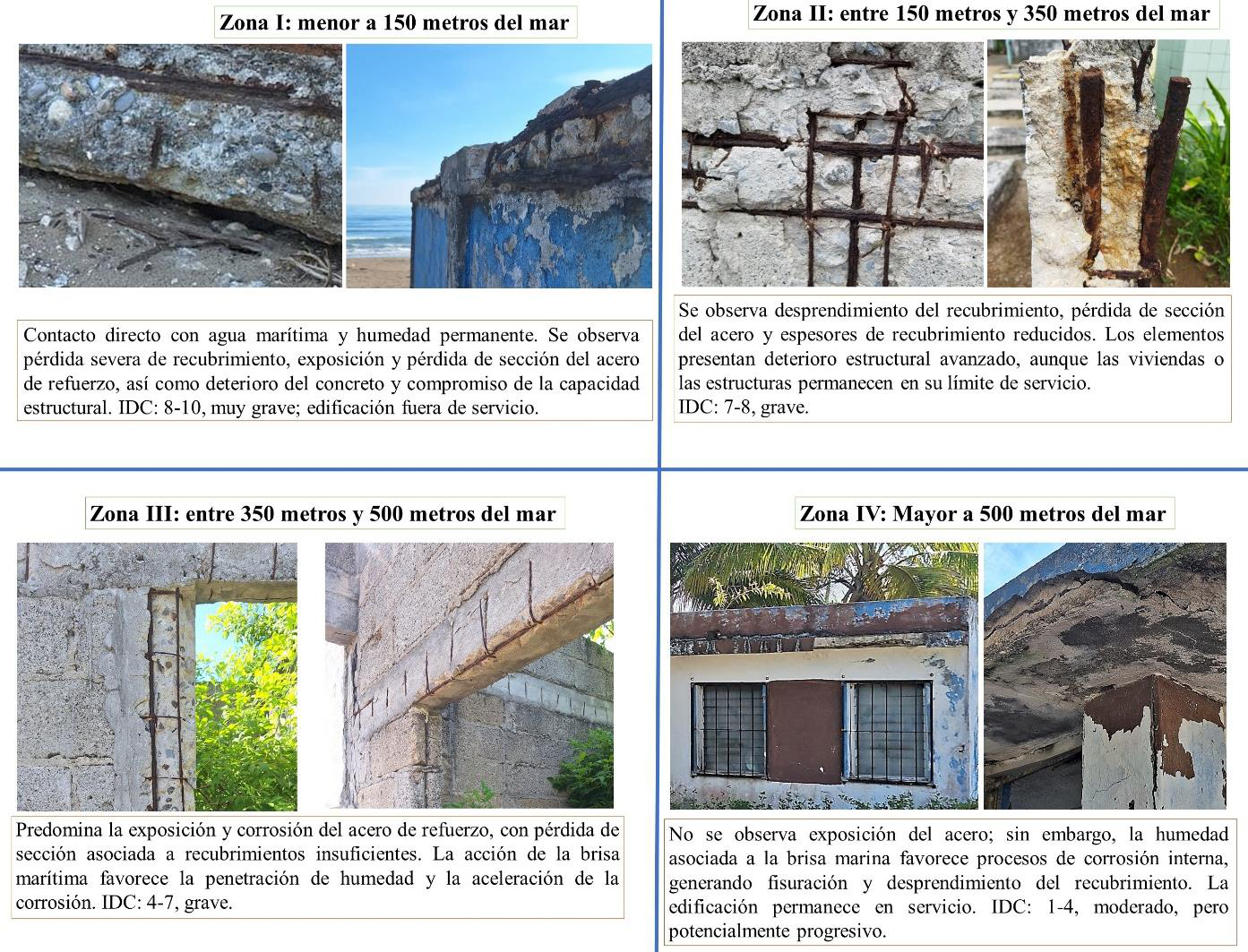
The premature deterioration of reinforced concrete structures in coastal areas results from the combined action of the aggressiveness of the maritime environment and the deficiencies of informal construction. The present work identifies and quantifies the determining factors of deterioration in houses on the central coast of Veracruz under the hypothesis of a multicausal model, based on an exploratory diagnosis in 65 structures located in eight coastal localities. A standardized protocol was applied that included visual inspection, compressive strength with a sclerometer, coating thickness with a vernier caliper, and depth of carbonation with phenolphthalein. To integrate the deterioration variables into a comparable metric, the Compound Damage Index (CDI, scale 1-10) was constructed. The results reveal an exponential decay relationship between the IDC and the distance to the coast: structures less than 150 m registered an average IDC of 8.23/10, compared to 1.51/10 in those located between 500 and 948 m. However, 84.6% of the furthest structures presented active corrosion, confirming that distance does not protect when coatings are insufficient. The average carbonation depth exceeded or equaled the coating thickness in the four exposure zones, with a maximum gap of 2.1 cm in the area closest to the coast and an exact convergence of both values (2.4 cm) in the farthest zone. Confined masonry was more vulnerable than monolithic reinforced concrete, with 97.9% of castles affected compared to 61.5% of columns. Unsupervised self-construction, the use of well water without quality verification, and maintenance with simple mortar on corroded steel act as amplifying factors of environmental deterioration. The results open lines of research aimed at the development of alternative protection systems, such as base coatings, supplementary cementitious materials, ecological pastes with low permeability, etc., that are economically accessible and compatible with the conditions of self-construction prevailing in Mexican coastal areas.
Downloads
References
[1] L. F. Rincon, Y. M. Moscoso, A. E. A. Hamami, J. C. Matos, and E. Bastidas-Arteaga, “Degradation Models and Maintenance Strategies for Reinforced Concrete Structures in Coastal Environments under Climate Change: A Review,” Buildings, vol. 14, no. 3, p. 562, Feb. 2024, doi: 10.3390/buildings14030562.
[2] A. F. Al Fuhaid and A. Niaz, “Carbonation and Corrosion Problems in Reinforced Concrete Structures,” Buildings, vol. 12, no. 5, p. 586, May 2022, doi: 10.3390/buildings12050586.
[3] M. Terrados-Cristos, M. Diaz-Piloneta, F. Ortega-Fernández, G. M. Martinez-Huerta, and J. V. Alvarez-Cabal, “Corrosion Risk Assessment in Coastal Environments Using Machine Learning-Based Predictive Models,” Sensors, vol. 25, no. 13, p. 4231, Jul. 2025, doi: 10.3390/s25134231.
[4] Y. M. Panchenko, A. I. Marshakov, L. A. Kudryavtseva, V. V. Kovtanyuk, and T. A. Nenasheva, “A chloride deposition model for predicting the categories of atmospheric corrosivity in coastal areas,” Corrosion Engineering, Science and Technology: The International Journal of Corrosion Processes and Corrosion Control, vol. 60, no. 5, pp. 376–389, Aug. 2025, doi: 10.1177/1478422X241298181.
[5] R. Zeszut, D. C. Hansen, D. Borth, R. J. Santucci, and C. Sanders, “Differences in Atmospheric Corrosion Severity Over Long and Short Distances,” Corrosion, vol. 80, no. 8, pp. 783–795, Aug. 2024, doi: 10.5006/4507.
[6] N. LeBozec and D. Thierry, “Corrosion Performance of Prepainted Galvanized Steel After 8‐Year Outdoor Exposure Upon the Distance to the Seashore in Temperate Environment,” Materials and Corrosion, Feb. 2026, doi: 10.1002/maco.70115.
[7] INEGI, “Geografía y Medio Ambiente.” Accessed: May 04, 2026. [Online]. Available: https://www.inegi.org.mx/temas/climatologia/
[8] B. Borah, H. B. Kaushik, and V. Singhal, “Analysis and Design of Confined Masonry Structures: Review and Future Research Directions,” Buildings, vol. 13, no. 5, p. 1282, May 2023, doi: 10.3390/buildings13051282.
[9] H. A. Velasquez, Á. Hurtado, D. Soto, and C. Angel, “Impact of structural degradation on the seismic resilience of self-built housing: an approach based on intelligent circular resilience,” Journal of Building Pathology and Rehabilitation, vol. 10, no. 2, p. 123, Dec. 2025, doi: 10.1007/s41024-025-00633-5.
[10] Q. Yuan, J. Zhang, Z. Huang, Z. Zhang, X. Wang, and B. Li, “Deposition and accumulation of marine aerosol and its penetration into concretes exposed to the marine atmospheric zone: an overview,” Archives of Civil and Mechanical Engineering, vol. 23, no. 1, p. 65, Jan. 2023, doi: 10.1007/s43452-022-00599-y.
[11] C. Kassinis, L. Aresti, M. Koronides, P. Christodoulides, C. Michailides, and T. Onoufriou, “A review on the environment’s influence on coastal marine steel corrosion and in-situ monitoring,” Journal of Materials Science: Materials in Engineering, vol. 20, no. 1, p. 125, Oct. 2025, doi: 10.1186/s40712-025-00352-2.
[12] O. Trocónis de Rincón, A. Romero de Carruyo, C. Andrade, P. R. L. Helene e I. Díaz, Eds., Manual de Inspección, Evaluación y Diagnóstico de Corrosión en Estructuras de Hormigón Armado. Maracaibo, Venezuela: Universidad del Zulia / CYTED, 2006
[13] H. Su, W. Liu, and X. Yao, “Effects of Gradient Marine Atmospheric Exposure on Mechanical Properties and Residual Stress of 2A14 Aluminum Alloy Tungsten Inert Gas-Welded Joints,” J. Mater. Eng. Perform., vol. 35, no. 27, pp. 27506–27517, Jul. 2026, doi: 10.1007/s11665-026-13725-1.
[14] Q. Yuan, J. Zhang, Z. Huang, Z. Zhang, X. Wang, and B. Li, “Deposition and accumulation of marine aerosol and its penetration into concretes exposed to the marine atmospheric zone: an overview,” Archives of Civil and Mechanical Engineering, vol. 23, no. 1, p. 65, Jan. 2023, doi: 10.1007/s43452-022-00599-y.
[15] NMX–C-515-ONNCCE-2016, “Industria de la construcción–Concreto Hidráulico-Durabilidad–Determinación de la profundidad de carbonatación en concreto hidráulico–Especificaciones y método de ensayo,” Diario Oficial de la Federación Mexicana. Accessed: May 18, 2024. [Online]. Available: https://www.dof.gob.mx/normasOficiales/6182/seeco11_C/seeco11_C.html
[16] K. L. Ackerman, A. D. Nugent, and C. Taing, “Mechanisms controlling giant sea salt aerosol size distributions along a tropical orographic coastline,” Atmos. Chem. Phys., vol. 23, no. 21, pp. 13735–13753, Nov. 2023, doi: 10.5194/acp-23-13735-2023.
[17] L. Xiang, Q. Meng, and P. Ren, “Effects of environmental and architectural factors on chloride-salt deposition on coastal building surfaces in the Zhujiang River Estuary,” Build. Environ., vol. 242, p. 110554, Aug. 2023, doi: 10.1016/j.buildenv.2023.110554.
[18] H. İ. Şenol, “Coastal erosion and stream flow dynamics: historical analysis and forecasting shoreline changes in the Yeşilırmak delta,” Environ. Earth Sci., vol. 84, no. 19, p. 543, Oct. 2025, doi: 10.1007/s12665-025-12537-1.
[19] L. Ahmad, A. Biswas, J. Warland, and I. Anjum, Climate Change and Agrometeorology. Singapore: Springer Nature Singapore, 2023. doi: 10.1007/978-981-99-4863-5.
[20] R. E. Melchers, “Corrosion at the Steel–Medium Interface,” Corrosion and Materials Degradation, vol. 5, no. 1, pp. 52–72, Jan. 2024, doi: 10.3390/cmd5010003.
[21] ASTM C805/C805M-25, “Standard Test Method for Rebound Number of Hardened Concrete,” Standard Test Method for Rebound Number of Hardened Concrete. Accessed: Sep. 28, 2026. [Online]. Available: https://store.astm.org/c0805_c0805m-25.html
[22] NMX-C-155-ONNCCE-2014, “Industria de la construcción-concreto hidráulico-dosificado en masa especificaciones y métodos de ensayo (cancela a la nmx-c-155-onncce-2004 y a la NMX-C-403-ONNCCE-1999).,” Organismo Nacional de Normalización. Accessed: Sep. 28, 2026. [Online]. Available: https://platiica.economia.gob.mx/normalizacion/nmx-c-155-onncce-2014/
[23] M. O. Osta, A. Azeem, S. Rashid, M. Harun, and A. Hanif, “Marine Resilience: Understanding the Durability and Effects on Concrete Structures—A Comprehensive Review,” Arab. J. Sci. Eng., vol. 51, no. 4, pp. 3981–4006, Feb. 2026, doi: 10.1007/s13369-025-10697-7.
[24] G. Vizentin and G. Vukelic, “Prediction of the Deterioration of FRP Composite Properties Induced by Marine Environments,” J. Mar. Sci. Eng., vol. 10, no. 4, p. 510, Apr. 2022, doi: 10.3390/jmse10040510.
[25] R. Zhao, C. Li, and X. Guan, “Advances in Modeling Surface Chloride Concentrations in Concrete Serving in the Marine Environment: A Mini Review,” Buildings, vol. 14, no. 6, p. 1879, Jun. 2024, doi: 10.3390/buildings14061879.
Downloads
Published
Data Availability Statement
The authors make their research data available; these may be requested via email at dreyesg@itsm.edu.mx.
Issue
Section
Categories
License
Copyright (c) 2026 Kenson Noel, David Reyes-Gonzalez, Rodrigo Vivar-Ocampo

This work is licensed under a Creative Commons Attribution 4.0 International License.
The authors who publish in this journal accept the following conditions:
The authors retain the copyright and assign to the journal the right of the first publication, with the work registered with the Creative Commons Attribution license 4.0, which allows third parties to use what is published as long as they mention the authorship of the work and the first publication in this magazine.
Authors may make other independent and additional contractual agreements for the non-exclusive distribution of the version of the article published in this journal (eg, include it in an institutional repository or publish it in a book) as long as they clearly indicate that the work it was first published in this magazine.
Authors are allowed and encouraged to share their work online (for example: in institutional repositories or personal web pages) before and during the manuscript submission process, as it can lead to productive exchanges, greater and more quick citation of published work (see The Effect of Open Access).
How to Cite