Intelligent monitoring and control of alcoholic fermentation: advances in sensors, IoT and artificial intelligence
DOI:
https://doi.org/10.37636/recit.v9n4e508Keywords:
Biosensors, Internet of Things (IOT), Bioprocesses, Predictive analytics, Machine learning, BiomassAbstract
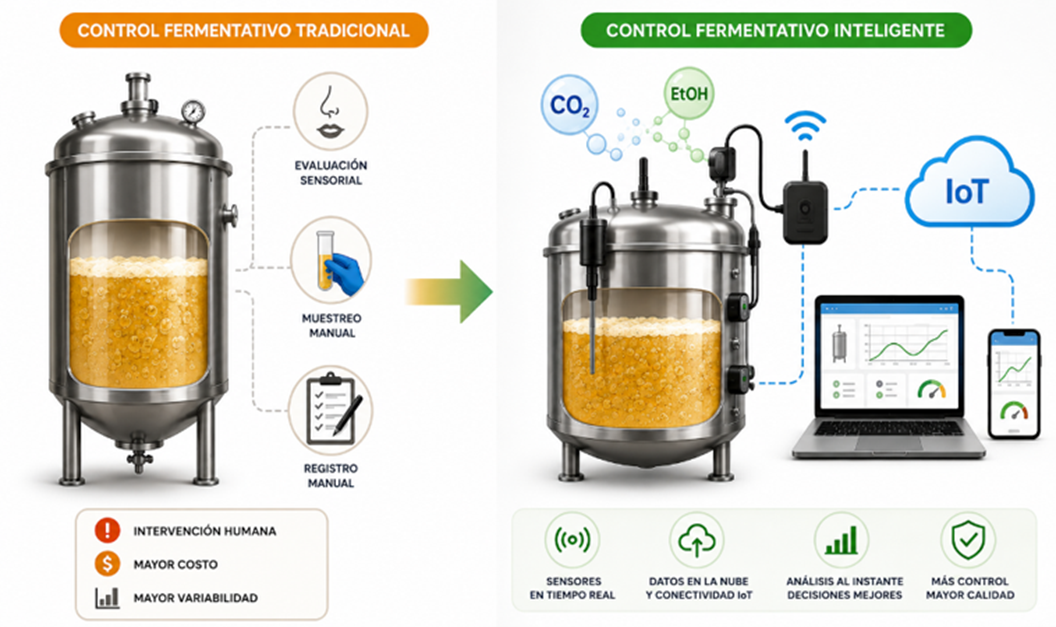
Alcoholic fermentation is a widely used bioprocess in the food and biotechnology industries, the monitoring of which depends on the precise measurement of critical variables such as ethanol, glucose, CO₂, pH, and biomass. This review analyzes research published between 2021 and 2026 on electronic sensors, IoT technologies, and artificial intelligence applied to the monitoring, estimation, prediction, and control of fermentation processes. The review was complemented by a bibliometric analysis of 69 documents retrieved from Scopus, published between 1984 and 2026. The analysis was performed using software such as Bibliometrix, VOSviewer, and Scimago Graphica. Electrochemical sensors, biomimetic systems, optical and physical sensors, as well as intelligent platforms for real-time control and predictive analysis, were evaluated. The reviewed research points toward automated systems that facilitate process monitoring and adjustment. Electrochemical sensors stand out for their sensitivity and ability to measure multiple parameters simultaneously. Electronic noses and tongues perform indirect analysis supported by machine learning, and still yield good results. Spectroscopy and other non-invasive systems add the ability to monitor several variables simultaneously without intervening in the process. However, challenges related to calibration, operational stability, costs, and industrial validation persist. Overall, the integration of smart sensors, IoT, and artificial intelligence is a key trend for the modernization and automation of fermentation control.
Downloads
References
[1] D. Buonocore, G. Ciavolino, D. D. Caro, y C. Liguori, «An IoT-based beer fermentation monitoring system», en 2021 IEEE International Workshop on Metrology for Agriculture and Forestry (MetroAgriFor), Trento-Bolzano, Italy: IEEE, nov. 2021, pp. 263-267. doi: 10.1109/MetroAgriFor52389.2021.9628536.
[2] P. Burkhardtsmaier, K. Pavlovskaja, D. Maier, S. Schäfer, U. Salat, y M. S. Schmidt, «Quantitative Monitoring of the Fermentation Process of a Barley Malt Mash by Benchtop 1H NMR Spectroscopy», Food Anal. Methods, vol. 14, n.o 7, pp. 1425-1431, jul. 2021, doi: 10.1007/s12161-021-01991-9.
[3] C. L. Gargalo, P. C. Lopez, A. Hasanzadeh, I. A. Udugama, y K. V. Gernaey, «On-line monitoring of process parameters during fermentation», en Current Developments in Biotechnology and Bioengineering, Elsevier, 2022, pp. 117-164. doi: 10.1016/B978-0-323-91167-2.00003-4.
[4] L. B. Ramos-Sánchez, L. Arias-Águila, J. A. L. Herrera, y R. A. V. Fajardo, «La Fermentación Alcohólica: Una Plataforma de Biomanufactura Global.», Rev. Investig. Hatun Yachay Wasi, vol. 5, n.o 1, pp. 121-137, ene. 2026, doi: 10.57107/hyw.v5i1.110.
[5] E. Cañete-Carmona, J.-J. Gallego-Martinez, C. Martin, M. Brox, J.-J. Luna-Rodriguez, y J. Moreno, «A Low-Cost IoT Device to Monitor in Real-Time Wine Alcoholic Fermentation Evolution Through CO2 Emissions», IEEE Sens. J., vol. 20, n.o 12, pp. 6692-6700, jun. 2020, doi: 10.1109/JSEN.2020.2975284.
[6] A. J. Gamboa-Escobar, C. M. Astorga-Zaragoza, J. Villanueva-Tavira, Y. Toledo-Sánchez, y S. P. Pérez-Sabino, «Oportunidades de Mejora en la Supervisión de Procesos Biotecnológicos para la Producción de Bebidas Fermentadas», Tend. En Energ. Renov. Sustentabilidad, vol. 5, n.o 2, pp. 1-5, feb. 2026, doi: 10.56845/terys.v5i2.447.
[7] J. Vošahlík, «IoT and measurement of fermentation process of rice wine», p. 603.6Kb, 2023, doi: 10.15159/AR.23.081.
[8] M. V. Santos, K. C. S. Rodrigues, I. I. K. Veloso, A. C. Badino, y A. J. G. Cruz, «Real-Time Monitoring of Ethanol Fermentation Using Mid-Infrared Spectroscopy Analysis of the Gas Phase», Ind. Eng. Chem. Res., vol. 61, n.o 21, pp. 7225-7234, jun. 2022, doi: 10.1021/acs.iecr.2c00325.
[9] D. R. D. K. Siregar, M. S. Surbakti, Fadhli, Zakaria, Susilawati, y H. Akbar, «Real-Time Ethanol Monitoring System for Palm Sap Fermentation Using a MiCS-5524 Gas Sensor and Arduino Uno», J. Technomaterial Phys., vol. 8, n.o 1, pp. 001-007, dic. 2025, doi: 10.32734/jotp.v8i1.23866.
[10] A. T. Naser, «ESP32-WiFi Network Smart Monitoring System.», Sci. Res. J. Eng. Comput. Sci., vol. 03, n.o 02, pp. 1-3, dic. 2023, doi: 10.47310/srjecs.2023.v03i02.003.
[11] Y. Feng et al., «Real-time and on-line monitoring of ethanol fermentation process by viable cell sensor and electronic nose», Bioresour. Bioprocess., vol. 8, n.o 1, p. 37, dic. 2021, doi: 10.1186/s40643-021-00391-5.
[12] S. Kontogiannis, M. Tsoumani, G. Kokkonis, C. Pikridas, y Y. Kotseridis, «Proposed SmartBarrel System for Monitoring and Assessment of Wine Fermentation Processes Using IoT Nose and Tongue Devices», Sensors, vol. 25, n.o 13, p. 3877, jun. 2025, doi: 10.3390/s25133877.
[13] I. Kovačević, I. Aleksi, T. Keser, y T. Matić, «Winnie: A Sensor-Based System for Real-Time Monitoring and Quality Tracking in Wine Fermentation», Appl. Sci., vol. 15, n.o 21, p. 11317, oct. 2025, doi: 10.3390/app152111317.
[14] A. Bowler, J. Escrig, M. Pound, y N. Watson, «Predicting Alcohol Concentration during Beer Fermentation Using Ultrasonic Measurements and Machine Learning», Fermentation, vol. 7, n.o 1, p. 34, mar. 2021, doi: 10.3390/fermentation7010034.
[15] J. Zhou et al., «Intelligent monitoring technologies for food fermentation processes: transformation from traditional experience to multimodal approaches and challenges», Food Sci. Biotechnol., may 2026, doi: 10.1007/s10068-026-02182-0.
[16] T. Horváth, S. Kun, L. Sipos, y D. T. Pham, «Automated monitoring of alcoholic fermentation: trends and challenges», J. Food Sci. Technol., vol. 63, n.o 2, pp. 224-237, feb. 2026, doi: 10.1007/s13197-025-06528-0.
[17] G. K. Raju y C. L. Cooney, «Fermentation monitoring», Curr. Opin. Biotechnol., vol. 3, n.o 1, pp. 40-44, feb. 1992, doi: 10.1016/0958-1669(92)90123-Z.
[18] V. Di Egidio, N. Sinelli, G. Giovanelli, A. Moles, y E. Casiraghi, «NIR and MIR spectroscopy as rapid methods to monitor red wine fermentation», Eur. Food Res. Technol., vol. 230, n.o 6, pp. 947-955, abr. 2010, doi: 10.1007/s00217-010-1227-5.
[19] M. Mirasoli, M. Guardigli, E. Michelini, y A. Roda, «Recent advancements in chemical luminescence-based lab-on-chip and microfluidic platforms for bioanalysis», J. Pharm. Biomed. Anal., vol. 87, pp. 36-52, ene. 2014, doi: 10.1016/j.jpba.2013.07.008.
[20] A. Kharkova et al., «Bionanocomposite Four-Channel Biosensor for Rapid and Convenient Monitoring of Glucose, Lactate, Ethanol and Starch», Gels, vol. 11, n.o 5, p. 355, may 2025, doi: 10.3390/gels11050355.
[21] C. Zanoni, L. V. Dallù, C. Costa, A. Cutaia, y G. Alberti, «A Screen-Printed Voltammetric Sensor Modified with Electropolymerized Molecularly Imprinted Polymer (eMIP) to Determine Gallic Acid in Non-Alcoholic and Alcoholic Beverages», Polymers, vol. 16, n.o 8, p. 1076, abr. 2024, doi: 10.3390/polym16081076.
[22] B. Li, J. Wang, y R. Zhang, «Detection and analysis of electrochemical signals in wine fermentation process», J. Food Meas. Charact., vol. 17, n.o 5, pp. 5103-5109, oct. 2023, doi: 10.1007/s11694-023-02027-y.
[23] O. M. Istrate, L. Rotariu, y C. Bala, «A Novel Amperometric Biosensor Based on Poly(allylamine hydrochloride) for Determination of Ethanol in Beverages», Sensors, vol. 21, n.o 19, p. 6510, sep. 2021, doi: 10.3390/s21196510.
[24] O. M. Istrate, C. Bala, y L. Rotariu, «A New Highly Sensitive Electrochemical Biosensor for Ethanol Detection Based on Gold Nanoparticles/Reduced Graphene Oxide/Polyallylamine Hydrochloride Nanocomposite», Biosensors, vol. 13, n.o 11, p. 954, oct. 2023, doi: 10.3390/bios13110954.
[25] G. Sun, X. Wei, D. Zhang, L. Huang, H. Liu, y H. Fang, «Immobilization of Enzyme Electrochemical Biosensors and Their Application to Food Bioprocess Monitoring», Biosensors, vol. 13, n.o 9, p. 886, sep. 2023, doi: 10.3390/bios13090886.
[26] S. Yang et al., «Online Glucose Analysis System With High Precision and Wide Detection Range for Fermentation Monitoring», IEEE Trans. Instrum. Meas., vol. 71, pp. 1-9, 2022, doi: 10.1109/TIM.2022.3218115.
[27] N. I. Rusli, I. P. Vincentini, F. Ceyssens, y M. Kraft, «Multi-Sensor Chip for Monitoring Key Parameters in Bioprocesses», IEEE Sens. J., vol. 21, n.o 18, pp. 19675-19683, sep. 2021, doi: 10.1109/JSEN.2021.3094034.
[28] E. Koukouviti, A. K. Plessas, V. Pagkali, A. Economou, G. S. Papaefstathiou, y C. Kokkinos, «3D-printed electrochemical glucose device with integrated Fe(II)-MOF nanozyme», Microchim. Acta, vol. 190, n.o 7, p. 274, jul. 2023, doi: 10.1007/s00604-023-05860-6.
[29] E. Koukouviti, C. Koulopoulou, N. Anastasiou, A. Economou, y C. Kokkinos, «3D printed electrochemical dual-sensor biodevice for the simultaneous determination of glucose and ethanol in wines», Food Control, vol. 181, p. 111784, mar. 2026, doi: 10.1016/j.foodcont.2025.111784.
[30] S. Kernbach et al., «The biosensor based on electrochemical dynamics of fermentation in yeast Saccharomyces cerevisiae», Environ. Res., vol. 213, p. 113535, oct. 2022, doi: 10.1016/j.envres.2022.113535.
[31] R. Muñoz-Castells et al., «Application of an Electronic Nose to the Prediction of Odorant Series in Wines Obtained with Saccharomyces or Non-Saccharomyces Yeast Strains», Molecules, vol. 30, n.o 7, p. 1584, abr. 2025, doi: 10.3390/molecules30071584.
[32] R. Brito-Pereira, R. Policia, C. Ribeiro, P. Martins, S. Lanceros-Mendez, y F. N. Crespilho, «Hydrogel In-Tape Electronic Tongue», ACS Appl. Electron. Mater., vol. 7, n.o 5, pp. 1792-1801, mar. 2025, doi: 10.1021/acsaelm.4c02059.
[33] C. Liu, T. Sun, W. Zeng, Y. Wang, X. Li, y Z. Wang, «Fusion the electronic tongue and electronic nose with a graph neural network-Mamba hybrid models for the rapid traceability of wine origin», Eur. Food Res. Technol., vol. 251, n.o 11, pp. 3533-3547, nov. 2025, doi: 10.1007/s00217-025-04849-0.
[34] L. C. Schroeder et al., «Discriminant analysis of volatile compounds in wines obtained from different managements of vineyards obtained by e-nose», Smart Agric. Technol., vol. 6, p. 100343, dic. 2023, doi: 10.1016/j.atech.2023.100343.
[35] C. Gonzalez y S. Fuentes, «Digital Assessment and Classification of Wine Faults Using a Low-Cost Electronic Nose, Near-Infrared Spectroscopy and Machine Learning Modelling», Sensors, vol. 22, n.o 6, p. 2303, mar. 2022, doi: 10.3390/s22062303.
[36] B. Wang, J. Deng, H. Jiang, y Q. Chen, «Electronic nose signals-based deep learning models to realize high-precision monitoring of simultaneous saccharification and fermentation of cassava», Microchem. J., vol. 182, p. 107929, nov. 2022, doi: 10.1016/j.microc.2022.107929.
[37] H. Jiang, J. Deng, y Q. Chen, «Monitoring of simultaneous saccharification and fermentation of ethanol by multi-source data deep fusion strategy based on near-infrared spectra and electronic nose signals», Eng. Appl. Artif. Intell., vol. 127, p. 107299, ene. 2024, doi: 10.1016/j.engappai.2023.107299.
[38] Q. D. N. Nguyen, H. V. A. Le, T. Nakano, y T. H. Tran, «Wine quality assessment through lightweight deep learning: integrating 1D-CNN and LSTM for analyzing electronic nose VOCs signals», Appl. Comput. Inform., mar. 2024, doi: 10.1108/ACI-10-2023-0098.
[39] I. Zafar, Y. Cui, Q. Bai, y Y. Yang, «Classifying Beers With Memristor Neural Network Algorithm in a Portable Electronic Nose System», Front. Phys., vol. 10, p. 907644, jun. 2022, doi: 10.3389/fphy.2022.907644.
[40] G. Gabrieli, M. Muszynski, y P. W. Ruch, «A reconfigurable integrated electronic tongue and its use in accelerated analysis of juices and wines», en 2022 IEEE International Symposium on Olfaction and Electronic Nose (ISOEN), Aveiro, Portugal: IEEE, may 2022, pp. 1-3. doi: 10.1109/ISOEN54820.2022.9789630.
[41] S. Pettinelli, C. Pérez‐Gonzàlez, C. Salvo‐Comino, F. Mencarelli, C. Garcia‐Cabezón, y M. L. Rodriguez‐Mendez, «High‐performance bioelectronic tongue for the simultaneous analysis of phenols, sugars and organic acids in wines», J. Sci. Food Agric., vol. 105, n.o 3, pp. 1430-1438, feb. 2025, doi: 10.1002/jsfa.13174.
[42] R. I. Potter, J. Lee, y C. F. Ross, «Early Oxidation Detection in White Wine by Electronic Tongue: A Preliminary Study», Food Sci. Nutr., vol. 13, n.o 6, p. e70366, jun. 2025, doi: 10.1002/fsn3.70366.
[43] S. Mamolar-Domenech, H. Crespo-Sariol, J. C. Sáenz-Díez, A. Sánchez-Roca, J.-I. Latorre-Biel, y J. Blanco, «A new approach for monitoring the alcoholic fermentation process based on acoustic emission analysis: A preliminary assessment», J. Food Eng., vol. 353, p. 111537, sep. 2023, doi: 10.1016/j.jfoodeng.2023.111537.
[44] W. Tang, Y. Qi, X. Yang, J. Wang, y Z. Li, «Low-cost and portable colorimetric platform for simultaneous detection of Fe, methanol, and total phenols in wine», Food Chem., vol. 398, p. 133907, ene. 2023, doi: 10.1016/j.foodchem.2022.133907.
[45] L. Zeng, A. Pernet, M. Cléroux, B. Bach, L. Froidevaux, y I. Preda, «Development of Distillation Sensors for Spirit Beverages Production Monitoring Based on Impedance Spectroscopy Measurement and Partial Least-Squares Regression», ACS Omega, vol. 8, n.o 17, pp. 15323-15333, may 2023, doi: 10.1021/acsomega.3c00481.
[46] N. Yang, C. Guerin, N. Kokanyan, y P. Perré, «Raman spectroscopy applied to online monitoring of a bioreactor: Tackling the limit of detection», Spectrochim. Acta. A. Mol. Biomol. Spectrosc., vol. 304, p. 123343, ene. 2024, doi: 10.1016/j.saa.2023.123343.
[47] N. Yang, C. Guerin, N. Kokanyan, y P. Perré, «In-line monitoring of bioreactor by Raman spectroscopy: Direct use of a standard-based model through cell-scattering correction», J. Biotechnol., vol. 396, pp. 41-52, dic. 2024, doi: 10.1016/j.jbiotec.2024.10.007.
[48] D. Schorn-García et al., «Spatially Offset Raman Spectroscopic (SORS) Analysis of Wine Alcoholic Fermentation: A Preliminary Study», Fermentation, vol. 9, n.o 2, p. 115, ene. 2023, doi: 10.3390/fermentation9020115.
[49] P. Papaspyridakou, P. Giannoutsou, y M. G. Orkoula, «Non-Destructive and Non-Invasive Measurement of Ethanol and Toxic Alcohol Strengths in Beverages and Spirits Using Portable Raman Spectroscopy», Biosensors, vol. 13, n.o 1, p. 135, ene. 2023, doi: 10.3390/bios13010135.
[50] E. Littarru et al., «Optimizing the winemaking process: NIR spectroscopy and e‐nose analysis for the online monitoring of fermentation», J. Sci. Food Agric., vol. 105, n.o 3, pp. 1465-1475, feb. 2025, doi: 10.1002/jsfa.13336.
[51] J. Unterkofler, D. W. Jeffery, O. J. Macintyre, y R. A. Muhlack, «Prototyping a sensor-based instrument for in-line optical monitoring in red wine fermentation», Appl. Food Res., vol. 6, n.o 1, p. 102069, jun. 2026, doi: 10.1016/j.afres.2026.102069.
[52] X. Jia, J. Roels, R. Baets, y G. Roelkens, «A Miniaturised, Fully Integrated NDIR CO2 Sensor On-Chip», Sensors, vol. 21, n.o 16, p. 5347, ago. 2021, doi: 10.3390/s21165347.
[53] A. Sanchez-Roca, J.-I. Latorre-Biel, E. Jiménez-Macías, J. C. Saenz-Díez, y J. Blanco-Fernández, «The Characterization of the Alcoholic Fermentation Process in Wine Production Based on Acoustic Emission Analysis», Processes, vol. 12, n.o 12, p. 2797, dic. 2024, doi: 10.3390/pr12122797.
[54] D. Geier, M. Mailänder, I. Whitehead, y T. Becker, «Non-Invasive Characterization of Different Saccharomyces Suspensions with Ultrasound», Sensors, vol. 24, n.o 19, p. 6271, sep. 2024, doi: 10.3390/s24196271.
[55] N. Hosseini y M. Baghelani, «Selective real-time non-contact multi-variable water-alcohol-sugar concentration analysis during fermentation process using microwave split-ring resonator based sensor», Sens. Actuators Phys., vol. 325, p. 112695, jul. 2021, doi: 10.1016/j.sna.2021.112695.
[56] A. Leo, A. G. Monteduro, S. Rizzato, A. Milone, y G. Maruccio, «Miniaturized Sensors for Detection of Ethanol in Water Based on Electrical Impedance Spectroscopy and Resonant Perturbation Method—A Comparative Study», Sensors, vol. 22, n.o 7, p. 2742, abr. 2022, doi: 10.3390/s22072742.
[57] A. Pastore, D. Badocco, L. Cappellin, M. Tubiana, y P. Pastore, «Real-time monitoring of the pH of white wine and beer with colorimetric sensor arrays (CSAs)», Food Chem., vol. 452, p. 139513, sep. 2024, doi: 10.1016/j.foodchem.2024.139513.
[58] N. Adamashvili, N. Zhizhilashvili, y C. Tricase, «The Integration of the Internet of Things, Artificial Intelligence, and Blockchain Technology for Advancing the Wine Supply Chain», Computers, vol. 13, n.o 3, p. 72, mar. 2024, doi: 10.3390/computers13030072.
[59] L. M. Baicu, M. Andrei, G. A. Ifrim, y L. T. Dimitrievici, «Embedded IoT Design for Bioreactor Sensor Integration», Sensors, vol. 24, n.o 20, p. 6587, oct. 2024, doi: 10.3390/s24206587.
[60] E. C. Rivera, C. K. Yamakawa, C. E. Rossell, J. Nolasco, y H. J. Kwon, «Prediction of intensified ethanol fermentation of sugarcane using a deep learning soft sensor and process analytical technology», J. Chem. Technol. Biotechnol., vol. 99, n.o 1, pp. 207-216, ene. 2024, doi: 10.1002/jctb.7525.
[61] H. J. Kwon, J. H. Shiu, C. K. Yamakawa, y E. C. Rivera, «Enhancing Fermentation Process Monitoring through Data-Driven Modeling and Synthetic Time Series Generation», Bioengineering, vol. 11, n.o 8, p. 803, ago. 2024, doi: 10.3390/bioengineering11080803.
[62] X. Li et al., «Dynamic hybrid modeling of fuel ethanol fermentation process by integrating biomass concentration XGBoost model and kinetic parameter artificial neural network model into mechanism model», Renew. Energy, vol. 205, pp. 574-582, mar. 2023, doi: 10.1016/j.renene.2023.01.113.
[63] J. Jeong y S. Kim, «Application of machine learning for quantitative analysis of industrial fermentation using image processing», Food Sci. Biotechnol., vol. 34, n.o 2, pp. 373-381, ene. 2025, doi: 10.1007/s10068-024-01744-4.
Downloads
Published
Data Availability Statement
This is a review article, which the reviewed research points towards automated systems that make it easier to monitor and adjust the process.
Issue
Section
Categories
License
Copyright (c) 2026 Nahomi Rubí Llontop-Ayasta, Elthon Steven Boñon-Rocha, Ulises Benjamín Narro-Altamirano, Víctor Javier Vásquez-Villalobos

This work is licensed under a Creative Commons Attribution 4.0 International License.
The authors who publish in this journal accept the following conditions:
The authors retain the copyright and assign to the journal the right of the first publication, with the work registered with the Creative Commons Attribution license 4.0, which allows third parties to use what is published as long as they mention the authorship of the work and the first publication in this magazine.
Authors may make other independent and additional contractual agreements for the non-exclusive distribution of the version of the article published in this journal (eg, include it in an institutional repository or publish it in a book) as long as they clearly indicate that the work it was first published in this magazine.
Authors are allowed and encouraged to share their work online (for example: in institutional repositories or personal web pages) before and during the manuscript submission process, as it can lead to productive exchanges, greater and more quick citation of published work (see The Effect of Open Access).
How to Cite