Selective separation interfaces for Ag(I) recovery from e-waste leachates: a DEA-based efficiency assessment
DOI:
https://doi.org/10.37636/recit.v9n1e435Keywords:
e-waste, silver, selective separation interface, diffusion cell, UV-Vis, DEA, efficiencyAbstract
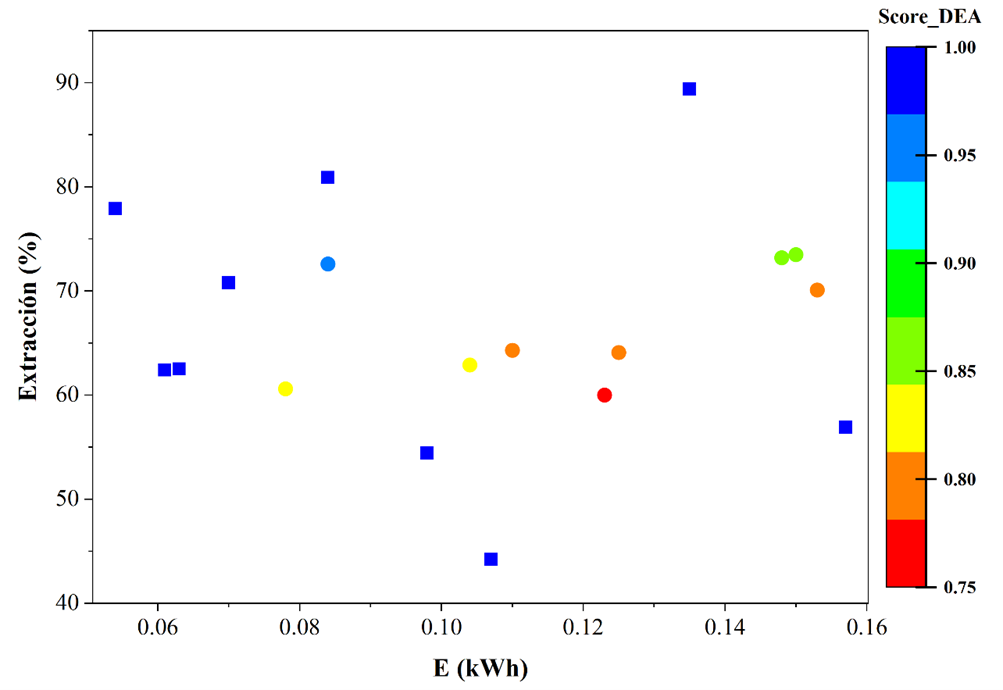
The efficiency of selective separation interfaces (SSIs) for recovering Ag(I) from e-waste leachates was examined through Data Envelopment Analysis (DEA) as a multicriteria assessment framework. The SSIs were produced by a dissolution–casting–evaporation route using cellulose triacetate as the polymeric support, dissolved in dichloromethane, and tris(2-ethylhexyl) phosphate (TEHP) as the carrier-phase component. Transport tests were conducted in a two-compartment diffusion cell under controlled conditions (V_d = 80 mL, V_a = 80 mL, A = 4.9 cm², 500 rpm, and 180 min). Ag(I) was quantified by UV–Vis spectrophotometry at 404 nm using an external calibration curve (Abs = 0.0052·C_{Ag(I)} + 0.0149; r = 0.9998; C in ppm), with matrix blanks used for background correction. An output-oriented BCC DEA model was applied to 18 experimental configurations (DMUs), considering SSI thickness (δ), carrier concentration (C_{car}) and energy consumption (E) as inputs, and extraction (%), flux (J) and selectivity (S) as outputs. The assessment identified 9 DMUs on the efficient frontier (score = 1.000), whereas the inefficient cases required output expansions of up to Φ = 1.328 (≈32.8%) to match the best observed performance. Overall, the results provide a quantitative basis for ranking SSI designs according to silver recovery performance and resource use.
Downloads
References
[1] C. P. Baldé et al., The Global E-waste Monitor 2024. Bonn, Germany: UNITAR (SCYCLE Programme) and International Telecommunication Union (ITU), 2024. [En línea]. Disponible en: https://ewastemonitor.info/
[2] C. P. Baldé, V. Forti, V. Gray, R. Kuehr, and P. Stegmann, The Global E-waste Monitor 2020: Quantities, flows and the circular economy potential. Bonn, Germany: UNITAR (SCYCLE Programme), ITU e ISWA, 2020. [En línea]. Disponible en: https://www.itu.int/en/ITU-D/Environment/Documents/Toolbox/GEM_2020_def.pdf
[3] C. P. Baldé, V. Forti, V. Gray, R. Kuehr, and P. Stegmann, The Global E-waste Monitor 2017: Quantities, flows, and resources. Bonn, Germany: United Nations University (UNU), ITU e ISWA, 2017. [En línea]. Disponible en: https://globalewaste.org/
[4] M. Heacock et al., “E-Waste and Harm to Vulnerable Populations: A Growing Global Problem,” Environmental Health Perspectives, vol. 124, no. 5, pp. 550–555, 2016, doi: 10.1289/ehp.1509699. DOI: https://doi.org/10.1289/ehp.1509699
[5] A. Akcil, C. Erust, C. S. Gahan, M. Ozgun, M. Sahin, and A. Tuncuk, “Precious metal recovery from waste printed circuit boards using cyanide and non-cyanide lixiviants—A review,” Waste Management, vol. 45, pp. 258–271, 2015, doi: 10.1016/j.wasman.2015.08.032. DOI: https://doi.org/10.1016/j.wasman.2015.01.017
[6] J. Cui and L. Zhang, “Metallurgical recovery of metals from electronic waste: A review,” Journal of Hazardous Materials, vol. 158, nos. 2–3, pp. 228–256, 2008, doi: 10.1016/j.jhazmat.2008.02.001. DOI: https://doi.org/10.1016/j.jhazmat.2008.02.001
[7] Z. Wu et al., “Recovery of metals from waste printed circuit boards: A review of current technologies and future perspectives,” Frontiers of Environmental Science & Engineering, vol. 11, p. 8, 2017, doi: 10.1007/s11783-017-0995-6. DOI: https://doi.org/10.1007/s11783-017-0995-6
[8] S. Debnath, U. Chowdhury, and T. Ghosh, “Sustainability of metal recovery from e-waste,” Frontiers of Environmental Science & Engineering, vol. 12, p. 2, 2018, doi: 10.1007/s11783-018-1044-9. DOI: https://doi.org/10.1007/s11783-018-1044-9
[9] Z. Sun, Y. Xiao, H. Agterhuis, J. Sietsma, and Y. Yang, “Recycling of metals from urban mines – a strategic evaluation,” Journal of Cleaner Production, vol. 112, parte 4, pp. 2977–2987, 2016, doi: 10.1016/j.jclepro.2015.10.116. DOI: https://doi.org/10.1016/j.jclepro.2015.10.116
[10] Y. Wang et al., “Highly selective recovery of gold and silver from E-waste using a synergistic leaching system,” Journal of Hazardous Materials, vol. 471, art. 133430, 2024, doi: 10.1016/j.jhazmat.2024.133430. DOI: https://doi.org/10.1016/j.jhazmat.2024.133430
[11] D. Merli, A. Spim, T. Valentini, D. Gazzola, and S. A. Zini, “A non-toxic and high selectivity process for the separation and recovery of silver ions,” Frontiers of Environmental Science & Engineering, vol. 17, no. 10, art. 123, 2023, doi: 10.1007/s11783-023-1723-z. DOI: https://doi.org/10.1007/s11783-023-1723-z
[12] Q. Tao et al., “Sustainable recovery of silver and copper from photovoltaic waste with UV-assisted thiosulfate leaching,” Metals, vol. 14, no. 6, art. 730, 2024, doi: 10.3390/met14060730. DOI: https://doi.org/10.3390/met14060730
[13] P. M. H. Petter, H. M. Veit, and A. M. Bernardes, “Evaluation of gold and silver leaching from printed circuit boards of cellphones,” Waste Management, vol. 34, no. 2, pp. 475–482, 2014, doi: 10.1016/j.wasman.2013.10.032. DOI: https://doi.org/10.1016/j.wasman.2013.10.032
[14] A. Ruan, C. Wu, Z. Zhang, S. Yi, W. Wen, and M. Chang, “Metal recovery from printed circuit boards via hydrometallurgical route: Leaching and separation,” Waste Management, vol. 34, no. 5, pp. 901–907, 2014, doi: 10.1016/j.wasman.2014.02.014. DOI: https://doi.org/10.1016/j.wasman.2014.02.014
[15] G. Zhou, H. Zhang, W. Yang, Z. Wu, W. Liu, and C. Yang, “Bioleaching assisted foam fractionation for recovery of gold from the printed circuit boards of discarded cellphones,” Waste Management, vol. 101, pp. 200–209, 2020, doi: 10.1016/j.wasman.2019.10.016. DOI: https://doi.org/10.1016/j.wasman.2019.10.016
[16] G. Merli et al., “Recovery of precious metals from printed circuit boards by cyanogenic bacteria: Optimization of cyanide production by statistical analysis,” Journal of Environmental Chemical Engineering, vol. 10, no. 3, art. 107495, 2022, doi: 10.1016/j.jece.2022.107495. DOI: https://doi.org/10.1016/j.jece.2022.107495
[17] R. Jha, M. K. Jha y V. Kumar, “Potential of polymer inclusion membrane process for selective recovery of metal values from waste printed circuit boards: A review,” Journal of Cleaner Production, vol. 265, art. 121621, 2020, doi: 10.1016/j.jclepro.2020.121621. DOI: https://doi.org/10.1016/j.jclepro.2020.121621
[18] B. Keskin, A. Cihanoğlu y Ö. Gül Özcan, “Polymer inclusion membrane applications for transport of metal ions: A critical review,” Chemosphere, vol. 279, art. 130604, 2021, doi: 10.1016/j.chemosphere.2021.130604. DOI: https://doi.org/10.1016/j.chemosphere.2021.130604
[19] M. A. Kaczorowska, M. Wiśniewska, M. Regel-Rosocka, and W. A. Stańczyk, “Advances in polymer inclusion membranes for removal of heavy metal ions: A review,” Membranes, vol. 12, no. 11, art. 1135, 2022, doi: 10.3390/membranes12111135. DOI: https://doi.org/10.3390/membranes12111135
[20] M. Macías y E. Rodríguez, “On the use of polymer inclusion membranes for metal recovery from wastewater,” Membranes, vol. 13, no. 5, art. 512, 2023, doi: 10.3390/membranes13050512. DOI: https://doi.org/10.3390/membranes13050512
[21] M. Senila, L. Senila, A. Pop et al., “Polymer inclusion membranes: Recent developments, characterization and applications,” Polymers, vol. 17, no. 6, art. 725, 2025, doi: 10.3390/polym17060725. DOI: https://doi.org/10.3390/polym17060725
[22] B. Staszak y K. Wieszczycka, “Removal and recovery of heavy metal ions using polymer inclusion membranes: A review,” Membranes, vol. 13, no. 1, art. 114, 2023, doi: 10.3390/membranes13010114. DOI: https://doi.org/10.3390/membranes13010114
[23] E. E. Ezugbe y S. Rathilal, “Membrane technologies in wastewater treatment: A review,” Membranes, vol. 10, no. 5, art. 89, 2020, doi: 10.3390/membranes10050089. DOI: https://doi.org/10.3390/membranes10050089
[24] B. Zhao et al., “Ionic liquid-based polymer inclusion membranes for metal ions extraction and recovery: Fundamentals, considerations and prospects,” Chemical Engineering Journal, vol. 481, art. 148792, 2024, doi: 10.1016/j.cej.2024.148792. DOI: https://doi.org/10.1016/j.cej.2024.148792
[25] S. Adigun, O. A. Elemile, M. D. Arowoshola et al., “Recent advances in polymer inclusion membranes and their derivatives as a promising approach for precious metal recovery,” RSC Sustainability, vol. 2, pp. 2768–2780, 2024, doi: 10.1039/D4SU00195B. DOI: https://doi.org/10.1039/D4SU00297K
[26] I. I. Nasser, F. Ibn El Haj Amor, L. Donato, C. Algieri, A. Garofalo, E. Drioli, and C. Ahmed, “Removal and recovery of Ag(CN)2− from synthetic electroplating baths by polymer inclusion membrane containing Aliquat 336 as a carrier,” Chemical Engineering Journal, vol. 295, pp. 207–217, 2016, doi: 10.1016/j.cej.2016.03.034. DOI: https://doi.org/10.1016/j.cej.2016.03.034
[27] A. Nowik-Zając, E. Radzyminska-Lenarcik, M. Ulewicz, and A. Sypula, “Recovery and selective transport of Ag(I) using polymer inclusion membranes with calixpyrroles,” RSC Advances, vol. 9, pp. 31122–31132, 2019, doi: 10.1039/C9RA04347K. DOI: https://doi.org/10.1039/C9RA04347K
[28] Y. Y. N. Bonggotgetsakul, R. W. Cattrall, and S. D. Kolev, “Recovery of gold from aqua regia digested electronic scrap using a PVDF-HFP based polymer inclusion membrane containing Cyphos® IL 104,” Journal of Membrane Science, vol. 514, pp. 274–281, 2016, doi: 10.1016/j.memsci.2016.05.002. DOI: https://doi.org/10.1016/j.memsci.2016.05.002
[29] J. Fontàs et al., “New insights on the effects of water on polymer inclusion membranes containing ionic liquid,” Membranes, vol. 12, no. 2, art. 193, 2022, doi: 10.3390/membranes12020193. DOI: https://doi.org/10.3390/membranes12020192
[30] S. Kebiche-Senhadji et al., “Transport of Cr(VI) through PVC-based polymer inclusion membrane using Aliquat 336,” Desalination, vol. 258, nos. 1–3, pp. 59–65, 2010, doi: 10.1016/j.desal.2010.03.047. DOI: https://doi.org/10.1016/j.desal.2010.03.047
[31] L. D. Nghiem, P. Mornane, I. D. Potter, J. M. Perera, R. W. Cattrall, and S. D. Kolev, “Extraction and transport of metal ions and small organic compounds using polymer inclusion membranes,” Journal of Membrane Science, vol. 281, nos. 1–2, pp. 7–41, 2006, doi: 10.1016/j.memsci.2006.03.035. DOI: https://doi.org/10.1016/j.memsci.2006.03.035
[32] A. Witt, H. Vávrová, J. Mlíková, and K. Štěpánek, “Influence of membrane composition on morphology and separation performance of polymer inclusion membranes,” Polymers, vol. 10, no. 2, art. 134, 2018, doi: 10.3390/polym10020134. DOI: https://doi.org/10.3390/polym10020134
[33] D. Wang, L. Wang, D. Wu, S. Zhang, and Z. Wang, “Separation and recovery of Au(I) from thiosulfate solution by a polymer inclusion membrane containing ionic liquid,” Separation and Purification Technology, vol. 224, pp. 127–135, 2019, doi: 10.1016/j.seppur.2019.04.030. DOI: https://doi.org/10.1016/j.seppur.2019.04.030
[34] A. Benosmane, A. Hamdi, and A. Bouhidel, “Selective transport of metal ions across polymer inclusion membranes containing calixresorcinarene,” Separation and Purification Technology, vol. 65, no. 2, pp. 211–219, 2009, doi: 10.1016/j.seppur.2008.10.039. DOI: https://doi.org/10.1016/j.seppur.2008.10.039
[35] G. Vlasopoulos, E. Koukkou, M. Voutsas, N. Papageorgiou, S. Kalogirou, and E. Gidarakos, “Hydrometallurgical recovery of silver and gold from waste printed circuit boards: Biofilm reactor integrated pilot application,” Journal of Environmental Management, vol. 344, art. 118334, 2023, doi: 10.1016/j.jenvman.2023.118334. DOI: https://doi.org/10.1016/j.jenvman.2023.118334
[36] International Organization for Standardization, ISO 14040:2006, Environmental management—Life cycle assessment—Principles and framework. Geneva, Switzerland: ISO, 2006. [En línea]. Disponible en: https://www.iso.org/standard/37456.html
[37] A. Charnes, W. W. Cooper, and E. Rhodes, “Measuring the efficiency of decision making units,” European Journal of Operational Research, vol. 2, no. 6, pp. 429–444, 1978, doi: 10.1016/0377-2217(78)90138-8. DOI: https://doi.org/10.1016/0377-2217(78)90138-8
[38] R. D. Banker, A. Charnes, and W. W. Cooper, “Some models for estimating technical and scale inefficiencies in data envelopment analysis,” Management Science, vol. 30, no. 9, pp. 1078–1092, 1984, doi: 10.1287/mnsc.30.9.1078. DOI: https://doi.org/10.1287/mnsc.30.9.1078
[39] K. Tone, “A slacks-based measure of efficiency in data envelopment analysis,” European Journal of Operational Research, vol. 130, no. 3, pp. 498–509, 2001, doi: 10.1016/S0377-2217(99)00407-5. DOI: https://doi.org/10.1016/S0377-2217(99)00407-5
[40] A. I. Ali, “Streamlined computation for data envelopment analysis,” IEEE Transactions on Systems, Man, and Cybernetics, vol. 23, no. 4, pp. 1048–1056, 1993, doi: 10.1109/21.247884. DOI: https://doi.org/10.1109/21.247884
[41] M. Guerrero, F. Aparicio, and C. Valero-Carreras, “Combining data envelopment analysis and machine learning for performance evaluation: A systematic review,” Mathematics, vol. 10, no. 6, art. 909, 2022, doi: 10.3390/math10060909. DOI: https://doi.org/10.3390/math10060909
[42] S. Ratner, “Network data envelopment analysis and its applications (2017–2022): A literature review,” Mathematics, vol. 11, no. 9, art. 2141, 2023, doi: 10.3390/math11092141. DOI: https://doi.org/10.3390/math11092141
Downloads
Published
License
Copyright (c) 2026 Ivan Avila Raya, Rodrigo Gómez Monge, Rodrigo Tavera Ochoa, Alfonso Lemus Solorio, José Luis Rivera Rojas, Salomón Ramiro Vásquez García

This work is licensed under a Creative Commons Attribution 4.0 International License.
The authors who publish in this journal accept the following conditions:
The authors retain the copyright and assign to the journal the right of the first publication, with the work registered with the Creative Commons Attribution license 4.0, which allows third parties to use what is published as long as they mention the authorship of the work and the first publication in this magazine.
Authors may make other independent and additional contractual agreements for the non-exclusive distribution of the version of the article published in this journal (eg, include it in an institutional repository or publish it in a book) as long as they clearly indicate that the work it was first published in this magazine.
Authors are allowed and encouraged to share their work online (for example: in institutional repositories or personal web pages) before and during the manuscript submission process, as it can lead to productive exchanges, greater and more quick citation of published work (see The Effect of Open Access).
How to Cite