Design, fabrication, and experimental evaluation of a three-finger Fin Ray soft gripper
DOI:
https://doi.org/10.37636/recit.v9n3e502Keywords:
Soft gripper, Fin Ray effect, Additive manufacturing, TPU, Finite element simulation, Experimental validation, Robotic graspingAbstract
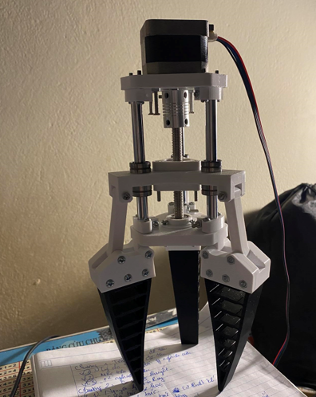
This study presents the design, finite element analysis, fabrication, and experimental validation of a low-cost three-finger soft gripper based on the Fin Ray effect. The proposed system integrates TPU 95A compliant fingers, a PLA supporting structure, and an Arduino-controlled stepper-motor actuation mechanism. Several Fin Ray rib configurations were systematically evaluated using analytical modelling, finite element simulations, and experimental testing under a representative 5 N loading condition. The results showed that the contact region located approximately between one-half and two-thirds of the finger length produced the most effective deformation behavior. Among the investigated configurations, the curved-rib design achieved the largest displacement of approximately 14.45 mm while maintaining stable grasping performance. Good agreement was obtained between numerical predictions and experimental measurements, with deformation errors generally below 10% and a maximum error of 11.22%. The study establishes a reproducible CAD–FEA–3D printing experimental validation workflow and demonstrates a low-cost Fin Ray soft gripper platform that can support future research, rapid prototyping, and engineering education.
Downloads
References
[1] D. Rus and M. T. Tolley, “Design, fabrication and control of soft robots,” Nature, vol. 521, no. 7553, pp. 467-475, May 2015, doi: 10.1038/nature14543. DOI: https://doi.org/10.1038/nature14543
[2] S. Kim, C. Laschi, and B. Trimmer, “Soft robotics: A bioinspired evolution in robotics,” Trends Biotechnol., vol. 31, no. 5, pp. 287-294, May 2013, doi: 10.1016/j.tibtech.2013.03.002. DOI: https://doi.org/10.1016/j.tibtech.2013.03.002
[3] C. Laschi, B. Mazzolai, and M. Cianchetti, “Soft robotics: Technologies and systems pushing the boundaries of robot abilities,” Sci. Robot., vol. 1, no. 1, Art. no. eaah3690, Dec. 2016, doi: 10.1126/scirobotics.aah3690. DOI: https://doi.org/10.1126/scirobotics.aah3690
[4] C. Majidi, “Soft-matter engineering for soft robotics,” Adv. Mater. Technol., vol. 4, no. 2, Art. no. 1800477, Feb. 2019, doi: 10.1002/admt.201800477. DOI: https://doi.org/10.1002/admt.201800477
[5] J. Shintake, V. Cacucciolo, D. Floreano, and H. Shea, “Soft robotic grippers,” Adv. Mater., vol. 30, no. 29, Art. no. 1707035, Jul. 2018, doi: 10.1002/adma.201707035. DOI: https://doi.org/10.1002/adma.201707035
[6] W. Crooks, S. Rozen-Levy, B. Trimmer, C. Rogers, and W. Messner, “Fin Ray Effect inspired soft robotic gripper: From the RoboSoft Grand Challenge toward optimization,” Front. Robot. AI, vol. 3, Art. no. 70, Nov. 2016, doi: 10.3389/frobt.2016.00070. DOI: https://doi.org/10.3389/frobt.2016.00070
[7] Y. Yang, K. Jin, H. Zhu, G. Song, H. Lu, and L. Kang, “A 3D-printed Fin Ray Effect inspired soft robotic gripper with force feedback,” Micromachines, vol. 12, no. 10, Art. no. 1141, Sep. 2021, doi: 10.3390/mi12101141. DOI: https://doi.org/10.3390/mi12101141
[8] G. L. Srinivas, A. Javed, and L. M. Faller, “Versatile 3D-printed fin-ray effect soft robotic fingers: Lightweight optimization and performance analysis,” J. Braz. Soc. Mech. Sci. Eng., vol. 46, Art. no. 382, May 2024, doi: 10.1007/s40430-024-04957-0. DOI: https://doi.org/10.1007/s40430-024-04957-0
[9] F. Varghese, F. Auat-Cheein, and M. Koskinopoulou, “Finite element optimization of a flexible fin-ray-based soft robotic gripper for scalable fruit harvesting and manipulation,” Smart Agric. Technol., vol. 11, Art. no. 100899, Aug. 2025, doi: 10.1016/j.atech.2025.100899. DOI: https://doi.org/10.1016/j.atech.2025.100899
[10] X. Shan and L. Birglen, “Modeling and analysis of soft robotic fingers using the Fin Ray effect,” Int. J. Robot. Res., vol. 39, no. 14, pp. 1686-1705, Dec. 2020, doi: 10.1177/0278364920913926. DOI: https://doi.org/10.1177/0278364920913926
[11] X. Wang, J. J. Dabrowski, J. Pinskier, L. Liow, V. Viswanathan, R. Scalzo, and D. Howard, “PINN-Ray: A physics-informed neural network to model soft robotic Fin Ray fingers,” in Proc. IEEE/RSJ Int. Conf. Intell. Robots Syst. (IROS), 2024, pp. 247-254, doi: 10.1109/IROS58592.2024.10802217. DOI: https://doi.org/10.1109/IROS58592.2024.10802217
[12] Q. Cong, W. Fan, and D. Zhang, “TacFR-Gripper: A reconfigurable Fin-Ray-based gripper with tactile skin for in-hand manipulation,” Actuators, vol. 13, no. 12, Art. no. 521, Dec. 2024, doi: 10.3390/act13120521. DOI: https://doi.org/10.3390/act13120521
[13] Z. Deng and M. Li, “Learning optimal Fin-Ray finger design for soft grasping,” Front. Robot. AI, vol. 7, Art. no. 590076, Feb. 2021, doi: 10.3389/frobt.2020.590076. DOI: https://doi.org/10.3389/frobt.2020.590076
[14] K. Elgeneidy, P. Lightbody, S. Pearson, and G. Neumann, “Characterising 3D-printed soft Fin Ray robotic fingers with layer jamming capability for delicate grasping,” in Proc. 2nd IEEE Int. Conf. Soft Robot. (RoboSoft), Seoul, Republic of Korea, 2019, pp. 143-148, doi: 10.1109/ROBOSOFT.2019.8722715. DOI: https://doi.org/10.1109/ROBOSOFT.2019.8722715
[15] R. L. Truby and J. A. Lewis, “Printing soft matter in three dimensions,” Nature, vol. 540, no. 7633, pp. 371-378, Dec. 2016, doi: 10.1038/nature21003. DOI: https://doi.org/10.1038/nature21003
[16] T. J. Wallin, J. Pikul, and R. F. Shepherd, “3D printing of soft robotic systems,” Nat. Rev. Mater., vol. 3, pp. 84-100, Feb. 2018, doi: 10.1038/s41578-018-0002-2. DOI: https://doi.org/10.1038/s41578-018-0002-2
[17] F. Schmitt, O. Piccin, L. Barbe, and B. Bayle, “Soft robots manufacturing: A review,” Front. Robot. AI, vol. 5, Art. no. 84, Jul. 2018, doi: 10.3389/frobt.2018.00084. DOI: https://doi.org/10.3389/frobt.2018.00084
[18] G. M. Whitesides, “Soft robotics,” Angew. Chem. Int. Ed., vol. 57, no. 16, pp. 4258-4273, Apr. 2018, doi: 10.1002/anie.201800907. DOI: https://doi.org/10.1002/anie.201800907
[19] F. Ilievski, A. D. Mazzeo, R. F. Shepherd, X. Chen, and G. M. Whitesides, “Soft robotics for chemists,” Angew. Chem. Int. Ed., vol. 50, no. 8, pp. 1890-1895, Feb. 2011, doi: 10.1002/anie.201006464. DOI: https://doi.org/10.1002/anie.201006464
[20] P. Polygerinos et al., “Modeling of soft fiber-reinforced bending actuators,” IEEE Trans. Robot., vol. 31, no. 3, pp. 778-789, Jun. 2015, doi: 10.1109/TRO.2015.2428504. DOI: https://doi.org/10.1109/TRO.2015.2428504
[21] A. D. Marchese, R. K. Katzschmann, and D. Rus, “A recipe for soft fluidic elastomer robots,” Soft Robot., vol. 2, no. 1, pp. 7-25, Mar. 2015, doi: 10.1089/soro.2014.0022. DOI: https://doi.org/10.1089/soro.2014.0022
[22] R. Deimel and O. Brock, “A novel type of compliant and underactuated robotic hand for dexterous grasping,” Int. J. Robot. Res., vol. 35, no. 1-3, pp. 161-185, Jan. 2016, doi: 10.1177/0278364915592961. DOI: https://doi.org/10.1177/0278364915592961
[23] E. Brown et al., “Universal robotic gripper based on the jamming of granular material,” Proc. Natl. Acad. Sci. U.S.A., vol. 107, no. 44, pp. 18809-18814, Nov. 2010, doi: 10.1073/pnas.1003250107. DOI: https://doi.org/10.1073/pnas.1003250107
[24] M. Cianchetti, C. Laschi, A. Menciassi, and P. Dario, “Biomedical applications of soft robotics,” Nat. Rev. Mater., vol. 3, pp. 143-153, Jun. 2018, doi: 10.1038/s41578-018-0022-y. DOI: https://doi.org/10.1038/s41578-018-0022-y
[25] M. Manti, V. Cacucciolo, and M. Cianchetti, “Stiffening in soft robotics: A review of the state of the art,” IEEE Robot. Autom. Mag., vol. 23, no. 3, pp. 93-106, Sep. 2016, doi: 10.1109/MRA.2016.2582718. DOI: https://doi.org/10.1109/MRA.2016.2582718
[26] J. Hughes, U. Culha, F. Giardina, F. Guenther, A. Rosendo, and F. Iida, “Soft manipulators and grippers: A review,” Front. Robot. AI, vol. 3, Art. no. 69, Nov. 2016, doi: 10.3389/frobt.2016.00069. DOI: https://doi.org/10.3389/frobt.2016.00069
[27] L. Hines, K. Petersen, G. Z. Lum, and M. Sitti, “Soft actuators for small-scale robotics,” Adv. Mater., vol. 29, no. 13, Art. no. 1603483, Apr. 2017, doi: 10.1002/adma.201603483. DOI: https://doi.org/10.1002/adma.201603483
[28] S. Terryn, J. Brancart, D. Lefeber, G. Van Assche, and B. Vanderborght, “Self-healing soft pneumatic robots,” Sci. Robot., vol. 2, no. 9, Art. no. eaan4268, Aug. 2017, doi: 10.1126/scirobotics.aan4268. DOI: https://doi.org/10.1126/scirobotics.aan4268
[29] R. Chen et al., “Bio-inspired shape-adaptive soft robotic grippers augmented with electroadhesion functionality,” Soft Robot., vol. 6, no. 6, pp. 701-712, Dec. 2019, doi: 10.1089/soro.2018.0120. DOI: https://doi.org/10.1089/soro.2018.0120
[30] S. Terrile, M. Arguelles, and A. Barrientos, “Comparison of different technologies for soft robotics grippers,” Sensors, vol. 21, no. 9, Art. no. 3253, May 2021, doi: 10.3390/s21093253. DOI: https://doi.org/10.3390/s21093253
Published
Data Availability Statement
The data that support the findings of this study are available from the corresponding author upon reasonable request.
Issue
Section
Categories
License
Copyright (c) 2026 Hoang Bui Huy

This work is licensed under a Creative Commons Attribution 4.0 International License.
The authors who publish in this journal accept the following conditions:
The authors retain the copyright and assign to the journal the right of the first publication, with the work registered with the Creative Commons Attribution license 4.0, which allows third parties to use what is published as long as they mention the authorship of the work and the first publication in this magazine.
Authors may make other independent and additional contractual agreements for the non-exclusive distribution of the version of the article published in this journal (eg, include it in an institutional repository or publish it in a book) as long as they clearly indicate that the work it was first published in this magazine.
Authors are allowed and encouraged to share their work online (for example: in institutional repositories or personal web pages) before and during the manuscript submission process, as it can lead to productive exchanges, greater and more quick citation of published work (see The Effect of Open Access).
How to Cite