Study of the effect of electrodeposition of Ag and Cu ions on previously modified surfaces of AISI 304 steel on its susceptibility to antimicrobial inhibition
DOI:
https://doi.org/10.37636/recit.v9n1e274Keywords:
Electroplating, Metal ions, Biofouling, BiofilmsAbstract
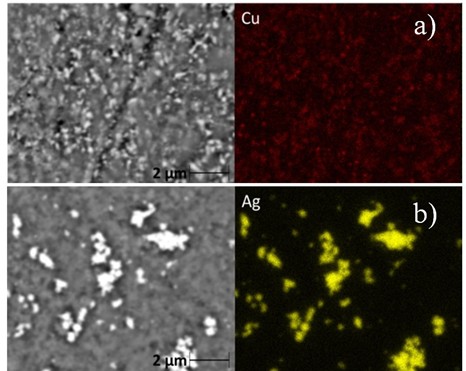
Preventing biofouling in different aqueous environments, without introducing toxic substances into the environment, has driven the development of new research. The application of nanotechnology in biofouling protection has been promoted in various fields. In the present work, the mechanism involved in the formation of biofilms on AISI 304 stainless steel previously modified with metal ion deposits (Ag and Cu) was studied. The modified surfaces were characterized by various techniques, such as X-ray diffraction (XRD), scanning electron microscopy (SEM), energy dispersive spectroscopy (EDS), contact angle and roughness. Likewise, the microbial activity of the substrates with Ag and Cu electrodeposits was evaluated according to ASTM E2562-12. SEM micrographs showed the morphology of the copper and silver coatings on the stainless-steel surface, where the formation of a homogeneous and well-distributed deposit of Cu and Ag nanoparticles was observed. The composition of these nanoparticles was confirmed by EDS analysis. XRD analysis confirmed the presence of Ag and Cu in addition to Fe-γ austenite (FCC) on the surface. This expanded austenite provides high resistance to wear and corrosion. On the other hand, the surfaces with the silver deposit showed a decrease in antimicrobial activity, this is because silver interferes with cellular metabolism either by breaking the cell wall or causing genetic alterations in the bacteria that lead to its death.
Downloads
References
1. L. Tian, Y. Yin, H. Jin, W. Bing, E. Jin, J. Zhao, and L. Ren, "Novel marine antifouling coatings inspired by corals", Materials Today Chemistry, vol. 17, pp. 100294, 2020. DOI: https://doi.org/10.1016/j.mtchem.2020.100294
https://doi.org/10.1016/j.mtchem.2020.100294 DOI: https://doi.org/10.1016/j.mtchem.2020.100294
2. H. Jin, L. Tian, W. Bing, J. Zhao, and L. Ren, "Toward the application of graphene for combating marine biofouling", Advanced Sustainable Systems, vol. 5, no. 1, pp. 2000076, 2021. DOI: https://doi.org/10.1002/adsu.202000076
https://doi.org/10.1002/adsu.202000076 DOI: https://doi.org/10.1002/adsu.202000076
3. B. J. Little, D. J. Blackwood, J. Hinks, F. M. Lauro, E. Marsili, A. Okamoto, and H.C. Flemming, "Microbially influenced corrosion-Any progress?", Corrosion Science, vol. 170, pp. 108641, 2020. DOI: https://doi.org/10.1016/j.corsci.2020.108641
https://doi.org/10.1016/j.corsci.2020.108641 DOI: https://doi.org/10.1016/j.corsci.2020.108641
4. J.A. Lewis, "Battling biofouling with, and without, biocides", Chemistry in Australia, pp. 26-29, 2018.
5. G.V. Vimbela, S.M. Ngo, C. Fraze, L. Yang, and D.A. Stout, "Antibacterial properties and toxicity from metallic nanomaterials", International Journal of Nanomedicine, vol. 12, pp. 3941-3965, 2017. https://doi.org/10.2147/IJN.S134526 DOI: https://doi.org/10.2147/IJN.S134526
6. A. Singh, P.K. Gautam, A. Verma, V. Singh, P.M. Shivapriya, A. Shivalkar, and S.K. Samanta, "Green synthesis of metallic nanoparticles as effective alternatives to treat antibiotic-resistant bacterial infections: A review", Biotechnology Reports, vol. 25, pp. e00427, 2020. DOI: https://doi.org/10.1016/j.btre.2020.e00427
https://doi.org/10.1016/j.btre.2020.e00427 DOI: https://doi.org/10.1016/j.btre.2020.e00427
7. O. Maťátková, J. Michailidu, A. Miškovská, I. Kolouchová, J. Masák, and A. Čejková, "Antimicrobial properties and applications of metal nanoparticles biosynthesized by green methods", Biotechnology Advances, vol. 58, pp. 107905, 2022. https://doi.org/10.1016/j.biotechadv.2022.107905 DOI: https://doi.org/10.1016/j.biotechadv.2022.107905
8. J. Becerra, P. Ortiz, A.P. Zaderenko, and I. Karapanagiotis, "Assessment of nanoparticles/nanocomposites to inhibit micro-algal fouling on limestone façades", Building Research & Information, vol. 48, no. 2, pp. 180-190, 2020. https://doi.org/10.1080/09613218.2019.1609233 DOI: https://doi.org/10.1080/09613218.2019.1609233
9. M. Guerrero Correa, F.B. Martínez, C.P. Vidal, C. Streitt, J. Escrig, and C.L. de Dicastillo, "Antimicrobial metal-based nanoparticles: a review on their synthesis, types and antimicrobial action", Beilstein Journal of Nanotechnology, vol. 11, pp. 1450-1469, 2020. https://doi.org/10.3762/bjnano.11.129 DOI: https://doi.org/10.3762/bjnano.11.129
10. B.J. Little and J.S. Lee, "Microbiologically Influenced Corrosion. In Kirk-Othmer Encyclopedia of Chemical Technology", USA. John Wiley & Sons, Inc., Wiley Online Library, Hoboken, 2009. https://doi.org/10.1002/0471238961.micrlitt.a01 DOI: https://doi.org/10.1002/0471238961.micrlitt.a01
11. L. López, and G. Vargas, "High wear resistance and better pitting corrosion resistance of AISI 316L stainless steel by a self-protective oxy-nitrocarburizing paste", Journal of Materials Research and Technology, vol. 16, pp. 1803-1813, 2022. https://doi.org/10.1016/j.jmrt.2021.12.118 DOI: https://doi.org/10.1016/j.jmrt.2021.12.118
12. ASTM, Standard Test Method for Quantification of Pseudomonas aeruginosa Biofilm Grown with High Shear and Continuous Flow using CDC Biofilm Reactor (E2562-12), 2017.
13. Abbas, Q. & Binder, L. (2010). Synthesis and Characterization of Choline Chloride-Based Binary Mixtures. ECS Transactions. 33 (7): 49-59. https://doi.org/10.1149/1.3484761 DOI: https://doi.org/10.1149/1.3484761
14. A.M. Popescu, V. Constantin, A. Cojocaru, and M. Olteanu, "Electrochemical Behaviour of Copper (II) Chloride in Choline Chloride-urea Deep Eutectic Solvent", Rev. Chim, vol. 62, no. 2, pp. 206-211, 2011.
15. B. Khodashenas, and H.R. Ghorbani, "Synthesis of silver nanoparticles with different shapes", Arabian Journal of Chemistry, vol. 12, no. 8, pp. 1823-1838, 2019. https://doi.org/10.1016/j.arabjc.2014.12.014 DOI: https://doi.org/10.1016/j.arabjc.2014.12.014
16. B. Bhu Shan, "Principles and Applications of Tribology". (Second Edition). John Wiley & Sons, Ltd, pp.993, 2013.
17. W. Sim, R.T. Barnard, M.A.T. Blaskovich, and Z.M. Ziora, "Antimicrobial Silver in Medicinal and Consumer Applications: A Patent Review of the Past Decade (2007⁻2017)", Antibiotics (Basel), vol. 7, no. 4, pp. 93, 2018. https://doi.org/10.3390/antibiotics7040093 DOI: https://doi.org/10.3390/antibiotics7040093
18. I. Salah, I.P. Parkin, and E. Allan, "Copper as an antimicrobial agent: recent advances", RSC Advances, vol.11, no. 30, pp. 18179-18186, 2021. https://doi.org/10.1039/D1RA02149D DOI: https://doi.org/10.1039/D1RA02149D
Downloads
Published
License
Copyright (c) 2026 Coraquetzali Magdaleno López

This work is licensed under a Creative Commons Attribution 4.0 International License.
The authors who publish in this journal accept the following conditions:
The authors retain the copyright and assign to the journal the right of the first publication, with the work registered with the Creative Commons Attribution license 4.0, which allows third parties to use what is published as long as they mention the authorship of the work and the first publication in this magazine.
Authors may make other independent and additional contractual agreements for the non-exclusive distribution of the version of the article published in this journal (eg, include it in an institutional repository or publish it in a book) as long as they clearly indicate that the work it was first published in this magazine.
Authors are allowed and encouraged to share their work online (for example: in institutional repositories or personal web pages) before and during the manuscript submission process, as it can lead to productive exchanges, greater and more quick citation of published work (see The Effect of Open Access).
How to Cite